How to Read a Victorian Era Patent
·Revised
Introduction
Victorian era patents are easy to underestimate. At first glance they appear to belong to lawyers, engineers, patent clerks, and other people trained to enjoy difficult documents. The pages are formal, the drawings are lettered, the descriptions are dense, and the language often assumes a world of trades and practices that the modern reader no longer carries in ordinary memory. Yet the difficulty is not usually the invention itself. The difficulty is knowing where to begin.
A patent is best read not as a block of legal text, but as an answer to a practical problem. Something leaked, wore out, wasted time, produced uncertain results, or demanded more labour than the inventor thought necessary. The invention is the proposed remedy. Once that relationship is understood, the document becomes far less remote. The drawing becomes a map, the specification becomes an explanation, and the claim becomes a boundary drawn around the idea.
This article follows naturally from How to harvest ideas from vintage Trade Journals for your own use, where the emphasis was on reading old trade material as active evidence rather than passive period detail. A patent asks for the same kind of attention. It rewards the reader who looks past the object and asks what pressure, inconvenience, or opportunity made the invention worth describing.
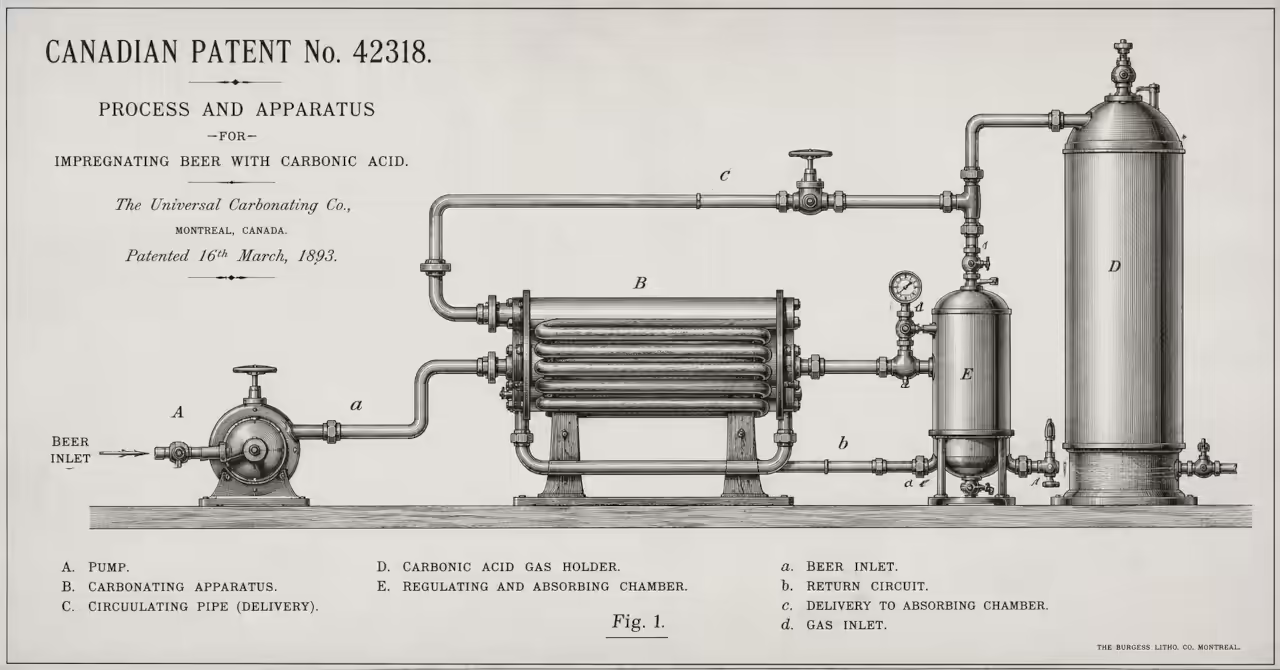
To make that approach practical, we will use Canadian Patent No. 42318 from 1893, a Process and Apparatus for Impregnating Beer with Carbonic Acid. It is a useful example because the subject is familiar enough to invite curiosity, while the mechanism remains technical enough to teach the reading method. The patent appears to concern beer carbonation, but its real interest lies in how the inventor attempted to control that process.
The First Mistake Everybody Makes
The first mistake is to read the patent as though understanding will arrive by proceeding obediently from the first line to the last. That approach can work, but it often makes the document harder than it needs to be. Victorian patents were written to define and protect an invention, not to welcome a general reader into the subject. The specification may describe parts, connections, and operations before the reader has developed any sense of what the invention is trying to accomplish.
A better beginning is to treat the patent as one would treat an unfamiliar machine on a workshop bench. Before reading every detail, look for the broad arrangement. What is the main object? What connects to it? What moves? What is being added, removed, turned, lifted, heated, cooled, measured, or restrained? This kind of first inspection gives the reader a working orientation before the formal language begins to do its work.
In the beer patent, that initial inspection is particularly helpful. The drawing shows a cask, external pipework, a pump, and a carbonic acid cylinder. Even before the specification is fully read, the arrangement suggests a process rather than a mere container. The beer is not simply sitting in a vessel. It is being moved through a controlled circuit.
Why the Drawing Matters More Than the Text
Patent drawings are often treated as illustrations, but in practice they are frequently the reader's best starting point. A drawing shows relationships before it requires terminology. It allows the eye to follow a pipe, trace a shaft, locate a valve, or recognise the difference between the ordinary body of a machine and the part the inventor wants to emphasise. The drawing will not answer every question, but it often tells the reader what questions are worth asking.
The beer patent uses a pump to circulate liquid through an external loop, drawing beer from the cask and returning it again. This might appear to be little more than a plumbing arrangement, yet circulation is the organising principle of the invention. Viewed in that light, the valves, connections, and carbonic acid cylinder cease to be separate components and instead become parts of a single controlled process.
That is where the drawing begins to teach the reader. The important feature is not merely that carbonic acid is present, nor that a pump is present, nor that the beer remains in a cask. The important feature is the relationship between movement and saturation. The apparatus is arranged so that carbonic acid can be introduced into a moving stream and distributed through repeated circulation.
The Question Hidden Inside Every Patent
The most useful question to ask of a patent is not simply, What does this invention do?
That question comes too late. The better question is, What problem made this invention necessary?
Once the problem is identified, the invention usually becomes easier to understand because each part can be judged by whether it contributes to the proposed solution.
In the case of Patent No. 42318, the title points toward beer and carbonic acid, but the title alone can mislead the reader into thinking the invention is about making fizzy beer. Beer was already charged with carbonic acid through fermentation practices. The inventor's concern was more specific: how to introduce carbonic acid directly and distribute it through the beer in a more controlled way.
This distinction matters because it moves the interpretation from novelty to process control. The patent is not interesting merely because beer is involved, though that certainly helps the modern reader enter the subject. It is interesting because it shows an industrial mind attempting to replace a slower or less predictable biological stage with a mechanical arrangement that promises greater control over the final result.
What the Beer Patent Is Really About
Once the problem is understood, the beer patent becomes much easier to read. The invention concerns a closed cask connected to an external circulation path. Beer is drawn out, passed through the apparatus, exposed to carbonic acid, and returned to the vessel. The process may then be repeated until the beer is sufficiently impregnated. The parts matter because they support that movement.
This is the point at which the reader begins to distinguish between ordinary equipment and inventive arrangement. A cask is not new. A pump is not new. A gas cylinder is not new. The patent's interest lies in the way these things are brought together for a particular result. The invention is not a single heroic component but a controlled relationship between vessel, circulation, and gas injection.
That distinction is often the key to reading old patents well. Many inventions are not dramatic objects but improved arrangements. They alter sequence, flow, access, adjustment, timing, pressure, or distribution. Their value lies in making a known task more reliable, repeatable, economical, or convenient. The modern reader who looks only for a spectacular new machine will miss much of what Victorian invention actually looked like in practice.
The Moment Everything Clicks
This is the point where many readers discover that old patents are considerably less mysterious than they first appear. What seemed like an impenetrable technical document often resolves into a surprisingly practical idea once the underlying problem becomes visible. The reward is not merely understanding a single patent, but gaining confidence that the next one can be approached in exactly the same way.
Every good patent reading has a moment when the document stops being a list of parts and becomes a working proposition. In the beer patent, that moment arrives when circulation is recognised as the central idea. The apparatus is not merely attached to the cask. It creates a loop. The carbonic acid is not merely supplied to the beer. It is introduced into a moving current, where the act of circulation helps distribute it through the liquid.
Once this is seen, the patent can be explained in plain English: it describes a method for preparing beer by circulating it from a closed cask through an external apparatus while introducing carbonic acid into the moving stream. That sentence is not only a summary. It is an interpretation. It identifies the object, the purpose, the mechanism, and the inventive centre of the document.
This is also where a patent becomes useful beyond itself. The reader has gained a way to describe the invention, but also a way to connect it to surrounding questions. What did brewers want to control? What did the market expect from finished beer? What kinds of apparatus were becoming available to make such control practical? A patent begins as a document and quickly opens into a wider technical world.
What Victorian Patents Actually Preserve
The lasting value of Victorian patents is not limited to the inventions they record. They also preserve the inconveniences that invention attempted to overcome. Each patent marks a point of friction in a working world. A process was too slow, a tool too clumsy, a fitting too unreliable, a product too inconsistent, or a method too dependent on judgement and circumstance. The patent captures the moment when someone proposed a more deliberate arrangement.
Many of the most interesting patents describe machines, tools, fittings, and workshop devices that have long since disappeared from everyday use. Yet traces of these inventions survive in auction catalogues, museum collections, trade journals, advertisements, and the occasional surviving example offered by collectors.
That makes patents particularly valuable for archive work. They do not merely show what existed; they show what someone thought needed improvement. A single patent may point outward to trades, materials, users, markets, supporting technologies, and competing methods. This is why patents sit comfortably beside advertisements, catalogues, trade journals, and surviving artefacts. Each source supplies a different kind of evidence, and the strongest interpretation often comes from reading them together.
This outward movement is closely related to the method discussed in From Ads to Archives: Expanding the Curation Method. A patent should not be treated as an isolated end point. It is often an entry point into a cluster of related evidence. The beer-carbonation patent leads not only to brewing, but to process control, gas handling, pressure vessels, market preparation, and the industrial desire for repeatable results.
The Reader's Practical Reward
The reward for reading a patent this way is simple: you leave with understanding rather than description. Instead of saying that a patent concerns carbonated beer, you can explain what problem the inventor was trying to solve and how the apparatus attempts to solve it. That understanding can support an artefact page, a caption, a short note, or further research into related technologies.
Patents preserve inventions, but they also preserve frustrations. Every specification is evidence that somebody looked at an existing process and decided it could be improved.
A useful patent reading usually resolves into a single sentence. For Patent No. 42318, that sentence might be: this invention prepares beer by circulating it through an external loop while introducing carbonic acid into the moving stream, allowing the beer to be charged in a more controlled manner.
Once you can explain a patent in plain language, the document has been translated from formal claim into working understanding. That is the moment when an old patent stops being an intimidating historical record and becomes an understandable piece of practical engineering.
Conclusion & Reflection
To read a Victorian era patent well is not to master every legal phrase or identify every component at first sight. It is to follow the inventor's reasoning from friction to remedy. The drawing gives the first orientation, the problem gives the motive, and the mechanism gives the invention its shape. The claim then becomes more intelligible because the reader has already understood what is being protected.
Canadian Patent No. 42318 is a modest but excellent example. It begins as a patent about beer and carbonic acid, but careful reading reveals a more interesting story about circulation, saturation, and control. The apparatus matters because it shows a practical attempt to make an existing process more deliberate and repeatable. That is the kind of insight hidden inside many old patents.
The broader lesson is that technical artefacts rarely stand alone. A patent belongs to a world of trades, frustrations, materials, and expectations. Once that world is restored, even a small invention becomes more meaningful. This is why the next useful step is not merely to read another patent, but to think about how artefacts are connected, contextualised, and made legible for modern readers. That question is explored further in The Isolated Artefact Pages Problem.
From the Curator's Workshop
If Victorian patents, workshop diagrams, and ingenious mechanical arrangements capture your imagination, our Cabinet of Curious Vintage Mechanisms design celebrates the same spirit of technical curiosity. Inspired by the machines, inventions, and industrial artefacts explored throughout the Phillaneum, it is a wearable tribute to the engineers, inventors, tinkerers, and collectors who see beauty in the workings beneath the surface.

Author's Notes
While researching this article, I realised that my greatest mistake when approaching old patents had been treating them as technical documents rather than historical clues. Like many readers, I was initially drawn to the invention itself, looking for the machine, mechanism, or clever idea hidden within the specification. What gradually became apparent, however, was that the most revealing part of a patent is often the problem it is trying to solve. The beer-carbonation patent used as our example is interesting not because it teaches us how to make beer fizzy, but because it reveals a brewer's desire for greater control, consistency, and predictability. Once I began reading patents through that lens, they stopped feeling like isolated inventions and started becoming windows into the working frustrations, ambitions, and practical realities of another age. That shift in perspective has changed the way I read every patent that has crossed my desk since.
Notes & Memoranda
As is often the case, the subject extends beyond the bounds of a single article. The notes and memoranda below gather together useful definitions, related observations, references, and occasional curiosities discovered along the way.
Glossary
- Patent
- A legal document granting an inventor exclusive rights to an invention for a limited period. Victorian patents typically contain a description of the invention, drawings illustrating its operation, and claims defining what aspects of the invention are protected.
- Specification
- The written portion of a patent that explains the invention and its operation. Patent specifications often contain detailed technical descriptions intended to describe the invention clearly while establishing the inventor's legal claim to the idea.
- Carbonic Acid
- A nineteenth-century term commonly used for carbon dioxide gas when applied to beverages. In brewing and bottling patents of the Victorian era, carbonic acid refers to the gas responsible for producing carbonation and effervescence in beer and other drinks.
- Circulation
- The controlled movement of a liquid through a system and back again. In Canadian Patent No. 42318, circulation is the key operating principle, allowing beer to pass repeatedly through an apparatus where carbonic acid can be introduced and distributed more evenly.
- Patent Claim
- A statement within a patent that defines the specific aspects of an invention that the inventor seeks to protect. While the drawings and specification explain how the invention works, the claims establish the legal boundaries of the invention itself.
Frequently asked questions
What is the best way to read a Victorian era patent?
The best way to read a Victorian era patent is to begin with the drawing, identify the problem the inventor was trying to solve, and then read the specification to understand the mechanism. The claim is easier to understand once the reader already knows what the invention is doing and why it matters.
Why are Victorian patents difficult to understand?
Victorian patents are difficult because they combine legal language, technical description, period terminology, and assumed trade knowledge. They were written to define and protect inventions rather than to introduce modern readers to the subject.
Why should readers look at the patent drawing first?
Patent drawings often show relationships before the text explains them. A drawing can reveal movement, connections, flow, and key components, giving the reader a practical orientation before reading the more formal written specification.
What does carbonic acid mean in a Victorian brewing patent?
In a Victorian brewing or bottling patent, carbonic acid usually refers to carbon dioxide gas used to carbonate beer or other beverages. The term reflects nineteenth-century technical language rather than modern everyday terminology.
What makes Canadian Patent No. 42318 a useful example?
Canadian Patent No. 42318 is a useful example because it has a familiar subject, beer carbonation, and a clear mechanical arrangement. The patent shows how beer could be circulated through an external loop while carbonic acid was introduced into the moving stream.
What can old patents reveal beyond the invention itself?
Old patents reveal the problems, frustrations, trades, materials, and working assumptions of their period. They show not only what someone invented, but what someone believed needed improvement.
Further Reading…


References
- Universal Carbonating Co., Process and Apparatus for Impregnating Beer with Carbonic Acid, Canadian Patent No. 42318 (1893).
- Engineer and Inventor, Canadian patent listings, March 1893.
Disclosure
This article uses Canadian Patent No. 42318, Process and Apparatus for Impregnating Beer with Carbonic Acid (1893), as a practical example for discussing how Victorian era patents can be read, interpreted, and understood by modern readers. The article is intended for general educational and historical interest and reflects the author's interpretation of the patent, its drawings, and its historical context. While based on primary source material, including patent records and contemporary patent listings, it is a condensed editorial discussion rather than a legal analysis, technical reconstruction, or comprehensive study of nineteenth-century patent practice.