Using Ads to Understand Old Technologies
·Revised
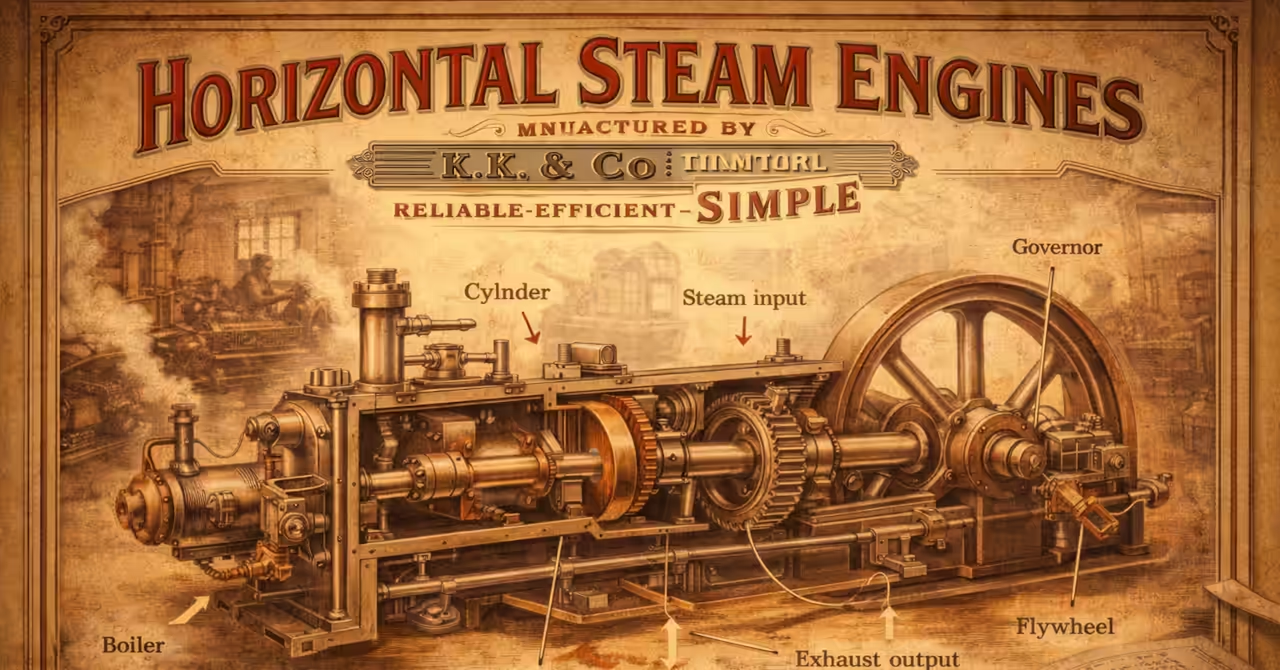
Advertisements Can Explain a Machine’s Place
Using advertisements to understand old technologies depends on seeing a clear relationship between the thing being sold and the world that made it necessary. An old advertisement is rarely just a sales page. It is often a compressed explanation of where a device fits, what problem it answers, what materials or standards it assumes, and what sort of user is expected to recognise its value. Read in that way, the advertisement becomes more than commercial ephemera. It becomes a practical guide to technical context.
This matters because many historical technologies do not survive with their full working environment intact. A machine may remain in a museum. A tool may appear in an auction photograph. A patent drawing may preserve the logic of an invention. But advertisements often preserve something slightly different and, in some cases, more useful. They show how the technology was presented to a buyer at the point where explanation met persuasion. That means they often carry clues about intended use, comparative advantages, installation conditions, maintenance expectations, and neighbouring products that made the device functional within a wider system.
That alone makes the advertisement a valuable technical source. It does not replace manuals, engineering drawings, or trade papers. It fills a different role. It shows how a technology was made legible in ordinary commercial life. For a reader trying to understand old technologies, that kind of evidence is often the bridge between object recognition and system comprehension.
Sales Copy Often Preserves Operational Logic
The reason advertisements help is straightforward. To sell a technology, the seller had to make its usefulness intelligible. A page for a pump, lamp, boiler fitting, sewing machine accessory, electrical device, or workshop tool could not rely on mystery alone. It had to show what the thing did, how it improved upon an existing method, and why a buyer should trust it. In doing so, it often preserved part of the technology’s operational logic.
That logic appears in several forms. A specification line may reveal size ranges, capacities, pressures, materials, or compatible fittings. An illustration may show not just shape, but mounting method, access points, proportion, and likely handling. A claim about efficiency suggests a recognised source of waste. A claim about safety suggests a known hazard. A claim about interchangeability implies a need for repair, replacement, or standardised supply. Even the language of convenience is rarely empty. It usually points to friction that the user was expected to understand from experience.
This is why old advertisements reward close reading. They are not neutral descriptions, but their persuasive purpose forces them to disclose selected facts. The seller must give the reader enough of the technical picture to support a commercial decision. That is precisely what makes the advertisement so helpful to the modern reader. It preserves a technology not in isolation, but in relation to use.
Products point outward to the systems around them
A single old technology almost always implies other things around it. An advertisement often reveals that dependency more clearly than a detached artefact page can. A pump suggests pipes, valves, power, seals, and maintenance. A domestic stove suggests fuel, flues, room layout, cookware, and habits of daily operation. A workshop tool suggests materials, benches, operator skill, and associated tools. Once the advertisement is read for these outward relationships, the technology begins to regain its lost environment.
This is the first great advantage of advertisement reading. It restores connection. A product is no longer a solitary invention or a charming old object. It becomes a node in a working field. If one advertisement names a patented valve, another shows the pipe system it joins, and a third sells packing material for the same class of installation, the reader can start reconstructing the technical world in which all three belonged. No single page gives the whole account. Several pages, read together, begin to do so.
That is especially useful when dealing with technologies that have become obscure. The advertisement may be the source that still explains why the object existed at all. It often states the problem the product claimed to solve in language close to the period of use. That is not complete technical understanding, but it is often the necessary beginning.
Advertising language reveals what users needed to know
Another strength of old advertisements is that they help identify the boundary between specialist knowledge and ordinary working knowledge. A seller had to judge what the intended reader already understood and what needed to be explained. That judgement now becomes historical evidence. If certain terms are used without explanation, they were probably familiar within the trade or market. If a feature is elaborated carefully, it was probably new, contested, or commercially important.
This helps modern readers avoid a common mistake, which is to imagine that old technologies were either fully obvious to their users or completely mysterious. In reality, technologies lived inside gradients of familiarity. Some details were standard knowledge. Others needed argument and demonstration. Advertisements record that distinction because they were written at exactly that point of contact between maker and buyer.
The result is valuable for interpretation. One learns not only what a device was, but what aspects of it were thought to matter most. Was the emphasis on durability, economy, safety, portability, sanitation, speed, or ease of operation. Each emphasis reveals something about user concern. The advertisement therefore helps translate a technical object back into the practical expectations that surrounded it.
Technical understanding grows through comparison
The strongest use of advertisements comes not from reading one page in isolation, but from comparing several within the same field. Patterns soon become visible. Repeated terminology stabilises uncertain meanings. Shared diagrams or visual conventions show what features were normal enough to be recognised at a glance. Rival claims reveal where competition was intense. Supporting goods disclose maintenance cycles and dependency chains. Through comparison, the technology becomes less opaque.
This is where advertisement reading becomes genuinely investigative. Instead of asking only what a product looked like, one asks what class of problem it belonged to, what kind of user it addressed, what standard it assumed, and what neighbouring products were necessary to make it work. Those questions turn the advertisement into a technical witness. It may not provide exhaustive engineering detail, but it often provides the interpretive frame needed to make old technologies understandable again.
That is the real value of using advertisements to understand old technologies. They restore relation, function, and commercial meaning to objects that might otherwise remain detached from their world. The next sensible step is to read advertisements beside catalogues, patents, trade journals, and surviving artefacts so that each source corrects the limits of the others. Once that is done, the old technology begins to look less like an isolated relic and more like a working proposition from its own time.
Author's Notes
Notes & Memoranda
Further Reading…


Disclosure
This article presents an interpretive reading of historical advertisements and related material, with attention to their technical, cultural, and practical context. It reflects editorial analysis rather than a definitive account of historical practice. Readers seeking primary context should consult period sources and surviving examples.