Introduction
Between the 1890s and the 1920s, lighter-than-air flight was not merely a spectacle — it was treated as an emerging engineering discipline. The airship had a technical press of its own: journals, society proceedings, club bulletins, and weekly aeronautical newspapers that documented envelopes, rigging, propulsion, lift calculations, trials, failures, and the slow conversion of “aerial navigation” into a system that could be designed, built, and operated.
This article sits within the broader Age of Airships topic, where the development of lighter-than-air travel is examined not only through engineering milestones, but through the printed record that accompanied them. Publications such as these journals formed part of the same system of experimentation, communication, and iteration explored in Airship Journal: The Future of Sustainable Flight, where early concepts are traced forward into modern interpretations.
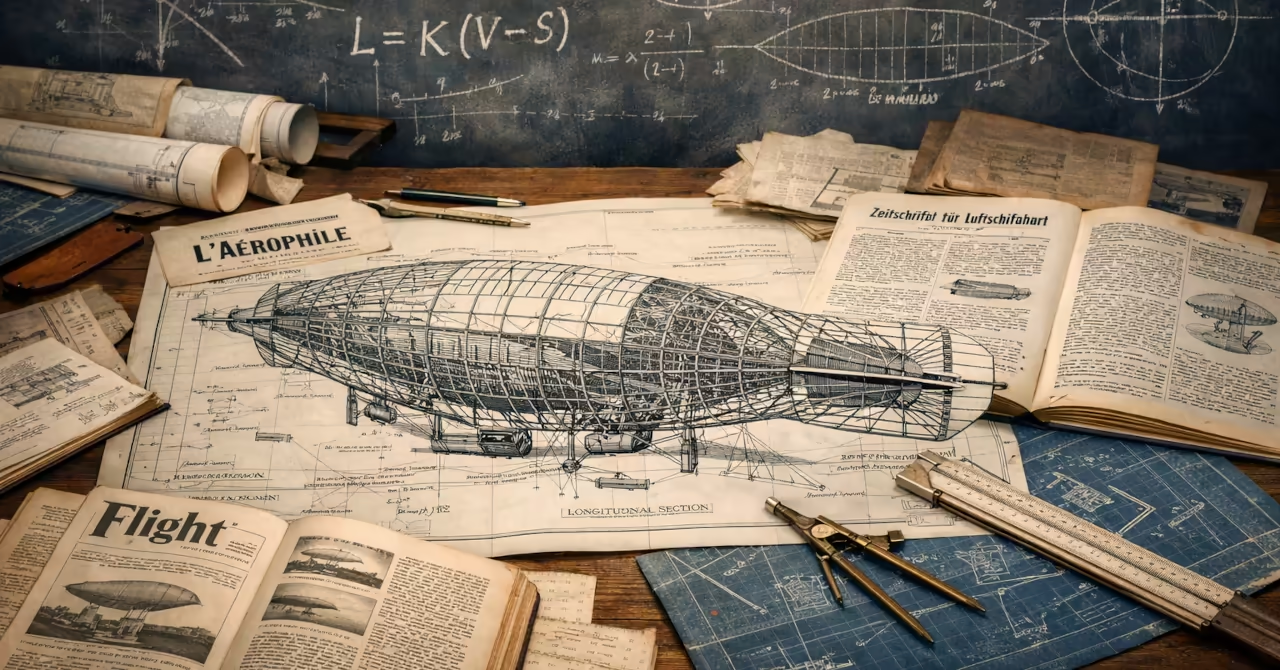
This page is a practical field guide to the technical periodicals of the airship era. It is not a list of books. It is a map of where the working language lived — the pages where engineers argued, clubs recorded trials, militaries codified requirements, and the Zeppelin worldview hardened into steel.
Key Technical Periodicals
L’Aérophile (France, from 1893)
Often treated as the documentary backbone of early aeronautics, L’Aérophile spans balloons, dirigibles, and the early aeroplane years, with frequent lighter-than-air coverage in its most formative decades. It balances technical detail with a disciplined, observational tone: reporting trials, documenting records, and printing diagrams and photographs as evidence, not decoration.
Key features
- Regular reporting on trials, records, and experimental configurations
- Illustrations and diagrams that preserve period engineering intent
- Club-adjacent authority (close to the institutional aeronautical world)
Why it matters
- Provides period-authentic vocabulary and framing for “aerial navigation”
- Connects engineering detail to a broader ecosystem of observers and institutions
- Acts as a reliable spine source when cross-checking claims and timelines
La Revue Aérienne (France, early 1900s)
More sober and engineering-forward than the popular-leaning illustrated press, La Revue Aérienne treats dirigibles as systems: envelopes, structure, propulsion, operating methods, and practical constraints. Where other magazines celebrate the moment, this one tends to catalogue the mechanism.
Key features
- Technical emphasis on design, experimentation, and system descriptions
- Less romantic editorial tone; more “workshop and test field” energy
- Useful for understanding what engineers argued about in real time
Why it matters
- Strengthens a “systems, not spectacle” interpretation of the airship era
- Provides language suitable for technical summaries and careful quotation
- Helps anchor Phillaneum commentary in contemporary engineering concerns
Zeitschrift für Luftschiffahrt (Germany, late 1800s–early 1900s)
Germany’s airship culture was intensely technical, industrial, and strategic, and this periodical reflects that seriousness. It is one of the places where rigid-airship thinking becomes legible: structure, materials, operational philosophy, and the broader industrial context that made large dirigibles conceivable.
Key features
- Strong attention to rigid-airship concepts, structure, and practical deployment
- Industrial and military-adjacent outlook (airships as national capability)
- German technical language that captures the Zeppelin-era mindset
Why it matters
- Shows how “airship as infrastructure” thinking formed at the source
- Provides a counterpoint to Anglo-French editorial framing
- Excellent for extracting period terminology and design assumptions
Flight (United Kingdom, from 1909)
A weekly aeronautical newspaper that begins in the transition period: balloons and dirigibles still matter, while aeroplanes are rapidly gaining momentum. Early issues frequently report on British and continental airships with a public-facing technical voice — readable, timely, and opinionated.
Key features
- Weekly reporting cadence: trials, procurement, accidents, and commentary
- Bridges the shift from ballooning to dirigibles to heavier-than-air dominance
- Accessible technical language suitable for contextual quotations
Why it matters
- Captures how airships were discussed as current affairs and capability
- Provides dates, names, and cross-references useful for triangulation
- Ideal for “what did the world think this week?” editorial inserts
Aeronautics (UK/US, early 1900s)
Shorter-lived and often more speculative, Aeronautics is valuable precisely because it preserves the experimental temper of the period. It documents prototypes, practical failures, and ambitious claims — sometimes sober, sometimes optimistic — in a way that reveals what builders believed was possible next.
Key features
- Prototype culture: experiments, set-backs, and iterative approaches
- Speculative tone that exposes contemporary expectations and blind spots
- Useful technical notes scattered through reports and correspondence
Why it matters
- Shows the “messy middle” between theory and workable systems
- Provides period evidence for how risk and feasibility were discussed
- Pairs well with more formal society proceedings to balance tone
Royal Aeronautical Society Proceedings (United Kingdom, ongoing)
Where magazines report and clubs certify, society proceedings calculate. The Royal Aeronautical Society’s papers bring formal engineering treatment to lift, stability, propulsion efficiency, materials, and operational problems. These are the documents that turn airships from romance into equations.
Key features
- Technical papers with formal structure, terminology, and argumentation
- Focus on fundamentals: lift, drag, stability, structures, propellers
- High signal-to-noise for engineering interpretation
Why it matters
- Provides defensible technical grounding for Phillaneum analysis
- Excellent for extracting “how they reasoned” rather than “what they saw”
- Supports comparisons across nations and design philosophies
Aéro-Club de France Bulletins & Reports (France, club publications)
Club bulletins look dry until you realise what they contain: meetings, trial reports, record attempts, letters, and administrative notes that capture the daily machinery of early aeronautics. This is documentation from inside the living ecosystem — not polished hindsight.
Key features
- Record certifications, trial notes, committee decisions, correspondence
- Practical observations: weather, operating constraints, procedural detail
- Often links inventors, pilots, observers, and institutions in one place
Why it matters
- Perfect for reconstructing “what happened” and “how it was validated”
- Supplies authentic period phrasing and institutional perspective
- Strengthens timelines and provenance without relying on later retellings
Scientific American (United States, frequent airship coverage in 1890s–1910s)
Not a specialist airship journal, but consistently useful: it reports experiments, claims, and failures with a tone that mixes curiosity and scepticism. When you want to see how technical ideas were presented to an educated public — without collapsing into pure fantasy — it is a rich quarry.
Key features
- Recurring coverage of experimental dirigibles and engineering proposals
- Readable explanations paired with cautious evaluation
- Good illustrations and summaries that point to deeper sources
Why it matters
- Provides quotable period summaries to frame technical discussion
- Useful for triangulating dates and claims reported elsewhere
- Helps place airships inside broader industrial and scientific discourse