Practical Applications of Airships in Modern Transport
Airships occupy a peculiar place in aviation history. Once symbols of technological ambition and imperial reach, they later became cautionary tales of fragility and fire. Yet in recent decades, these lighter-than-air craft have re-entered serious engineering discussion, not as nostalgic curiosities, but as practical tools for specific transport problems.
This renewed interest is not romanticism. It is systems thinking.
As the transport sector confronts decarbonisation pressures, infrastructure limits, and remote logistics challenges, airships present a compelling case in defined operational niches. I explore the technical distinctions in more detail in the classification of airships.
Sustainability in the Skies
Conventional aviation is energy-intensive because lift is produced dynamically through forward motion. Airships generate lift statically, through buoyancy. That single engineering distinction changes the energy equation.
Modern helium-filled airships require significantly lower propulsion power per tonne of payload compared with fixed-wing aircraft. Slower cruise speeds reduce drag and fuel burn. Hybrid-lift concepts combining buoyancy with aerodynamic lift further improve efficiency.
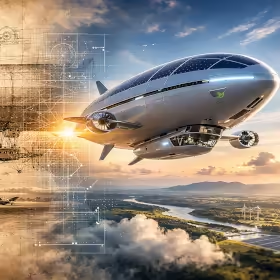
Large surface areas also create opportunities for photovoltaic integration, and several contemporary designs explore electric propulsion supported by onboard solar arrays.
Airships will not replace jetliners. But for low-speed freight, surveillance, and endurance missions, their emissions profile is meaningfully different.
Efficiency Beyond Fuel
Efficiency in transport is not merely fuel consumption. It is infrastructure dependency.
Airships can:
- Operate without paved runways
- Hover or conduct vertical loading operations
- Access remote or undeveloped regions
- Remain aloft for extended durations
This makes them particularly attractive for:
- Remote resource projects
- Arctic and Antarctic logistics
- Disaster relief supply chains
- Oversized cargo transport
Their operational flexibility may prove more valuable than raw speed in specific use cases.
Innovation in Aerial Design
Modern airships bear little resemblance to early rigid Zeppelins beyond their elongated form.
Contemporary designs incorporate:
- Advanced composite envelope materials
- Fly-by-wire control systems
- Computerised ballast management
- Thrust vectoring propulsion
- Redundant gas cell compartmentalisation
Safety modelling has improved dramatically since the early 20th century, and hydrogen, once abandoned after disasters, is again under cautious technical evaluation due to its superior lift characteristics.
Applications now extend beyond transport into:
- High-resolution aerial surveying
- Telecommunications platforms
- Environmental monitoring
- Luxury experiential travel
Cargo Carriers of the Future
Cargo remains the most commercially viable near-term application.
Airships excel where:
- Cargo is bulky rather than urgent
- Roads and ports are absent
- Runway construction is impractical
- Environmental impact must be minimised
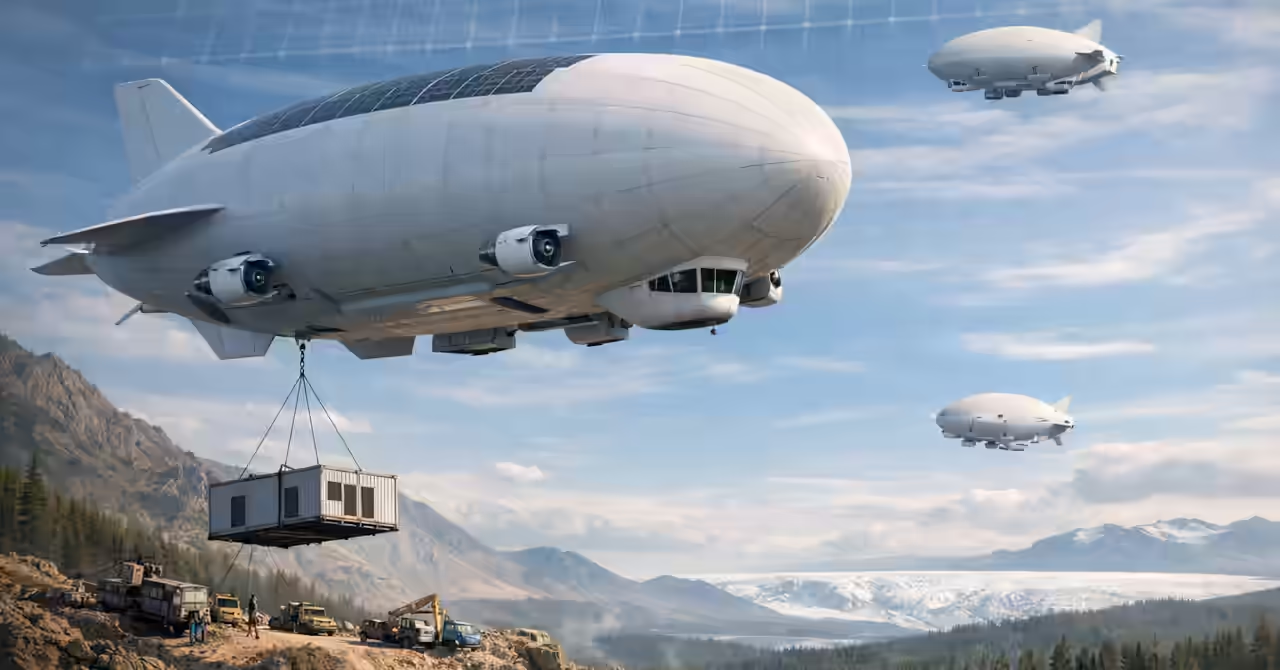
Heavy machinery, prefabricated infrastructure modules, mining equipment, and emergency relief supplies are prime candidates. For isolated communities or research stations, an airship can greatly reduce the need for expensive conventional transport infrastructure, although specialised mooring, handling and operational support may still be required.
Passenger Airships: Experiential Travel
There is renewed interest in passenger operations as unique and premium travel experiences.
The appeal lies in:
- Low altitude panoramic visibility
- Quiet propulsion
- Extended dwell time over landscapes
- Spacious cabin layouts
Concept proposals include aerial cruises over rainforest, polar ice, and savannah regions; slow travel reimagined as atmospheric theatre. The economics remain uncertain. The aesthetic appeal is undeniable.
Speculative Futures: Ten Bold Proposals
Airships have always attracted imagination. Some proposals are improbable; others merely await materials science breakthroughs.
- Skyborne Hydroponic Farms — Floating agricultural platforms supplying urban centres.
- Aerial Cultural Centres — Libraries and museums suspended above cities.
- Stratospheric Research Stations — Persistent high-altitude laboratories.
- Solar Energy Platforms — Large-surface airborne solar harvesters.
- Atmospheric Probes for Gas Giants — Buoyant exploration craft for Jupiter or Saturn.
- Hybrid Sea–Air Explorers — Convertible exploration platforms.
- Long-Duration Communications Nodes — Semi-permanent telecommunication relays.
- Mobile Disaster Response Hospitals — Rapidly deployable aerial medical facilities.
- Autonomous Cargo Corridors — Automated slow-freight air networks.
- Nuclear-Assisted Propulsion Concepts — Theoretical endurance platforms (engineering and political constraints remain substantial).
Outlandish? Perhaps. But airships have always lived at the boundary between engineering and imagination.
Navigating Challenges
The constraints are real.
- Wind sensitivity remains a major operational consideration, particularly during landing and ground handling.
- Ground handling infrastructure, mooring systems and trained crews may still be required even when conventional runways are not.
- Public perception is still coloured by early disasters.
- Helium supply is finite and geopolitically concentrated.
Safety certification frameworks must evolve alongside design innovation. The modern airship will succeed only where its advantages clearly outweigh its compromises.
The Difficult Part Begins Near the Ground
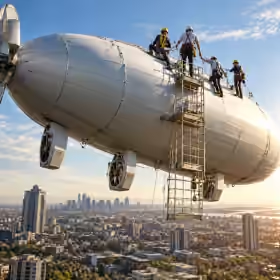
The ability to operate without a conventional runway does not mean that an airship is easy to handle once it reaches the ground. In some respects, the opposite is true. In flight, buoyancy supports most of the vehicle and the crew principally manages direction, trim and speed. Near the ground, the same enormous and relatively lightweight structure becomes highly sensitive to wind while simultaneously having to interact with ropes, landing gear, mooring equipment and people.
This makes landing and ground handling a different engineering problem from ordinary flight. Loads that were distributed through the surrounding atmosphere must suddenly be transferred into fittings, wheels, skids, cables and structural attachment points. Designers therefore have to consider not only how efficiently the airship flies, but how safely those forces can be managed while it arrives, loads cargo or remains stationary.
Wind makes the problem harder. Close to the surface, gusts, turbulence and nearby obstructions can create rapidly changing conditions at precisely the moment when the airship has less room to manoeuvre. Historically, this made the ground crew an effective part of the control system, coordinating lines, mooring equipment, thrust and the movement of the ship itself. Ground handling was therefore not simply an activity performed after flight; it was part of the operating system of the airship.
Mooring masts, specialised landing gear and handling equipment consequently should not be regarded as accessories. They form part of the complete transport system. Yet every wheel, structural fitting or handling mechanism also adds weight that must be carried during flight. Airship designers therefore face a recurring trade-off: greater independence on the ground generally requires additional hardware in the air.
This qualification is important when discussing the infrastructure advantages of airships. They may eliminate the need for long paved runways and major airports, but they do not eliminate infrastructure altogether. Instead, they exchange conventional aviation infrastructure for a different combination of clear operating areas, mooring systems, weather support, trained crews and specialised handling equipment.
Looking Ahead
Airships will not dominate global aviation. They are not intended to. Instead, they represent a specialised tool. One that aligns with emerging priorities in sustainability, remote logistics, and endurance operations. In that sense, their return is not nostalgic revival, but strategic re-evaluation. Airships blend Edwardian ambition with contemporary engineering discipline. They invite us to reconsider not merely how fast we travel, but how intelligently.
The age of airships may not repeat the past but it may yet reshape the future.