Design and Construction of Airships: Engineering the Future
·Revised

A Brief Overview of Airship Engineering
Airship engineering is a multidisciplinary field combining aeronautics, materials science and structural engineering. The fundamental challenge is deceptively simple: create an aircraft that produces sufficient buoyant lift while remaining aerodynamic, controllable and structurally sound, and still retaining enough lifting capacity for propulsion systems, equipment, crew, fuel and useful payload.
The lifting gas itself also remains an active design constraint in flight, because changes in altitude, temperature and pressure must be accommodated while the aircraft maintains its shape, trim and controllability.
The Core of Airship Design: Buoyancy
The fundamental principle that allows an airship to remain aloft is buoyancy. A lifting gas with a lower density than the surrounding atmosphere displaces heavier air and therefore produces an upward force. Modern airships generally use helium because it is substantially less dense than air and, unlike hydrogen, is non-flammable. The materials containing the lifting gas must consequently balance several competing requirements, including low mass, gas retention, strength, flexibility and resistance to environmental degradation.
Structural Integrity and Design Nuances
Airships are commonly divided into three broad structural types: rigid, semi-rigid and non-rigid. Each represents a different engineering solution to the problem of maintaining aerodynamic form while supporting the loads imposed by propulsion, payload and flight.
- Rigid Airships: These use an internal structural framework to maintain the external form of the aircraft. Historic Zeppelins are the best-known examples. Separate gas cells are contained within the structure, allowing the framework rather than gas pressure alone to define the airship's overall shape.
- Semi-Rigid Airships: These combine a pressure-supported envelope with a partial structural framework, often incorporating a keel or reinforced lower structure to distribute loads from the gondola, propulsion system and payload.
- Non-Rigid Airships (Blimps): These have no complete internal structural framework. Their aerodynamic form is maintained primarily by the pressure difference between the gas-filled envelope and the surrounding atmosphere.
Consider reading my article, History and Classification of Airships, which examines the different airship classifications in greater detail.
Managing Design Parameters
The design parameters of an airship are closely tied to its intended role, and changing that role can alter almost every major engineering decision. I examine a number of possible uses in my article, Practical Applications of Airships.
A long-range cargo airship, for example, may place particular emphasis on useful payload, structural efficiency, endurance and cargo-handling systems. Increasing payload capacity may require greater lifting-gas volume, but a larger aircraft also introduces additional structural, aerodynamic and operational considerations.
A passenger or tourism airship would present a different optimisation problem. Visibility, cabin comfort, noise, vibration, accessibility and passenger safety could become more important design considerations. An observation or research airship intended to remain airborne for extended periods might instead emphasise endurance, electrical power availability, equipment mounting and station-keeping capability.
These examples illustrate an important engineering principle: there is no universally ideal airship. Envelope volume, structural mass, propulsion, aerodynamic performance, payload and operating environment form an interconnected system of compromises.
Environmental Design Considerations
Airships are frequently proposed as a potentially lower-energy alternative for some forms of aviation, particularly where speed is less important than endurance or payload. Their buoyant lift means that they do not need to generate all of their lift aerodynamically in the manner of a conventional aeroplane. This characteristic creates opportunities for comparatively low-power flight in some operating conditions, but it does not automatically make an airship environmentally benign.
The complete environmental performance of an airship depends on factors including its size, construction materials, propulsion system, energy source, helium management, payload, operating speed, infrastructure and service life. Modern electric or hybrid propulsion could reduce direct emissions where suitable energy sources are available, while lightweight materials can improve useful lifting capacity. Those benefits must be considered alongside the environmental cost of manufacturing materials, producing energy and supplying helium.
Airships may therefore prove environmentally advantageous for particular missions rather than serving as a universal replacement for conventional aircraft. I discuss the broader subject in my article on Sustainable Aviation.
Anatomy of an Airship
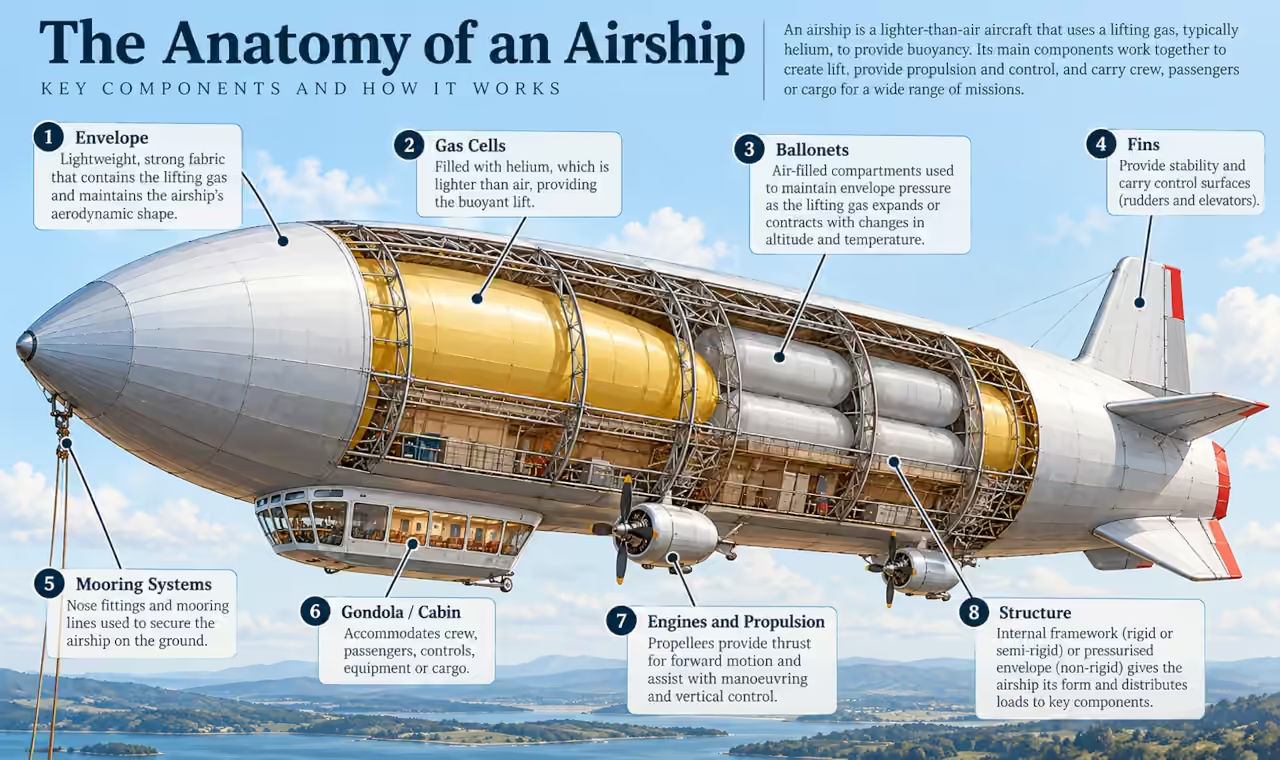
Although individual designs vary considerably, most airships combine a recognisable group of systems for producing lift, maintaining their form, carrying useful loads and controlling flight.
- Envelope: The large aerodynamic outer body of the airship. Depending on the type of airship, it may contain the lifting gas directly or surround separate internal gas cells.
- Gondola or Cabin: A structure associated with the envelope that can accommodate crew, passengers, controls, equipment or cargo. Its configuration varies considerably between airship designs.
- Ballast: Mass carried as part of the aircraft's weight and buoyancy-management system. Historically, water and sand have been used, although the precise method of managing buoyancy depends on the aircraft.
- Engines and Propulsion: Propellers or other propulsion systems provide thrust and, in some modern concepts, may also contribute to manoeuvring and vertical control.
- Fins: Aerodynamic surfaces, normally positioned towards the stern, which contribute to stability.
- Gas Cells or Gas Bags: In rigid designs, separate cells can contain the lifting gas within the external structure.
- Ballonets: Air-filled compartments used in many pressure airships to compensate for changes in lifting-gas volume, maintain envelope pressure and assist with trim.
- Mooring and Ground-Handling Systems: Equipment such as nose fittings, mooring lines and landing gear enables the aircraft to be secured and handled on the ground. Ground operations are themselves an important part of practical airship design.
- Gas and Pressure Management: Valves, ballonets, blowers or air-induction systems manage envelope pressure and accommodate changes in lifting-gas volume as atmospheric conditions and altitude change.
- Control Surfaces: Rudders and elevators provide yaw and pitch control when sufficient airflow exists across them.
- Structural and Load-Distribution Systems: Depending on the type of airship, loads may be carried through an internal framework, keel, suspension system or reinforced portions of the envelope.
These components do not operate independently. The design of one system can alter the requirements of several others, making the airship fundamentally a systems-engineering problem rather than simply a balloon fitted with engines.
Materials and Construction Methodologies
Airship materials have changed considerably over time. Historic rigid airships famously employed lightweight metal structures, including duralumin, while fabric and coated materials were used for gas cells and external coverings. Contemporary designs can draw upon modern aluminium alloys, engineered fabrics and composite materials, depending upon the structural concept and operating requirements.
Material selection involves more than simply choosing the lightest available material. Strength-to-weight ratio, fatigue, permeability, ultraviolet exposure, temperature, manufacturability, inspection, repairability and cost can all influence the final design.
Construction methodology likewise depends strongly upon airship type. A rigid airship requires its structural framework and internal gas-cell system to be integrated with the external covering and other aircraft systems. A non-rigid airship instead depends upon the integrity and pressure of its envelope, placing different demands on fabric manufacture, seams, attachments and load distribution.
Operational Dynamics of Airships
Controlling an airship involves the interaction of buoyancy, aerodynamic forces, propulsion, aircraft mass and lifting-gas pressure. Unlike a conventional aeroplane, an airship can have most of its weight supported by buoyancy even at very low forward speed. That does not make it a powered balloon: practical flight depends upon keeping several systems close to a workable balance while the atmosphere, fuel state and loading continually change around them.
What Happens to the Helium as an Airship Climbs?
As an airship climbs, the atmospheric pressure surrounding it decreases. The lifting gas therefore tends to expand. In a pressure-supported, non-rigid airship this is one of the principal reasons for carrying ballonets: as the helium expands, air can be released from the ballonets, creating room inside the envelope while the pressure difference required to preserve the airship's shape is kept within its operating limits.
The process reverses during descent. As surrounding pressure increases and the helium occupies less volume, blowers, air scoops or other air-supply systems can refill the ballonets. The ballonets therefore act primarily as pressure, volume and trim-management devices. They are not simply an altitude lever, and they do not create additional helium lift; rather, they allow a pressure airship to accommodate the changing volume of its lifting gas without allowing the envelope to become slack or excessively pressurised.
Rigid airships solve the structural problem differently because an internal framework maintains the external form, but their gas cells still experience the same underlying changes in gas volume as pressure and temperature vary. Valves, gas-cell volume and operating procedures must therefore be designed so that expansion does not create unacceptable pressure or structural loads. The familiar streamlined hull may look constant from outside, while the gas system within it is continually responding to the atmosphere.
How an Airship Controls Its Height
An airship is normally operated near a chosen buoyancy condition rather than being made to climb and descend solely by repeatedly releasing lifting gas or dropping ballast. The useful question is not simply whether the aircraft is lighter or heavier than the surrounding air, but how buoyancy, weight, thrust and aerodynamic forces can be combined to produce the required vertical motion while preserving enough control for the rest of the flight.
Ballast is one part of that system, but it is a limited reserve. Releasing ballast reduces aircraft weight and can make an airship more buoyant, yet the lost mass cannot simply be recovered in flight. Fuel consumption creates a related but less discretionary problem by gradually making the aircraft lighter as the flight progresses. Designers and crews therefore have to consider not only total mass but also where fuel, ballast, passengers and cargo are located, because moving weight fore and aft changes trim as well as overall buoyancy.
Forward motion adds another control mechanism. Rudders and elevators become effective as airflow increases, and the hull and fins can generate aerodynamic forces that contribute to climbing or descending. Some modern concepts also use vectored propulsion, allowing engine thrust to contribute directly to low-speed manoeuvring or vertical control. Hybrid airships take this further by deliberately combining aerostatic lift with aerodynamic or propulsive lift.
Height control is therefore best understood as a systems problem. Buoyancy carries much of the aircraft, but ballast, loading, trim, gas pressure, aerodynamic lift and propulsion determine how that buoyancy is used. A balloon can often accept a change in altitude as the consequence of becoming lighter or heavier. An airship has to make the same change while remaining a controllable aircraft and while preserving enough margin to continue the journey.
Challenges and Innovations in Airship Construction
Airships offer unusual capabilities, but their scale and relatively low operating speeds create substantial engineering and operational challenges. Large surface area makes wind and weather particularly important, both in flight and during ground handling. Structural mass must be tightly controlled because every increase in empty weight reduces the lifting capacity available for useful payload.
Aerodynamic drag also increases the propulsion power required to achieve higher speeds. Consequently, airship designers generally cannot treat speed as an isolated objective: envelope geometry, structural requirements, propulsion power, energy storage, stability and useful payload must be considered together.
Modern avionics, flight-control systems, improved materials and vectored propulsion provide designers with capabilities unavailable to the engineers of the great historic airships. Whether these technologies are sufficient to make particular modern airship concepts commercially successful, however, ultimately depends upon the mission and its economics as much as the technical feasibility of the aircraft itself.
The Future of Airship Design and Construction
Renewed interest in lower-emission transportation has encouraged engineers and companies to reconsider lighter-than-air aircraft. Proposed applications include freight transport, persistent observation, communications, scientific work and tourism. Hybrid concepts also attempt to combine buoyant lift with aerodynamic lift or vectored propulsion.
Solar power and electric propulsion are particularly interesting for aircraft intended to operate for long periods with relatively modest power requirements. Yet such concepts remain subject to familiar engineering constraints: available lifting volume, structural mass, weather tolerance, propulsion requirements, energy storage, infrastructure and economics.
Airships should therefore be regarded not as an inevitable successor to the aeroplane, but as a different class of aircraft whose unusual characteristics may make them particularly effective for certain missions. Their future will depend upon finding applications in which buoyant lift provides a genuine advantage that outweighs their limitations.
Conclusion
Airship design is ultimately an exercise in balancing competing engineering demands. More volume can produce more buoyant lift, but also creates a larger structure and greater aerodynamic exposure. Stronger structures carry loads more effectively, but structural mass consumes lifting capacity. Greater speed can improve operational usefulness, but requires additional propulsion power and increases aerodynamic demands.
That tension is what makes airships such interesting machines. Their basic physical principle is centuries old, yet modern materials, propulsion, electronics and control systems allow engineers to reconsider how that principle might be applied. The airship's future is therefore less a question of recreating the great dirigibles of the past than determining whether modern engineering can identify new missions for which lighter-than-air flight remains an unusually effective solution.
Author's Notes
Notes & Memoranda
As is often the case, the subject extends beyond the bounds of a single article. The notes and memoranda below gather together useful definitions, related observations, references, and occasional curiosities discovered along the way.
Glossary
Some of the terms used in this article have specialised, historical or technical meanings. This glossary provides additional context for selected terms and ideas.
- Ballonet
- An air-filled compartment within an airship's envelope used to compensate for changes in lifting-gas volume, maintain envelope pressure and assist with trim.
- Duralumin
- An early 20th‑century aluminium alloy prized for a high strength‑to‑weight ratio and used for the structural framework of historic rigid airships; its age‑hardening behaviour made strong, lightweight frames possible, while its susceptibility to corrosion and fatigue required protective treatments and careful maintenance.
- Pressure height
- The altitude at which an airship's lifting gas has expanded sufficiently to fill the available envelope volume with its ballonets completely deflated; further ascent must then be accommodated through pressure-control measures and the aircraft's operating limitations.
- Semi‑rigid airship
- A hybrid structural class that relies mainly on an internally pressurised envelope for form but adds a partial structural element—commonly a keel or reinforced lower girder—to carry concentrated loads from the gondola, engines and payload, combining advantages of both rigid and non‑rigid designs for load distribution and reduced structural mass.
- Vectored propulsion
- A propulsion arrangement in which thrust can be directed or tilted (for example by swivelling propellers or ducts) so that engines contribute to low‑speed manoeuvring, vertical control and station‑keeping; this capability reduces reliance on aerodynamic control surfaces or shedding lifting gas and is especially valuable for slow, precision flight.
- Permeability (of envelope materials)
- The tendency of a material to allow gas molecules—notably small helium atoms—to pass through it; low permeability is crucial for retaining lifting gas over long service lives, so modern envelopes use multilayer laminates and coatings to slow diffusion and reduce operational costs and helium losses.
Frequently asked questions
Curious about something you’ve just read? These frequently asked questions explore some of the key ideas, details and questions surrounding the topic.
Why is helium the preferred lifting gas for modern airships?
Helium is substantially less dense than air, producing buoyant lift, and unlike hydrogen it is non-flammable; containment materials must also balance low mass, gas retention, strength, flexibility and resistance to environmental degradation.
How do rigid, semi-rigid and non-rigid airships differ structurally?
Rigid airships use an internal framework that defines their shape and contain separate gas cells, semi-rigid designs combine a pressure-supported envelope with a partial framework such as a keel, and non-rigid airships (blimps) maintain shape primarily through internal pressure in the envelope without a full internal structure.
What determines how much payload an airship can carry?
Payload is the gross lift provided by the lifting gas minus the weight of the envelope, structure, engines, fuel or batteries, control systems, crew and equipment; the FAA gives a design gross lift of 0.0635 lb per cubic foot of helium at 96% purity (about 1.02 kg per cubic metre), so reducing structural mass directly increases useful payload.
Are airships inherently a low‑emission transport option?
Not automatically — environmental performance depends on size, materials, propulsion and energy source, helium management, operating speed, infrastructure and service life; electric or hybrid propulsion can reduce direct emissions in suitable contexts, but manufacturing and helium supply also affect overall environmental impact.
Further Reading…


References and Further Reading
- Federal Aviation Administration, Airship Design Criteria , FAA-P-8110-2, 1995. [Retrieved 26 September 2026]
- NASA Technical Reports Server, The Case for LTA . [Retrieved 03 October 2026]
- United States Naval Institute, The Whys and Wherefores of Airships , 1922. [Retrieved 03 October 2026]
- Smithsonian National Air and Space Museum, A Firsthand Account of an Airship's 1920s Crossing of the U.S. . [Retrieved 03 October 2026]
- Airships.net, Hindenburg Flight Operations and Procedures . [Retrieved 03 October 2026]
Disclosure
This article explores historical and speculative approaches to airship design and construction for educational and general-interest purposes. Concepts, illustrations and engineering interpretations presented here should not be regarded as current professional engineering advice, certified designs, or instructions for the construction or operation of an airship.