Introduction
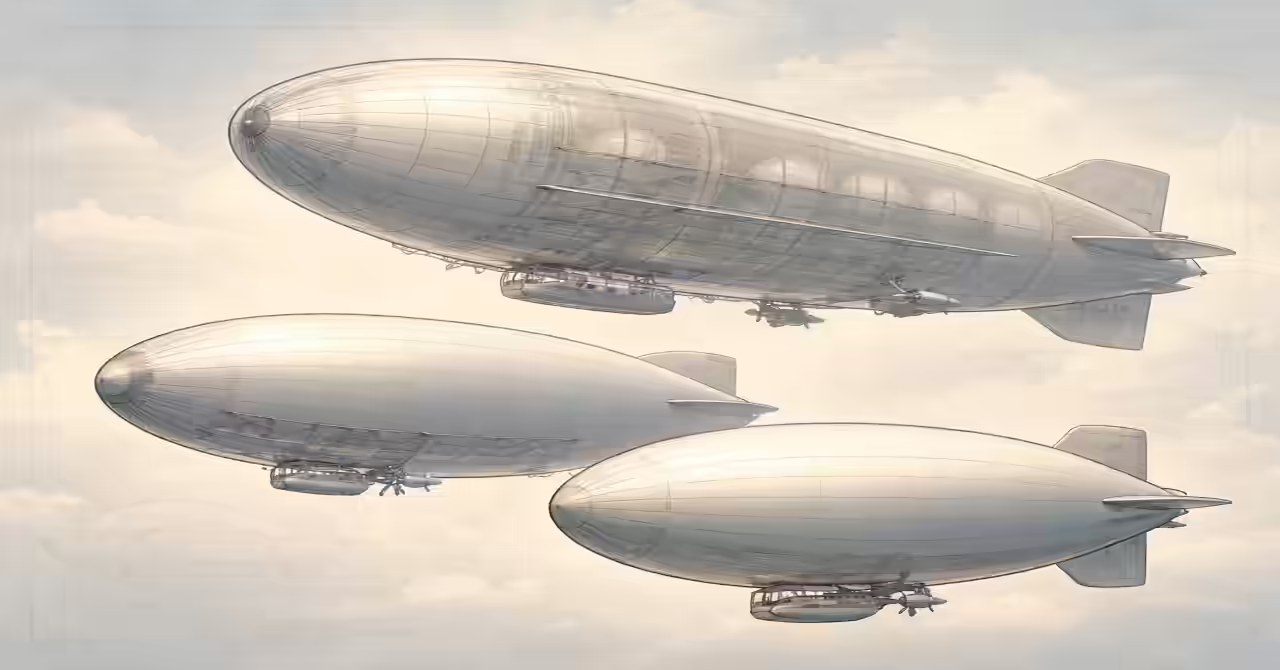
Airships are classified into three main types: rigid, semi-rigid, and non-rigid (blimps). Each design reflects a different approach to structure, lift, and control, shaped by the engineering limits of its time. Understanding these classifications explains not only how airships worked, but why they were built the way they were. To see how these designs were used in practice, explore airship applications, or examine the engineering principles behind them in airship construction.
Airships have long captured the human imagination, floating gracefully above cities and across continents, embodying the spirit of adventure and the marvels of technological innovation. From their inception, these lighter-than-air vessels have played pivotal roles in exploration, communication, and even warfare, leaving an indelible mark on the annals of history. As we journey through the evolution of these magnificent flying machines, we'll delve into their historical significance and the nuances that set them apart. The vast world of airships can be broadly categorized into three main classifications: rigid, semi-rigid, and non-rigid. Each type, with its distinct structural design and functionality, tells a unique story of human ingenuity and the relentless pursuit of touching the skies.
Airship Classification at a Glance
Quick Reference
Rigid Airships
Maintain shape using an internal framework; large, structured, and capable of long-distance travel.
Semi-Rigid Airships
Use a partial frame combined with gas pressure; more flexible but still guided by structure.
Non-Rigid Airships (Blimps)
No internal frame; shape is maintained entirely by internal gas pressure.
Rigid Airships
Rigid airships, often synonymous with the term 'Zeppelin' due to their most famous manufacturer, are a class of airship defined by their internal framework. Unlike their semi-rigid and non-rigid counterparts, these airships maintain their shape not by the pressure of the lifting gas inside but by a structural skeleton made of lightweight materials.
Historically, the Zeppelin stands out as the most iconic example of rigid airships. Named after Count Ferdinand von Zeppelin, these airships became symbols of German engineering prowess in the early 20th century. The Zeppelin's design was characterized by a series of internal metal frames covered by a fabric skin, with separate cells filled with hydrogen or helium gas. This design allowed for larger sizes and greater carrying capacities than other types of airships.
The advantages of rigid airships were numerous. Their internal framework allowed them to carry heavier loads, including passengers in luxurious accommodations, cargo, and even small aircraft. They were also less affected by changes in gas volume due to temperature fluctuations, making them more stable in varying weather conditions. Additionally, their larger size often meant they could achieve longer ranges and endure longer flight durations.
However, there were also disadvantages. The very structure that gave them stability and capacity also made them more complex and expensive to build and maintain. Their size made them more vulnerable to adverse weather conditions during takeoff, landing, and mooring. And, critically, their reliance on hydrogen, a flammable gas, posed significant safety risks.
This vulnerability became tragically evident in the Hindenburg disaster of 1937. The LZ 129 Hindenburg, a German Zeppelin, caught fire while attempting to land in Lakehurst, New Jersey. The disaster resulted in the deaths of 36 people and marked the end of the era of passenger travel on rigid airships. The event was widely publicized, and the haunting images of the Hindenburg engulfed in flames became an enduring symbol of the dangers of airship travel.
Semi-Rigid Airships
Semi-rigid airships, as the name suggests, strike a balance between the structural rigidity of the Zeppelins and the flexibility of non-rigid blimps. These airships are characterized by their partial internal framework, typically a keel, which provides some structural stability, while still relying on the internal pressure of the lifting gas to maintain their shape.
The primary difference between semi-rigid and the other designs lies in this keel. While rigid airships have a complete internal skeleton, and non-rigid airships rely solely on their gas pressure, semi-rigid designs use the keel to distribute the weight of the gondola, engines, and other equipment, ensuring a more even distribution of stresses. This keel, often made of lightweight materials, runs along the length of the airship, providing a spine of sorts.
Historically, the Italian airship Norge is a notable example of a semi-rigid design. In 1926, under the command of Roald Amundsen, the Norge became the first aircraft to fly over the North Pole, showcasing the potential of semi-rigid airships in exploration. Their design was particularly favored in situations where a balance between size, payload, and maneuverability was required.
The advantages of semi-rigid airships are evident in their versatility. They offer greater structural stability than non-rigid designs without the complexity and expense of a full internal framework like the rigid airships. This makes them more resilient to changes in gas volume and external forces, such as wind gusts. Their keel also allows for easier mounting of engines, equipment, and gondolas.
There are disadvantages. While they can carry heavier payloads than non-rigid airships, they still can't match the capacity of the large rigid designs. Additionally, their partial framework adds to the overall weight, potentially reducing their range and efficiency compared to non-rigid designs. Maintenance can also be more complex than non-rigid airships, given the added structural components.
In essence, semi-rigid airships represent a middle ground in the world of lighter-than-air travel. They encapsulate a compromise, blending the best of both rigid and non-rigid designs, and have carved out their niche in the annals of aviation history.
Non-Rigid Airships (Blimps)
Non-rigid airships, commonly known as blimps, are perhaps the most recognizable form of airship in popular culture. Unlike their rigid and semi-rigid counterparts, blimps lack an internal framework. Instead, they rely entirely on the pressure of the lifting gas within to maintain their shape. The absence of an internal structure means that when deflated, a blimp collapses, much like a balloon.
Historically, blimps have been widely used for a variety of purposes. One of the most iconic examples is the Goodyear blimp. Since the 1920s, Goodyear's fleet of blimps has been a regular sight at major American sporting events, providing aerial coverage and becoming synonymous with the brand. Beyond advertising, blimps have been employed for reconnaissance, especially during the World Wars. Their quiet operation made them ideal for patrolling coastlines and spotting enemy submarines.
The advantages of blimps are numerous. Their simplicity in design often translates to lower manufacturing and maintenance costs compared to rigid and semi-rigid airships. The absence of an internal structure means they can be easily deflated and stored, requiring minimal ground infrastructure. Their quiet operation, combined with the ability to hover and perform low-speed maneuvers, makes them ideal for tasks like observation and aerial photography.
Blimps also come with their set of disadvantages. Their lack of an internal structure means they are more susceptible to deformation from external forces, such as strong winds. This can make them challenging to handle during takeoff, landing, and mooring. Additionally, their payload capacity is generally lower than that of rigid or semi-rigid airships, limiting their use for heavier cargo or larger passenger operations.
Blimps, with their iconic shape and storied history, have played a significant role in the world of aviation. From advertising to warfare, their versatility and simplicity have ensured their continued relevance in an ever-evolving landscape of flight.
The Dawn of Airships
Long before the roar of jet engines filled the skies, humanity's dream of flight was realized through the silent ascent of balloons and the graceful glide of airships. The earliest attempts at flight were marked by a combination of curiosity, courage, and innovation. Balloons, initially filled with hot air and later with gas, paved the way for the birth of the airship concept. These initial endeavors were not just about defying gravity; they represented the human spirit's unyielding quest to explore the unknown.
The concept of the airship emerged as a natural progression from these balloons. Unlike their predecessors, airships were designed to be steerable, allowing for directed flight. This added control opened up a realm of possibilities. No longer were these vessels at the mercy of the winds; they could now be piloted with intent and purpose.
Airships quickly found their place in exploration. The vast and uncharted territories of our planet, previously inaccessible or too dangerous to traverse by land, became reachable. Explorers used these vessels to map out remote regions, from dense jungles to polar expanses. The stories of their voyages filled newspapers and inspired countless others to dream of aerial adventures.
Beyond exploration, airships began to play a crucial role in communication. They acted as floating mail carriers, bridging distances faster than ground-based methods of the time. Letters, news, and even small cargo were transported across countries and continents, knitting the world closer together.
However, with the onset of global conflicts, the role of airships took a darker turn. Their potential in warfare became evident. These silent observers in the sky were employed for reconnaissance, spotting enemy movements from a vantage point that was hard to counter. They also played roles in naval operations, acting as eyes in the sky for fleets below. Their presence, both as tools of observation and as symbols of technological might, influenced the strategies and outcomes of many battles.
Experimental and Futuristic Airship Designs
Beyond the traditional classifications of rigid, semi-rigid, and non-rigid airships, the realm of aviation has always been a hotbed for innovation and experimentation. Visionaries and engineers, driven by the dream of perfecting flight, have often ventured beyond conventional designs, leading to the creation of airships that defy standard categorization.
Many of these ideas are now being revisited through the lens of modern sustainable aviation, where efficiency, reduced emissions, and alternative propulsion systems are shaping a new generation of lighter-than-air craft.
One such experimental design is the hybrid airship, which combines characteristics of both lighter-than-air (LTA) and heavier-than-air (HTA) aircraft. These airships use a combination of buoyant lift from gas and aerodynamic lift from wings or vectored thrust. The advantage is that they can carry heavier payloads without the need for large volumes of lifting gas.
Aerodynamic airships are another intriguing concept. These are designed to generate a significant portion of their lift aerodynamically, using body shapes that resemble wing profiles. By doing so, they aim to combine the efficiency of fixed-wing aircraft with the VTOL (Vertical Take-Off and Landing) capabilities of airships.
Looking to the future, the possibilities are boundless. Here are some speculative designs that might grace our skies:
Solar-Powered Airships: Imagine airships with skins embedded with solar cells, allowing them to harness solar energy for propulsion and onboard systems. Such airships could potentially remain airborne for extended periods without the need for refueling.
Shape-Shifting Airships: Leveraging advancements in materials science, future airships might be able to alter their shape in response to environmental conditions or mission requirements, optimizing for speed, stealth, or stability.
Underwater Airships: Borrowing concepts from submarines, these airships could operate both in the sky and underwater, transitioning between the two mediums, making them ideal for research or even transportation.
Nano-Airships: On the smaller end of the scale, swarms of tiny airships, perhaps no larger than insects, could be used for surveillance, environmental monitoring, or even pollination in agricultural settings.
Floating Habitats: Envision massive airships, more like floating cities, equipped with all the amenities of modern life. These could serve as airborne resorts, research platforms, or even long-term habitats.
While some of these ideas might seem straight out of science fiction, it's essential to remember that many of today's technological marvels were once mere figments of imagination. As history has shown, the sky is not the limit when it comes to the evolution and innovation of airship designs.
Fun Fact… Did you know that the term "blimp" is believed to have originated from the sound made when one taps the airship's surface? A British officer, A.D. Cunningham, supposedly flicked the envelope of a non-rigid airship with his thumb and noted the "blimp" sound it produced, leading to the popular nickname we use today!
Airship Gazettes and Technical Journals
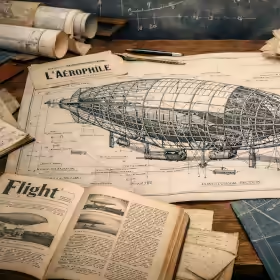
Much of what we understand about airship development comes not only from surviving machines, but from the pages of contemporary journals and gazettes. These publications, often written for engineers, investors, and technically curious readers, documented new designs, speculative ideas, and emerging technologies with remarkable detail. Far from being static records, they reveal a living conversation about flight—one that balanced practical engineering with bold imagination.
Today, these sources remain a rich resource for understanding how airships were conceived, debated, and refined. They offer insight into both successful innovations and ideas that never left the drawing board, many of which echo in modern discussions of efficiency and sustainability. For a closer look at these original materials, explore airship gazettes and journals.
Conclusion
The journey of airships, from their inception to their current forms, is a testament to human ingenuity and the relentless drive to conquer the skies. From the majestic Zeppelins that once graced our horizons to the nimble blimps that hover above our sporting events, airships have always been more than just vessels of transport; they are symbols of innovation, exploration, and ambition.
While the golden age of airships might seem like a chapter from the distant past, the story is far from over. With the rapid advancements in technology, materials science, and sustainable energy, we stand on the cusp of a new era for these magnificent flying machines. The challenges that once grounded them are being reimagined as opportunities. The dream of silent, efficient, and sustainable flight is closer than ever.
As we look to the future, it's not just about reviving the past but about redefining what's possible. Imagine a world where airships are the backbone of our transportation networks, where floating cities in the sky are no longer the stuff of fiction, and where the boundaries between land, sea, and air blur.
The legacy of airships is rich and storied, but their future is even more exciting. As we continue to push the boundaries of what's possible, there's every reason to believe that the best days of airships are yet to come. So, let's cast our eyes upwards and dream big, for the sky is not the limit—it's just the beginning.