Introduction
What if the greatest obstacle to the North Pole is not cold or distance. What if it is an assumption. The assumption is that building must begin on the ground. This article treats the North Pole as a systems test rather than a development proposal.
The Pole is not fixed land. It is moving ice. It has no stable foundation. It has no roads or ports. It has no easy way to deliver heavy material. Traditional construction depends on all of these things.
This article treats the North Pole as a systems test. It asks a single question. Can we place a human settlement there without permanent transport works? Can we do it without leaving scars that last longer than the mission?
The answer explored here is speculative. It is also disciplined. It combines two ideas. The first is factory-built architecture. The second is lighter-than-air transport. Together they form a third idea. Transport becomes temporary infrastructure. In construction systems, transport is often treated as a separate problem. Here it becomes the infrastructure.
Constructing high-rise buildings on the North Pole
A conventional building site needs ground that stays put. It needs trucks, cranes, and steady supply lines. It needs workers who can arrive and leave on schedule. The North Pole offers none of that.
Ice shifts. Leads open. Pressure ridges rise. A flat work pad can become a broken field in a week. Even if a structure survives, access is never guaranteed.
There is another problem. Permanent infrastructure in polar regions is hard to justify. Roads cut and crush. Ports demand dredging and rubble. Runways need constant maintenance. All of this can outlast the purpose that created it.
So the question becomes simple. How do you deliver shelter without building the usual path to shelter?
Manufacture before foundation
Modern construction often treats a building as a one-off project. It is assembled in the open. It is built by many trades on many schedules. The work is exposed to weather and delay.
Factory construction changes the order of events. It brings work indoors. It concentrates tools and skills in one place. It allows repeatable methods and tighter tolerances.
In this view, a building is closer to a product. It can be built as a complete system. It can leave the factory with wiring, plumbing, insulation, and fittings already installed.
This idea is not new. It was argued with special force by R. Buckminster Fuller. Fuller was a systems thinker. He looked for whole solutions. He asked how shelter could be produced like an aircraft. He asked why the building site had to be a place of invention.
Fuller also asked a second question. If the building is made in a factory, how should it travel. How do you move a complete structure without breaking it into thousands of parts.
Airships are modern infrastructure
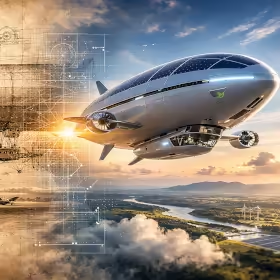
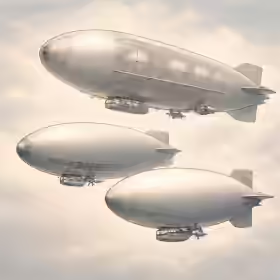
The airship is an old vehicle. It is also a useful one. It can lift large volumes with little power. It can hover. It can move loads that are awkward for road or rail.
Many people think first of disaster. They think of the Hindenburg. That image is real. The lesson is also specific. It was about hydrogen and an era of materials that had limits.
A modern airship is a different machine. It can use helium. It can use better fabrics and better control systems. It can use propulsion that allows precision at low speed.
Airships also had serious development programs after the 1930s. The United States Navy operated large airships for patrol and research. Heavy-lift concepts were studied in the mid twentieth century. Many were not built. The reasons were economic and political. The reasons were not simple physics.
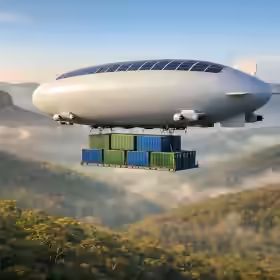
For the North Pole, the airship offers a special advantage. It can be a road that does not touch the ground. It can be a port that leaves no dredged channel. It can arrive, work, and depart.
How a colony could be delivered
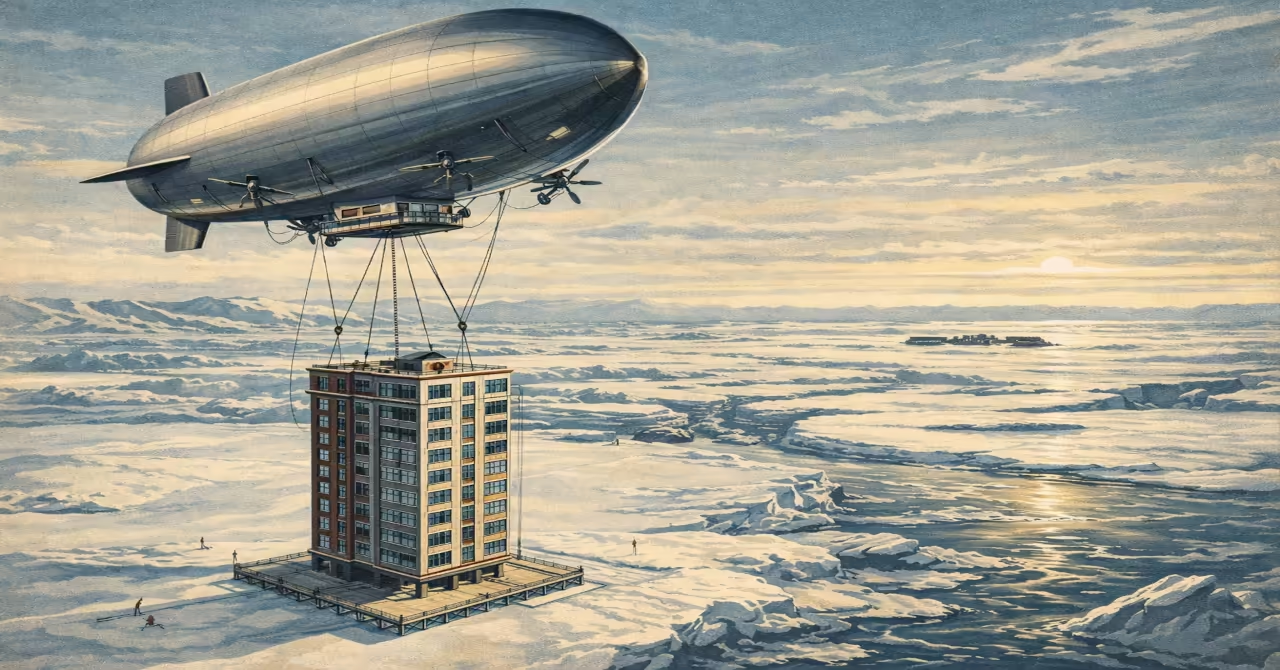
Now we come to the speculative core. Imagine a building made as a complete unit. Imagine it built in a temperate factory. Imagine it tested before it ever leaves the floor.
The structure is designed for transport. It is braced for lift loads. It has hard points for rigging. It has insulation for long exposure. It has integrated services. It has a compact outer skin.
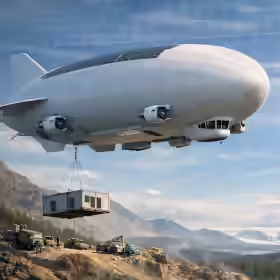
A heavy-lift airship arrives at the factory. It connects to the rigging points. It raises the building into a horizontal carry position. This keeps the center of gravity low. It also reduces wind sail during the cruise.
The airship then becomes a logistics chain of one. It does not need a runway at the destination. It does not need a dock. It needs only a safe weather window and a site selected on the ice.
At the Pole, the airship hovers. It uses winches and control lines. It lowers the building with slow precision. It does not rush. It cannot rush.
The building must then meet the ice. That is the hardest part. In older proposals, dramatic methods were suggested. One idea was to create a crater by explosive means. That idea belongs to its time. It conflicts with the ethic of low impact.
A modern approach would aim for reversibility. It would use methods that can be undone. It would use anchoring that adapts to movement. It would avoid permanent excavation.
Proposed Delivery Sequence
- Manufacture complete building module in factory
- Integrate services and structural bracing for lift loads
- Connect airship heavy-lift rigging
- Transport via controlled weather window
- Lower to prepared ice base
- Deploy reversible anchoring system
- Maintain via periodic aerial servicing
- Retrieve or relocate if required
Reversible foundations on moving ice
A building on sea ice needs a base that spreads load. It also needs a way to accept drift and flex. The goal is not to defeat the ice. The goal is to cooperate with it.
One method is the ballast plate. The base sits on a wide plate system. The plates distribute weight like snowshoes. They can be repositioned as ice changes.
Another method is the melt-set anchor. Heated probes can sink into ice and refreeze. This creates a temporary grip. It can be released later with heat.
A third method is the floating raft. The building sits on a platform that accepts movement. It is then moored with lines. These lines can be adjusted as the floe shifts.
None of these methods are simple. All of them are gentler than roads and ports. They also match the goal of retrieval. A settlement should be able to leave.
The key idea is this. The airship is not just a delivery truck. It is a service tool. It can return for maintenance runs. It can swap modules. It can lift a unit away if the ice fails.
Technology development
This vision requires a deliberate near-technology leap. It is a single leap, not magic. It needs improved materials for envelopes. It needs reliable control in bad air. It needs propulsion that can hold position in gusts.
It also needs an operating doctrine. Polar flight is demanding. Weather moves fast. Visibility can collapse. Navigation can be difficult at high latitude. Any airship program would need strict rules and careful training.
Manufacturing must also evolve. A transported building must be designed like cargo. It must endure lift forces and vibration. It must endure thermal gradients. It must endure long exposure during placement.
This is why the North Pole is useful as a thought experiment. It forces the system to be complete. Weak links are revealed at once.
Risks and opportunities
The risks are real. Airships are sensitive to weather. They have limits in wind and ice. They demand planning and patience.
The economics are also uncertain. A polar base is costly. A heavy-lift program is costly. It may only make sense when the same system serves many remote regions. It may need scientific, civil, and commercial uses to share the burden.
There is also a political risk. A settlement at the Pole carries symbolism. It can be read as claim and conquest. It can create tension. Any serious plan would need careful governance and clear purpose.
Yet there are opportunities too. A reversible base could reduce long-term damage. It could enable short scientific missions with lower footprint. It could support climate monitoring and communications. It could even serve as a test bed for other extreme environments.
Further research is required
Several questions remain open. We would need deeper study of past heavy-lift airship research. We would need modern data on envelope materials and fatigue. We would need comparisons between temporary and permanent polar logistics.
We would also need legal clarity. The Arctic is governed by treaties and national interests. A non-permanent installation may be treated differently from a permanent base. This matters. It may shape what is acceptable.
Finally, we would need practical proof. A small demonstration would come first. It would carry a module, not a tower. It would test handling, placement, and retrieval. It would test the full cycle.
Conclusion
The North Pole may never be built in the way cities are built. That is not the point. The point is the question it forces us to ask.
If transport can act as infrastructure, then roads are not always required. If buildings can be manufactured as complete systems, then foundations can become lighter and more reversible.
This is not a promise of inevitability. It is a reminder that old ideas can be re-read. Some were abandoned for reasons that had nothing to do with feasibility. Some may return with better tools and better ethics.
Perhaps the future of extreme environments is not permanent conquest. Perhaps it is careful placement. Perhaps the highest form of engineering is the ability to arrive, to learn, and to leave without a trace.