Using Curator Notes to Rescue Dense Source Material
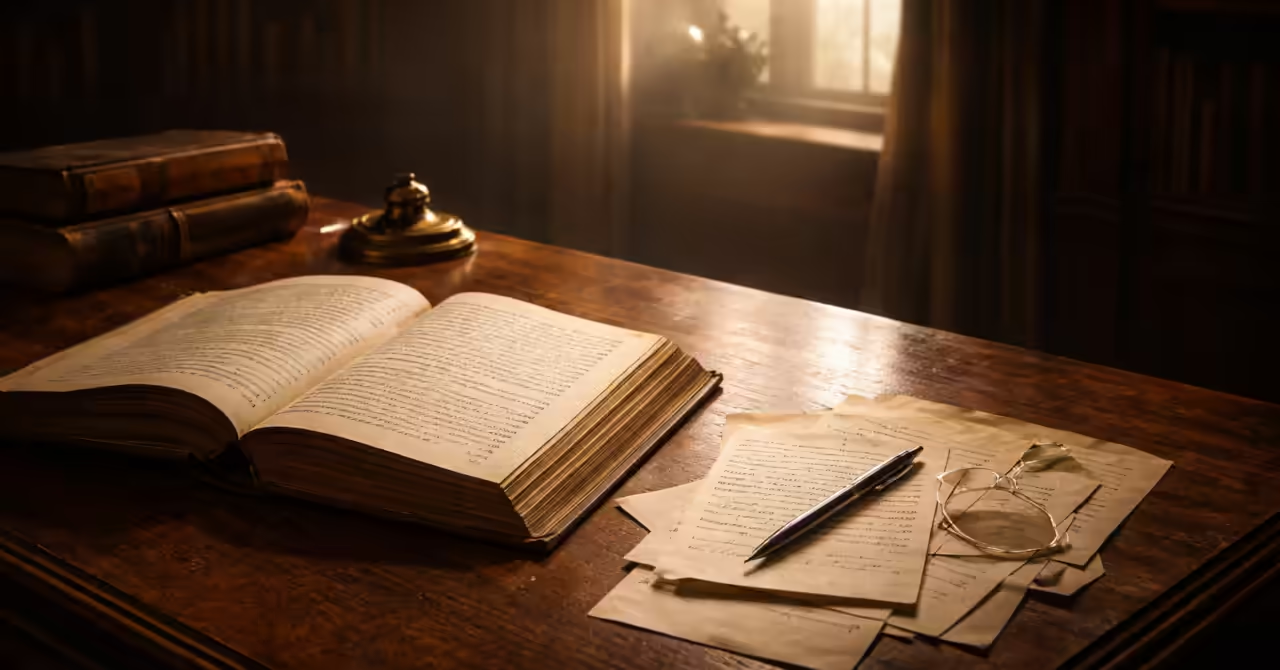
Why Dense Texts Need a Human Threshold Guide
Some historical texts ask a modern reader for more than patience. They ask for missing customs, older moral language, and a confidence in reference that no longer sits in the room. Curator notes matter because they can connect two things that often drift apart on heritage pages: the integrity of the original text and the real needs of the present-day reader.
That relationship is easy to misjudge. If a note is too slight, the reader remains outside the text, glancing at its surface and moving on. If it is too forceful, the note begins to take possession of the artefact. The old document becomes a prop for a modern opinion piece. What is needed instead is a threshold guide. The note should help the reader enter, orient, and remain alert. It should not do the reading for them.
On a site like Phillaneum, this is especially important. Dense source material is often worth preserving not because it is immediately friendly, but because it records a way of seeing that would otherwise be lost. A difficult Victorian essay, a stiff review, or a moralising preface may contain awkward assumptions and beautiful turns in the same breath. Curator notes can make that complexity usable. They can invite readers into the room without rearranging the furniture.
Curator Notes as Bridges Rather Than Shortcuts
The best curator notes work by mediation, not simplification. They do not flatten a difficult text into a neat modern summary. They identify the point of contact between an unfamiliar world and a recognisable concern. Once that point is visible, the reader has somewhere to stand.
In practice, this means a note should name the living question inside the old material. A Victorian essay on Sidney’s ancestry may look, at first glance, like a parade of titles and family honour. In Sir Philip Sidney - The Prelude - Clio in the Nineteenth Century, the insight is present but buried beneath dense structure and archaic language. Yet the live question remains close to reputation, inheritance, and the urge to explain character through story. A note on Tennyson criticism may seem to belong to a vanished moral culture. Yet the reader may recognise a familiar concern about difficulty, beauty, and whether art must be useful to deserve attention.
This is the central relationship. Dense source material carries an older set of assumptions. Curator notes translate the reader’s point of entry, not the source itself. They help a modern audience ask better questions of the text. They do not replace the text with a safer version.
That distinction gives heritage publishing its tone. A curator is not there to rescue the reader from history. A curator is there to help the reader notice where history still presses against present habits of reading, judging, and feeling.
How a Note Opens the Door Without Rewriting the Room
The mechanism is usually quite simple. A strong curator note does three things in quick succession. It names the likely obstacle, offers a framing lens, and preserves the reader’s freedom to proceed.
The obstacle may be tone, reference, social assumption, or sheer density. Many nineteenth-century pieces begin with confidence that now feels forbidding. The reader may feel excluded before the argument has even begun. A note can acknowledge that sensation without mocking the text. It can say, in effect, that what appears narrow or remote may actually be a debate about visibility, duty, or the uses of art.
The framing lens comes next. This is where the note becomes useful rather than decorative. A lens is not a verdict. It is a way of seeing. It helps the reader grasp what kind of text they are meeting. Is this a moral prelude, a work of literary devotion, a performance of authority, or a record of professional taste? Once the kind of thing is visible, the prose becomes less forbidding.
The final step is restraint. The note should leave open space for encounter. It should not force every sentence into a single moral lesson. Heritage pages benefit from a little trust. Readers do not need every meaning pre-chewed. They need enough orientation to begin reading with confidence.
Between Helpful Framing and Editorial Overreach
The contrast is worth stating plainly. Helpful framing enlarges the original work. Editorial overreach shrinks it. One invites curiosity. The other performs control.
Overreach often arrives disguised as clarity. A curator feels responsible for accessibility and begins ironing out the source until nothing difficult remains. Yet difficulty is not always a defect. It may be the very sign that a text belongs to another age. To remove all friction is to remove part of the document’s truth.
There is another risk as well. Modern commentary can become morally congratulatory. The old text is treated as a specimen to be corrected rather than an artefact to be understood. That approach gives the reader an easy superiority, but very little insight. It also weakens the page. Instead of creating a rich conversation across time, it reduces the experience to approval and disapproval.
A better note allows tension to remain visible. It can admit omission, hierarchy, or sentimentality in the source while still asking what the text was trying to do. That balance is more generous and more exact. It respects the reader, the artefact, and the historical distance between them.
Applying the Method Across Heritage Pages
This method extends well beyond literary essays. It can guide the treatment of advertisements, manifestos, exhibition catalogues, religious commentary, and technical prose. Each of these asks for a slightly different form of mediation, but the underlying task remains the same. Find the modern point of recognition without dissolving the original texture.
For Phillaneum, that means curator notes can become part of the site’s editorial signature. A page is not made readable by adding more explanation everywhere. It is made readable by placing the right explanation in the right place. Sometimes one paragraph is enough. Sometimes the page needs a short note on tone, a glossary, or a question-led FAQ. The choice should follow the nature of the source.
It also means curator notes can deepen internal connection across the site. A note on one Victorian article may point quietly toward another piece on ancestry, reputation, or the slow reading of poetry. In that way, the curator is not only easing entry into a single text. The curator is helping build a larger reading path, one in which old material begins to speak to neighbouring articles, themes, and curiosities.
The Next Step Is Better Questions, Not Less History
Dense source material does not need to be made thin in order to be inviting. It needs a patient threshold. Curator notes serve best when they help readers recognise the question alive inside an unfamiliar text and then step back with confidence.
That is a useful principle for any heritage page. If the source feels distant, ask what present concern it is brushing against. If the note feels heavy, ask whether it is guiding entry or taking control. From there, the next step is a natural one: look at how related pages handle the same problem, especially where biography, criticism, and editorial framing meet. That is often where the richest reading begins.
Editor's Notes
At the heart of this piece is a quiet but persistent question about how we come to understand a life. The text circles around ideas of character, inheritance, and moral weight, yet what it is really asking is how much of a person can be explained, and how much must simply be lived. There is a tension between admiration and inquiry. The subject is presented with care, even reverence, yet the reader is invited to look closer and consider what sits beneath that surface.
The author’s intent feels anchored in a world where moral clarity and cultural confidence were more readily assumed. There is a sense that the act of writing about a figure could also guide the reader toward a better way of seeing. Today, that tone can feel both distant and revealing. It asks more of the reader, yet it also shows how meaning was once shaped through conviction rather than hesitation. Reading it now, we are not only encountering the subject, but also the voice of an age that believed interpretation carried responsibility.
This piece sits comfortably among others in our collection that explore how history is shaped through narrative rather than record alone. It connects with our work on literary criticism, biography, and the quiet craft of editorial framing. Readers may notice echoes in discussions of Tennyson, or in articles that examine how older texts are brought forward with care. Together, these works form a conversation about how we read across time, and how each act of reading becomes a form of interpretation in its own right.
Notes & Memoranda
Frequently asked questions
Why do some historical texts feel difficult to read today?
Many historical texts were written for readers who shared assumptions about religion, class, education, and public life that no longer feel familiar. Their tone can seem formal, their references may pass without explanation, and their sentences often move with more patience than modern readers expect. The difficulty is not only in vocabulary. It also lies in the loss of shared cultural context.
How do curator notes help without changing the original meaning?
Curator notes work best when they provide orientation rather than replacement. They point out the live question inside a difficult text, identify likely barriers to entry, and offer a useful framing lens for modern readers. The original wording and argument remain intact. The note simply helps readers enter the material with better footing.
How do curator notes differ from footnotes or academic commentary?
Footnotes usually clarify specific references, names, dates, or terms. Academic commentary often aims at formal analysis, scholarly debate, or historical interpretation in greater depth. Curator notes serve a different purpose. They are editorial thresholds. Their role is to help a general reader understand what kind of text they are meeting and why it may still matter.
What is the best way to handle outdated or controversial ideas in old texts?
The strongest approach is to acknowledge such ideas clearly without pretending they are harmless, while also resisting the urge to reduce the whole artefact to a single modern judgement. Good editorial framing gives readers enough context to recognise the historical limits of the text, while preserving its value as a record of how people once thought, argued, and explained the world.
Further Reading…
References
- How to Read Victorian Trade Journals Today, phillaneum.com [retrieved 2026-04-03]
- Sir Philip Sidney - The Prelude - Clio in the Nineteenth Century, phillaneum.com [retrieved 2025-12-13] - the original discussion that got the author investigating how to read dense texts in the modern era
Disclosure
This article presents an interpretive exploration of how curator notes can support the reading of dense historical texts, based on editorial perspective and selected Victorian-era material. The analysis reflects a contemporary reading approach rather than a definitive account of historical intent. Readers seeking primary understanding should consult original sources and relevant scholarly editions.