Guide To Accomplishments In Conversation  |  1879

The Art of Conversation at Dinner Parties
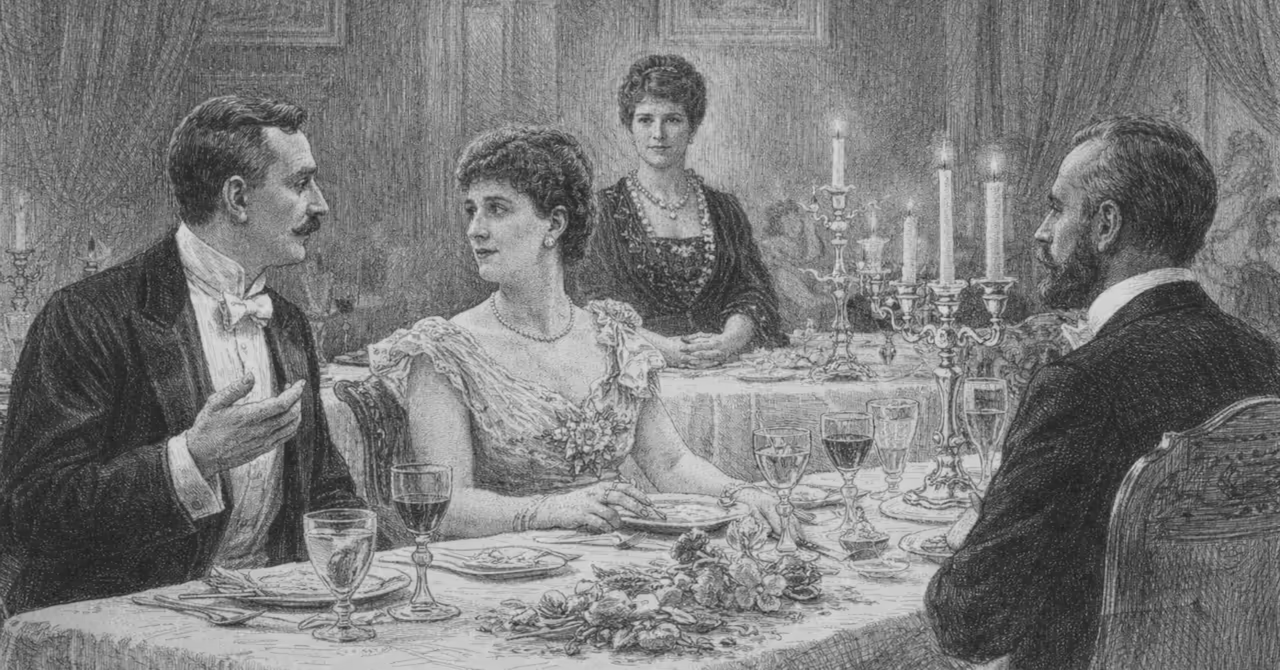
Greyscale illustration of a formal 1890s dinner party, two guests in quiet conversation while the hostess observes from the centre of the table.
Conversation observed by the hostess at a formal dinner table

When guests are strangers to each other, a dinner-party is the severest test as to the ability possessed by each to converse well.

Sometimes we may know from the character of the host or hostess, or of “the house,” that of those who assemble there. It may be “ultra-fashionable,” “moderately fashionable,” or “rather fashionable.” It may be “extremely conservative,” “highly respectable,” or “very respectable,” and again it may be one of the numerous crosses of two or more of these. It may be based on rising wealth with new affiliations through the younger branches, or by marriage, to the respectable and fashionable, and it may consist of nice, quiet people, forming a sort of unknown island, which maintains very little communication with the great continent of society.

It may be diplomatic, or only political, and it may be sectarian. The lady of the house may have been deeply steeped in Parisian French, while her husband is as decidedly immersed in Pennsylvania German. It may be the party of a rising young professional man, or that of one who is firmly established in the world; or of a real estate auctioneer, or prominent editor, or it may be military, or naval, or rural.

If you know thus much of your entertainer, you may probably conjecture something as to the general character of those whom you are invited to meet. Of one thing you may be certain, that the more highly cultivated the guests, and the more decided their cosmopolitanism, the easier will be the intercourse, and the less apparent any want of previous acquaintance among them. There is a freemasonry among men and women of the world which renders a dull dinner impossible. Much tact is often displayed by the entertainer in seating together persons of a congenial disposition, who will readily engage in animated conversation, which acts as a stimulus to all around, and is all the more effective since it renders occasional silence less liable to observation.

If you are seated by a lady who seems reserved, plunge into general subjects and current topics, taking care, however, to make your beginning apropos to some trifle which the dinner itself cannot fail to suggest. On such occasions, general information on small matters will be of great assistance. Lead your neighbor to speak on some subject with which you may happen to be familiar, and as soon as she displays any familiarity with it, encourage her by courteous questions to proceed. If she say but little, talk all the more.

There is no soil in which something will not grow if it be properly cultivated, and no woman who will not converse in time. If there be a lion of any degree of celebrity whatever, present, though he be only the local clergyman, you may appropriately enough ask for information relative to him, or bestow it. Much may be done in ascertaining where your fellow guest has travelled, and in inducing her to speak of the celebrated persons whom she has seen or met.

Avoid all egotism whatever direct or implied. Many persons seem to think that among strangers it is necessary to give autobiographic hints sufficient to show that they are entitled to consideration. Rely upon it, if you converse well enough to excite interest, the world will soon know everything about you.

I have presumed an extreme case, and the most trying which can happen at a dinner,—to be seated by a diffident woman, or, what is the same thing, by an over-cautious person, who for a long time casts on others the burden of the conversation. Absolute reserve, from any one, under such circumstances, is unpardonable—it is a lack of courtesy to the entertainer, and a reproach to the quality of the guests.

With any person who is not reserved you should enjoy conversation. If you are possessed of the lightest general knowledge of men and things, of the current topics of the day, of books, or of places, it will be your own fault if you cannot find something to say, and gradually expand it to animated narrative or discussion. Be always on the alert to suppress yourself when you see that your companion is beginning to listen with interest to his own voice; and when others also begin to listen or to take part in the conversation, be prompt to show them every courtesy and deference.

Never forget that at a dinner, as on all occasions of hospitality, it is your chief duty to relieve the hostess from every annoyance or care.

It would be well if those who give dinners; as well as their guests; would bear in mind the following remarks of a French writer :

“It must not be imagined that the dinner to which you are invited, is simply given for the purpose of giving a gross and purely material pleasure; no, it is to put you in company with persons of consideration, and to give you an opportunity to display your intelligence, or cause your good qualities to be appreciated in the species of demi-intimacy which may result from it.”

To which may be added these remarks on dinner parties, and other social meetings, at the present day:

“If you have no accurate ideas as to any of the thousand trifles which rise up at every instant when one has entered a salon, observe in silence, and imitate what you see done by well-bred persons. The aristocratic element being that which now prevails at the tables of all respectable families, and in every parlor where good company assembles, it will be easy to do this simply and adroitly, without aiming at producing an effect.”*

It has been said that the table is the touch-stone of a gentleman. He who may successfully conceal vulgarity in every other phase of life, is sure to betray it almost immediately at dinner.

Exhibit Notes

This chapter from Guide to accomplishments in conversation, letter-writing, and oratory offers a measured meditation on conversation as a social skill rather than a display of personality. Written in 1879, it treats the dinner table as a testing ground where character, cultivation, and courtesy are quietly revealed. Conversation is framed not as entertainment, but as a shared responsibility—one that sustains harmony, eases strangers into company, and reflects respect for both host and fellow guests.

At the heart of the text is an emphasis on what may be called the quiet virtues of conversation: attentiveness, restraint, encouragement of others, and an ability to read the room. The advice repeatedly discourages egotism, theatricality, and forced brilliance, favouring instead tactful questions, gentle prompting, and even well-timed silence. Conversation, in this view, is less about what one contributes than how one enables others to speak.

Much of this counsel remains recognisably applicable today. Modern social settings—whether dinners, meetings, or informal gatherings—still reward those who listen well, adapt to context, and avoid dominating the exchange. The notion of “demi-intimacy,” formed through shared but bounded interaction, continues to describe how acquaintances become at ease without overstepping social limits. While fashions and settings have changed, the underlying social mechanics remain strikingly familiar.

The historical context is essential to understanding the tone and assumptions of the piece. Written for a late-19th-century, upwardly mobile readership, it reflects a world in which social mobility depended heavily on manners, self-command, and cultural literacy. French salon culture looms large as an ideal, and conversation is treated as a marker of refinement and moral character. Read today, the text serves both as practical advice and as a revealing artefact of an era that regarded conversation as a civic and ethical art.

Colour banner showing antique porcelain plates and ornate silverware on a burgundy background
eBay (US) advertisement — search the globe for 1800s engraved dinner plates

Frequently asked questions

What did good conversation at a Victorian dinner party actually involve?

Good conversation at a Victorian dinner party was defined less by brilliance than by conduct. Guests were expected to listen attentively, encourage others to speak, avoid egotism, and adapt gracefully to strangers. Conversation functioned as a social glue—its purpose was to create ease, demonstrate cultivation, and honour the hospitality of the host.

How did French salon culture influence English-language etiquette guides of the period?

French salon culture provided both language and authority for Victorian etiquette writers. Concepts such as restraint, observation, and demi-intimacy were borrowed from Parisian social life, where conversation was treated as a refined art. Quoting French sources lent prestige and framed polite conversation as an expression of cultural literacy rather than personal display.

Which aspects of Victorian dinner-table etiquette still apply in modern social life?

Many Victorian principles remain strikingly current: listening well, reading the room, resisting the urge to dominate conversation, and allowing silence when appropriate. While social settings have changed, the idea that conversation is a shared responsibility—and a reflection of care for others—continues to shape successful social interaction today.

Glossary

Apropos
At an appropriate or fitting moment; relevant in both timing and context. In the article, it refers to conversational openings that arise naturally from the immediate situation.
Diffident
Lacking self-confidence or hesitant in social settings. The text uses the term to describe guests who are reserved not from rudeness, but from self-conscious restraint.
Demi-intimacy
A partial or bounded form of intimacy created through shared conversation and company, allowing familiarity without the expectations of close friendship.
Cultivated
Possessing refinement of mind and manners developed through education, observation, and social experience, rather than formal schooling alone.
Freemasonry (figurative)
Used metaphorically to describe an unspoken mutual understanding among socially experienced people, enabling ease of interaction without prior acquaintance.
Aristocratic element
A style of behaviour characterised by restraint, confidence, and ease, rather than hereditary rank. The term reflects manners associated with elite social circles.
Salon
A formal social gathering, particularly associated with French culture, where conversation, intellect, and cultural exchange were central to social life.

References

  1. Edward W. Cox (as “Mrs. Jane Aster”), Guide to Accomplishments in Conversation, Letter-Writing, and Oratory (G. W. Carleton & Co., New York, 1879), pp. 124–129.

Editorial Policy

This article is a heritage reprint from its original publication and is presented as a historical record. Phillaneum seeks to preserve such material in both human- and machine-readable form, with minor adjustments to format, layout, and typography made to improve clarity and accessibility for modern readers.

In some cases, original illustrations have been carefully re-rendered using contemporary tools to improve legibility on modern displays. Where this has occurred, the imagery remains faithful to the source material in composition and detail, and is intended as a visual facsimile rather than a reinterpretation of the historical artefact.

Editorial commentary and contextual material are provided separately by Phillaneum curators to support historical understanding and do not alter the original source text. This article is presented for cultural and historical interest; statements within reflect the period in which they were written and should be understood within that historical context rather than as contemporary guidance or opinion.

Change log

  1. [2026-01-06] Curated item added to phillaneum.com