Sir Philip Sidney – A Literary Prelude: Not All Shadows
Sir Philip Sidney
Part 1—The Prelude.
Chapter 2—Not all Shadows.
We need not give the genealogists too hard measure. Many a Jabez,
more honourable than his brethren,
lies hid for us, a jewel in the dustheap, in the
pages of those pedantic old pedigree-makers. The very names, the Fulke Fitz Warrens, and the
Warren de l’Isles, that bristle over the pages of Collins’s account of the genealogy of the
Sidney family,1 have a twang of chivalry about them, an
associative power that sets at nought the compiler’s evident respect for the duty of dulness.
What charms must they have had for him who fed his mind daily with mediæval romance
and story, with the black letter of the "Morte d’Arthur" when a boy, with the
converse of Edmund Spenser when a man! The perusal of his ancestry must have helped to make
him what he was, the chevalier sans peur et sans reproche,
and he did not hesitate to
own its influence. He glories in being a Dudley,2 and
does acknowledg that his cheefest honour is to be a Dudlei.
The perfunctory,
copy-book morality of Horace and such writers, was not then in vogue; a man might thank God
for a noble ancestry, as his heart told him to do, without rebuke of conscience for unseemly
and pharisaical pride. A man is not merely what he makes himself; he is what God
makes him; and when God would make a man noble and great, He often puts him where the
blood of the noble and great may stir and tingle in his veins, where, with his mother’s milk
or at his nurse’s knee, he may drink in tales of the valour and virtue, and obedience of
those of his name and house; how, through faith, they subdued kingdoms, waxed valiant in
fight, and turned to flight the armies of the aliens. Therefore these
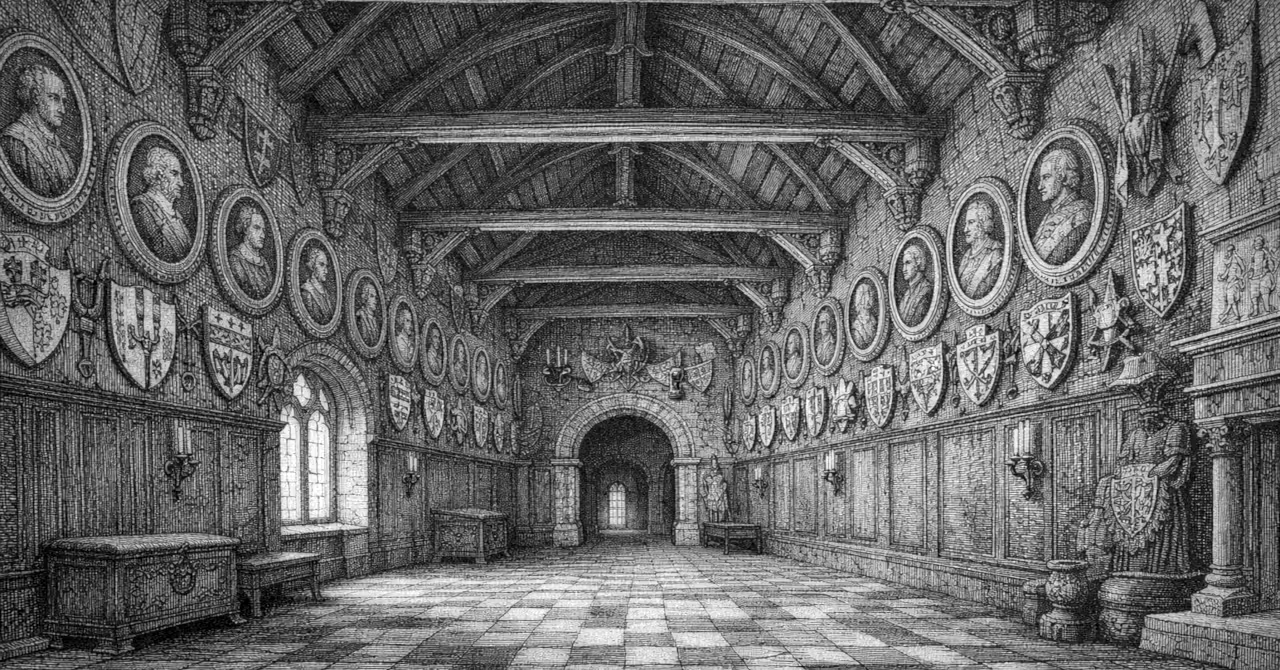
"imagines" that crowd the hall of Sir Philip Sidney’s childhood’s home
are not all shadows to us, being not all shadows to him; and we may linger a little among
them without grudging the time.
There were those of bad repute as well as of good, even among his mother’s
ancestry, the De l’Isles; the first of that name who has an habitation in history,
was accounted one of the evil Councillors
of an evil monarch:
Brian de l’Isle, who received nobility and dignity from King John. But we
find no stain upon the valour of the race, and but that one upon their patriotism.
Gerard, the evil Councillor’s great grandson (I think), was conspicuous in all
Edward III.’s wars in Scotland and France. He was at Crecy, at Calais, at Poictiers,
right through to the peace of Bretigny: and many another mighty cleaver of helmets
(whom it were needless to invoke) he numbered in his kith and kin. Beside
the De l’Isles, we find among the family heroes the stalwart figure of Richard
Beauchamp, my Lord of Warwick,
known to the French at Agincourt and Bordeaux,
and to us mostly through Shakespeare: also John Talbot, my Lord of Shrewsbury, who
died a soldier’s death at Chastillion, rather than survive defeat; and the
Beauchamps and Talbots upward to the time when they left their Norway forests with
Rolf the Ganger, and upward still to the beginning of things. One of the daughters
of the Talbots, Viscounts Lisle (in whom the family centers), marries (temp. Edw. IV.)
one Edward Grey, probably a King’s poor cousin,
who is thereupon made
Baron, and afterwards Viscount Lisle; again the family centers in a daughter,
by name Elizabeth, and she marries Edmund Dudley, a powerful man of law of that day:
known to us not as favourably as an instrument of Henry VII. for the replenishing of
his coffers. He with his colleague Empson made extortion an art; studied obsolete
statutes with praiseworthy ingenuity; invented recherché methods of rifling
the strong box of the subject, which were found to benefit himself, even
more than his sovereign, till his sin found him out; and altogether did his best to
merit the exalted position to which the vox populi and the young king’s
consent adjudged him as soon as his master was dead. He was beheaded amid universal
acclamation, in the second year of Henry VIII. There was a little son of his, six
years old, John Dudley; to whom his father perhaps was indulgent enough when he had
leisure, and who must have been sorely puzzled by his ignominious transit. He
grows up; a valiant youth of good parts; goes to France with Charles Brandon Duke of
Suffolk to fight the Duke of Bourbon; being valiant as I said, he is knighted at 22;
Sir John Dudley. The King notices him; bluff
King Hal, who loved a man;
honour grows upon him; he is master of the armory; he is master of Horse to
pale-faced Anne of Cleves, our new queen; a Viscount (De l’Isle by title, for he
represents his grandmother’s family); Lord High Admirall for life; one dignity
following close upon another: waging war, meantime, as the Baillies of Eddenborow
and the Dauphin at Boulogne can testify, successfully by land and sea. So his honour
grows; and the block whereon he shall lay his head is yet in the heart of the oak,
in the depth of the forest. An ambitious man, who, being high, dreams of being higher,
perhaps highest: (for the times are big with all manner of possibilities:) not very
clear in his convictions, but blustering and impetuous in the utterance of them,
selling himself, body and soul, to the impulse of the moment; a lion in battle,
in his heart of hearts a coward; not scrupulous of means, but by temperament a fighter,
rather than a plotter; the hottest-headed of men; so unlike the oily respectability
and shallow consistency of his rival Somerset. Through Edward’s reign these two
struggle; a life-and-death struggle. As the Duke sinks, the Earl rises; Earl (newly)
of Warwick; soon a Duke too, of Northumberland; victor over Scots at Musselburgh,
insurgents at Norwich. Thus Duke meets Duke in the tug of war; Northumberland, once
clearly in the ascendant, marries his eldest son to Somerset’s daughter; there seem
fire-seeds of generosity in this man, which burst into blaze now and then. The next day,
his third son Robert (to be Earl of Leicester, not invisible in this, or in general
history,) is married (publicly enough, as appears from Edward’s journal), to Amy,
daughter of Sir John Robsart; after which marriage there were certain gentlemen
that did strive who should first take away a goose’s head which was hanged alive on
two cross-posts.
All that follows we know, how the gentle lady Jane Dudley is caught
away from her oriel window and Plato his Phædo,
into a vortex of plot and intrigue,
a Queen against her will, against her judgment: how the plain good sense of Englishmen
declares against cajolery, even for a Protestant succession: and our blustering Duke
rides out through Shoreditch, distrusting his doings and his party; The people throng
to see us, but none biddeth us God speed.
We remember his spasmodic effort to save
himself, by setting up Queen Mary’s standard at the market-cross whither he had gone to
set up Queen Jane’s; we remember his arrest at King’s College, and that uneasy struggle
to win himself a respite by vehemently abjuring all he had vehemently professed; overdoing
it even to the last, and impetuously declaring that he deserved to die a thousand such
deaths, that he died in the true Catholic faith; and so, dastard-like, with Peter,
he forsook his Master.
Not pitied he, more than his father on that spot forty-three
years ago; for he drags down with him to death the innocent, the gifted, the loving and
loveable Jane Grey, sweetest saint that ever suffered for sins not her own.
This Duke’s children, by his wife Jane Guildford, of the old De la Warr stock, were
- John, Earl of Warwick, imprisoned with his father, but liberated shortly after, with the seeds of jail fever in him; he died at Penshurst, October 1554.
- Ambrose, Earl of Warwick:
he was a most excellent person, and died without issue.
- Robert, Earl of Leicester.
- Guildford, who died on the scaffold, with his wife Jane Grey.
- Henry, slain four years afterward at the siege of St. Quintin’s.
And two daughters,—Lady Mary Sidney, and Catherine, Countess of Huntingdon.
Sir Philip’s father’s genealogy has no names in it so eminent for good or ill as some we have touched upon. There was a William de Sidne, an Angevin friend and servant of our Angevin King, Henry II.; and there was a William Sidnei, sprung lineally from him,—a Flodden-hero, who received knighthood from Henry VIII., and the manor of Penshurst in Kent from Edward VI. He has issue, four daughters,—
- Anne, Lady Hungerford; a daughter of whom (Sir Philip’s first cousin) marries a blue-blooded Castillian, Duke of Feria, of many and sounding titles.
- Lucy, Lady Harrington.
- Anne, Lady Fitzwilliam, ancestress of at least one man not immemorable,—George Gordon, Lord Byron.
- Frances, Countess of Suffolk.
And one son—Henry Sidney, the father of Sir Philip, one of the noblest to the many noble
gentlemen of that age, the young prince’s playfellow, the young king’s dearest friend. He is one
of the four gentlemen of the bedchamber (another being William Cecil); he is the most compleat
young gentleman of the court;
being knighted, (no empty title. in those days,) he marries the
lady Mary, the great Duke’s daughter; for knighthood raises a man to the level of the highest.
But troublous times are at hand; the boy-king dies in his friend’s arms. Sir Henry is in no mind
for plotting; he retires, full of sad thought, with his young wife, to the beechwoods of Penshurst.
His friend and king is gone; those nearest to him are engaged in an unlawful struggle, which cannot
end but in failure and destruction; his allegiance, as a true Christian man, is due to one whom he
can scarcely regard but as an enemy to the true Christian faith. They can do nothing but sit still
and wait, though with heavy heart, they two; and as messenger after messenger comes in, like those
who burst upon Job, each with his freight of dolorous tidings, what wonder if the gentle Mary’s
heart sank utterly within her, if she resigned, as for ever, all thought of this world’s happiness?
Her father put to an ignominious death; her noble young brother, and that sweet sister-in-law,
whom she has but lately taken to her love: these are heavy blows indeed; but she has a brave heart;
her stay is in God, and her help in tending that sick brother, John, who has come to them from
prison, as a brand plucked from the burning; alas! only to smoulder slowly away, instead of being
caught in sudden blaze. Other hope too she has,—to be better fulfilled; and, in these dull
November days, God cheers her with a son, a richer and dearer blessing than aught He has taken
away. To her children, her husband, and her God, life shall henceforth be given. The mischance of
sickness has cast a veil over her excellent beauty,
3 the
mischance of history over her gaiety of heart, and the world, with its critic sneers, is not for
her. Yet is she no ascetic, By nature of a large ingenuous spirit;
a mother indeed for our
Philip, who learns, or inherits, from her that chivalrous sense of duty, that affectionate
cheerfulness, that crystal-clear and radiant truthfulness of heart.4
Henry Sidney is respected, even trusted, by the Queen; he is sent to Ireland, two years after
her accession, as Vice-Treasurer, and is connected therewith, as Justice, Deputy, Governor
(under Mary and Elizabeth), for eleven years: resident there, or at Ludlow, for he is also
Lord President of the Marches of Wales—a post more of a sinecure than his Irish one.
What he does in Ireland time would fail us to tell. How he routs the insurgent Scots of
Ulster—killing James Macconnel their leader, with his own hand, and thus winning those
spolia opima,
which in all Rome’s history were gained but thrice; how he defeats the
O’Molloy and the O’Reilly, and gains the submission of Shane O’Neill himself; how he fortifies
Dublin; builds the bridge of Athlone; gives presidents to the remoter provinces; divides
Munster into counties; revives obsolete statutes, to the great good of the realm;
prints
the laws and ordinances of Ireland; increases the crown revenues; settles the boundary of the
Pale;
projects a University; invites the Irish chieftains (many of them debased Normans)
to his castle, and reclaims them to clean-living and sobriety,
by a good example; how,
in brief, having found Ireland ruined by intestine feuds, the Pale overrun by thieves and
robbers, the countrymen poor, the soldiers beggarly, loose, and idle, the churches uncovered,
and the clergy scattered,
he leaves it (compared with what it was) orderly and peaceful,
prospering in Church and State: all this must be read in Collins, and in Fuller, who sums
up the whole matter (as is his wont), epigrammatically, in nine Herculean labours. Altogether,
this man stands out great above his fellows; patient and laborious to a degree; a much-suffering
Ulysses (suffering too from sharp internal complaint); a man of parts, of sweet delivery,
truthful, dutiful, modest, godly; of even cheerfulness, so that he writes to his son;
Yow degenerate from yowr father, yf yow find not your selfe most able in wytte and body to
doe any thinge when you be most mery.
He lives splendidly, as a viceroy in Ireland ought to
do; spends his patrimony on his queen’s service; dies poor, and is buried, like Valerius,
at the public expense. He had been summoned from Ireland in consequence of intrigues between
the Desmonds and the Ormonds, and, as he stepped on board, he exclaimed with the Psalmist, says
Fuller, When Israel came out of Egypt and the house of Jacob from among a strange people.
He had three sons:—
- Sir Philip.
- Sir Robert, afterwards Earl of Leicester, and grandfather of Algernon Sidney.
- Sir Thomas.
And four daughters, but one of whom survived him, the noble Countess of Pembroke,
Sidney’s sister, Pembroke’s mother,
5 of whom
we shall hear again.
[ To be continued. ]
1 Int. to Sidney Papers.
2 Defence of Earl of Leicester, ibid.
3
Fulke Greville, Lord Brooke: our chief contemporary authority on the facts of Sidney’s life.
His book is of a class which is now styled Reminiscences
rather than Memoirs.
4
See Mr. Kingsley’s portraiture of Mrs. Leigh, a wonderfully truthful delineation
of a noble lady of the time. Lady Sidney, particularly, he must have had in view.
Mrs. Leigh’s fondness for the little mystic
Alt-Deutsch Theologie,
which some have objected to as not very probable, has its counterpart in Lady Anne Bacon’s
translations from Bernardo Ochino, one of the earliest
Socinians.
Cf. Macaulay’s Essay on Bacon, Ed. Rev., July 1837.
5
Marble Pyles let no man rayse
To her name for after Daies.
Some kinde woman, borne as she,
Reading this, like Niobe
Shall turne marble, and become
Both her mourner and her tombe.
So sings rare Ben Jonson. It is worth noticing, that Milton has introduced a similar cold conceit into his epitaph on Shakespeare, which, fortunately, is perfect enough without it.