How to harvest ideas from vintage Trade Journals for your own use
·Revised
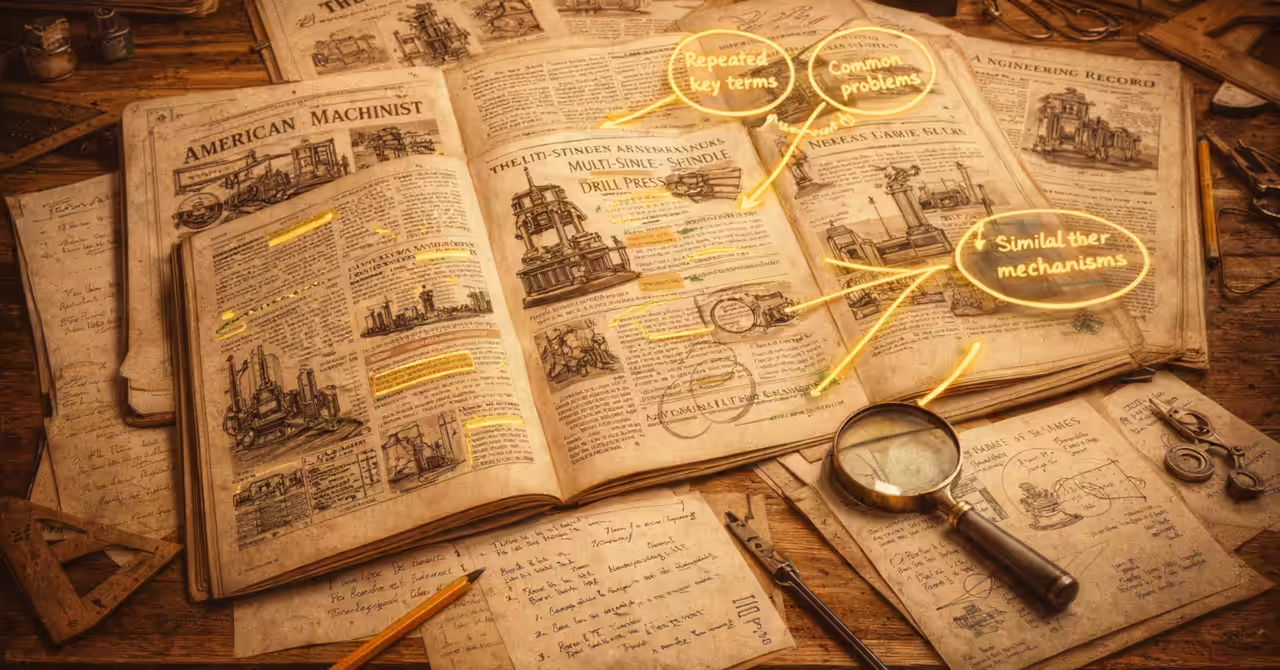
Trade Journals Turn Observation Into Method
To harvest ideas from vintage trade journals for your own use, one must first see the relationship between observation and application. A trade journal is not simply a storehouse of old facts. It is a record of how a working culture described its problems, tested its preferences, and circulated its solutions. If read passively, it remains a period document. If read actively, it becomes a method source, much as discussed in How to Read Victorian Trade Journals Today. The page begins to offer not just information about the past, but patterns that can be interpreted, adapted, and applied in the present. That shift from observation to use is the real prize.
This matters because trade journals were designed for readers who needed more than amusement. They served manufacturers, merchants, engineers, workshop owners, buyers, and serious practitioners. Their pages often joined advertisements, editorials, technical notes, market reports, patent notices, correspondence, and product announcements within one working ecosystem. The result is unusually rich. A modern reader can see not only what existed, but how one field explained itself to its own participants.
It is also worth noting that many trade journals were not written for the general public at all. Circulation was often limited to practitioners, suppliers, or members of a specific industry. In their own time, these pages operated as semi-private channels of professional communication, largely shielded from broader scrutiny.
Today, that boundary has dissolved. Through projects such as Phillaneum.com, these once-restricted materials can now be read, examined, and reinterpreted in the open. Modern readers can engage with a layer of industrial and commercial thinking that was never originally intended for them.
This approach draws on repeated analysis across multiple journals and industries within the Phillaneum archive.
These journals also assume a shared language of practice. Terminology, processes, and commercial relationships are often referenced without explanation, because no explanation was needed for the intended audience. For a modern reader, this can make even simple passages appear dense or opaque.
One useful question to carry through each page is this:
What did this article or advertisement assume about the world that we no longer assume?
This is where contextual reading becomes essential. By defining terms, unpacking assumptions, and situating each article within its working environment, Phillaneum.com restores clarity to material that would otherwise remain partially inaccessible. The goal is not simplification, but translation, and that same interpretive logic also informs From Ads to Archives: Expanding the Curation Method.
That makes the vintage trade journal especially valuable for present-day idea harvesting. It does not hand over finished solutions. Instead, it reveals how ideas were framed, how constraints were recognised, and how improvements were argued. When read with discipline, those patterns can still be carried forward.
Useful Ideas Emerge From Repeated Signals
The mistake many readers make is to search a trade journal for isolated brilliance. They look for one striking diagram, one elegant advertisement, one forgotten machine, or one remarkable phrase. Such finds can be enjoyable, but the deeper value usually lies elsewhere. Trade journals are best read for recurrence. When similar concerns appear across editorials, notices, product claims, and reader correspondence, one begins to see which pressures shaped the field. That is where transferable ideas tend to live.
For example, a repeated concern with durability may reveal more than a preference for stronger goods. It may point to harsh service conditions, costly maintenance, poor supply reliability, or customer distrust of novelty. A repeated emphasis on standard sizes may indicate market maturity, interchangeability problems, or the commercial value of easier stocking and repair. Even the language of improvement must be handled carefully. Improved, sanitary, efficient, or labour-saving are not merely persuasive words. They are clues to what the trade believed needed solving.
This means that harvesting ideas is not a matter of copying old products or reviving old slogans. It is a matter of extracting structure from repetition. The journal becomes useful when the reader asks not only what is shown, but what keeps being shown, what keeps being defended, and what keeps being assumed. Those recurrences reveal operational logic, and operational logic travels further than surface style. In a broader sense, this same question is explored in Could You Rebuild an Industry From Ads Alone?
Read each page for problem, mechanism, and context
A practical method begins with three questions: what problem is being addressed, by what mechanism, and in what context that mechanism matters. These questions are simple, but they quickly sharpen the quality of reading. An advertisement for a fitting is no longer just an object to observe. It becomes a response to leakage, wear, installation difficulty, or cost. A note on workshop layout, such as that discussed in Managing Tools in the Workshop, stops being quaint period detail and instead reads as a decision about flow, access, labour, or supervision. A product announcement shifts from novelty to evidence, showing how a field attempted to move from inconvenience to advantage.
This triad is especially useful because it separates transferable thinking from period-specific appearance. You may not wish to reproduce the exact object or process described in a journal from the 1890s. Yet the underlying relation between problem and mechanism may still be instructive. A trade may have solved a coordination issue with better standardisation. A firm may have gained trust by making performance legible rather than mysterious. A workshop may have reduced friction by simplifying access, reducing variation, or clarifying sequence. These are not antique curiosities. They are patterns of organised response.
Once seen in this way, the journal stops being a museum piece and becomes a pattern book for practical interpretation. The surface remains historical, but the logic begins to travel.
Separate direct reuse from interpretive reuse
Not every idea harvested from a trade journal should be reused in the same way. Some ideas can be taken quite directly. A layout method, naming habit, visual hierarchy, or explanatory style may adapt well with little change. Other ideas require interpretation before they become useful. A nineteenth-century advertisement may not offer a modern product strategy, but it may reveal how clarity builds confidence or how tightly sales language can be tied to practical benefit. The modern application lies in the principle, not the literal form.
This distinction prevents two common errors. The first is shallow imitation, where old language or imagery is borrowed without understanding the conditions that made it work. The second is needless distance, where the past is treated as too remote to teach anything operational. Both mistakes disappear when direct reuse and interpretive reuse are handled separately. One asks, what can be adopted. The other asks, what can be translated.
For an independent publisher, maker, curator, or designer, this is particularly valuable. A journal may offer direct inspiration in typography, framing, comparison methods, or the presentation of technical detail. At the same time, it may offer deeper interpretive lessons in trust, sequence, modularity, reader education, or the commercial power of specificity. One level gives form. The other gives structure.
Application begins when notes become propositions
The real moment of harvesting comes after reading. A good note does not stop at describing what is seen. It states what can be done with it. This requires a shift in how each example is handled. An advertisement is no longer just an example to admire. It becomes a test of clarity. A trade notice is no longer just a record. It becomes a decision about how information is structured and grouped. An editorial voice is no longer just a tone. It becomes a balance that can be examined and reproduced.
This is where personal implementation begins. The journal supplies raw material, but the reader must convert it into intention. Each observation should lead to a possible action, even if small. Some will shape writing. Others will influence curation, structure, or presentation. Without that step, the reading remains appreciative but inactive.
Vintage trade journals are valuable because they were written for people who needed to act. They organised information, preference, and persuasion within working fields. Read in the same spirit, they still do. When observation is turned into proposition, the journal stops being something you consulted and becomes something you used.
This means that harvesting ideas is not a matter of copying old products or reviving old slogans. It is a matter of extracting structure from repetition. For readers interested in how this kind of evidence can support broader historical reconstruction, see Using Ads for Research and Reconstruction of Historical Ideas.
The Phillaneum Method
A practical sequence for converting observation into usable ideas:
- Observe what problem is being addressed
- Identify repeated signals across multiple entries
- Interpret the underlying structure
- Translate into modern application
From Observation to Application
To read a trade journal well is to move beyond observation. Each advertisement, notice, or technical note contains a decision: what to include, what to omit, and how to present it. The reader’s task is to recover those decisions and test them against modern use.
This is the beginning of idea harvesting. Not copying, but extracting principles that can be reapplied across writing, curation, product thinking, or communication design.
The next step is to examine these principles in practice. In the following article, we take a set of vintage advertisements and break them down into repeatable structures that can be used today.
Author's Notes
Notes & Memoranda
Glossary
- Active reading
- A mode of reading in which the reader interprets material for use, identifying problems, mechanisms, and patterns rather than passively absorbing information.
- Operational pattern
- A repeated structure or relationship observed across multiple instances within a working context, indicating how a process or system tends to behave.
- Recurring signal
- A consistent theme, concern, or claim that appears across different sections of a source, pointing to underlying pressures, priorities, or constraints within a field.
- Mechanism
- The means by which a problem is addressed, including processes, structures, or methods that produce a particular result.
- Operational context
- The conditions under which a mechanism functions, including environment, constraints, users, and practical requirements that shape its effectiveness.
- Operational logic
- The underlying reasoning that explains how and why a system or process works in practice, as revealed through repeated decisions and outcomes.
- System
- A set of interconnected elements, such as people, processes, tools, and constraints, that operate together to produce consistent outcomes within a working environment.
- Direct reuse
- The application of an observed idea, structure, or method with minimal modification, where the original form remains largely intact.
- Interpretive reuse
- The adaptation of an observed principle or pattern into a new form, translating its underlying logic rather than copying its original appearance.
- Proposition
- A practical statement derived from observation that suggests a specific action or testable idea for application in a new context.
- Trade Journal
- A periodical publication produced for a specific industry or profession, typically circulated among practitioners and not intended for the general public.
Frequently asked questions
Why are vintage trade journals useful for modern readers?
Vintage trade journals are useful because they preserve how working industries described problems, compared solutions, and communicated change. Even when the products or technologies are outdated, the underlying patterns of explanation, persuasion, and practical decision-making can still be interpreted and applied today.
What should a reader look for when analysing a trade journal page?
A reader should look for the problem being addressed, the mechanism said to solve it, and the context in which that solution mattered. This helps move beyond surface description and reveals the operational logic behind advertisements, notices, editorials, and technical commentary.
What is the difference between direct reuse and interpretive reuse?
Direct reuse means adopting an idea, structure, or presentation method with little change. Interpretive reuse means translating the underlying principle into a new context without copying the original form. One preserves form more closely, while the other preserves logic.
Why do vintage trade journals often feel difficult to read today?
Many trade journals were written for practitioners rather than the general public. They assumed shared industry knowledge, specialist terminology, and familiarity with the commercial conditions of their time. Modern readers often need contextual explanation to understand what was being assumed, argued, or valued.
Mentions & Echoes
The following articles extend or reflect the ideas explored here, returning to similar questions through different materials, contexts, and lines of inquiry.
- The Phillaneum Gazette 004 – The Vintage Advertisement Edition – Featured as a new addition in this issue, where it introduces a practical method for reading trade journals as working documents, forming part of a broader examination of vintage advertising as a coordinated system of industry and communication.
- How to Read a Victorian Era Patent – Continues the journey from trade journals into the world of invention. Having learned how to harvest ideas from industry publications, readers are introduced to patents as another form of historical evidence, revealing the frustrations, ambitions, and practical solutions that shaped nineteenth-century technology.
Further Reading…



Disclosure
This article presents an interpretive reading of historical advertisements and related material, with attention to their technical, cultural, and practical context. It reflects editorial analysis rather than a definitive account of historical practice. Readers seeking primary context should consult period sources and surviving examples.