Could You Rebuild an Industry From Ads Alone?
·Revised
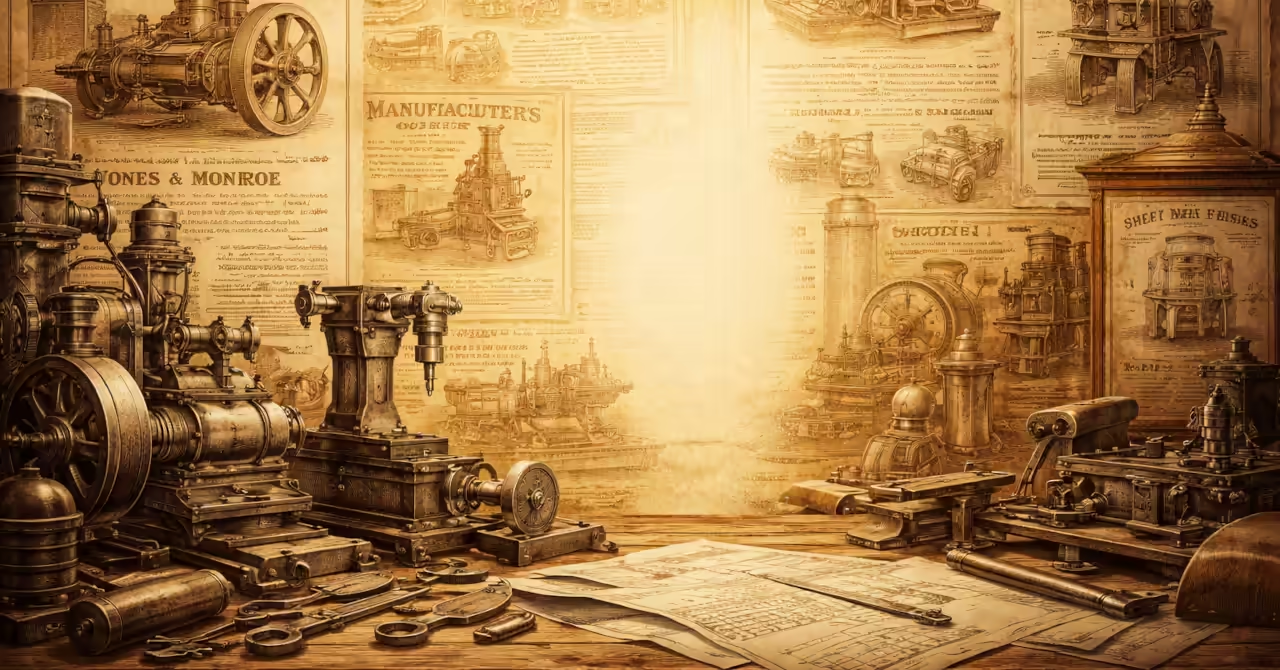
Advertisements as Industrial Evidence
It is easy to treat a vintage advertisement as a surface object. It has typography, ornament, slogans, and a pleasing arrangement of images and claims. It can be framed, collected, or admired for style alone. Yet the same page can also be read as industrial evidence. That is the relationship at the centre of this question. A printed advertisement is both a persuasive object and a compressed description of a working world. Once read in that second way, it begins to show traces of manufacture, trade, logistics, standards, materials, and intended use.
The proposition may sound extravagant at first. Could an industry be rebuilt from advertisements alone? Not perfectly, and not in every detail. No sensible reader would confuse a sales page with a complete factory record. An advertisement is selective by nature. It hides weakness, simplifies complexity, and presents an ideal case. Even so, it reveals far more than it first appears to reveal. In many cases it tells us what was being made, who it was for, what qualities mattered, what variants existed, what supporting goods were assumed, and what sort of technical language the market could already understand.
That makes the vintage advertisement valuable in a special way. It does not merely depict a past industry. It preserves the interface between industrial production and public communication. That interface is often enough to sketch the outline of a system. If a reader gathers many such pages, compares them carefully, and resists the temptation to treat each one as isolated, a larger mechanical picture starts to emerge.
Sales Language Often Carries System Detail
The reason advertisements can support reconstruction is simple. They must translate production into buying decisions. To do that, they carry selected facts from the workshop, the drawing office, the warehouse, and the merchant counter into a form the reader can act upon. A good advertisement does not reproduce the whole factory. It carries enough of the factory’s logic to make the product legible.
That logic appears in several forms at once. Product names imply categories and subcategories. Measurements reveal standards and compatibility. Material descriptions point to supply chains and manufacturing limits. Illustrations disclose form, fittings, proportions, and intended modes of handling. Claims about durability, economy, speed, or safety tell us what problems the trade was trying to solve. Testimonials and client lists hint at sectors of use. Even the address line may reveal whether the seller was a maker, an agent, an importer, or a distributor.
When many advertisements are read together, these fragments become cumulative. One page may show a machine. Another shows spare parts. A third names the patent. A fourth shows a workshop using the same class of apparatus. A fifth offers belts, lubricants, fasteners, or packing materials required to keep it in service. None of these pages is complete in isolation. Together they begin to describe an industrial environment. The industry becomes visible not through a single master document, but through repeated commercial signals.
Products reveal the shape of a working system
A practical example helps. Imagine a run of advertisements from the 1890s for pumps, valves, pipe fittings, packing compounds, gauges, and boiler controls. A casual reader may see separate commercial notices. A system-minded reader sees an operating field. The pump requires pipe. The pipe requires fittings. The fittings require sealing methods. The boiler requires monitoring. The whole installation requires maintenance, replacement parts, and trusted suppliers. At once the advertisement ceases to be a decorative page and becomes a clue to interdependence.
This is where industrial reconstruction begins. You do not start with the ambition to recreate an entire factory district in one leap. You start by noticing dependency. An advertised object implies associated objects. A claimed performance figure implies a test condition or accepted expectation. An offer of multiple sizes implies standardised demand. An image of installation implies an environment of use. Step by step, the advertisement points outward.
The same applies to language. Words such as improved, patent, reinforced, adjustable, sanitary, portable, heavy duty, or guaranteed are not empty when placed in historical context. They answer pressures in the market. Improved from what. Sanitary in response to which concern. Adjustable for what variability in use. These are commercial words, but they rest on practical circumstances. They are signals from the industrial world translated into persuasive form.
Advertisements distort reality but still disclose it
There is, however, an important caution. An advertisement is not neutral evidence. It is designed to flatter the product and narrow the reader’s attention. That means reconstruction from advertisements alone will always be partial and slightly theatrical. The page is trying to sell confidence. It may overstate novelty. It may understate labour. It may hide fragility behind the language of robustness. It may present a polished machine while omitting the mess of upkeep, transport, and failure.
Yet this distortion does not make the source useless. It makes the source readable in a particular way. The exaggeration itself is informative. If firms compete over quick delivery, then delivery was a serious commercial concern. If they boast of interchangeability, then compatibility mattered in practice. If they stress low maintenance, then maintenance was costly enough to trouble buyers. Even the omissions have meaning. Silence around certain processes may indicate that they were assumed knowledge within the trade.
This is why a cluster of advertisements is stronger than a single page. One firm’s claim can be doubtful. Ten firms repeating related claims begin to describe the market. Patterns emerge. Shared terminology stabilises. Repeated visual conventions become trustworthy. The industrial outline grows clearer not because any one advertiser is fully honest, but because the field as a whole leaves recurring marks.
Reconstruction begins when the reader follows outward
The most useful next step is not to admire the page more closely, but to follow its implications outward. A brand name can lead to catalogues, trade directories, patents, or surviving artefacts. A technical term can lead to manuals and trade journal discussion. A drawing can be compared with surviving examples in museum collections or auction photographs. An address can place the firm within a manufacturing district. A client list can connect the object to railways, farms, mines, shipyards, or domestic households.
At that point the advertisement becomes a launch point for disciplined curiosity. It has done its job twice. First, in its own time, it attempted to secure a buyer. Second, in ours, it helps reveal the structure around the thing being sold. That is the deeper value of the source. It preserves not only an object, but a small working proposition about how a world was organised.
So the answer is measured but clear. No, advertisements alone cannot rebuild an industry in total. They cannot replace engineering drawings, wage books, factory plans, or operating manuals. But yes, they can supply enough connected evidence to begin reconstructing industrial form, commercial priorities, and technical relationships. Read singly, they are fragments. Read collectively, they become a map. The next sensible step is to place them beside catalogues, patents, and trade journals, where their compressed signals can expand into a fuller historical machine.
Author's Notes
Notes & Memoranda
Mentions & Echoes
The following articles extend or reflect the ideas explored here, returning to similar questions through different materials, contexts, and lines of inquiry.
- How to harvest ideas from vintage Trade Journals for your own use - Provides a practical framework for identifying and interpreting the recurring patterns considered in this discussion.
Further Reading…




Disclosure
This article presents an interpretive reading of historical advertisements and related material, with attention to their technical, cultural, and practical context. It reflects editorial analysis rather than a definitive account of historical practice. Readers seeking primary context should consult period sources and surviving examples.