The Phillaneum Gazette 004 – The Vintage Advertisement Edition
The Editor's Quill
This issue of The Phillaneum Gazette is devoted to the vintage advertisement. At first glance, these artefacts offer a familiar charm: bold claims, careful illustration, and typography that speaks in a confident voice from another age. They are visually arresting and often beautiful in their restraint. Yet to leave them at the level of nostalgia is to miss their deeper value.
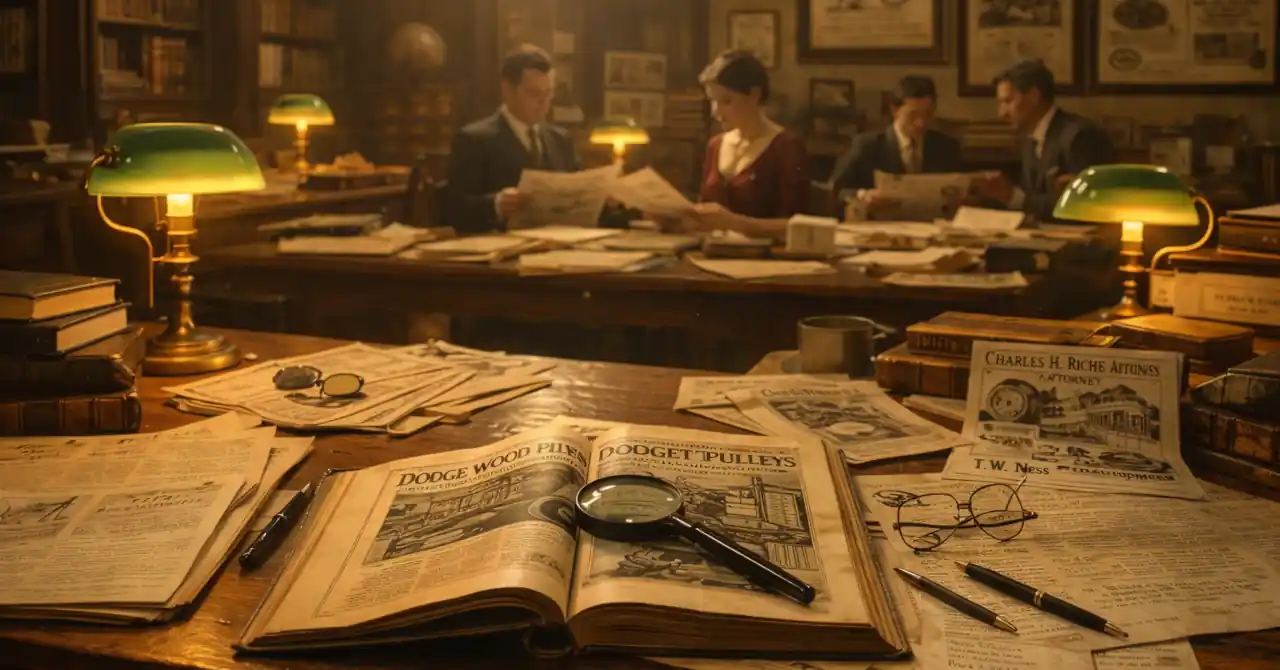
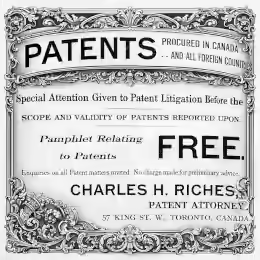
In this edition, we look beyond the surface appeal and treat these advertisements as working documents of the industrial era. Each notice reveals a system in motion. Patent services, mechanical components, telephones, and bicycles point to a coordinated industrial world rather than isolated invention. Read together, they form a record of how industries organised themselves, how problems were solved, and how trust was established in practice.
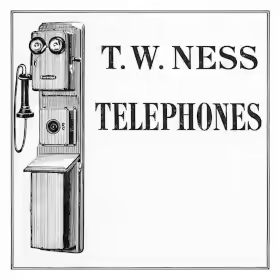
The advertisement for a patent attorney reflects a world already structured around intellectual property and invention as a profession. A pulley advertisement points to supply chains, standardisation, and the quiet infrastructure that powered entire workshops. A telephone notice captures a moment when communication was still engineered rather than assumed. A bicycle advert shows a technology settling into everyday use, shaped by local conditions and practical demand. These are not isolated examples, but selected readings from a broader working archive assembled over time.
This perspective is developed further in our Vintage Advertising Journal: The Language of Persuasion, where advertising is treated not as ephemera, but as a complete language. Across typography, imagery, and phrasing, these artefacts reveal how trust was constructed, how needs were shaped, and how early markets were imagined. What appears simple becomes, on inspection, a structured system of communication.
What emerges in this issue is not simply a gallery of old advertisements, but a set of insights. These pieces show how industries matured, how persuasion operated when audiences expected clarity rather than spectacle, and how systems formed around reliability rather than novelty. The movement from invention to system becomes visible through careful reading.
For the modern reader, this is where the value lies. To study these advertisements is to sharpen one’s understanding of communication, positioning, and technological adoption. The forms have changed, but the underlying principles remain. In pulling back the curtain on these artefacts, we find not only the texture of the past, but a clearer view of the present.
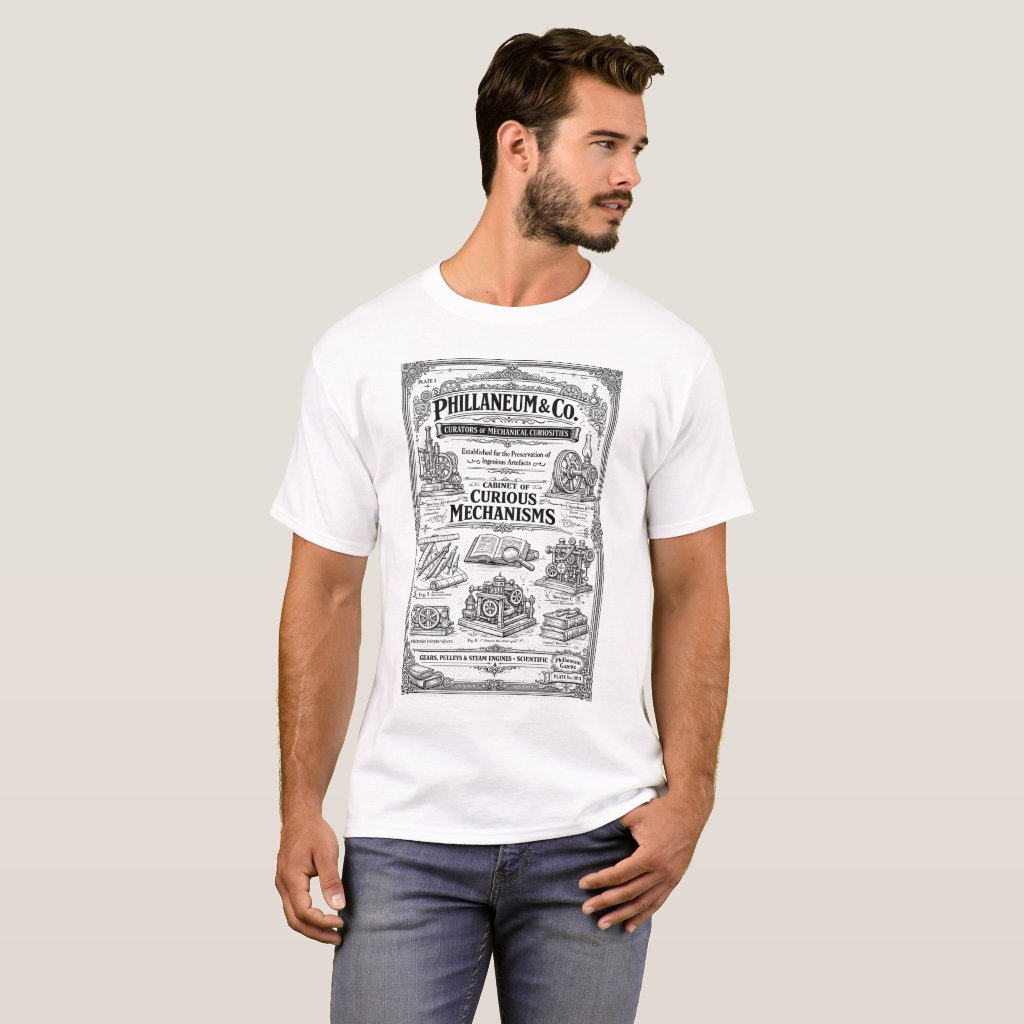
Cabinet of Curious Mechanisms T-Shirt View at our Zazzle Store
New Additions to the Collection


Changes on the Estate


Marginalia
Person of Letters
- Meaning
- A writer engaged in letters as a cultivated pursuit, guided by curiosity and reflection rather than commercial necessity or public demand.
- When used
- Used when describing an individual who writes with intellectual independence, often observing culture, society, or artefacts without being driven by the pressures of the marketplace.
- Pronunciation (Australian English)
- /ˈpɜː.sən əv ˈlɛt.əz/ “PER-suhn uhv LET-uhz”
- In a sentence
- He approached the archive not as a marketer, but as a person of letters, reading each advertisement as a fragment of thought from another age.
- Why use it (rather than “writer” or “author”)
-
- Person of Letters conveys independence, cultural awareness, and a reflective approach to writing.
- Writer is broad and neutral, offering no insight into motive or disposition.
- Author implies publication and output, but not necessarily intellectual stance or detachment from commerce.
- Phillaneum note
- In the study of vintage advertising, the person of letters does not seek to be persuaded, but to understand—treating each notice not as instruction, but as evidence of how a previous age reasoned, desired, and presented its world.
Curiosities from Abroad
These selections extend the study beyond the Cabinet, offering external sources that reward the same careful reading applied in this issue. Each link has been chosen not for novelty, but for its ability to reveal how advertising operates within a broader system—across different periods, regions, and forms. Taken together, they provide a wider field of observation, where the patterns of persuasion, structure, and communication can be traced with greater clarity. The reader is invited to explore them not as diversions, but as working material.
- The Conversion Path – Designing What Happens Next – A modern articulation of how attention is guided to action, revealing that the systems of persuasion seen in the 1890s remain structurally intact today.
- Library of Congress – Consumer Advertising During the Great Depression – A focused guide to advertising between 1929 and 1933, showing how persuasion adapted to economic strain, regulation, and shifting social conditions.
- New York Public Library – The New-York Directory and Almanack – An early commercial reference blending directory, currency tables, and practical data, demonstrating how information itself functioned as structured advertising.
- Trove – Advertising Australia (Public List) – A curated collection of Australian advertisements revealing local styles and techniques, offering insight into how persuasion evolved within a national context.
Numerical Curiosities
28 ◆ 7 ◆ 86 ◆ 1 ◆ 24
Selected from the seed of this issue. Determined by rule, not by omen.
Recreations
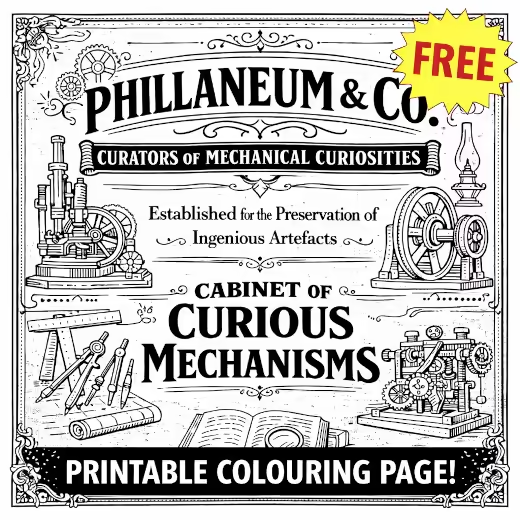
(free download, no registration required)
The Maker's Ledger
A few notes from the workshop: what's been fixed, improved, or learned on the road to keeping this site fast, useful, and brimming with curiosities.
- Numerical Curiosities and the Use of the Issue Seed
- This issue introduces a small numerical curiosity, presented as a set of five favoured numbers. They are not chosen, nor are they random in the usual sense. They are procedurally generated from the issue number itself, in this case 004, using a fixed method. The same issue will always produce the same set. In this way, the numbers belong to the edition as much as any article or artefact. The decision to use a seeded method rather than chance is deliberate. It reflects a Victorian confidence in systems, in repeatable processes, and in the idea that order can be derived from rule. Where a purely random selection would feel arbitrary, this approach produces a result that is both constrained and reproducible. It can be inspected, repeated, and trusted to behave consistently. It is a modest feature, but a telling one. The Cabinet has always been concerned with the arrangement of things as much as their collection. Here, mathematics provides the arrangement. The numbers are not meaningful in themselves, but in their method of selection they echo a period that increasingly looked to science and calculation as a way of understanding and curating the world. The numbers do not claim meaning. The method does.
- On Privacy, Disclosure, and the Modern Visitor
- A new Privacy and Data Statement has been introduced across the site. Its inclusion arises not from regulation alone, but from observation. Recent patterns in automated bot traffic, indexing behaviour, and machine readership have made it increasingly clear that even a modest cabinet such as this is subject to forms of inspection unknown to earlier ages. In response, the decision has been made to state plainly how the site operates. No personal data is collected, no tracking apparatus is employed beyond that required for basic function, and no attempt is made to follow the visitor beyond the bounds of the page. The intention is not merely compliance, but clarity. There is, perhaps, a historical echo in this. The Victorian advertiser, so often studied in these pages, worked to establish trust through visible claims: guarantees of manufacture, statements of origin, assurances of quality. In a similar spirit, the modern site must declare its terms of engagement. Where once it was the product that required explanation, now it is the system that delivers it. It is a small addition to the structure of the site, but an important one. If the Cabinet is to remain a place of quiet study, it must also be a place where the terms of entry are understood. The visitor is not the product. The page is the offering.
At the Next Gathering
At our next gathering, the Cabinet turns from the grand furniture of the room to the quiet details that often pass unnoticed. The Phillaneum Gazette 005 – Decorative Furniture Panels will explore the carved, pressed, painted, and inlaid panels that transformed ordinary cabinets, sideboards, gramophones, and parlour furnishings into works of domestic art.