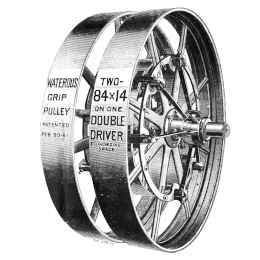
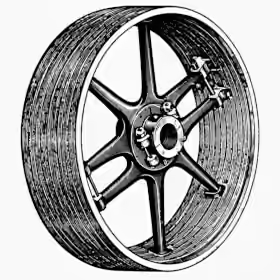
Dodge Patent Wood Split Pulleys
ENGINEER AND INVENTOR | April 1893
Our Dodge Patent Wood Split Pulley T-shirt remasters the wonderful 1893 advertisement that inspired this article, preserving its period typography and distinctive pulley engraving. It is wearable industrial history for engineers, machinists and vintage machinery enthusiasts — and purchasing one helps support Phillaneum.
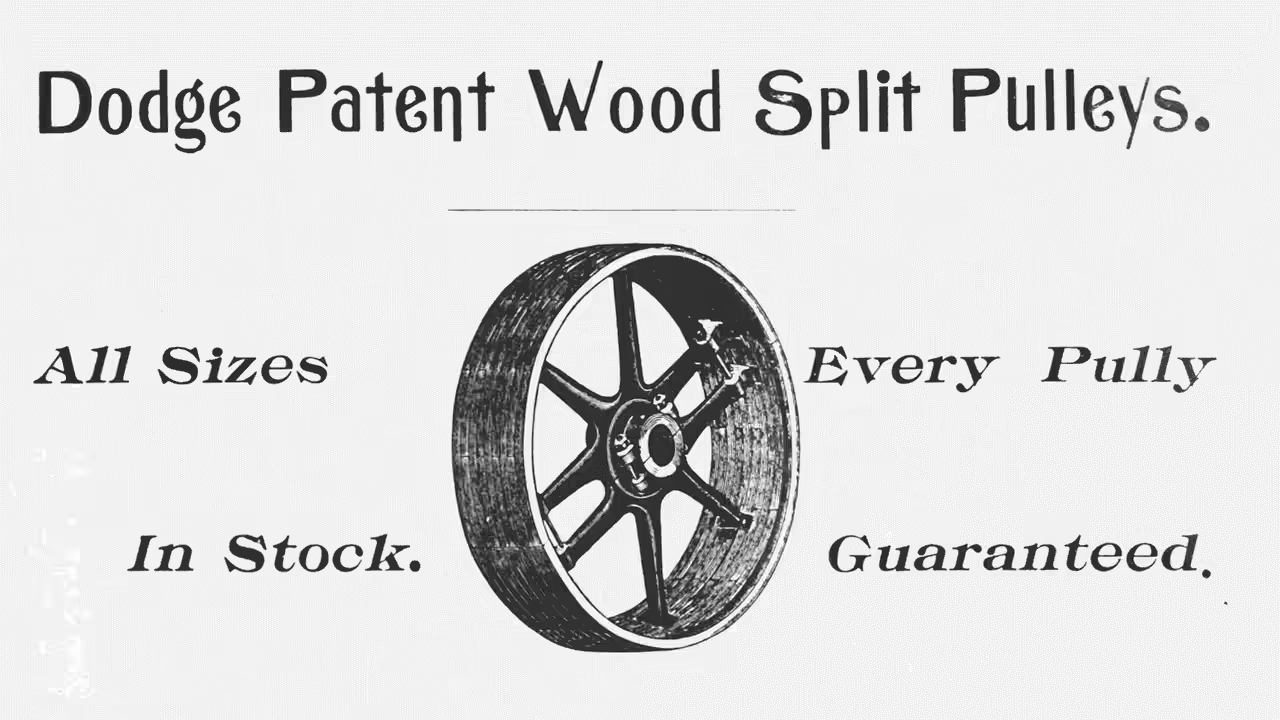
This advertisement for Dodge Patent Wood Split Pulleys, published in the April 1893 issue of Engineer and Inventor, represents a mature moment in the industrial supply economy of the late nineteenth century. The pulley illustrated is a split wooden design, engineered so that it could be assembled directly onto an existing shaft without dismantling surrounding machinery. In an era dominated by line shaft power systems, where a single engine distributed motion throughout an entire workshop via belts and rotating shafts, such practical innovations were essential. A failed or poorly fitted pulley could halt production across multiple machines, making reliability and ease of installation critical considerations.
The use of the term “patent” signals more than a technical feature. By the 1890s, patent systems were firmly embedded within industrial practice, supported by a growing profession of patent attorneys, agents, and technical consultants. Manufacturers actively patented incremental improvements in materials, fastening methods, and balancing techniques, using these protections both defensively and as a mark of credibility in the marketplace. To the Victorian reader, the word “patent” conveyed not only legal protection but also an assurance of tested ingenuity and recognised innovation.
The advertisement’s language is notable for its emphasis on availability rather than technical specification. Phrases such as “All Sizes In Stock” and “Every Pulley Guaranteed” point to a transition from bespoke workshop fabrication to standardised, catalogue-based supply. By this period, industrial firms maintained large inventories of interchangeable components, enabling rapid fulfilment across expanding railway and shipping networks. At the same time, the mention of custom or special pulleys acknowledges the persistent variability of workshop layouts, where each installation required careful adaptation to local conditions.
The choice of wood as a material is also revealing. Wooden pulleys were lighter than their cast iron counterparts, imposed less strain on shafting, and were often quieter in operation. They could be manufactured with precision laminations and were less prone to catastrophic failure, an important safety consideration in busy workshops. The split construction further reduced downtime, allowing maintenance or upgrades without disassembling entire drive systems.
Visually, the advertisement reflects the restrained clarity of late Victorian technical publishing. A single, well-rendered engraving of the pulley is set against confident but economical text. There is no excess ornamentation. Instead, the design communicates reliability, stock readiness, and industrial competence. This balance between image and claim mirrors the expectations of its readership: engineers, machinists, and workshop owners who valued directness and practical assurance over flourish.
As an artefact, this advertisement captures a moment when industrialisation had moved beyond experimentation into systems thinking. It speaks not only to the object itself but to the infrastructure surrounding it: patent law, supply chains, standardisation, and the daily realities of mechanical power distribution. In doing so, it offers a concise but vivid insight into how even a seemingly modest component formed part of the broader machinery of the Victorian industrial world.
Wallace H. Dodge founded the Dodge Manufacturing Company in Mishawaka, Indiana, in 1878, initially producing wooden products including wagon jacks. In 1880, the company relocated to premises that would become its established manufacturing site. On 4 July 1882, Dodge and fellow inventor George Philion received US Patent No. 260,462 for an improved separable pulley. Their design incorporated interchangeable bushings, allowing pulleys to be securely fitted to shafts of different diameters. By the time this advertisement appeared in 1893, the wood split pulley had developed from a patented engineering innovation into a commercially established industrial component. [1]
This 1893 advertisement for Dodge wood split pulleys is brief, but it reveals a great deal about the industrial environment it served. Workshops of the period depended on line shaft systems, where power was distributed by belts and pulleys from a central engine. In such systems, reliability and availability of components were essential. A pulley was not a minor fitting. It was part of the mechanical bloodstream of the workshop.
What stands out is the emphasis on stock and readiness. The claim of thousands of pulleys available for immediate shipment suggests a mature supply network. Industry had moved beyond bespoke fabrication toward standardised components held in inventory. At the same time, the promise of special designs on short notice acknowledges that no two workshops were identical. Standardisation and customisation existed side by side.
There is also a quiet confidence in the language. Guaranteed supply. Every pulley available. These are not technical claims but commercial ones. They reflect an industry where logistics, responsiveness, and trust in suppliers were becoming as important as engineering itself. This small advertisement captures that shift with clarity.
A wood split pulley is a pulley made in sections so it could be fitted to a shaft more easily than a solid pulley.
Wood split pulleys were typically lighter and easier to install on existing shaft systems, while metal pulleys were often heavier and more rigid.
Custom pulley design mattered because workshops and factories used many different shaft layouts, belt widths, and machinery arrangements.
Pulleys were used in line shaft systems to transfer power by belt from a central engine to individual workshop machines.
The following articles extend or reflect the ideas explored here, returning to similar questions through different materials, contexts, and lines of inquiry.
This article presents a curated extract and editorial interpretation of material originally published in Engineer and Inventor, April 1893. The content reflects the language, assumptions, and technical understanding of its time. While care has been taken to preserve the original context, minor formatting and presentation changes have been made. Readers seeking deeper technical accuracy or historical verification should consult primary sources and period engineering references.