What is a Wood Split Pulley and what did it do?
·Revised

While reading the April 1893 edition of Engineer and Inventor, I came across an advertisement for Dodge Patent Wood Split Pulleys. The advertisement is wonderfully direct: a large wooden pulley sits in the centre, surrounded by the claims “All Sizes In Stock” and “Every Pulley Guaranteed.” To the engineers and workshop owners reading the magazine in 1893, its purpose may have been obvious. To a modern reader, however, it raises a more fundamental question: what exactly was a wood split pulley, and what did it do?
The answer takes us into the world of the line-shaft workshop, where one source of power could operate an entire room full of machinery.
Power before every machine had its own motor
Today we expect a lathe, drill press, saw or milling machine to contain its own electric motor. Switch on the machine and its motor supplies the power.
A nineteenth-century workshop could operate very differently. A steam engine, waterwheel or other source of mechanical power drove a long rotating shaft running through the workshop, often suspended overhead. This was the line shaft.
Pulleys were mounted at intervals along this shaft. Leather belts ran from these pulleys down to corresponding pulleys on individual machines. As the line shaft rotated, its pulleys moved the belts; the belts rotated the pulleys on the machines; and the machinery operated.
The power path was therefore quite simple:
Power source → line shaft → pulley → leather belt → machine pulley → machine drive shaft.
One rotating shaft could consequently distribute mechanical power to numerous machines throughout a workshop.
So what was a wood split pulley?
A wood split pulley was a belt pulley constructed principally from wood and divided into two separable halves. When assembled, it looked and operated much like an ordinary pulley. The important difference became apparent when it was installed.
Instead of sliding the pulley onto the end of a shaft, the two halves could be positioned around an existing shaft and fastened together.
This explains the seemingly peculiar name. It was a wood pulley because its principal structure and belt-running surface were made from wood. It was a split pulley because the wheel, hub and associated structure were divided so that the pulley could be separated and assembled around the shaft.
The Dodge and Philion separable-pulley design illustrates the principle particularly well. Its wooden pulley was made in sections, with the completed pulley separating into two halves. Bolts held the halves together, while the hub arrangement clamped the pulley onto the shaft. Split removable thimbles could also be used to adapt a pulley to shafts of different diameters.
Why split the pulley?
Imagine an established workshop line shaft. It may run for much of the length of the building, supported by numerous bearings and hangers. Other pulleys are already attached to it, with machinery positioned beneath.
Now imagine that another pulley has to be added halfway along that shaft.
With a conventional solid pulley, the central hole has to pass over the shaft. That normally means approaching from an exposed end. Bearings, hangers and other pulleys may therefore have to be removed before the new pulley can be moved along the shaft to the required position.
The split pulley approached the problem from another direction.
Instead of taking the shaft apart to fit the pulley, take the pulley apart to fit the shaft.
The two halves could be brought together around the shaft at approximately the position where the pulley was required. The fasteners were then tightened, causing the hub to grip the shaft. The completed pulley rotated with the shaft and its outer wooden rim carried the leather drive belt.
That belt could then transmit the rotation to a pulley on the drive shaft of the machine below.
Why make a pulley from wood?
Wood may seem an unusual material for power-transmission equipment when viewed from the twenty-first century, but wooden pulleys offered useful characteristics for line-shaft installations.
They could be considerably lighter than equivalent cast-iron pulleys. This mattered when a long overhead shaft might carry many pulleys while itself being supported by bearings and hangers. Less rotating mass and less weight hanging from the shaft were useful attributes.
Wooden pulleys could also be manufactured from assembled and laminated sections rather than requiring a large metal casting. Contemporary designs demonstrate that these were engineered industrial components rather than improvised wooden wheels. The Dodge and Philion patent, for example, describes rings built from wooden segments together with divided hub and spoke structures specifically intended to form a separable pulley.
The advantages of the wood split pulley
The greatest advantage was installation and maintenance. A pulley could be added, removed or repositioned without necessarily dismantling a substantial section of line shaft.
That flexibility became especially valuable in a working factory. Machinery was replaced, production layouts changed, pulleys wore out and workshops expanded. A line-shaft installation was therefore not necessarily a permanent arrangement that remained untouched after construction.
The separable design could also provide adaptability. The Dodge and Philion system used removable split thimbles that could accommodate different shaft sizes. Contemporary patent litigation describes the design as capable of being adapted to shafts of different diameters and configured for fast or loose pulley applications.
Wood also offered the advantage of lower weight compared with many metal alternatives, reducing the burden placed on an already extensive shafting system.
There were disadvantages too
A wood split pulley was not a universal solution. Wood is affected by moisture, temperature, wear and age in ways that metal is not. A pulley assembled from wooden segments also depended upon sound construction, accurate alignment and secure fastening.
Balance was particularly important. A pulley rotating at speed needed to run true. Poor manufacture, damage or deterioration could introduce vibration into the shafting and belt system.
The split construction introduced another engineering requirement: a component deliberately designed to come apart for installation had to behave as a rigid component once installed. Its fasteners, hub and mating surfaces therefore had important work to do.
This helps explain why seemingly simple wooden pulleys generated patents and even patent litigation. The broad idea of a wooden pulley was not itself novel. The engineering value lay in how the pulley was constructed, divided, clamped and adapted to the shaft.
A small component in a much larger system
Looking again at the 1893 Dodge Patent Wood Split Pulleys advertisement, its confidence makes considerably more sense.
“All Sizes In Stock” was not simply advertising exuberance. A workshop dependent upon line-shaft power needed pulleys of different sizes for different machines, belt speeds and installations. A replacement or additional pulley was part of the infrastructure that kept the workshop operating.
The wood split pulley solved a particularly awkward problem within that infrastructure. It allowed a pulley to be fitted around a shaft that was already installed. Once clamped in place, the rotating shaft drove the pulley, the pulley moved its leather belt, and the belt transmitted power to the machinery below.
It is a modest piece of engineering, but that modesty disguises its importance. In the age of line-shaft power, the workshop was not a collection of independent powered machines. It was an interconnected mechanical system. Changing one component could affect the arrangement around it.
The split pulley made that system easier to alter, maintain and expand.
From the pulley to the workshop
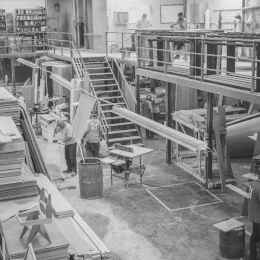
Understanding the wood split pulley also changes the way we look at nineteenth-century workshop photographs. The shafts overhead, the pulleys attached to them and the long leather belts disappearing towards individual machines were not incidental clutter. Together they formed the workshop's power-distribution network.
And that creates another question. If machines depended upon belts running from an overhead shaft, where could the machines actually be placed?
That takes us from one component to the organisation of the entire workshop.
Continue reading: Locating tools in a workshop.
From the Curator's Workshop
Our Dodge Patent Wood Split Pulley T-shirt remasters the wonderful 1893 advertisement that inspired this article, preserving its period typography and distinctive pulley engraving. It is wearable industrial history for engineers, machinists and vintage machinery enthusiasts — and purchasing one helps support Phillaneum.

Author's Notes
Notes & Memoranda
As is often the case, the subject extends beyond the bounds of a single article. The notes and memoranda below gather together useful definitions, related observations, references, and occasional curiosities discovered along the way.
How were wooden split pulleys constructed?
Wood split pulleys were carefully engineered assemblies rather than ordinary wooden wheels cut in half. Their construction required the two sections to form a strong, accurately aligned rotating component while remaining separable for installation.
An 1888 patent by William R. Fee described a pulley built from semicircular wooden boards, arranged in overlapping layers at right angles. Additional wooden segments formed the hub and outer rim. The overlapping joints helped the assembled halves behave as a complete wheel, while tapered split bushings secured the pulley around its shaft.
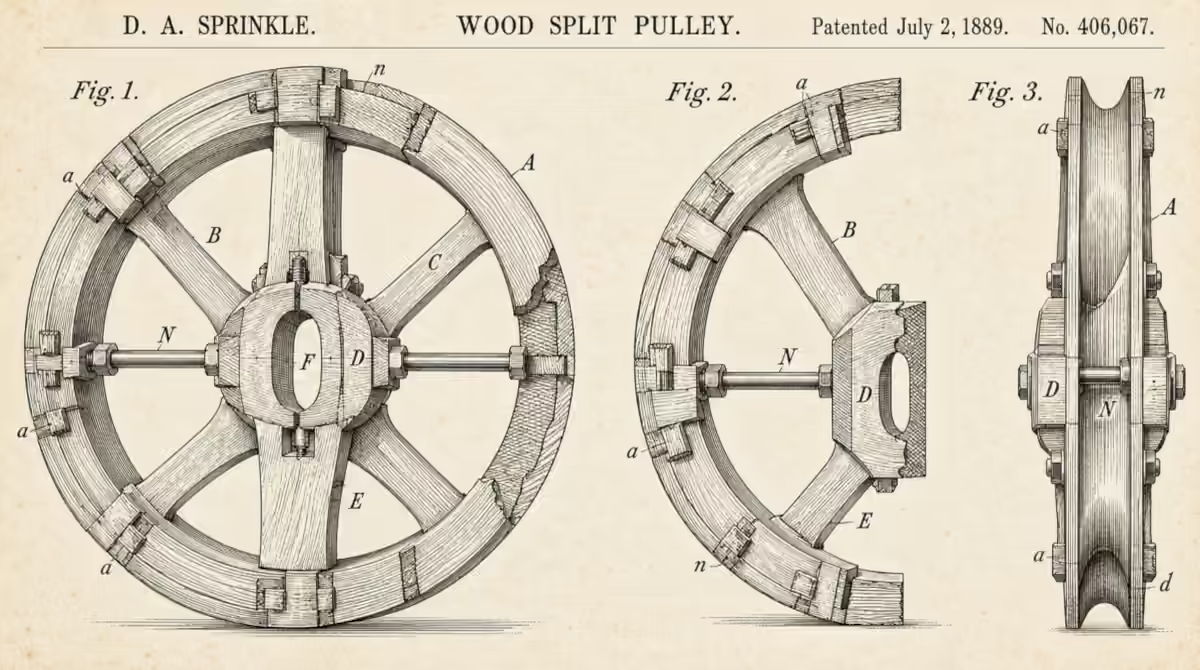
A different approach appeared in David A. Sprinkle's 1889 patent. His design employed wooden rim sections joined by dowel blocks and tongue-and-groove connections. Dovetailed arms, wedges, stay-rods and connecting bolts reinforced the assembly, while a divided hub gripped the shaft as the bolts were tightened.
These competing designs reveal the ingenuity behind a seemingly simple component. The challenge was not merely making a wooden wheel that could be opened, but ensuring that its joints, rim and hub remained secure under continuous rotation.
Further Reading…



References and Further Reading
- David A. Sprinkle, “Wood Split Pulley,” U.S. Patent No. 406,067 (1889), Google Patents: https://patents.google.com/patent/US406067A/en
- Menasha Wood Split Pulley Co. v. Dodge, 85 F. 971 (7th Cir. 1897), Federal Reporter scan: https://law.resource.org/pub/us/case/reporter/F/0085/0085.f1.0971.pdf
- “How to Make a Simple Split Pulley,” Scientific American, November 2, 1901: https://www.scientificamerican.com/article/how-to-make-a-simple-split-pulley/
- “Dodge Patent Wood Split Pulleys,” Engineer and Inventor, April 1893, Phillaneum exhibit page: https://phillaneum.com/book/eai/dodge-wood-split-pulley.html
- National Park Service, “III. Line Shaft Drive,” technical history of shaft-driven shop power: https://www.osti.gov/servlets/purl/6774921/
- Wikisource, “Pulley,” from the 1911 Encyclopædia Britannica: https://en.wikisource.org/wiki/1911_Encyclop%C3%A6dia_Britannica/Pulley
- Dodge Manufacturing Company, advertisement for Dodge Patent Wood Split Pulleys, The Canadian Manufacturer (1889), including contemporary claims for pulley sizes, weight savings, power transmission, production capacity and number of pulleys in use.
- William R. Fee, Wood Split Pulley, US Patent No. 393,326 , 20 November 1888.
- David A. Sprinkle, Wood Split Pulley, US Patent No. 406,067 , 2 July 1889.
Disclosure
This article provides a historical and technical interpretation of wood split pulleys based on period advertisements, patents and engineering sources. Designs and operating arrangements varied between manufacturers, workshops and applications.