Would Victorian Makers Recognise Today's Maker Movement?
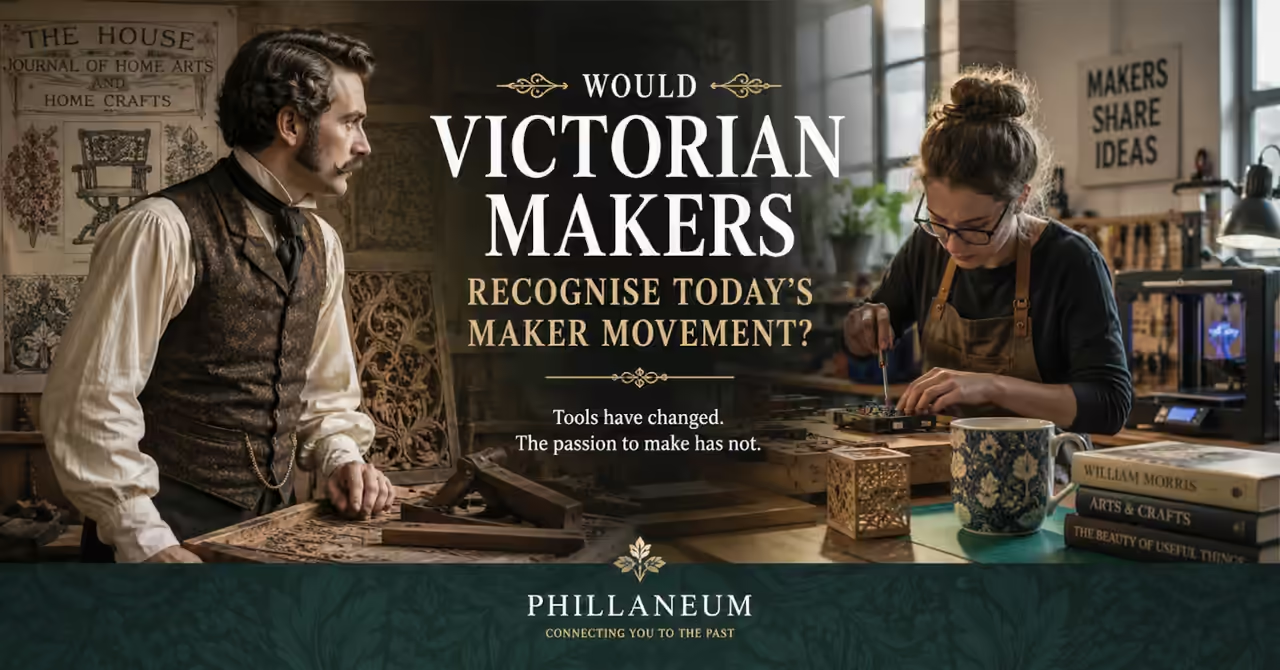
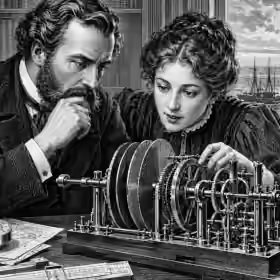
Imagine bringing a Victorian woodworker, embroiderer or amateur inventor into a modern makerspace.
The first few minutes would probably be bewildering. A laser cuts timber without a visible blade. A plastic component slowly appears inside a 3D printer. Someone draws an object on a computer and, moments later, sends instructions to a machine across the room. Another person is wiring together a tiny programmable circuit.
But ignore the machinery for a moment and watch the people.
Someone is designing something. Someone else is repairing something. A beginner is asking for advice. Another maker is examining a prototype that did not quite work and deciding what to change before trying again.
That part might look remarkably familiar.
Making Was Already a Culture
Victorians certainly did not have a “maker movement” in the modern sense, but making was already surrounded by a culture of practical knowledge, instruction and exchange.
Craft journals from the period did more than display attractive finished objects. They taught readers how to make things. Phillaneum's own collection of The House, a journal of home arts and crafts from 1902, contains lessons in leatherwork and woodcarving, embroidery, metalwork, furniture designs, practical patterns, competitions and illustrated answers to readers' questions.
The important point is not simply that Victorians made things. That would hardly be surprising.
It is that making created communities of knowledge.
People learned techniques from other people. They encountered new tools and materials. They studied designs, copied patterns, modified ideas and compared their own work with that of other makers. A beginner did not necessarily need formal training before attempting something new; practical instruction could arrive through a magazine, school, exhibition or knowledgeable acquaintance.
That sounds rather familiar.
The Victorian Internet Was Made of Paper
A modern maker who decides to build something can move through a remarkably efficient chain of knowledge. They might watch a tutorial, download a plan, ask a question in an online community, build the object and then share the finished result with other makers.
A Victorian maker worked much more slowly, but the underlying pattern could be surprisingly similar.
They might discover a project in a journal, obtain a printed pattern, read instructions, write to a correspondence column for advice and eventually show their work at a local exhibition or enter it in a competition.
The systems were not equivalent. The internet provides extraordinary speed, access and reach that no Victorian publication network could approach.
But some of the functions are recognisable.
Victorian craft journals distributed instructions, ideas, opinions, patterns, advertisements and examples of other people's work. Correspondence columns allowed readers to ask questions. Exhibitions showed what other makers were producing. Schools and societies created places where techniques could be demonstrated and discussed.
The maker network already existed.
It was simply made of paper, post, workshops and meeting rooms rather than fibre-optic cable.
Then Show Them a Laser Cutter
This is where the resemblance begins to break down.
A Victorian maker might understand very quickly why somebody wanted to make a decorative box, piece of furniture, embroidered panel or mechanical device. The astonishing part would be the capability now available to an ordinary enthusiast.
A modern amateur can design an object with computer software, manufacture it to extraordinary precision, alter the design in minutes and send that design to another maker on the opposite side of the world.
That raises a more difficult question: how much of making must actually be done by the maker?
A hand-carved timber panel is easy to recognise as craftsmanship. What about a panel designed by its owner but cut by a CNC router? What about a component produced by a 3D printer? And what if the maker merely downloads somebody else's design and presses the button?
Some Victorian Arts and Crafts thinkers would probably have had strong opinions about this distinction. William Morris, in particular, argued for meaningful work, good materials and a close relationship between the maker and the object being produced.
He might admire the independence of the modern makerspace while questioning whether every machine-made object emerging from it deserves to be called craft.
Perhaps We're the Ones Who Would Be Surprised
So, would Victorian makers recognise today's maker movement?
Almost certainly.
They would not recognise many of our machines, materials or digital tools. They might be astonished by the precision available to amateurs and completely overwhelmed by the speed at which knowledge now travels.
But they would recognise the person standing beside a workbench saying, “I wonder if I could make this myself.”
They would recognise the fascination with tools, the satisfaction of learning a difficult skill, the annoyance of a first failed attempt and the pleasure of finally producing something that works.
They would recognise people teaching one another, exchanging designs and discovering better ways of doing things.
Perhaps the greater surprise would be ours.
For many Victorians, making, repairing, altering and learning practical skills were not necessarily part of a special movement. They were ordinary elements of domestic life, work, education and recreation.
We tend to describe the maker movement as something enabled by 3D printers, open-source electronics and digital fabrication.
A Victorian visitor might see something older beneath all that machinery.
They might not ask why we have makerspaces.
They might ask why we ever stopped needing them.
From the Curator's Workshop
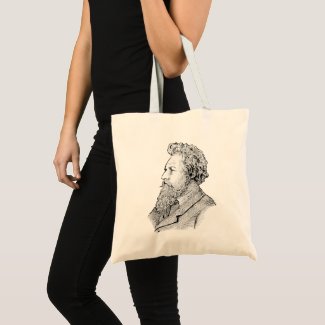
If William Morris had been offered a tote bag, we suspect he would at least have appreciated the idea of a useful object made beautiful. Our William Morris tote bag brings one of the great names of the Arts and Crafts movement into that most practical of modern objects: something made to be used, carried and seen. If this article has left you wondering what Victorian makers might recognise in our own age, take a little of their design philosophy with you, and support Phillaneum while you're at it.
Author's Notes
Notes & Memoranda
As is often the case, the subject extends beyond the bounds of a single article. The notes and memoranda below gather together useful definitions, related observations, references, and occasional curiosities discovered along the way.
Glossary
Some of the terms used in this article have specialised, historical or technical meanings. This glossary provides additional context for selected terms and ideas.
- Makerspace
- A shared workshop where people bring projects, tools and skills to work side-by-side; modern makerspaces typically provide access to specialised equipment (laser cutters, 3D printers, soldering gear) and emphasise open learning, collaboration and affordable access to machinery that would be costly for an individual to own.
- 3D printer
- An additive-manufacturing machine that builds three‑dimensional objects from a digital design by depositing material in successive layers (commonly thermoplastic filament or resin); it lets hobbyists rapidly prototype complex shapes, iterate designs quickly and produce parts that would be difficult or impossible to make by traditional hand tools.
- CNC router
- A computer‑numerical‑control cutting machine that removes material with a rotating bit to shape wood, plastic or metal; unlike 3D printing (additive) it is a subtractive process, prized for precise edging, panels and repeatable joinery in woodworking, and important for understanding how digital patterns translate into traditional materials.
- Arts and Crafts movement
- A late‑19th‑century design and social movement that reacted against industrial mass production by championing traditional craftsmanship, honest materials, decorative handwork and the integration of design with labour; it carried both aesthetic goals and social criticism, arguing that meaningful, well‑made work improved life and communities.
- Correspondence column
- A newspaper or magazine feature in which readers wrote questions, described problems or shared tips and received printed replies, functioning as a slow but wide‑reaching advice network that spread practical techniques, patterns and troubleshooting long before telephones or the internet made real‑time peer support possible.
Frequently asked questions
Curious about something you’ve just read? These frequently asked questions explore some of the key ideas, details and questions surrounding the topic.
In what ways were Victorian makers similar to modern makers?
Victorian makers formed communities of knowledge by sharing techniques, patterns and advice through craft journals, correspondence columns, schools, societies and exhibitions, and they learned by copying, modifying and comparing work much like modern makers do.
How did Victorian makers find instructions and get help without the internet?
They relied on craft journals that published lessons and patterns, wrote to correspondence columns for advice, used printed patterns, and met through schools, societies, workshops and local exhibitions supported by post and paper networks.
What aspects of modern makerspaces would most surprise a Victorian maker?
Victorian makers would be astonished by the unfamiliar machines, materials and digital tools, the extraordinary precision available to amateurs, and the speed at which designs and knowledge now travel.
Would machine-made or digitally produced objects be considered 'craft' by Victorian standards?
Some Victorian Arts and Crafts thinkers, notably William Morris, emphasized meaningful work, good materials and a close relationship between maker and object, so they might admire modern makerspaces' independence while questioning whether objects made largely by machines deserve to be called craft.
Further Reading…
Disclosure
This article is an interpretive comparison rather than a claim that the Victorian Arts and Crafts movement and today's maker movement are historically equivalent. Victorian makers held diverse views about craft, technology and industry, and the imagined reactions described here are intended to explore similarities and differences between two making cultures separated by more than a century.