5 famous artefacts from the 1800s that are lost forever
History is filled with celebrated objects that have somehow survived fire, revolution, shipwreck and centuries of careless handling. Yet survival is never guaranteed. Some creations once admired by thousands have disappeared so completely that all we have left are photographs, reproductions and written descriptions.
The nineteenth century was especially good at producing remarkable things. It gave us vast exhibition halls, revolutionary paintings, jewelled curiosities and ambitious books written entirely by hand. Unfortunately, the century’s treasures were also vulnerable to house fires, war, poor storage and simple human error.
Here are five famous artefacts from the 1800s that can no longer be seen in their original form. Each was real, admired and historically important. Each is now lost forever.
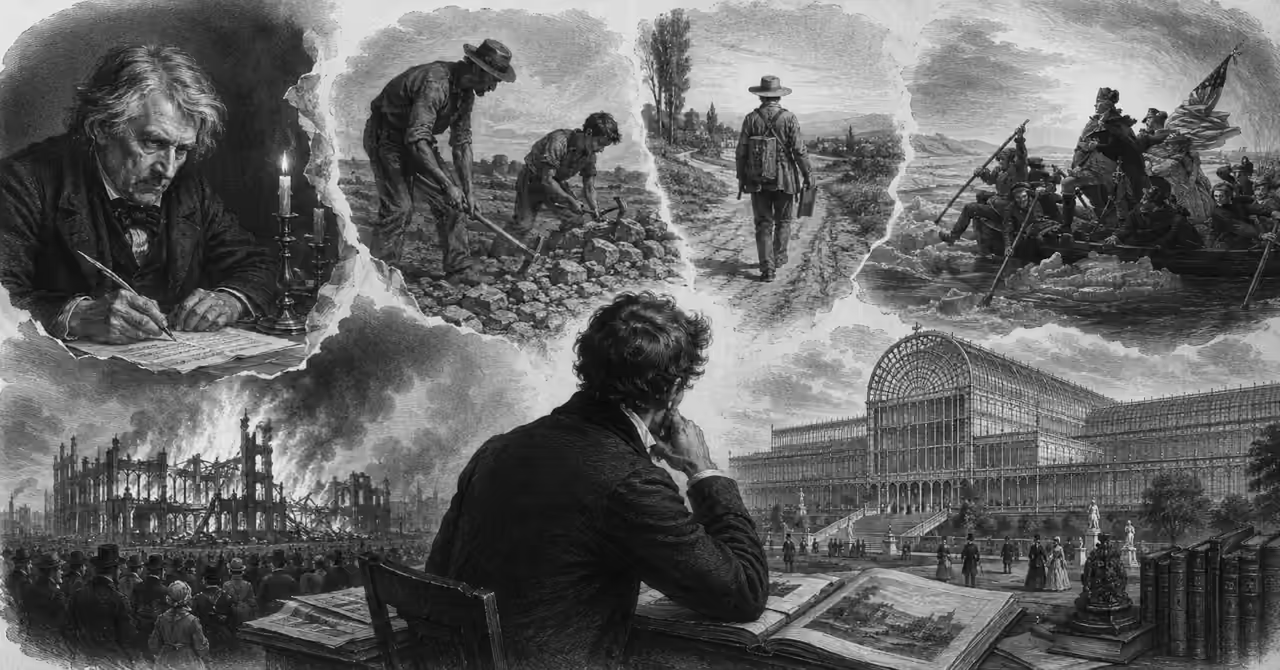
1. Thomas Carlyle’s Burned Manuscript of The French Revolution
Imagine spending months writing a book by hand, lending the only manuscript to a trusted friend—and discovering that it has been used to light a household fire.
That was the nightmare faced by Scottish writer Thomas Carlyle in 1835. Carlyle had completed the first volume of his history of the French Revolution and given it to philosopher John Stuart Mill for comment. Somewhere in Mill’s household, the manuscript was mistaken for wastepaper. A servant reportedly fed most of it into the fire.
There was no backup file, photocopy or second draft. Carlyle’s handwritten pages, containing the results of months of reading and composition, had simply ceased to exist.
Mill was horrified and offered financial compensation. Carlyle initially responded with remarkable restraint, but he still had to begin the volume again. The published book became one of the great works of Victorian historical writing, admired for its dramatic, almost cinematic style.
The lost manuscript remains fascinating because it would have allowed scholars to compare Carlyle’s first thoughts with the version he painfully reconstructed. The finished book survived, but the original path his imagination took through the Revolution was burned away in an ordinary domestic fireplace.
2. Gustave Courbet’s The Stone Breakers
When Gustave Courbet exhibited The Stone Breakers in 1850, audiences were confronted with something they were not accustomed to seeing on such a grand scale: two anonymous labourers doing exhausting manual work.
Painted in 1849, the enormous canvas showed an older man and a younger boy breaking stones beside a road. Their clothing was torn, their faces were obscured and there was nothing heroic about their labour. Courbet gave poor rural workers the physical scale normally reserved for kings, generals and religious figures.
The painting became one of the defining images of nineteenth-century Realism. Rather than beautifying poverty, it made viewers look directly at bodies worn down by work.
The original eventually entered the collection of the Gemäldegalerie in Dresden. During the Second World War, it was moved for protection. In February 1945, the vehicle carrying it and other paintings was reportedly destroyed during the bombing of Dresden.
Reproductions preserve the composition, but they cannot reproduce the surface of the canvas, Courbet’s rough brushwork or the physical impact of standing before a work more than two and a half metres wide. A painting created to make labour impossible to ignore is now itself visible only at a distance, through copies.
3. The First Washington Crossing the Delaware
Emanuel Leutze’s Washington Crossing the Delaware is one of the best-known historical paintings in the United States. George Washington stands upright in a crowded boat while soldiers struggle through an icy river beneath a dramatic dawn sky.
The enormous version displayed at the Metropolitan Museum of Art is not, however, Leutze’s first attempt.
The German-American artist completed an earlier version in 1850. Before it could establish its reputation, the painting was damaged by fire in his studio. It was restored and acquired by the Kunsthalle Bremen in Germany, where it remained for decades.
Then, in 1942, an Allied air raid destroyed it.
Fortunately, Leutze had painted a second full-sized version in 1851. That surviving canvas became the familiar image reproduced in textbooks, advertisements, political cartoons and popular culture. Without it, one of America’s most recognisable national images might be known only from sketches and written accounts.
The destruction of the first painting raises an intriguing question. How closely did the two versions really match? Small changes in colour, expression and detail may have altered the mood of the scene. We know what Leutze’s famous composition looked like, but we can no longer stand before his original solution.
4. Van Gogh’s The Painter on the Road to Tarascon
Vincent van Gogh painted The Painter on the Road to Tarascon in 1888 while working in the intense southern light of Arles.
The picture showed a solitary artist walking along a road with his equipment, straw hat and supplies. The figure is generally understood to be Van Gogh himself, although his face is largely hidden. His shadow stretches beside him, making the scene feel both cheerful and strangely lonely.
The painting later entered the Kaiser-Friedrich Museum in Magdeburg, Germany. During the Second World War, it was moved to a salt mine for protection. It disappeared in 1945 and is generally believed to have been destroyed by fire, although its precise fate has never been proved beyond all doubt.
Its loss is particularly poignant because Van Gogh sold little during his lifetime. Works now treated as priceless masterpieces were once stacked, traded, stored badly or regarded as inconvenient possessions.
Colour reproductions allow us to recognise the walking figure, but they cannot tell us exactly how the original paint caught the light. We have the image, yet the physical object touched by Van Gogh’s brush is gone.
5. The Crystal Palace
Not every lost artefact could hang on a wall or fit inside a cabinet. Some were large enough to contain entire exhibitions.
Joseph Paxton’s Crystal Palace was created for the Great Exhibition of 1851 in London’s Hyde Park. Constructed from iron, timber and hundreds of thousands of panes of glass, it looked less like a conventional building than a gigantic transparent machine.
Inside, visitors encountered industrial machinery, decorative arts, furniture, textiles and curiosities from across the world. More than six million people attended the exhibition, making the building itself one of the most famous creations of Victorian Britain.
After the exhibition, the structure was dismantled and rebuilt in an expanded form at Sydenham in South London. It became an entertainment and educational complex filled with courts, displays, gardens and performances.
On 30 November 1936, a fire took hold. Fanned by strong winds and fed by dry timber, it overwhelmed hundreds of firefighters. Crowds watched as the glowing structure illuminated the night sky. Within hours, the great palace had been reduced to ruins.
The surviving terraces, statues and park landscape provide hints of its scale, but the experience of entering that vast glass interior has vanished. The building that once promised a brilliant industrial future became one of the most spectacular architectural losses of the modern age.
When the Object Disappears but the Story Survives
These lost artefacts remind us that fame offers no protection against accident. A servant can mistake a manuscript for scrap paper. A railway vehicle can carry a masterpiece directly into a bombing raid. An exhibition palace admired by millions can disappear in a single night.
Yet an artefact does not vanish completely while its story continues to be told. Copies, photographs and eyewitness accounts preserve enough for us to imagine what has been lost—and perhaps to value more carefully what remains.
Phillaneum explores the overlooked objects, ideas and personalities of the Victorian world, from ambitious machines to the artists who believed everyday surroundings should contain beauty. Continue through the collection and discover how the nineteenth century still shapes the things we build, admire and use today.
From the Curator's Workshop
If you enjoyed discovering the remarkable objects the nineteenth century created—and the stories that survived when the objects themselves did not—carry a little of that artistic world with you. The William Morris Portrait Library Tote Bag celebrates one of the era’s most enduring creative figures, turning Victorian art and design into something practical enough for books, markets, museums and everyday wandering.

Author's Notes
Notes & Memoranda
As is often the case, the subject extends beyond the bounds of a single article. The notes and memoranda below gather together useful definitions, related observations, references, and occasional curiosities discovered along the way.
Glossary
Some of the terms used in this article have specialised, historical or technical meanings. This glossary provides additional context for selected terms and ideas.
- Realism
- A mid‑nineteenth‑century art movement that rejected romantic idealisation in favour of unvarnished depictions of everyday life, work and ordinary people; painters such as Courbet used large canvases, rough brushwork and humble subjects to make social conditions visible and to challenge traditional hierarchies of subject matter.
- Crystal Palace
- The vast iron‑and‑glass exhibition hall designed by Joseph Paxton for the 1851 Great Exhibition, notable for its greenhouse‑like modular construction that showcased Victorian engineering and industrial confidence; as both a building and a cultural symbol it embodied ideas of modernity, mass display and imperial exchange before its destruction by fire.
- Great Exhibition of 1851
- A landmark international fair held in London that displayed industrial machinery, manufactured goods and cultural objects from around the world, intended to celebrate industrial achievement and imperial commerce and to educate the public about recent technological and artistic developments.
- salt mine
- Deep underground caverns used during the Second World War to shelter artworks and museum collections because their stable temperature, low humidity and thick rock provided protection from bombing and theft; despite these advantages, items stored in mines still risked damage, loss or destruction in the chaotic final months of the war.
- Kunsthalle Bremen
- A German municipal art gallery (a 'Kunsthalle' being an institution focused on exhibitions rather than a state collection) that housed works such as Leutze’s painting; the term signals a particular institutional model important for understanding how and why certain works were displayed, moved or protected during crises.
Frequently asked questions
Curious about something you’ve just read? These frequently asked questions explore some of the key ideas, details and questions surrounding the topic.
Which five nineteenth-century artefacts are described as lost?
The lost items are Thomas Carlyle’s burned manuscript of The French Revolution, Gustave Courbet’s The Stone Breakers, Emanuel Leutze’s first Washington Crossing the Delaware, Vincent van Gogh’s The Painter on the Road to Tarascon, and Joseph Paxton’s Crystal Palace.
How did these artefacts disappear?
They were lost through a mix of human error, accidents and wartime destruction: Carlyle’s manuscript was burned as scrap in a household fire, Courbet’s canvas was destroyed during the bombing of Dresden, Leutze’s first painting was lost in an Allied air raid, Van Gogh’s work disappeared after being stored in a salt mine and is believed to have burned, and the Crystal Palace was consumed by a major fire in 1936.
Why are reproductions or surviving accounts considered inadequate substitutes for the originals?
Reproductions and descriptions preserve composition and narrative but cannot reproduce material qualities such as brushwork, paint surface, scale or the original manuscript’s insights, so the physical evidence of an artist’s technique and the sensory experience of the originals are lost.
Do any versions or traces of these works still exist?
Yes: Carlyle’s published book survives, reproductions and photographs preserve compositions like The Stone Breakers, Leutze painted a complete second Washington Crossing the Delaware that survives, colour reproductions let us recognise Van Gogh’s image, and terraces, statues and the park site of the Crystal Palace remain as physical reminders.
Further Reading…

Disclosure
This article presents a general-interest overview of historical artefacts and works associated with the nineteenth century that were subsequently destroyed, lost or disappeared. Some details surrounding their loss remain uncertain or are based on the best available historical accounts, and surviving reproductions, photographs and descriptions may not fully represent the original objects.