10 Famous Victorian Singers We Will Never Hear
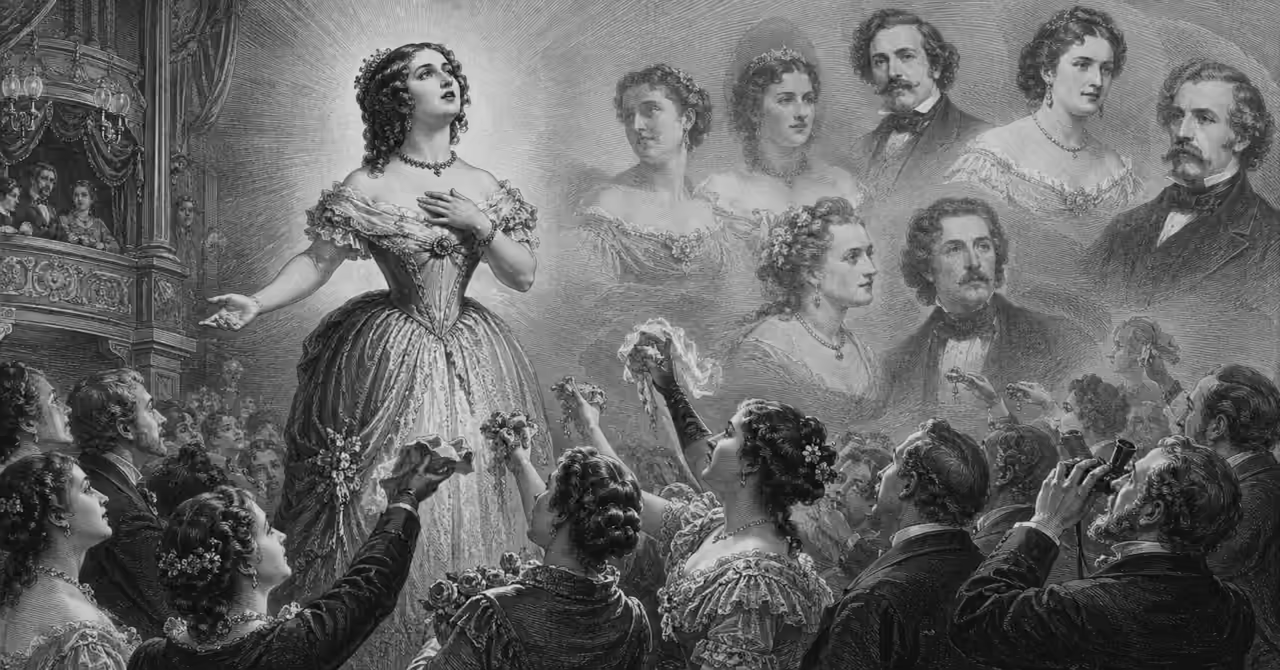
Imagine entering a crowded opera house in Victorian London to hear a singer described as the finest voice in the world. The audience falls silent, the orchestra begins, and a sound fills the theatre that people will discuss for decades.
Then the final note fades, and the voice is gone.
The nineteenth century produced singers of extraordinary fame. They toured internationally, commanded enormous fees, inspired composers and drew crowds comparable with those attracted by modern celebrities. Yet many reached their peak before sound recording became practical. Their portraits survive, critics described their performances in lavish detail, and their names still appear in musical histories—but we cannot hear what made them famous.
Here are ten celebrated Victorian singers whose voices are lost entirely, or survive only in recordings made long after their greatest years.
1. Jenny Lind – The Swedish Nightingale
Jenny Lind was probably the most famous singer of the nineteenth century. Known as the “Swedish Nightingale”, she became admired not merely for vocal technique but for the apparent purity and emotional warmth of her performances.
Her 1850 American tour, organised by showman P. T. Barnum, became a national sensation. Thousands gathered to see her arrive, newspapers reported her movements, and tickets were auctioned for astonishing prices. The excitement became known as “Lind mania”.
Yet no verified recording of Jenny Lind survives. We know that audiences cheered, wept and crowded the streets to see her, but the voice that caused all that excitement can now exist only in the imagination.
2. Adelina Patti – A Voice Heard Too Late
Adelina Patti became one of the highest-paid sopranos of her age. She performed before royalty, enjoyed international celebrity and negotiated fees that made her one of the entertainment world’s great financial powers.
Unlike most singers on this list, Patti did make recordings. Unfortunately, they were produced from 1905 onwards, when she was already in her sixties and decades beyond the height of her career.
The recordings remain fascinating because they preserve traces of her phrasing, control and style. However, they cannot fully reveal the youthful voice that Victorian audiences considered almost flawless. They are less a complete portrait than a glimpse through a rapidly closing door.
3. Jean de Reszke – The Tenor Who Refused to Record
Jean de Reszke was considered one of the greatest operatic tenors of the late nineteenth century. His performances in Wagnerian and French opera attracted enormous praise, and he became a favourite at the leading opera houses of Europe and America.
Recording technology existed during his lifetime, but de Reszke refused to make commercial records. Early recording machines could distort powerful voices, narrow their range and remove much of the atmosphere of a live performance.
He apparently preferred to leave no recording rather than allow an inadequate machine to misrepresent his art. It was an understandable decision, but one that left later generations permanently unable to judge his reputation for themselves.
4. Christine Nilsson – Jenny Lind’s Great Rival
Christine Nilsson was another Swedish soprano who rose from modest beginnings to international fame. Because of her nationality, talent and celebrity, she was often presented as the natural successor—and sometimes rival—to Jenny Lind.
Nilsson performed in the major opera houses of Europe and America and became particularly admired for roles requiring both technical brilliance and dramatic presence.
Although she lived until 1921, no authenticated recording of her voice is known to survive. Like Lind, she occupies the peculiar position of being historically famous for a sound that no living listener can experience.
5. Sims Reeves – Britain’s Favourite Tenor
Sims Reeves was regarded by many Victorians as Britain’s greatest tenor. He became especially famous for performances of Handel, Mendelssohn and popular English songs, moving comfortably between prestigious concert halls and music enjoyed in ordinary homes.
His reputation rested on clarity, expressive delivery and an ability to make familiar songs feel emotionally immediate. Victorian audiences knew his voice so well that his name alone could fill a hall.
Reeves died in 1900, just as recording technology was beginning to develop into a practical commercial medium. He came tantalisingly close to preservation, but not close enough.
6. Charles Santley – An Echo of a Great Baritone
Charles Santley was one of Britain’s leading baritones and enjoyed a career lasting several decades. He performed in opera, oratorio and concerts, becoming particularly admired for the authority and intelligence of his interpretations.
Santley lived long enough to make recordings, but they were produced very late in his life. By then, listeners were hearing an elderly singer rather than the commanding Victorian performer who had established his reputation.
His records are still valuable historical artefacts. They preserve aspects of his musical style, but only hint at the strength, colour and range of the voice audiences remembered from his prime.
7. Marietta Alboni – The Great Contralto
Marietta Alboni possessed one of the most celebrated contralto voices of the nineteenth century. Her rich lower register and unusually wide range allowed her to perform music unavailable to many other singers.
She appeared throughout Europe and America, earning admiration from audiences, critics and fellow musicians. Her voice was frequently described in terms of warmth, depth and effortless power.
Alboni retired before commercial sound recording became possible and died in 1894. Her reputation remains substantial, but the qualities that distinguished her extraordinary voice are preserved only in written descriptions.
8. Anna Bishop – The Singer Who Toured the World
Anna Bishop was not content to remain within the familiar opera houses of Europe. She spent decades touring internationally, performing across the Americas, Australia, India and other parts of the world rarely visited by leading European singers.
Her travels made her one of the most widely experienced performers of her generation. For audiences far from London, Paris or Milan, an appearance by Bishop may have been their only opportunity to hear an internationally celebrated opera singer.
Despite performing before countless listeners across several continents, she left no recording. Her voice travelled unusually far during her lifetime, yet could not travel forward through time.
9. Mario – The Romantic Star of Victorian Opera
Giovanni Matteo de Candia, known professionally as Mario, became one of Europe’s most celebrated tenors. His aristocratic background, handsome appearance and elegant stage presence made him an ideal romantic hero.
Mario was also closely associated with soprano Giulia Grisi, both professionally and personally. Together, they became one of the great operatic partnerships of the Victorian era.
He died in 1883, well before recording technology could preserve a theatrical voice with any fidelity. Paintings show us the glamorous performer, but the lyrical tenor that completed the effect has vanished.
10. Giulia Grisi – A Defining Victorian Soprano
Giulia Grisi was one of the defining sopranos of early Victorian opera. She created important roles, worked with major composers and became celebrated for combining beautiful singing with convincing dramatic performance.
Audiences did not regard her merely as someone who delivered difficult music accurately. She inhabited her characters, helping to establish the expectation that a great opera singer should also be a compelling actor.
Grisi died in 1869, long before her performances could be recorded. Her influence remains visible in operatic history, but the voice that made her famous disappeared with the audiences who heard it.
Voices Preserved Only in Words
These singers remind us how fragile fame once was. A modern performer may leave behind thousands of recordings, broadcasts, interviews and amateur videos. A Victorian singer could perform before enormous audiences for forty years and leave behind nothing more audible than silence.
Written reviews can tell us that a voice was powerful, pure, agile or moving, but words cannot recreate its exact colour. Nor can they reproduce the atmosphere of a crowded theatre, the acoustics of an old concert hall or the emotional force of hearing a legendary performer in person.
Perhaps that absence is part of the fascination. These singers remain famous because their audiences insisted that they were extraordinary, yet we can never settle the matter for ourselves. Their greatest performances survive as historical mysteries: once heard by thousands, remembered for generations, and now forever beyond replay.
From the Curator's Workshop
If you enjoyed stepping into the vanished world of Victorian performers, take a little of that nineteenth-century beauty with you. The William Morris Portrait Library Tote Bag brings the distinctive art and character of the Arts and Crafts era into everyday life—a practical companion for books, records, museum visits, market discoveries and whatever other curiosities you collect along the way.

Author's Notes
Notes & Memoranda
As is often the case, the subject extends beyond the bounds of a single article. The notes and memoranda below gather together useful definitions, related observations, references, and occasional curiosities discovered along the way.
Glossary
Some of the terms used in this article have specialised, historical or technical meanings. This glossary provides additional context for selected terms and ideas.
- Lind mania
- A phrase used to describe the intense public frenzy around Jenny Lind's 1850 American tour — crowds, press obsession and ticket auctions on a scale then unusual — illustrating an early form of mass celebrity and spectacle created by media coverage and theatrical promotion.
- recording machines
- Early mechanical devices for capturing sound (the acoustic era), which used a horn and a vibrating stylus to cut grooves in wax or shellac; they had limited frequency range, poor dynamic response and could distort powerful or highly resonant voices, so they often failed to convey the full colour and atmosphere of a live operatic performance.
- contralto
- The lowest typical female singing voice, prized in the nineteenth century for its rich, dark timbre and extended lower register; contraltos like Marietta Alboni were valued both for rare repertoire possibilities and for a vocal weight and colour that stood apart from more common soprano voices.
- oratorio
- A large-scale concert work, usually on a sacred or narrative subject, for soloists, chorus and orchestra but unstaged and without costumes; in Victorian Britain oratorio performances (by composers such as Handel and Mendelssohn) were central to public musical life and demanded clear, expressive singing rather than operatic acting.
- Wagnerian
- Relating to the operas of Richard Wagner, whose works feature dense orchestration, long continuous musical lines and dramatically demanding vocal parts; singers in Wagnerian roles needed exceptional stamina, volume and a voice capable of cutting through large orchestral textures, qualities that early recording technology struggled to capture faithfully.
Frequently asked questions
Curious about something you’ve just read? These frequently asked questions explore some of the key ideas, details and questions surrounding the topic.
Why can't we hear the voices of many famous Victorian singers?
Many reached their peak before commercial sound recording was practical, some retired or died before recordings existed, and others either refused to record or only made recordings very late in life, so only portraits and written descriptions remain.
Are there any recordings of Jenny Lind?
No verified recording of Jenny Lind survives; although her 1850 American tour organised by P. T. Barnum produced extraordinary public excitement known as 'Lind mania', the voice that created it cannot be heard today.
Which celebrated singers left recordings that don't reflect their prime?
Adelina Patti made recordings beginning in 1905 when she was in her sixties, and Charles Santley also recorded very late in life; both sets of records preserve aspects of style but cannot fully represent their youthful peak.
Who refused to be recorded and what was the reason?
Jean de Reszke refused to make commercial records because early recording machines could distort powerful voices, narrow their range and remove much of the atmosphere of a live performance, and he preferred no recording to a misrepresentation.
Further Reading…
Disclosure
This article discusses historical singers whose voices are wholly or partly lost to modern listeners. Statements about vocal quality, reputation and audience reaction are necessarily based on surviving contemporary accounts and later historical scholarship, which can be subjective. In a few cases, late recordings survive, but these were made well after the singer’s prime and should not be regarded as complete representations of how Victorian audiences would have heard them.