7 Victorian Measurements Rarely Used Today
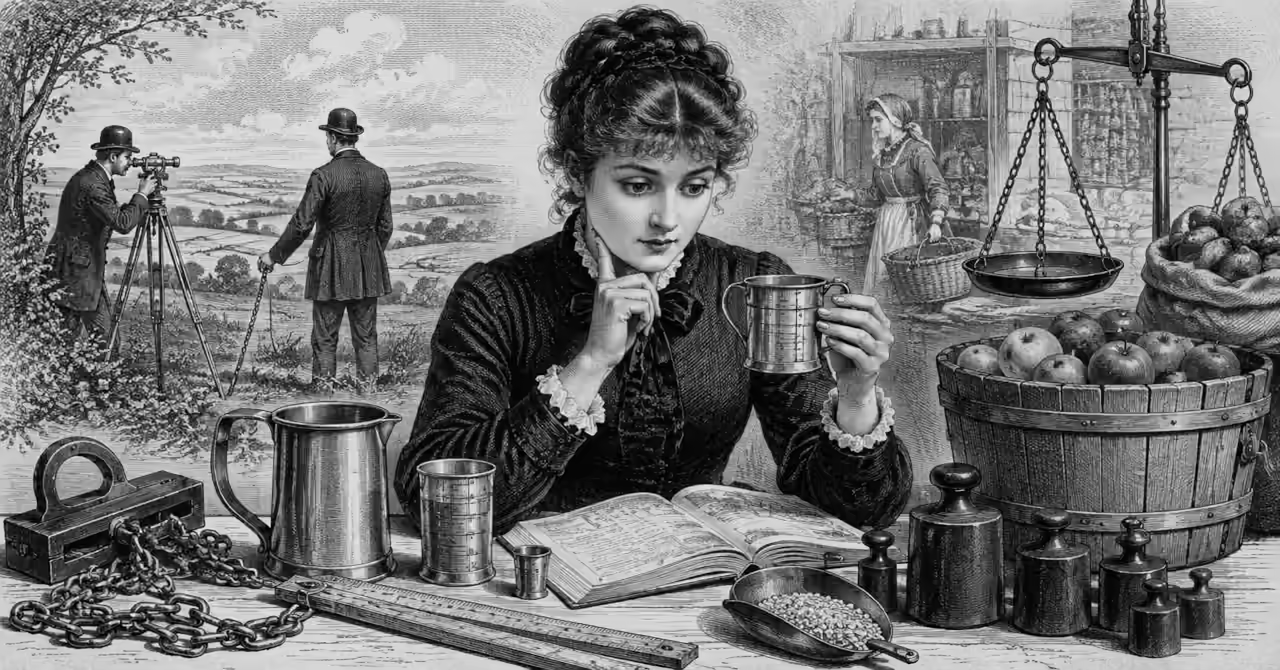
If you have ever opened a Victorian cookbook, newspaper or household guide and wondered what on earth a gill, dram or chain was, you are not alone. Victorian measurements can make familiar activities suddenly seem wonderfully strange. A farmer might describe a field in chains, a cook might pour half a gill of cream, and a doctor might prescribe medicine by the dram — all without giving the numbers a second thought.
This becomes especially noticeable when exploring Victorian food. In our article 4 Victorian Dishes We Would Never Eat Today, the dishes themselves may seem peculiar enough, but the recipes and household instructions behind them belonged to an equally unfamiliar world of weights, measures and quantities. Understanding those measurements gives us another small window into how Victorians actually cooked, shopped, worked and organised everyday life.
Many of these units were already centuries old by the Victorian era, inherited from agricultural, commercial and scientific traditions. They survived because people understood them, tools had been made around them, and entire trades depended upon them. A few remain with us in specialised corners of modern life; others have almost completely vanished.
So, how long was a chain? How much could you drink from a gill? And just how small was a dram? Here are seven Victorian measurements that were once perfectly ordinary — and what they mean in the measurements we use today.
1. Rod
A rod was a unit of length measuring 16½ feet, or approximately 5.03 metres. It was particularly useful in agriculture, surveying and the marking of property boundaries.
The strangely precise length made more sense within the wider imperial system. Four rods made one chain, forty rods made one furlong and 320 rods made one mile. A Victorian surveyor could therefore move between small property measurements and much larger distances without changing to an unrelated unit.
Rods often appeared in descriptions of fields, roads, gardens and estates. A narrow strip of land might be recorded as two rods wide, while the frontage of a rural property could be listed in rods and yards.
The rod has largely vanished from ordinary speech, but it remains useful when interpreting Victorian maps, land deeds and auction notices. Without knowing the measurement, a reader can easily underestimate how carefully old properties were recorded.
2. Chain
A chain measured 66 feet, or about 20.12 metres. It was one of the most important measurements used by Victorian surveyors, engineers and railway builders.
The name came from the physical surveying chain used to measure land. The best-known form contained 100 metal links and could be stretched across a field, road or proposed railway route. Surveyors counted complete chains and individual links, creating measurements that could later be transferred to maps and plans.
Ten chains made one furlong, while eighty chains made one mile. An acre could also be represented as an area one chain wide and ten chains long, showing how closely the unit was connected with land measurement.
The chain became especially important during the nineteenth-century expansion of railways. Engineers used it to record track distances, bridge locations, cuttings and signals. Britain’s railway industry still retains traces of this system, making the chain one of the more persistent survivors of Victorian engineering.
3. Furlong
A furlong measured 220 yards, or approximately 201 metres. Today it is associated mainly with horse racing, but Victorians encountered it in agriculture, surveying, transport and newspaper reports.
The word comes from “furrow long”, referring to the approximate length of a traditional ploughed strip of land. Eight furlongs made one mile, giving the measurement a convenient place within the imperial system.
A Victorian newspaper might describe a railway station as being several furlongs from a village, or report that a new road had been extended by half a furlong. Estate plans and agricultural records also used furlongs when describing long boundaries and fields.
Horse racing preserved the unit because race distances were already established in furlongs and tradition carried them forward. Even readers who never use the measurement elsewhere may still recognise a six-furlong sprint or a race run over a mile and two furlongs.
4. Gill
A gill was a small measure of liquid equal to one quarter of an imperial pint, or approximately 142 millilitres. It commonly appeared in recipes, household instructions and the sale of drinks.
Victorian cooks might use a gill of milk, cream, stock or wine when preparing puddings, sauces and soups. The quantity was large enough to be practical but smaller than a pint, making it useful before standard measuring cups became common household equipment.
The gill could also be divided into smaller portions. Half a gill was roughly 71 millilitres, while a quarter-gill was only about 35 millilitres. These subdivisions allowed cooks and publicans to work with modest quantities using familiar vessels.
The measurement has now largely disappeared from Australian and American kitchens. As a result, anyone attempting a Victorian recipe must usually convert gills into millilitres before beginning.
5. Dram
The dram was used as both a measure of weight and a small quantity of liquid. Its meaning depended upon the trade and context in which it appeared.
As an imperial unit of weight, one dram equalled one-sixteenth of an ounce, or approximately 1.77 grams. Victorian pharmacists and apothecaries used drams, grains, scruples and ounces when preparing medicines. A prescription could therefore require several drams of one substance and only a few grains of another.
The word also became associated with small servings of alcoholic spirits. A “dram” of whisky did not always describe a precisely measured quantity; it could simply mean a modest drink. This informal meaning survives in the familiar expression “a wee dram”.
Because the dram could refer to different systems of measurement, it must be interpreted carefully in historical documents. In a medical text it may represent an exact weight, while in a story or newspaper report it may simply describe a drink.
6. Peck
A peck was a dry measure used for grain, fruit, vegetables and other produce. One imperial peck equalled two imperial gallons, or approximately 9.09 litres.
Unlike kilograms, which measure weight, the peck measured volume. A peck of apples therefore referred to the amount of fruit that fitted into a standard container rather than to a fixed weight. The actual weight could vary according to the size and density of the produce.
Victorian farmers, market traders and household shoppers understood the peck as part of a larger system. Four pecks made one bushel, allowing produce to be sold in quantities suited to both families and commercial buyers.
The measurement survives most visibly in the tongue-twister about Peter Piper picking a peck of pickled peppers. To Victorian listeners, the phrase did not describe an imaginary quantity. A peck was a recognised market measure and represented a substantial container of produce.
7. Stone
A stone equals 14 pounds, or approximately 6.35 kilograms. It was widely used during the Victorian period for describing the weight of people, animals and certain goods.
A person weighing 154 pounds could be described more simply as weighing 11 stone. Additional pounds were stated separately, so someone weighing 158 pounds would be recorded as 11 stone 4 pounds.
Victorian newspapers used stones when describing boxers, athletes, criminals, patients and unusually large or small individuals. Doctors also recorded body weight in stones and pounds, while livestock dealers could use the measurement when discussing animals.
The stone remains familiar in Britain and Ireland, particularly for personal weight, but it is uncommon in Australia, the United States and most other countries. Its survival makes it unusual among Victorian measurements: no longer internationally common, yet not entirely obsolete.
Measuring the Victorian World
These measurements were never merely quaint words. They helped Victorians divide the landscape, build railways, prepare medicines, buy food and understand their own bodies. A chain could carry an engineer’s calculations across the countryside, a gill could determine whether a pudding succeeded, and a dram might mean either a pharmacist’s careful dose or a welcome glass of whisky. Together, they formed an almost invisible framework around everyday Victorian life.
It is intriguing to wonder what might have survived had the world continued measuring itself this way. We might still describe a garden in rods, order small quantities by the dram or instinctively understand the distance of a chain. Instead, most of these measurements slipped quietly from ordinary language, leaving behind traces in old recipes, railway surveys, estate plans and expressions such as weighing something in stone.
Learning their modern equivalents therefore does more than make historical documents easier to understand. It lets us briefly see the world according to a different set of assumptions — one in which measurements inherited from fields, workshops, markets and generations of practical experience still made perfect sense.
And measurements were hardly the strangest ideas that Victorians inherited from the past. Beyond the ruler and measuring cup lay another world of folklore, superstition and people whose unusual behaviour or mysterious abilities could earn them a rather unsettling reputation. Continue exploring with 5 Types of "Witches" in Victorian Folklore.
Continue Exploring Victorian Everyday Life
Measurements were not the only ordinary parts of Victorian life that can seem wonderfully strange today. The dinner table could be just as unfamiliar.
From the Curator's Workshop
If you enjoyed discovering the curious details hidden in everyday Victorian life, carry a little of that world with you. The Phillaneum William Morris Portrait Library Tote Bag celebrates one of the era’s great creative figures in a practical piece inspired by the art, design and history that make the nineteenth century so endlessly fascinating.
Author's Notes
I love these little remnants of everyday Victorian life because they make the past feel wonderfully tangible. A chain isn't just an obsolete measurement when you imagine someone actually pacing out land with one, and a gill becomes much more memorable when you picture it being poured across a Victorian counter.
Old measurements remind us that people in the nineteenth century didn't merely dress differently or live among different objects. They divided up and described the physical world differently too. Once you start noticing these forgotten words in old recipes, newspapers, catalogues and advertisements, they become another small doorway into understanding how Victorian life actually felt.
Notes & Memoranda
As is often the case, the subject extends beyond the bounds of a single article. The notes and memoranda below gather together useful definitions, related observations, references, and occasional curiosities discovered along the way.
Frequently asked questions
Curious about something you’ve just read? These frequently asked questions explore some of the key ideas, details and questions surrounding the topic.
How long is a chain and how was it used?
A chain measured 66 feet (about 20.12 metres) and typically contained 100 metal links; surveyors, engineers and railway builders used it to measure land, with ten chains equalling a furlong and eighty chains making a mile, and an acre often represented as one chain by ten chains.
What is a gill and how much liquid does it hold?
A gill is one quarter of an imperial pint, approximately 142 millilitres; it was common in recipes and drink measures and can be subdivided into about 71 ml for a half-gill and 35 ml for a quarter-gill.
What did dram mean in Victorian times?
A dram could be a precise unit of weight—one-sixteenth of an ounce (around 1.77 grams) used by pharmacists—or an informal small serving of spirits (as in 'a wee dram'), so context determines whether it’s an exact measurement or simply a modest drink.
What is a peck and how does it differ from kilograms?
A peck is a dry volume equal to two imperial gallons (about 9.09 litres) and measures the space taken by produce rather than its weight, so the actual weight of a peck of apples depends on the size and density of the fruit; four pecks make a bushel.
Further Reading…
Research Note
Historical units and modern equivalents used in this article were checked against established reference works on British imperial weights and measures. Where historical usage varied by period, region or trade, the article uses an approximate modern equivalent rather than implying a precision that Victorian practice did not always have.
Disclosure
Historical measurements varied by period, region and context, and some units could have different meanings in particular trades. Modern equivalents in this article are approximate and are provided to help readers understand the relative scale of measurements commonly encountered in Victorian-era sources.