An Unfinished Conversation: A Victorian Farewell (2026)
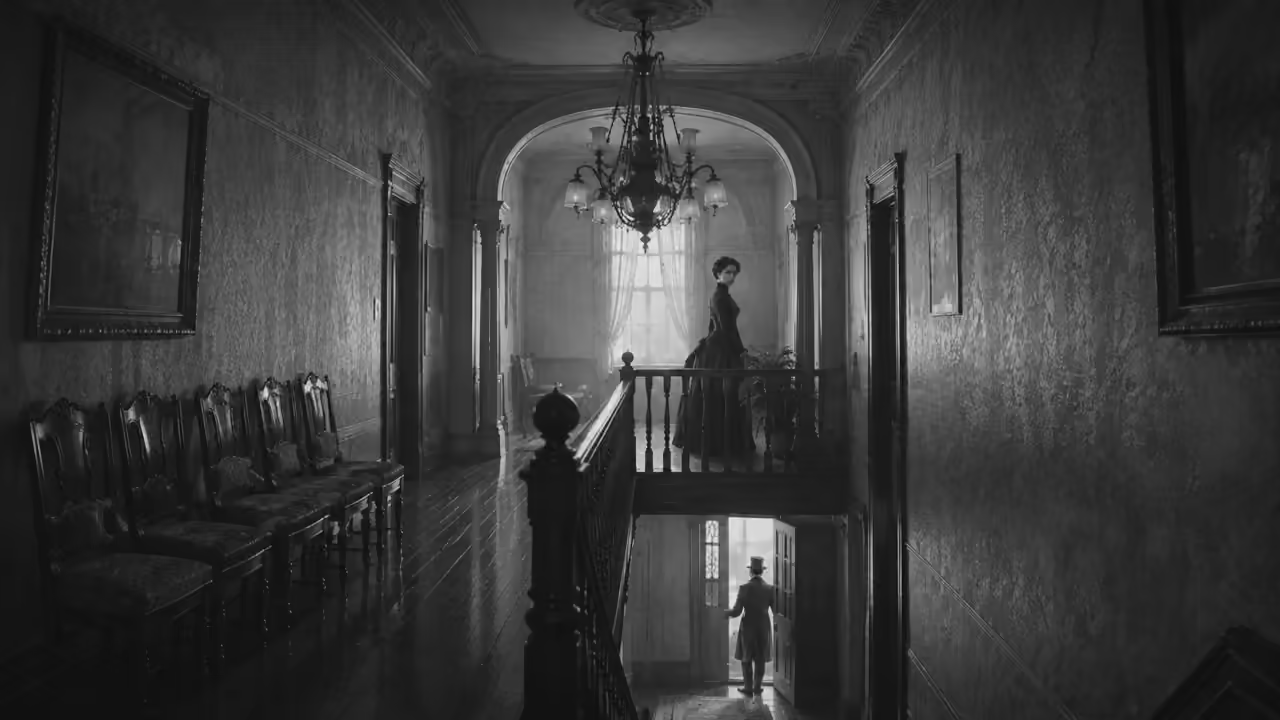
A gentleman pauses with his hand upon the door. Above him, a beautifully dressed lady watches in silence from the upper landing. Neither speaks. Neither moves. Yet the grand Victorian hallway seems to hold the weight of words that were never said. An Unfinished Conversation is an original Phillaneum artwork inspired by those quiet moments that history rarely records.
Set within an imagined upper-class Australian interior around 1902, the scene offers no obvious drama. No farewell is exchanged. No explanation is given. Instead, the empty chairs, the long hallway and the distance between the two figures invite us to wonder whether we are witnessing an ordinary afternoon departure—or a goodbye that quietly lasted a lifetime.
The Lady on the Landing
The woman stands formally dressed beneath the elaborate light fitting of a grand Victorian hallway. Her clothing and posture speak of composure, social expectation and careful self-control. She looks towards the viewer, but her attention seems divided between the present moment and the man below.
Her expression is not one of obvious grief. Victorian society often prized restraint, particularly among women of established social standing. Strong feelings could be communicated through a pause, a glance or a silence rather than an open declaration. Her apparent calm therefore leaves room for many interpretations. She may be disappointed, hopeful, resigned or simply uncertain of what comes next.
She remains inside the building, surrounded by polished timber, patterned walls and carefully arranged furnishings. The interior offers comfort and status, but it also seems to confine her. Her stillness contrasts with the gentleman’s movement towards the outside world.
The Empty Chairs
Along the hallway sits a row of stiff, upright chairs. Their arrangement is deliberate and orderly, but their emptiness gives them an unexpected emotional weight. They suggest waiting, formal visits and conversations conducted under the quiet supervision of social convention.
Perhaps guests once occupied them. Perhaps family members gathered there before a departure. Perhaps one of the chairs had been intended for the gentleman, but the conversation ended before he sat down.
The chairs also represent absence. They are furniture designed for human presence, yet no one uses them. Their emptiness quietly expands the emotional distance between the two figures. They make the house feel inhabited but strangely lonely, as though its rooms are still holding the memory of earlier voices.
The Electrolier Above
Suspended above the hallway is an ornate electrolier, one of the defining decorative features of affluent Victorian and early Federation interiors. More than a source of light, electroliers became symbols of modernity and prosperity as electricity gradually replaced gas lighting in prestigious homes, hotels and public buildings. Its warm glow draws the eye upward, quietly connecting the lady on the landing with the gentleman below while illuminating the empty space between them.
The electrolier does more than illuminate the hallway. It becomes a silent witness to the moment, drawing the eye upward while connecting the two figures across the space between them. Beautifully crafted electroliers were also remarkable examples of Victorian decorative metalwork. To discover how these elegant fittings combined craftsmanship, artistry and the latest electrical technology, explore our article on Ornamental metal craft Victorian Electroliers (electric chandeliers).
The Gentleman at the Door
At the foot of the grand hallway, the gentleman has almost reached the outside world. His hand rests upon the polished brass door handle, but the door remains closed. Sunlight waits beyond the threshold, yet he lingers for one final heartbeat. It is the smallest pause, almost imperceptible, but it changes everything.
Why does he hesitate? Is he hoping to hear his name called one last time? Has he remembered the words he should have spoken? Or has the conversation already ended, leaving only silence where reconciliation might once have been possible? The woman above offers no answer. She simply watches.
The artwork never reveals whether this is an ordinary departure or the last farewell two people will ever share. Perhaps he intends to return before dinner. Perhaps he leaves after a disagreement, a broken engagement or a family decision from which there is no return. Or perhaps, years later, both will remember this quiet moment and realise it was the last time they ever stood beneath the same roof. The mystery belongs to the viewer, and that uncertainty is what gives An Unfinished Conversation its enduring emotional power.
The open door offers no answer. It is both an exit and a possibility.
A Federation-Era Australian Interior
Although the scene is imagined, its atmosphere is intended to feel plausible within an affluent Australian setting during the early Federation period. Wealthy homes, government residences, grand hotels and professional offices often drew heavily upon British Victorian taste. Ornate wallpaper, dark timber staircases, formal waiting areas and imported decorative fittings could all be found within substantial Australian buildings of the time.
The large hanging light ornament gives the hallway an institutional grandeur. The building might be a mansion belonging to a pastoral family, a government office, a private club or a city hotel. Its exact identity is deliberately uncertain. That ambiguity allows the emotional story to exist without being tied to a single event or location.
The architecture also contributes to the mood. The long corridor creates physical and emotional depth. Doors lead into unseen rooms, the staircase divides the figures across different levels, and the bright exterior contrasts with the shadowed interior. The building appears dignified and secure, yet it cannot protect its occupants from change.
What Was Left Unsaid
The title An Unfinished Conversation does not necessarily mean that the two figures were speaking moments earlier. The unfinished conversation may consist of words that were never spoken at all.
Perhaps social expectations prevented honesty. Perhaps pride made reconciliation impossible. Perhaps both people believed there would be another opportunity. Like many remembered moments, its significance may only become clear when the chance to complete it has disappeared.
The image therefore asks the viewer to create the missing story. Some may see romantic loss. Others may imagine family conflict, wartime departure, professional duty or an ordinary separation made meaningful only by hindsight. The artwork offers no official conclusion because its emotional force depends upon uncertainty.
An Original Celebration of the Period
An Unfinished Conversation is not presented as a record of a real historical event. It is a newly created Phillaneum artwork designed to celebrate the visual language, architecture and emotional restraint associated with the Victorian and early Federation eras.
Its story belongs partly to the period and partly to the viewer. The lady remains on the landing. The chairs remain empty. The gentleman's hand rests upon the door. Whether he is leaving for an afternoon or a lifetime is never revealed. Like so many moments that shape our lives, the conversation remains unfinished.
From the Curator's Workshop
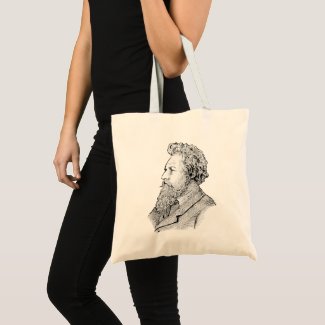
The richly furnished world imagined in An Unfinished Conversation belongs to the same age that produced William Morris and the Arts & Crafts Movement. Readers curious about the designer behind this enduring aesthetic can first discover why William Morris was celebrated as an apostle of art, or carry a little of that artistic heritage into everyday life with the William Morris Portrait Library Tote Bag. Every purchase helps Phillaneum continue creating and sharing original works inspired by the Victorian world.
Author's Notes
Notes & Memoranda
As is often the case, the subject extends beyond the bounds of a single article. The notes and memoranda below gather together useful definitions, related observations, references, and occasional curiosities discovered along the way.
Further Reading…
Disclosure
An Unfinished Conversation is an original Phillaneum artistic interpretation inspired by the architecture, culture and social atmosphere of the Victorian and early Federation periods. It depicts an imagined scene rather than a specific historical event, person or location, and is intended to celebrate the era through creative storytelling.