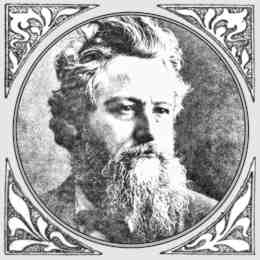
Apostles of Art - William Morris
In this series it is intended to set before students of art some account from authoritative sources of the great modern teachers, their life and doctrine. This first article is republished from a lecture delivered by Mr. F. S. Ellis before the Applied Art Section of the Society of Arts, in whose journal it subsequently appeared.
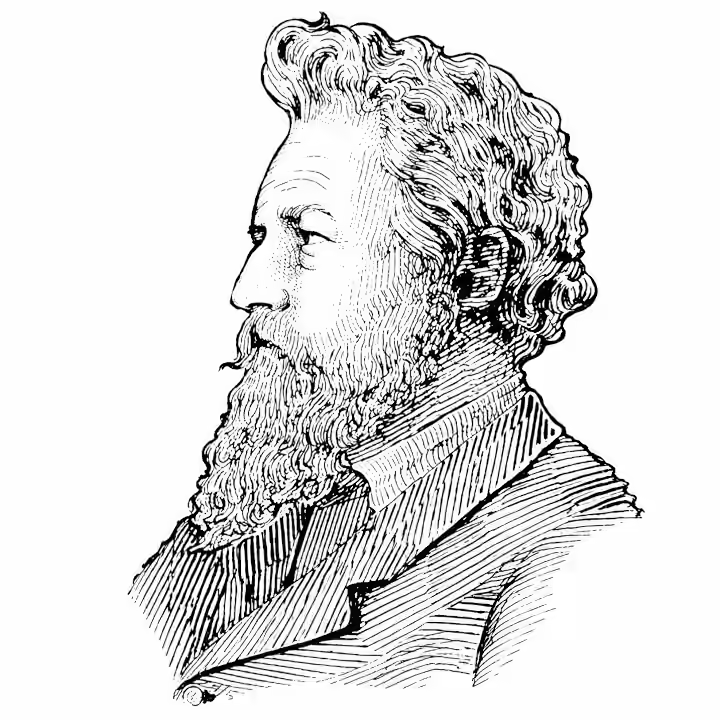
Though years have gone by, it seems but yesterday since I made one of a large audience which listened, with earnest attention and eager interest, to an address on the subject of The Woodcuts of Gothic Books by the great man concerning whose wonderful artistic and literary career I have undertaken to speak. But I believe I am justified in calling his career not only wonderful, but also in applying to it the often misused term unique; for, casting back one's eye over the glorious roll of English poets, which among them, I would ask you, besides William Morris, has been so gifted as not only to enrich the world with a full tide of song, but also to make the age in which he lived an epoch in decorative art?
Little did I suppose, as I listened to his well chosen words on the occasion I have mentioned, that it would ever fall to my lot to speak of him as belonging to the past, for he was four years my junior, and until his last illness attacked him, seemed always possessed of so much life, vigour and activity as might be expected to carry him to extreme old age. Alas! that it is otherwise, for his value in the world was far greater than that of a whole heap of other men, including myself.
No one who has eyes to see, intelligence to understand, and wit to judge, can doubt that in the loss of William Morris we have reason to mourn a genius of such magnitude as towered aloft even among the men of marked ability, brilliant faculties, and great attainments who were contemporary with him, like a landmark in a wide plain. His death has left a blank that none of us can reasonably hope to see filled in our time. But though he was my junior in the mere reckoning of years, from the first day that I made his acquaintance I recognised clearly in how great a degree he was mv senior in intellectual capacity and acquired knowledge. For more than thirty years I was accustomed to regard him as a teacher and a master, and you must therefore not expect from me anything by way of criticism on his lifework other than hearty appreciation, admiration love and wonder.
Yet it must not be supposed that he was one of those who desire to exact from their associates entire agreement on all subjects, or who thrust their views and opinions, whether upon art or other matters, dogmatically upon their neighbours; he was, on the contrary, always most willing to listen to objections, and to explain and consider a question from various points of view, unless he found his interlocutor to degenerate into ignorant nonsense or self-conceit, when he would close the discussion quickly enough.
In thinking over his marvellous personality, I should not, though his versatility was wonderful, be inclined to describe him as a versatile man, for that term is usually applied to one who can do a great many things fairly well, but for the most part imperfectly. That was not the case with William Morris. Many things he assuredly could do, but he never rested till he was fully master of that which he undertook, and could do it thoroughly well—I will not say perfectly, for he would himself have counted the word perfection inadmissible in art; as Ruskin has admirably and forcibly pointed out, perfection usually means a loss of strength and degeneration into littleness, and a phrase that was constantly on Morris’s lips was that, according to the French proverb, Better is the enemy of good.
But he was a many-sided man; to work at whatever he set his hand to till he was so entirely master of the subject that he was able to instruct others; to know the history, the secret, lie why and wherefore of everything he engaged in was his great characteristic. Yet those who knew him best will bear me out when l say that never was any man more entirely free from petty conceit and self-consequence. Though fully conscious of his own power and inherent abilitv; though, I believe, gratified to feel assured that he was looked up to by his fellow’s as a man of genius, he was, nevertheless, one of the most simple-minded, yea, one of the most humble-minded, among men. His consciousness of power and knowledge in such things as he gave his mind to, raised him above the pettiness of conceit; while his clear conception of the limitations of his own, and of all human knowledge, engendered in him that humility which is a special note of truly great minds.
It was my good fortune to make the acquaintance of William Morris as long ago as 1864. When Jason was as yet unpublished, and he was unknown in literature and art beyond a narrow circle of friends. One of his grand qualities was faithfulness. I believe I may say with confidence that throughout his whole career he never lost a friend, except by the hand of death. The friends of his youth were the friends of his maturity—alas! that it cannot be said of his old age, for he was but sixty-two when he died, and no one ever thought of Morris as an old man. Even when the stroke of sickness fell upon him, and until within a few weeks of his death, his mind was as fresh and vigorous, his touch as certain, his fecundity of invention as wonderful, and his imagination not only as brilliant as in youth, but infinitely more so, growing brighter, richer, and more varied and powerful as the years rolled on, and until the verv end was reached.
It is needless for me to recite to an audience such as I have the honour of addressing this afternoon any particulars concerning the biography of William Morris. They were given, pretty much as I could relate them, in many of the magazines and newspapers immediately after his death, and in Mr. Aymer Yallance's important and excellent work entitled The Art of William Morris.
Suffice it to say that William Morris was born on March 24, 1834, the eldest son of a man engaged in financial business in the City of London, who, by the accident of a fortunate investment made a short time before he was cut off in the very prime of life, left his widow in such circumstances as enabled her to give all her children a handsome fortune as they came of age. This was certainly a circumstance as happy as it was remarkable, in that it opened possibilities to the future artist of carrying into effect his views on art at an early age—which might otherwise have been seriously retarded, or even never have had the opportunity of expansion and fulfilment. That the surroundings of the boy and youth were by no means calculated to awaken a love of art will be readily understood and allowed by all who are conversant with what was in vogue in prosperous middleclass life during the first half of the present century. But it would seem that a love of the beautiful, and a sense of what was ugly, abhorrent and vulgar, was intuitive in William Morris’s mind.
I remember him speaking many a time of the exhibition of 1851, at which all the world was struck with unbounded admiration, and telling how, as a youth of seventeen, he declined to see anything more wonderful in it than that it was wonderfully ugly, and, sitting himself down on a seat, steadily refused to go over the building with the rest of his family.
At Marlborough College, which he always spoke of with the greatest dislike and repugnance, he would not join in the ordinary games or sports, but found delight in rambling over the country-side on holidays, exploring its archaeology and enjoying the scenery. His walks bout the Wiltshire downs he used to talk of about the Wiltshire downs he used to talk of enthusiastically to the end of his days. I have also heard him describe how, in the shorter intervals of leisure, he would employ himself in making nets, a token of the spirit of the handi-craftsman which afterwards found such ample and glorious development. His abhorrence of Marlborough arose largely from the recollection that his teachers there taught him nothing whatever, so that one of the aptest scholars that ever lived had to be put under a coach before he was equal to matriculating at Oxford.
It is needless to make more than a passing remark on a circumstance which had assuredly a most important effect upon his life work. I refer to the extraordinary fact of his lifelong friend, Edward Burne-Jones, matriculating on the same day, and shortly afterwards forming his acquaintance. Nor is it necessary to inquire into the causes that led both these students to renounce the clerical career that had been marked out for them. An inspiration fell on these youths, each of them coming from family and surroundings as little likely to prompt them to art or poetry as were those of Chaucer, of Shakespeare, of Turner, or Ruskin, but, as we say, the wind bloweth where it listeth.
The influence of Ruskin with the promoters of the Oxford Union caused Dante Gabriel Rossetti to obtain a commission at Oxford, and here was the flame at which the ready match of enthusiasm was kindled. The Oxford of forty or fifty years since was a spot much more calculated to foster and encourage the spirit of Medievalism, wrhich was an integral part of Morris’s nature, than it is under its present aspect. The whole place wore a much more venerable and antiquarian air than it does at the present time. In his later years, Morris would earnestly deplore the ruthless spirit of change which had robbed Oxford of the charm it once had for him, and it was with difficulty he could be persuaded to go thither, even though his residence at Kelmscott brought him so close upon its borders.
I can well remember that from time to time he used to speak writh enthusiasm of the delight he experienced, as an undergraduate in turning over some of the magnificent manuscripts preserved in the Bodleian especially the Romance of Alexander, a thirteenth-century Apocalypse, and otherof the inestimable treasures which find a home in that library.
(To be continued)