5 Arctic Airship Expeditions That Changed Polar Exploration
Introduction
The Arctic has always been a severe test of machinery. It is cold, remote, wind-shaped, and largely indifferent to human confidence. Ships could be trapped by ice. Sledges were slow. Aircraft were still fragile. For a time, the airship seemed to offer a better answer. It could cross ice without roads. It could carry stores, instruments, and crews. It could travel where no railway, steamer, or dog team could easily go.
That was the promise. The reality was harder. Polar air was not empty space. It was weather, fog, ice, drift, and poor visibility. Engines failed. Gas bags leaked. Navigation became uncertain near the top of the world. The dream was elegant. The Arctic was not.
These five expeditions show why the airship became one of the most dramatic machines in polar history. Some failed outright. One succeeded beautifully. All of them changed how explorers imagined the frozen north.
1. Andrée's Balloon Expedition, 1897
Salomon August Andrée did not fly an airship in the strict powered sense. He flew a hydrogen balloon. Yet his 1897 attempt belongs at the beginning of any Arctic lighter-than-air story. It showed both the attraction and the danger of rising above the ice.
Andrée planned to reach the North Pole by drifting with the wind. The balloon, named Örnen, lifted from Svalbard with three men aboard. The idea had a clean Victorian logic. Where ships were stopped by ice, the balloon would simply pass overhead.
The plan failed almost at once. The balloon lost lift. The drag ropes did not give the steering control that Andrée had hoped for. The crew came down on the ice after only a short flight. They then began a long struggle on foot. Their camp was not found until 1930.
This expedition mattered because it exposed the first great polar air problem. The sky above the Arctic was not a shortcut unless the machine could be controlled. Drift alone was not enough. The Arctic would not reward optimism without engineering discipline.
2. Walter Wellman's Airship Attempts, 1906 to 1909
Walter Wellman was a journalist, promoter, and polar enthusiast. He believed the airship could do what ships and sledges had failed to do. His plan was direct. Build an airship in the north. Launch from Spitsbergen. Fly to the Pole.
It sounded simple in print. It was much less simple in practice. Wellman's airships faced delay, weather, mechanical trouble, and the usual cruelty of remote engineering. The machines were ambitious for their time. They were also being asked to operate at the edge of practical knowledge.
The most famous of his polar craft was America. It was a serious attempt. It had engines, crew, fuel, and a mission. Yet it never conquered the Arctic. The airship was damaged and delayed. Later attempts also fell short.
Wellman's work is easy to dismiss because it did not reach the Pole. That would be unfair. His attempts helped move Arctic aviation away from pure spectacle and toward logistics. Hangars, supply bases, engine reliability, weather windows, and crew endurance all became part of the problem. The airship was no longer just a balloon with ambition. It was becoming a system.
3. The Norge Expedition, 1926
The Norge was the great proof case. In 1926, Roald Amundsen, Lincoln Ellsworth, Umberto Nobile, and their crew crossed the Arctic in a semi-rigid airship. The journey travelled from Svalbard, over the North Pole, and onward to Alaska.
Here the airship finally did what its advocates had promised. It crossed a region that had defeated ships and exhausted land parties. It carried a crew through vast distances. It turned the pole from an endpoint into a waypoint.
The success of Norge was not magic. It was preparation. The airship had better engineering than earlier craft. It had an experienced commander in Nobile. It had Amundsen's polar judgement. It also had the benefit of a clearer mission. This was not a vague dream of conquest. It was a planned crossing.
The result changed polar exploration. It showed that lighter-than-air craft could have a genuine role in remote travel. It also created a dangerous confidence. After Norge, the airship was no longer only a speculative machine. It had touched the top of the world.
4. The Italia Disaster, 1928
Two years after Norge, Umberto Nobile returned to the Arctic in the airship Italia. The expedition had scientific aims as well as national prestige behind it. It was meant to build on success. Instead, it became one of the most famous airship disasters in polar history.
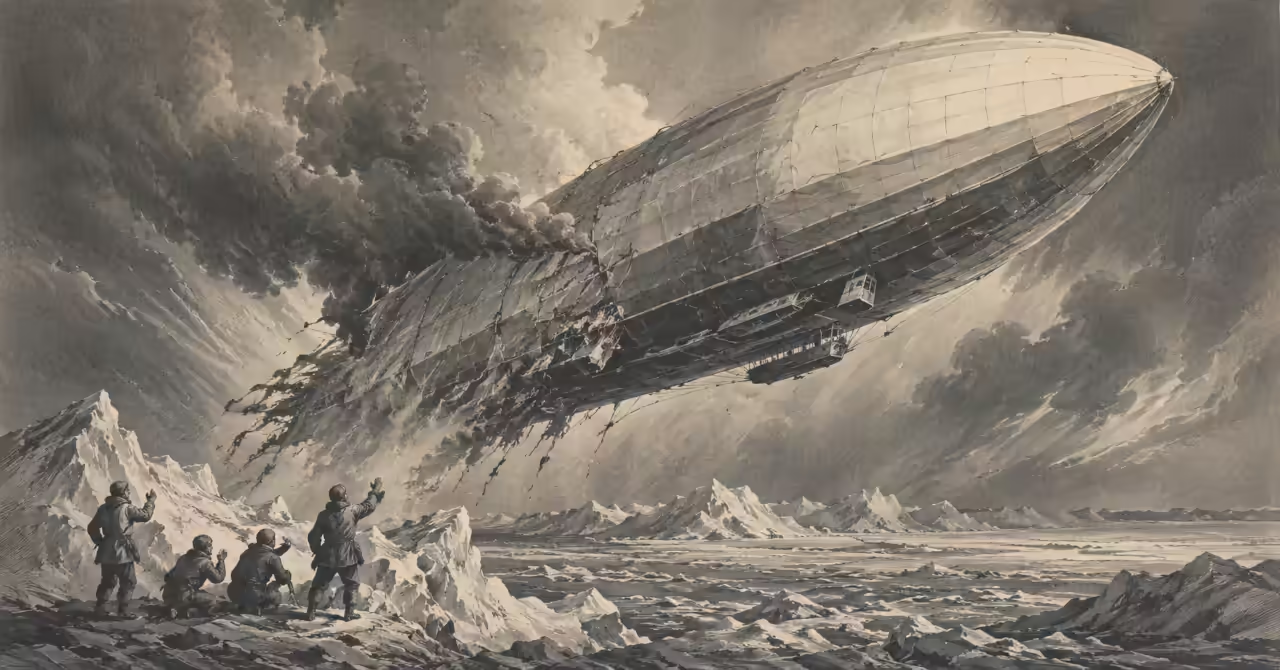
Italia reached the North Pole, but trouble came on the return journey. The airship encountered severe conditions and crashed onto the ice. Part of the crew survived in what became known as the Red Tent. Others were carried away with the drifting envelope.
The rescue effort became an international drama. Ships, aircraft, and polar parties searched for the survivors. Roald Amundsen, already a legend of polar exploration, disappeared while taking part in the rescue effort. The story became larger than the airship itself.
The Italia disaster changed the public meaning of Arctic airships. The machine was no longer just a symbol of progress. It was a reminder that success in the Arctic could be temporary. A voyage could be brilliant for most of its length and still end in catastrophe.
5. The Graf Zeppelin Arctic Flight, 1931
By 1931, the airship had matured. The German Graf Zeppelin was not a fragile experiment. It was one of the most capable airships ever built. Its Arctic flight was not a wild dash to plant a flag. It was a scientific and technical mission.
The expedition carried researchers, instruments, cameras, and mail. It surveyed remote Arctic regions and demonstrated the value of aerial observation. This was a different kind of polar airship journey. It was less romantic than the earlier attempts. It was also more modern.
The importance of the Graf Zeppelin flight lies in its discipline. It showed that the airship could be a platform. It could observe, map, carry, and connect. It did not need to be judged only as a heroic vehicle for reaching the Pole.
For anyone interested in modern airship concepts, this is the expedition that still feels practical. It points toward cargo lift, remote access, environmental monitoring, and service to places with little infrastructure. It suggests that the airship's most useful future may not be spectacle. It may be patient work in difficult places.
Conclusion
Arctic airship history is not a simple tale of failure. It is a sequence of experiments under extreme pressure. Andrée showed the danger of uncontrolled drift. Wellman showed the difficulty of building a polar air system. Norge showed what success could look like. Italia showed how quickly success could turn. Graf Zeppelin showed a more mature path.
The lesson is not that airships were foolish. The lesson is that the Arctic was never a blank map waiting to be crossed. It was an operating environment. It demanded control, endurance, planning, and respect.
That is why these old expeditions still matter. Modern airship proposals often return to the same promise. They offer access to remote regions without roads, runways, ports, or heavy ground disturbance. The appeal is real. The history is useful. Every new design should carry a little memory of the ice, the fog, the broken engines, and the red tent.
The airship remains one of the most elegant answers ever proposed for difficult country. It also remains one of the machines most dependent on judgement. In the Arctic, lift was never enough. The machine had to understand the place it was trying to cross.

Author's Notes
I have a soft spot for airships. They occupy an unusual place in technological history. They are practical enough to have worked, yet ambitious enough to feel almost fictional today. Every generation seems to rediscover them. Every generation believes it may finally have solved the problems that defeated the last.
While researching modern proposals for Arctic cargo airships, I kept encountering the same names. Andrée. Wellman. Nobile. Amundsen. Their stories were often mentioned in passing, yet they formed a fascinating narrative of trial, failure, success, and tragedy. I felt they deserved to be gathered together in a single account.
What strikes me most is how contemporary many of these expeditions feel. The challenges remain familiar. Remote communities still need transport. Infrastructure is still expensive. Environmental impact still matters. The Arctic remains vast. When modern engineers discuss heavy-lift airships, they are often revisiting questions first explored more than a century ago.
I do not see these expeditions as evidence that airships failed. Rather, they remind us that difficult environments reveal the limits of every technology. The Arctic was a demanding test ground for lighter-than-air flight. It exposed weaknesses, but it also revealed possibilities. The success of the Norge and the scientific work of the Graf Zeppelin suggest that the story was never as simple as success or failure.
Perhaps that is why I keep returning to airships. They represent a future that almost happened. Their history is filled with cautionary lessons, but also with remarkable imagination. In an age once again searching for efficient ways to reach remote places, their long shadow still stretches across the ice.
Notes & Memoranda
As is often the case, the subject extends beyond the bounds of a single article. The notes and memoranda below gather together useful definitions, related observations, references, and occasional curiosities discovered along the way.
Glossary
- Airship
- A powered lighter-than-air aircraft that uses lifting gas such as hydrogen or helium to remain airborne. In this article, airships are examined as tools for Arctic exploration, scientific research, and long-distance travel across regions where conventional transport faced significant obstacles.
- North Pole
- The northernmost point on Earth, located at 90 degrees north latitude. During the late nineteenth and early twentieth centuries it became one of the world's most sought-after exploration goals, motivating several of the ambitious airship expeditions discussed in this article.
- Semi-rigid airship
- A type of airship that combines a flexible gas envelope with a structural keel that helps support loads and maintain shape. The Norge and Italia expeditions demonstrated both the capabilities and limitations of this design in extreme polar conditions.
- Polar exploration
- The study, mapping, and travel of Earth's Arctic and Antarctic regions. In this article, polar exploration serves as the driving purpose behind many airship journeys, highlighting how new technologies were repeatedly tested against some of the planet's harshest environments.
- Arctic logistics
- The movement of people, equipment, supplies, and information across remote northern regions. The article connects historical airship expeditions with modern proposals for cargo airships, suggesting that many contemporary logistics challenges resemble those faced by earlier polar pioneers.
Frequently asked questions
Why were airships used for Arctic exploration?
Airships appealed to polar explorers because they could travel over sea ice, mountains, and remote terrain without roads, railways, or open water. They promised long range travel across places that were difficult for ships, sledges, and early aircraft.
Was the Norge expedition successful?
Yes. The Norge expedition of 1926 was one of the great successes of Arctic airship history. It crossed the Arctic from Svalbard over the North Pole and onward to Alaska.
What happened to the Italia airship?
The Italia reached the North Pole in 1928, but crashed on the return journey. Some crew members survived on the ice in the famous Red Tent while an international rescue effort searched for them.
Why did so many Arctic airship expeditions fail?
Arctic airship expeditions faced extreme cold, fog, icing, poor visibility, uncertain navigation, strong winds, and mechanical limits. The Arctic was not only a destination. It was a demanding operating environment.
Do Arctic airship expeditions still matter today?
Yes. These expeditions still matter because modern airship concepts often return to the same promise: reaching remote regions without roads, runways, ports, or heavy ground disturbance.
Further Reading…



References
- Andrée's Story: The Complete Record of His Polar Flight, 1897.
- Umberto Nobile, My Polar Flights.
- Zeppelin of the Ice, Wilbur Cross.
- Encyclopaedia Britannica: Arctic Exploration.
Disclosure
This article examines a selection of notable Arctic airship expeditions as a lens through which to explore the history of polar exploration, engineering ambition, and remote transportation. The discussion is intended for general educational and historical interest. While based on documented events, it is a condensed editorial overview rather than a comprehensive academic treatment of the expeditions, individuals, or technologies involved.