The 1893 Invention That Could Have Changed Beer Forever
·Revised
Introduction
While exploring the inventions recorded in the Engineer & Inventor, one entry in an 1893 list of newly issued Canadian patents stood out: an apparatus for carbonating beer. The inventor was Christian Feigenspan, a brewer in Newark, New Jersey, who in April 1892 had signed his name to an invention that promised to change one of the oldest and most important stages of brewing. Feigenspan was not proposing a new bottle, an improved tap or some curious Victorian drinking accessory. He believed he could dispense with part of the traditional fermentation process itself and prepare beer for market by circulating it through a closed system while injecting carbon dioxide.
Most remarkably, Feigenspan claimed that his apparatus could completely saturate the beer with carbonic acid, as carbon dioxide was then commonly called, in two hours or less. It is an extraordinary claim to find buried in a nineteenth-century patent, because the machinery he described points towards something immediately familiar to the modern brewer: controlled, mechanical carbonation.
The Problem With Waiting for Beer
Feigenspan began his patent by explaining how beer was ordinarily prepared. After its first fermentation in open vessels, the beer was drawn away from the yeast into large casks, where it remained for a longer period as ruh-beer. It was then transferred again and mixed with young beer, or kraeusen, causing fermentation to recommence. Towards the end of this secondary fermentation the cask was sealed, trapping the naturally produced carbon dioxide within the beer.
This worked, but Feigenspan saw another possibility. Instead of relying upon the addition of kraeusen and the final fermentation to produce the desired condition, why not introduce carbon dioxide directly?
His stated objective was strikingly ambitious: to “dispense altogether” with the addition of kraeusen and the final fermentation while producing what he considered a superior beer. The biology of the final stage would be replaced, at least in part, by machinery and control.
A Victorian Carbonation Machine
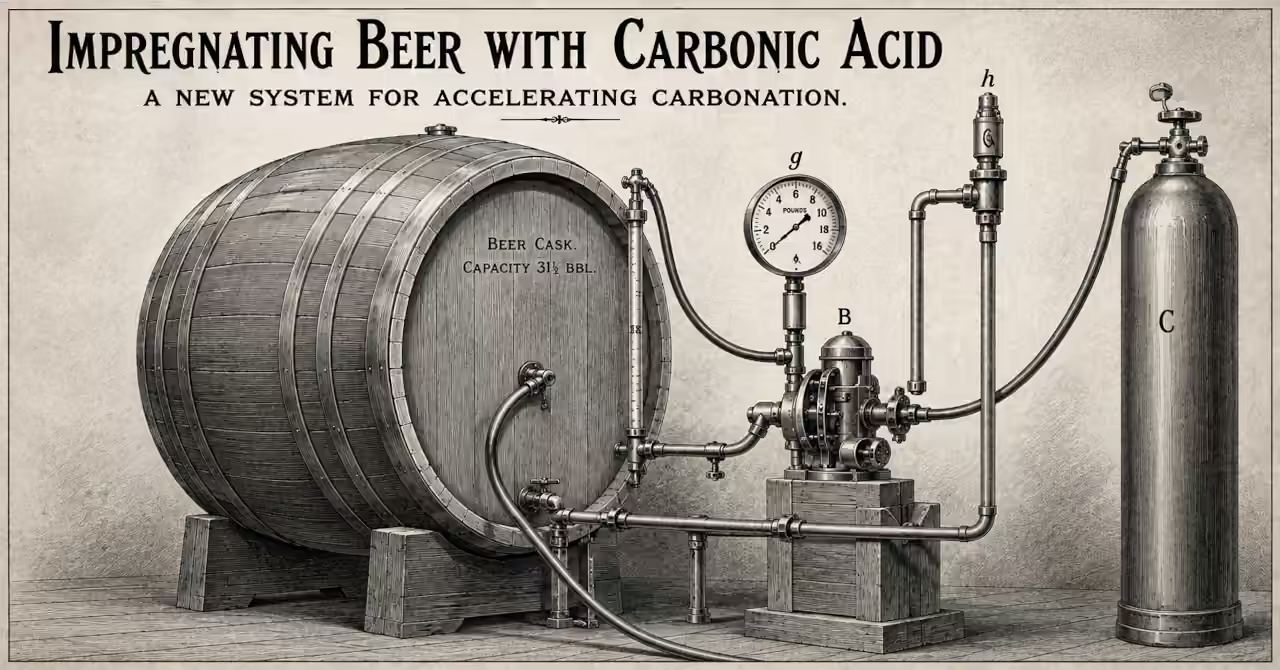
The surviving patent drawing makes the idea wonderfully tangible. There is a large wooden beer cask, hoses, valves, a pump, a pressure gauge and a cylinder of carbon dioxide. It looks thoroughly Victorian, yet its purpose is surprisingly modern.
Beer was drawn from the cask by a pump and returned to it, establishing continuous circulation. Carbon dioxide was introduced into this moving stream so that repeated circulation would expose the contents of the cask to the gas. Feigenspan even provided a safety valve and pressure gauge, allowing the brewer to observe and control what was happening inside the vessel.
Then comes the figure that makes the patent remarkable. Feigenspan wrote that in two hours or less the beer was generally completely saturated, with the gauge indicating between 10 and 12 pounds of pressure. The beer could then be left to rest for several days before being transferred into kegs, either directly or after filtration.
He Was Already Improving It
Feigenspan had apparently gone beyond merely imagining the process. His description records practical observations about making it work better. He found that taking carbon dioxide from the bottom rather than the top of the cylinder could provide more rapid absorption, because the carbonic acid could be supplied to the circulating beer more or less as a liquid. He specified approximately a quarter-pound of carbon dioxide for one barrel of beer.
He also proposed an alternative arrangement in which the carbon dioxide jet itself produced circulation, eliminating the need for a separate pump. Nor did he restrict the invention to one precise machine. His claims centred upon the broader method of circulating beer externally from a closed cask while injecting carbon dioxide into that moving stream.
What Could Have Been?
It is tempting, looking back more than 130 years later, to see the future sitting in Feigenspan's brewery. Here was a brewer thinking about fermentation not simply as an inherited craft process, but as something whose individual functions might be separated, controlled and accelerated.
The patent documentation alone cannot tell us whether his method became commercially important, whether other brewers were developing comparable systems, or how directly it contributed to later forced-carbonation technology. Those questions require a wider investigation. What the documents do establish is fascinating enough. In 1892, Feigenspan proposed replacing the final fermentation used for carbonation with a controllable process involving pumps, circulating beer, compressed carbon dioxide and measured pressure.
Had his particular system become widely adopted, improved and standardised, the history of industrial brewing might have followed a subtly different path. The great transformation he imagined was not really carbonation itself. It was the possibility of replacing time and biological variability with machinery.
Conclusion
Christian Feigenspan signed his patent specification on 26 April 1892. On the page, his invention is little more than a wooden barrel surrounded by pipes, a pump and a gas cylinder. Yet behind that deceptively simple drawing is a recognisably modern idea: make the process measurable, circulate the product, introduce exactly what is needed, and obtain in hours what fermentation had previously been asked to accomplish.
Perhaps that is what makes forgotten patents so compelling. Occasionally, among the valves, barrels and faded handwriting, we glimpse a road technology might have taken. In Feigenspan's case, that road leads from a Newark brewery in 1892 towards a tantalising question: how different might beer have become if his two-hour idea had caught on?
From the Curator's Workshop
From ingenious brewing machinery to the designs of William Morris, the Victorian world was filled with people determined to make everyday objects better. Carry a little of that inventive spirit with you with the Phillaneum’s William Morris Portrait Library Tote Bag, created for readers who enjoy surrounding themselves with the art, ideas and curiosities of the nineteenth century.

Author's Notes
I thought that Feigenspan's apparatus could hardly look more Victorian. There it was: a wooden cask surrounded by pipes, a pump and a cylinder of compressed gas. Look past the nineteenth-century hardware, however, and the thinking becomes strikingly modern. Feigenspan saw a biological process that normally demanded time and asked a very different question: could one part of it instead be measured, controlled and accelerated by machinery? It is a small conceptual leap on paper, but one that anticipates the philosophy behind an enormous amount of later industrial technology.
What particularly struck me was that this was not merely a speculative drawing. Feigenspan recorded operating pressures, a quantity of carbon dioxide per barrel and observations about how drawing carbon dioxide from different parts of the cylinder affected absorption. Most wonderfully, he claimed that the beer could generally be saturated in two hours or less. Those details give us the impression of an inventor who had been experimenting with his apparatus, observing its behaviour and refining the process rather than simply imagining what might work.
One detail, however, gave my modern eye pause: the apparent peril of pumping compressed carbon dioxide into a wooden cask. It is difficult to look at that barrel and not wonder what happened if the pressure simply kept rising. Feigenspan had thought about that too. His apparatus included a pressure-relief valve, allowing excess pressure to escape rather than continue building inside the cask. I find that small detail rather reassuring, but also revealing: this was not simply a scheme for forcing gas into a barrel. Feigenspan was designing a controlled pressure system, complete with provision for what might happen when the pressure became too great.
There is also something tantalising about inventions such as this because history tends to show us the technologies that ultimately succeeded, making their development appear almost inevitable. Feigenspan's patent reminds us that it was not. The nineteenth century was crowded with alternative machines, processes and ideas competing to solve the same problems. I cannot claim from this patent alone that his particular system would have transformed brewing, but I can look at that wonderful drawing and recognise an idea reaching towards the future. For me, that possibility of discovering a technological road that might have been taken is precisely what makes forgotten inventions worth investigating.
Notes & Memoranda
As is often the case, the subject extends beyond the bounds of a single article. The notes and memoranda below gather together useful definitions, related observations, references, and occasional curiosities discovered along the way.
Glossary
Some of the terms used in this article have specialised, historical or technical meanings. This glossary provides additional context for selected terms and ideas.
- kraeusen
- A German-derived brewing practice in which actively fermenting young beer or wort is added to a larger batch to restart fermentation and produce natural carbonation; historically used to prime casks without adding sugar. Kraeusen (also written kraeusening) alters flavour and carbonation by introducing live yeast and fermentable material rather than mechanically adding gas.
- ruh-beer
- An older brewing term for beer that has completed its first, active fermentation and is being held in casks for conditioning before any secondary treatment; effectively the intermediate or ‘rough’ beer awaiting kraeusen or further maturation. The phrase emphasises the staged process brewers used to manage yeast activity and carbonation before modern forced methods.
- carbonic acid
- A nineteenth‑century name for what brewers experienced as dissolved carbon dioxide in beer; historically used to describe the fizz and preservation effects of CO2. Modern chemistry recognises a small fraction of dissolved CO2 converts to carbonic acid (H2CO3), but the historical term was mainly a practical label for the gas responsible for effervescence and mild acidity.
- forced carbonation
- The deliberate, mechanical introduction of carbon dioxide into beer under pressure to achieve desired carbonation levels, rather than relying on secondary fermentation to produce CO2 naturally. It speeds production, yields more consistent effervescence and requires pressure control and equipment such as cylinders, gauges and pumps.
- pounds of pressure (psi)
- A gauge reading (pounds per square inch) used to measure internal pressure in a vessel; in brewing a reading of 10–12 lb/in² indicates moderate pressure applied to encourage CO2 dissolution into beer. Such measurements let brewers control carbonation, predict safety limits for casks and standardise outcomes across batches.
Frequently asked questions
Curious about something you’ve just read? These frequently asked questions explore some of the key ideas, details and questions surrounding the topic.
What did Christian Feigenspan's 1892 invention claim to accomplish?
He claimed to carbonate beer by circulating it through a closed system while injecting carbon dioxide, completely saturating the beer in two hours or less and thereby dispensing with the traditional addition of kraeusen and final fermentation.
How did Feigenspan's carbonation machine work?
Beer was pumped from a wooden cask through hoses where carbon dioxide was injected into the moving stream, with a safety valve and pressure gauge to observe and control the process; he also proposed using the CO2 jet itself to produce circulation in an alternative arrangement.
What practical details did Feigenspan provide about gas use and pressure?
He reported that beer was generally completely saturated in two hours with the gauge showing between 10 and 12 pounds of pressure, and he specified roughly a quarter-pound of carbon dioxide per barrel.
Did Feigenspan's method become the standard approach to carbonation?
The patent documentation does not show whether the method became commercially important or directly influenced later forced-carbonation technology; determining that requires a wider historical investigation and remains uncertain.
Further Reading…
- Canadian Patents Issued 16th March 1893, Engineer and Inventor, April 1893.
- Feigenspan, Christian. Process and Apparatus for Impregnating Beer with Carbonic Acid. Canadian Patent No. 42,318, 1893.
Disclosure
This article explores a historical patent and its possible significance based on surviving documentation. Any discussion of its wider influence or potential impact on brewing technology is interpretive and should not be taken as evidence that the invention was commercially adopted or directly influenced later brewing practices.