ENGINEER AND INVENTOR  |  April 1893

A New Claimant for the Invention of the Electric Glow Lamp
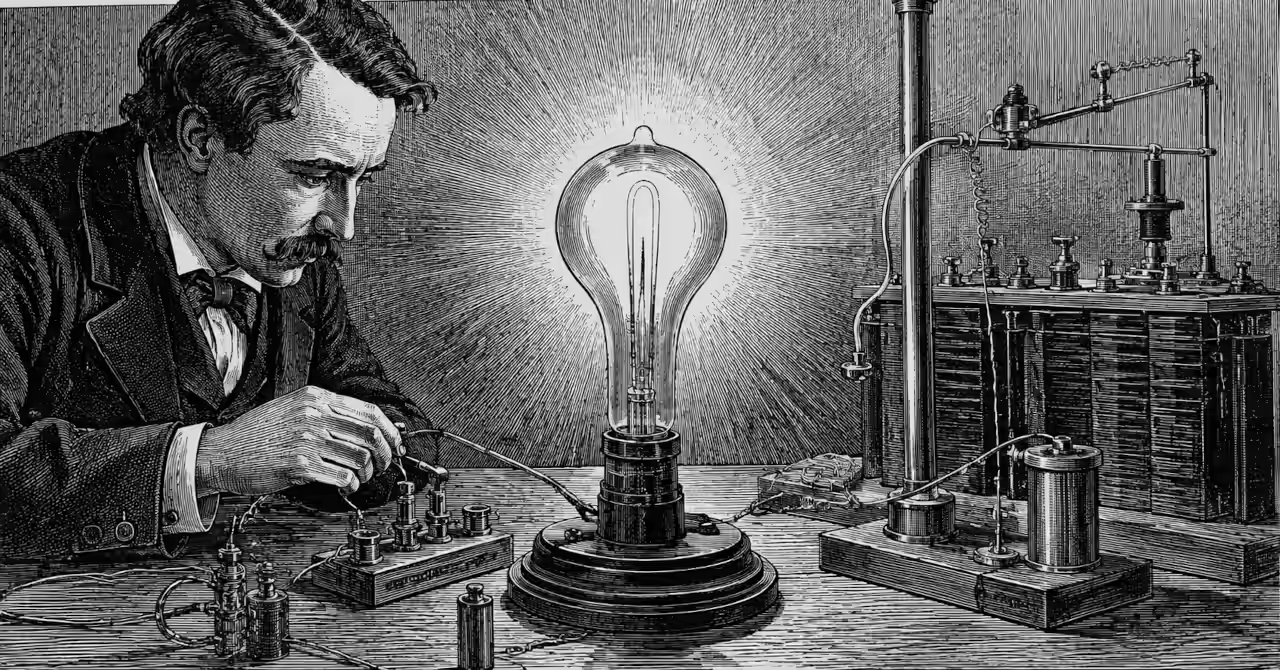
Nineteenth-century inventor demonstrating an incandescent electric lamp in a laboratory, rendered as a greyscale woodcut engraving
Recreated 1890s technical journal scene in the style of a nineteenth-century print image

Electrical circles have been stirred from centre to circumference during the past month by the appearance, under somewhat sensational circumstances, of a new and hitherto unknown claimant for the honor of having invented the incandescent electric lamp, commonly known as the electric light bulb. It will be remembered that the long and expensive litigation over the validity of Edison's patent was only lately decided in his favor against the rival Sawyer-Mann patents.

The General Electric Company, which is the owner of the Edison patent, promptly proceeded to bring suit against a number of manufacturers engaged in the manufacture of glow lamps (electric light bulbs) for infringement. The company was proceeding aggressively and successfully in having restraining order: and injunctions issued against such offenders, until near the close of January, when they struck a snag in the form of a defence of a new and startling character offered by one of the manufucturers whom they had summoned into court.

This defence was neither more nor less than the allegation, backed by numerous affidavits and a number of exhibits, that one Henry Goebel, a German, who has been for many years a resident of New York, where he had followed the trade of a watchmaker, had himself invented, used and repeatedly exhibited in his shop, and in the streets of New York, previous to the year 1860, incandescent electric lamps, lighted by means of primary battery, and which, in every essential particular, in the use of a carbonized filament of vegetable fiber of high resistance, a vacuum chamber of glass, with leading-in wires of platinum and other metals, fully answers to the description of the Edison lamp of today.

Such prominent electrical experts as Frank L. Pope and Prof. Charles R. Cross, testify, after examination of the exhibits, that the lamps were undoubtedly identical with the Edison lamp in the essential features of employing a high resistance carbonized filament in vacuo.

That such important facts should have slumbered all these years, when they were apparently so accessible, and would have been in such demand in the great suit just won by the Edison interests, is one of the curious things that defy explanation. The outcome of this new turn in the litigation of the lamp question will be watched with intense interest. That the new matter is not esteemed to be dangerous to the Edison interests, is attested by the steadiness of the securities of the company, which, at the time of this writing, appear to have been unaffected by it.

Market Analysis: Early incandescent lamps occupy a unique place between industrial history and decorative collecting. While common household bulbs were produced in enormous quantities, surviving examples from the formative years of electric lighting are increasingly sought after by collectors. Carbon filament lamps, unusual bulb shapes, original packaging, and examples associated with early manufacturers attract particular interest. Alongside museum-grade pieces, the market also offers affordable examples suitable for display collections, restoration projects, and enthusiasts interested in the history of electrical innovation.

Vintage incandescent light bulbs and carbon filament lamps displayed as collectible electrical artefacts
eBay (US) advertisement — search the global marketplace for antique incandescent light bulbs

Exhibit Notes

Published during a period of intense patent litigation surrounding electric lighting, this article captures a moment when the ownership of technological innovation carried enormous commercial significance. The emergence of Henry Goebel as a potential prior inventor threatened not only an accepted historical narrative but also the legal foundations of valuable electrical patents. At the time, companies such as General Electric were actively defending their intellectual property through the courts, making questions of priority far more than matters of historical curiosity. Whether ultimately successful or not, claims such as these reveal the highly competitive environment in which many nineteenth-century inventions were developed, defended, and commercialised.

Curator's Review

When I first encountered this article, I expected to find another nineteenth-century report celebrating a new electrical achievement. Instead, I found something far more intriguing: a challenge to a story that many readers would have assumed was already settled. The article captures a moment when the accepted narrative surrounding the invention of the incandescent lamp was suddenly thrown into doubt by the emergence of a previously unknown claimant.

What drew me to preserve this piece was not the technical question of who invented the light bulb first, but the human story that surrounds the claim. History is often presented as a collection of established facts, yet articles such as this remind us that historical memory is frequently contested. Patents, reputations, commercial interests, and personal testimony all intersect here, creating a drama that extends far beyond the workshop and laboratory.

Whether Henry Goebel's claim ultimately convinces the reader is almost secondary. The enduring value of this article lies in its record of uncertainty. It preserves a fascinating moment when the past itself seemed open to revision, inviting us to consider how inventions become legends and how legends become history.

Notes & Memoranda

Glossary

Incandescent Lamp
An electric lamp that produces light by heating a filament until it glows. Early versions used carbonized filaments enclosed within a glass bulb.
Carbonized Filament
A thin strand of carbon, often produced from treated plant fibres, used in early electric lamps to emit light when heated by an electrical current.
Vacuum Chamber
The airless glass enclosure surrounding a lamp filament. Removing oxygen helped prevent the filament from burning away rapidly.
Patent
A legal right granted to an inventor, providing exclusive control over the manufacture and use of an invention for a defined period.
Patent Litigation
Court proceedings concerning the ownership, validity, or infringement of patented inventions.
Injunction
A court order directing a person or company to stop a particular activity, often used in patent disputes.
Primary Battery
A non-rechargeable battery that converts chemical energy into electrical energy, commonly used in early electrical experiments.
General Electric Company
An American electrical company that acquired and defended many of Thomas Edison's electrical patents during the late nineteenth century.

Frequently asked questions

Who was Henry Goebel?

Henry Goebel was a German-born New York watchmaker who became the subject of nineteenth-century patent disputes after claims emerged that he had constructed incandescent electric lamps before Thomas Edison's famous patent.

What was the Goebel claim?

The claim alleged that Goebel had built and demonstrated incandescent lamps before 1860 using a carbonized filament, a glass vacuum chamber, and electrical connections that closely resembled later commercial lamp designs.

Why was this claim important in 1893?

The claim emerged during major patent litigation involving Edison's incandescent lamp and raised the possibility that earlier work could challenge the accepted history of one of the nineteenth century's most significant inventions.

Why is this article exhibited by Phillaneum?

Phillaneum exhibits this article because it demonstrates how invention, memory, patents, reputation, and historical narratives can remain contested long after a technology becomes widely accepted and celebrated.

Mentions & Echoes

The following articles extend or reflect the ideas explored here, returning to similar questions through different materials, contexts, and lines of inquiry.

Disclosure

This article presents a curated extract and editorial interpretation of material originally published in Engineer and Inventor, April 1893. The content reflects the language, assumptions, and technical understanding of its time. While care has been taken to preserve the original context, minor formatting and presentation changes have been made. Readers seeking deeper technical accuracy or historical verification should consult primary sources and period engineering references.

Change log

  1. [2020-12-27] Initial release
  2. [2022-06-19] Minor editorial and metadata updates
  3. [2022-12-27] General editorial alignment
  4. [2026-05-30] Migration to Chronos Engine