How Incandescent Lightbulbs Work and Why Edison’s Design Won
·Revised
Introduction
If you have arrived here from our 1893 article on the three-wire system of electric distribution, you have already seen part of the infrastructure that helped make electric lighting practical. Now we can follow those wires to the object at the other end.
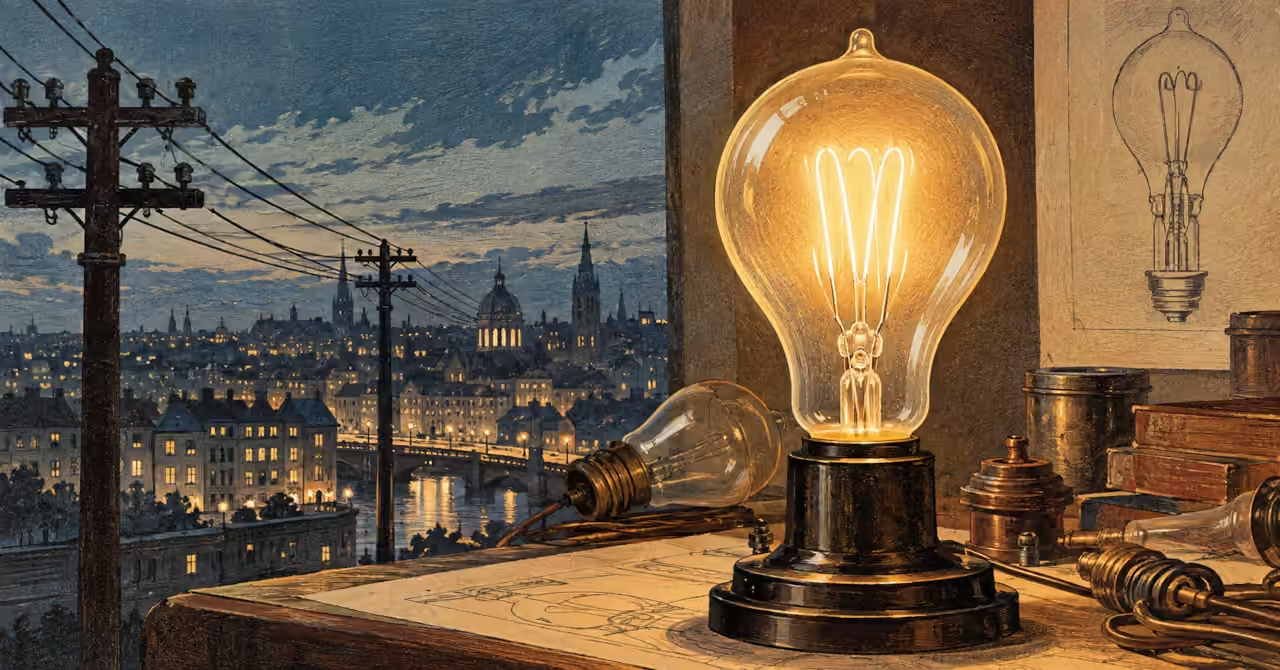
An incandescent lightbulb performs an extraordinary trick by deliberately turning most of its electrical energy into heat. Current passes through a very thin filament until it becomes hot enough to glow. A glass envelope prevents that white-hot material from simply burning away in the air. It looks simple because more than a century of engineering made it look simple.
But making something glow was never the hardest problem. Inventors had demonstrated incandescent light before Thomas Edison entered the field. The real challenge was producing a lamp that was bright enough, durable enough and cheap enough to manufacture, while drawing a manageable current when hundreds or thousands of lamps were connected to an electrical network. That last requirement would prove particularly important.
There is a problem with asking who invented the lightbulb: which lightbulb? The first demonstration, the first vacuum lamp, the first durable filament and the first commercially useful lighting system are different achievements. History compresses them into a single object and usually attaches a single name.
1. The filament is the heater: Light begins as electrical resistance
The most important part of an incandescent lamp is also one of the smallest. The filament is a narrow strip or wire deliberately made to resist the flow of electricity. Push current through it and electrical energy becomes heat. Raise its temperature far enough and some of the energy begins to emerge as visible light.
That sounds straightforward until you try to build one. The filament has to become extraordinarily hot without melting, burning, sagging or breaking. It must also have the right electrical resistance. Make it too thick or too conductive and the lamp can demand an impractically large current. Make it too fragile and you have produced a spectacular laboratory demonstration rather than a useful household product.
There is another catch. Incandescent lamps are charming precisely because they are so good at getting hot, but heat is also their great inefficiency. Much of the energy leaves as infrared radiation rather than visible light. The familiar warm glow is therefore the visible portion of a much larger thermal event.
This is why the filament became the central engineering argument inside the bulb. It needed to be hot enough to shine, resistive enough to suit the electrical supply, durable enough to survive and consistent enough to manufacture by the thousands. Making a wire glow was the easy part. Making the right wire glow was much harder.
2. Before tungsten came carbon: Edison was not first
By the time Edison began serious work on incandescent lighting, he was entering an existing field. British inventor Joseph Swan had spent years experimenting with carbon conductors inside evacuated glass bulbs. Improvements in vacuum pumps eventually made such lamps much more practical, and Swan publicly demonstrated incandescent lighting in Britain before Edison unveiled his commercially important lamp.
That fact sometimes gets turned into a modern accusation that Edison simply received credit for somebody else's invention. The history is more interesting than that. Swan and Edison were solving overlapping problems, but a lamp that could produce light was not necessarily a lamp suited to supplying an entire town.
At Menlo Park, Edison and his assistants tested a remarkable range of filament materials. On 21–22 October 1879 they achieved a successful lamp using carbonised cotton thread. Further experiments led to carbonised bamboo for commercial lamps, with the U.S. Department of Energy recording examples lasting as long as 1,200 hours.
Durability mattered, but Edison was pursuing another property that is much less obvious when you look at an old bulb: high electrical resistance. That would help turn the contest from a race to make the best individual lamp into a race to build the most practical lighting system.
3. Why Edison’s design won: The bulb had to work by the thousand
Imagine that you have successfully illuminated one room. Now someone asks you to illuminate a street, then a neighbourhood, then thousands of buildings. Suddenly the brightness of your experimental lamp is only one part of the problem. Every lamp needs electricity delivered through copper conductors, and every additional ampere affects the size, cost and losses of that distribution network.
This exposed an important difference between competing approaches. Swan's early lamps used relatively low-resistance carbon conductors and consequently required comparatively high currents. They could produce useful incandescent light, but multiplying that electrical demand across a large installation made distribution more difficult and expensive.
Edison deliberately pursued a high-resistance lamp. A thin, high-resistance carbon filament allowed useful light at a lower current and made it practical to connect many lamps in parallel across a distribution system. Each lamp could be switched independently while operating from a common supply. The filament was therefore not merely a better glowing thread. Its electrical characteristics were chosen with the network beyond the bulb in mind.
This is the part of the Edison story that the familiar tale of a lone inventor and a miraculous bulb tends to miss. Edison and his team worked on generators, conductors, distribution, switches, sockets, fuses and meters as parts of the same problem. Manufacturing mattered too. A lamp intended for mass electrification had to be made repeatedly to predictable dimensions and performance, not individually coaxed into life on an experimenter's bench.
There was a commercial dimension as well. An electric-light company did not merely need a bulb that worked. It needed generating equipment, wiring, installation methods, replacement lamps and a way of measuring what customers consumed. Edison was trying to make electric lighting into an infrastructure business.
So did Edison simply defeat Swan? Not quite. Their histories eventually became entangled rather than ending with one inventor disappearing. Patent disputes followed, and in Britain their interests were combined in the Edison & Swan United Electric Light Company, commonly known as Ediswan. Swan remained an important figure in the development of practical incandescent lighting.
This gives us a better answer to the question in the title. Edison's design won not because he was the first person to make a conductor glow, but because his high-resistance lamp was engineered as one component of a scalable electrical system. The winning invention was larger than the bulb.
The copper problem: a lamp can work beautifully on a laboratory bench and still be a poor commercial design. Once thousands of lamps are connected, current demand, conductor size and the cost of distributing electricity become part of the lamp's engineering.
4. The vacuum is part of the lamp: Glass does more than keep the dust out
There was still a rather immediate problem inside every incandescent lamp. Put a red-hot carbon or metal filament in ordinary air and oxygen attacks it rapidly. The transparent glass envelope therefore creates something the filament needs to survive: a controlled atmosphere.
Early practical incandescent lamps relied on a high vacuum. Later lamps commonly used gases such as nitrogen or argon. In either case, the apparently empty space around the filament is an engineered part of the lamp rather than unused volume.
The glass itself has a surprisingly difficult job. It must remain transparent, tolerate repeated heating and cooling, maintain its internal atmosphere and form a reliable seal around the conductors carrying electricity into the bulb. The internal stem must support a delicate filament without providing an easy path for air to leak inside.
The atmosphere also changes how the filament ages. Hot filament material slowly evaporates. In a vacuum, some of that material can settle on the inside of the glass and darken it. A gas filling changes both evaporation and heat transfer and can permit different filament operating conditions.
In other words, the bulb is not merely a convenient transparent container. The space inside it is part of the mechanism.
5. Why tungsten replaced carbon: Better light meant running hotter
Edison’s carbon filaments helped make commercial incandescent lighting possible, but they were not the end of the story. Engineers wanted more visible light from the electricity being consumed, and one route to greater efficiency was to operate the filament at a higher temperature.
Tungsten was exceptionally attractive because of its very high melting point. Early twentieth-century developments, including practical tungsten filaments from 1904 onward, opened the way to lamps that could operate substantially hotter than their carbon predecessors.
Of course, solving one problem created another. Tungsten was difficult to turn into the fine, reliable filament required inside a lamp. Manufacturing techniques had to improve. Filaments were later coiled so that a long length of hot wire could occupy a compact space, and gas-filled lamps allowed designers to alter the balance between filament temperature, evaporation and heat loss.
Notice the pattern. There was never a point at which engineers simply discovered the best filament. A hotter filament can produce more useful light, but it also evaporates faster. Extend its life by operating it more gently and you sacrifice brightness and efficiency. Change the gas around it and you change heat loss again.
The incandescent bulb was an optimisation problem hiding inside a household object.
6. The Centennial Light: What happens if longevity wins?
If hotter and brighter can mean shorter-lived, an obvious question follows: just how long could an incandescent filament survive if longevity became the priority?
The Centennial Light at a fire station in Livermore, California, offers an extraordinary real-world example. Installed in 1901, it has remained illuminated nearly continuously for more than a century and is recognised by Guinness World Records as the world's longest-burning lightbulb.
Its survival is remarkable, but it is not evidence that manufacturers could simply have given every household a century-long bulb. The Centennial Light is now extremely dim and operates at only a few watts, according to the Livermore Centennial Light Committee. Low-power operation reduces filament temperature and stress, while long periods of continuous operation also avoid much of the repeated thermal expansion and contraction caused by switching.
The trade-off is visible with your own eyes. The lamp survives, but it provides very little useful illumination. Everyday lamps were expected to be brighter, smaller, affordable and useful. Those requirements demanded more aggressive operating conditions and therefore shorter service lives.
The Centennial Light is fascinating precisely because it pushes one variable towards an extreme. It reminds us that engineering longevity is rarely free.
Fun Fact… A failing incandescent filament can help destroy itself. As filament material slowly evaporates, a section may become thinner than the rest. That weak point becomes hotter, accelerating further evaporation until the filament finally breaks.
Conclusion
The incandescent lightbulb became ordinary only after engineers solved a surprisingly interconnected collection of problems. The filament had to glow without immediately destroying itself. The glass had to maintain a controlled atmosphere. Factories had to make lamps consistently. And, crucially, the electrical network had to supply large numbers of them without requiring an uneconomical quantity of copper and generating equipment.
That is why the argument over who “invented the lightbulb” can obscure the more interesting history. Joseph Swan and other experimenters made important contributions to practical incandescent lighting. Edison’s decisive advantage was to treat the lamp as part of something larger. Resistance, current, generators, conductors, sockets, switches, meters and manufacturing all belonged to the same problem. The breakthrough was not making one wire glow. It was building a world in which millions of glowing wires could work.
Look closely at an old bulb and its glass, supports, wires and filament preserve that engineering argument in miniature. Victorian inventors also left us another way to reconstruct such arguments: their patents. These documents can reveal not only what an inventor claimed, but how a problem was described and which details were considered novel. Continue with How to Read a Victorian Era Patent, where we take apart a real nineteenth-century patent and learn how to read the evidence for ourselves.
From one bulb to a cabinet of mechanisms
The incandescent lamp is a wonderful example of why we like looking inside old technology. A thin carbon filament seems like a tiny detail, yet its electrical resistance could influence how much current a lighting system required, how much copper was needed to distribute that electricity, and ultimately whether electric light made commercial sense at scale. Around it, the vacuum, glass envelope, support wires and base each solved another part of the problem. What appears to be a simple glowing bulb is really a cabinet of interconnected engineering decisions.
That same idea sits behind our Mechanisms collection: take familiar objects apart, look beyond the component everyone notices, and discover the engineering decisions hidden inside.

Author's Notes
I used to turn incandescent lightbulbs on without giving them a second thought. I grew up with them, changed them when they blew and occasionally burnt my fingers on one. What surprised me while revisiting the technology was how much engineering history had become invisible through familiarity. The bulb looks almost inevitable to us: glass, filament, wires and a metal base. Yet none of those parts was inevitable. Each records a decision about resistance, temperature, materials, manufacturing and cost. Even the space that appears to contain nothing at all, the vacuum or gas surrounding the filament, is a working part of the machine.
The more interesting surprise was that the bulb cannot really be understood by studying the bulb alone. Joseph Swan could make useful incandescent light, and Edison was certainly not the first person to make a conductor glow. What distinguished Edison's approach was the question he was effectively asking: what must this lamp be like if we intend to connect thousands of them? Suddenly filament resistance becomes a question about copper wire, generators and distribution economics. A tiny change inside the glass envelope can alter the economics of an electrical network stretching across a city. That relationship between component design and system design is, to me, the most revealing part of the story.
It also changes how I think about the word invention. We naturally want an invention to have a moment, a name and an object we can point to. Engineering history is rarely so obliging. The incandescent lamp emerged from better vacuum pumps, experiments with carbon, improved generators, electrical distribution, manufacturing methods and the work of competing inventors. Edison matters enormously, but understanding why he matters requires looking beyond the famous bulb. Sometimes the most important invention is not the component itself, but the system that finally allows the component to become ordinary.
Notes & Memoranda
As is often the case, the subject extends beyond the bounds of a single article. The notes and memoranda below gather together useful definitions, related observations, references, and occasional curiosities discovered along the way.
Curator's Note — When does an invention become an invention?
Patent history makes technological progress look tidier than it was. A patent records a claim at a particular moment; it does not necessarily identify the first experiment, the decisive improvement or the technology people eventually adopted. The incandescent lamp is an unusually good example of the difference.
Glossary
Three technical ideas are particularly important to understanding why the incandescent lamp worked, and why Edison's version suited large electrical networks.
- Electrical resistance
-
The opposition a material presents to the flow of electric current. In this story, resistance matters far beyond the bulb itself. Edison deliberately pursued a high-resistance filament that could produce useful light while drawing less current than competing low-resistance lamps. Multiplied across hundreds or thousands of lamps, lower current reduced the amount of copper required for distribution and helped make a large-scale lighting network economically practical.
Related on Phillaneum: The Three-Wire System of Electric Distribution (1893) shows how the economics of carrying electricity became an engineering problem in its own right. - Filament
-
The thin resistive conductor that becomes hot enough to emit visible light when electric current passes through it. A successful filament had to satisfy several competing requirements at once: sufficient resistance, extreme operating temperature, useful brightness, acceptable life and repeatable manufacture. Its dimensions and material therefore affected not only the lamp's performance, but the electrical system supplying it.
Related on Phillaneum: A New Claimant for the Invention of the Electric Glow Lamp (1893) reveals how claims over the incandescent lamp were still being contested more than a decade after Edison's famous experiments. - Controlled atmosphere
- The deliberately created environment surrounding the filament inside the glass envelope. Early practical lamps used a high vacuum to prevent oxygen from rapidly destroying the hot filament. Later lamps used gases such as nitrogen and argon to alter heat transfer and filament evaporation. What appears to be empty space inside a bulb is therefore an engineered part of the mechanism.
Further Reading…

References and Further Reading
- Smithsonian National Museum of American History: Incandescent Lamps—How They Work
- U.S. Department of Energy: The History of the Light Bulb
- Smithsonian Institution: Edison Light Bulb
- Thomas Edison National Historical Park and Rutgers: Electric Lamp
- City of Livermore: World’s Longest-Burning Light Bulb Turns 125
Disclosure
This article is intended as a general exploration of the history and engineering of incandescent lighting. Historical accounts of the development of the electric lamp involve numerous inventors, experiments and competing technologies, and simplified descriptions should not be interpreted as assigning sole invention to any one individual. Technical explanations are provided for historical interest and are not instructions for working with electrical equipment.