7 Victorian Analog Computers That Didn't Need Electricity
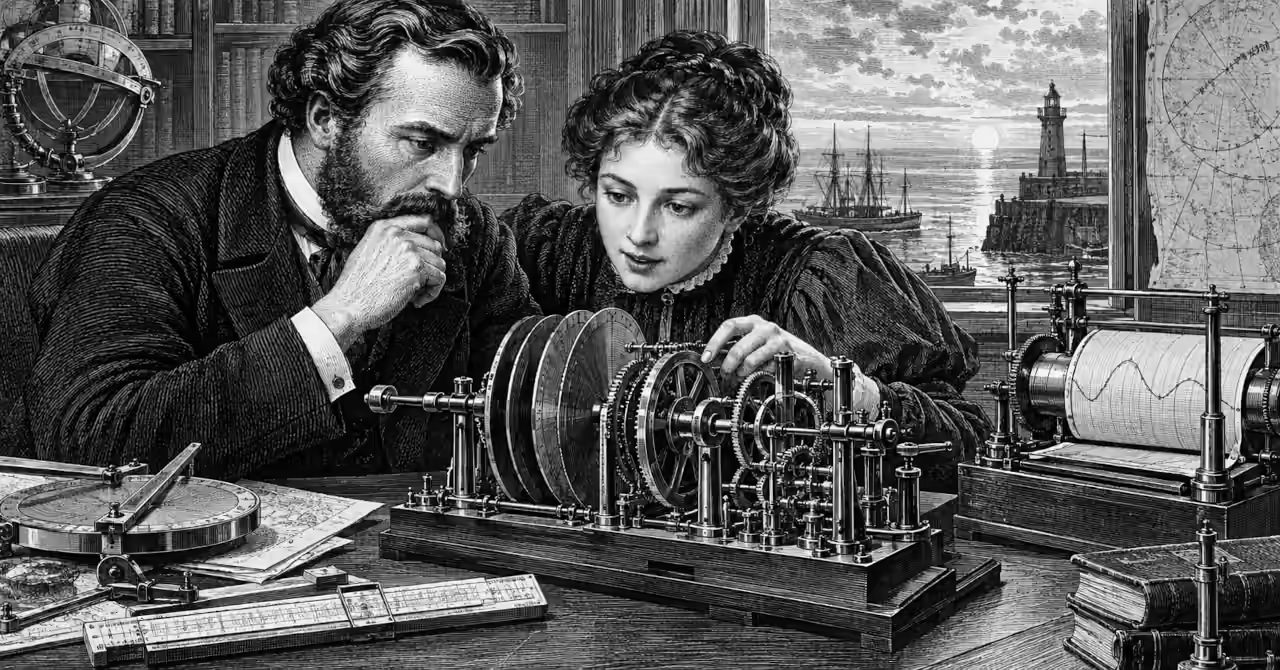
Long before computers became electronic, Victorian engineers were already building machines that could calculate, measure, predict and even solve mathematical problems. They did not have screens, memory chips or keyboards. Instead, they used sliding scales, rotating discs, brass gears, pulleys and carefully shaped wheels.
These devices were not computers in quite the way we now understand the word. Most were designed to perform one particular kind of calculation rather than run different programs. Yet they shared a remarkably modern idea: a physical machine could represent a mathematical problem and produce an answer faster, or more reliably, than a person working with pencil and paper.
Some fitted into a coat pocket. Others occupied an entire room. Together, they reveal that the history of computing began much earlier than electronics.
1. Slide Rules: The Engineer’s Pocket Computer
A slide rule looks like an ordinary ruler until you notice that one part moves. Its scales are arranged logarithmically, allowing the user to multiply and divide by sliding two numbered sections against one another. More elaborate versions could also assist with square roots, trigonometry and other calculations.
By the late Victorian period, slide rules were becoming essential tools for engineers, surveyors, navigators and scientists. They did not display every decimal place, but that was rarely the point. A skilled user could obtain a practical answer quickly enough to size a pipe, estimate a load or check a design.
The most impressive component was not the instrument itself, but the knowledge in the operator’s hands. For generations of engineers, carrying a slide rule was rather like carrying a scientific calculator—except that it never needed batteries and could not object to being dropped.
2. Planimeters: Measuring the Shape of Almost Anything
Suppose you had a map showing an irregular lake, field or parcel of land. Working out its area by dividing it into rectangles and triangles would be possible, but tedious. A planimeter offered a more elegant solution.
The operator traced the boundary of the shape with a pointed arm. As the arm moved, a system of joints and wheels translated that journey into a measurement of the enclosed area. It was as though the machine understood the difference between wandering around a shape and measuring what lay inside it.
Improved planimeters appeared during the nineteenth century and became useful to surveyors, engineers and mapmakers. They were analog computers in a very literal sense: the movement of the mechanism physically represented the geometry of the problem.
3. Mechanical Integrators: Turning Motion into Mathematics
Integration sounds forbidding, but its practical purpose is often straightforward: finding a total from many small changing quantities. Victorian engineers developed mechanical integrators that could perform this process using wheels, discs and rotating shafts.
A wheel touching a moving disc might rotate more or less depending on where it rested. By carefully arranging those movements, the machine could accumulate a result. Instead of solving a long mathematical expression line by line, the operator allowed the mechanism to embody the calculation.
These integrators became the hidden building blocks of more ambitious machines. Their descendants would eventually help solve complex engineering equations in the enormous differential analysers of the twentieth century. The room-sized machines came later, but the crucial mechanical idea was already taking shape in the Victorian workshop.
4. Harmonic Analysers: Machines That Could Untangle Waves
Many natural events appear irregular until they are separated into simpler repeating patterns. Sound, vibration and tides can all be understood as combinations of waves. Victorian physicists used harmonic analysis to break complicated curves into these underlying components.
Doing this by hand demanded a formidable amount of calculation. Mechanical harmonic analysers made the task more manageable. An operator could trace a recorded curve, while the machine’s mechanisms extracted information about the different waves hidden within it.
This was useful wherever repeating motion mattered: acoustics, engineering vibration, astronomy and tidal science. To a modern reader, the machine seems almost uncanny. A collection of brass arms and rotating discs could examine a wobbly line and reveal the orderly rhythms concealed inside it.
5. Lord Kelvin’s Tide Predictor: Forecasting the Sea with Gears
Tides do not follow one simple clock. They are influenced by several astronomical cycles, each contributing its own repeating rise and fall. Calculating their combined effect for a particular port was slow and demanding work.
In the early 1870s, William Thomson—later known as Lord Kelvin—designed a tide-predicting machine that combined these separate cycles mechanically. Pulleys, cords and rotating components represented different tidal influences. As the machine turned, their movements were added together and traced as a predicted tide curve.
The result was more than a scientific curiosity. Reliable tide tables mattered to shipping, harbour operations and coastal navigation. A machine of gears and wires was helping sailors know when there would be enough water beneath their ships. It was a specialised computer built not to count money or print numbers, but to imitate the rhythm of the sea.
6. The Arithmometer: A Mechanical Office Calculator
Not every Victorian calculating machine belonged in a scientific laboratory. The arithmometer brought mechanical calculation into offices, banks, insurance companies and commercial organisations.
Developed from a design patented by Charles Xavier Thomas de Colmar in 1820, later models could perform addition, subtraction, multiplication and division using cranks, sliders and numbered registers. The machine was not analog in the same sense as a planimeter or tide predictor; it handled distinct numerical values. Nevertheless, it was an important Victorian computer and one of the first calculating machines to achieve lasting commercial success.
Its appeal is easy to understand. Large calculations could be completed with less mental labour and fewer opportunities for error. The familiar office sound of clicking keys had not yet arrived, but the age of mechanised arithmetic had begun.
7. Babbage’s Difference Engine: A Computer Too Ambitious for Its Time
Charles Babbage imagined machines far more ambitious than ordinary calculators. His Difference Engine was designed to calculate and print mathematical tables automatically, reducing the human errors that frequently appeared in navigation, astronomy and engineering references.
The complete machine was not built during his lifetime, partly because of its immense complexity, cost and manufacturing demands. Yet the design demonstrated how a sequence of calculations could be carried out through carefully organised mechanical operations.
Babbage’s later Analytical Engine went further, proposing a general-purpose machine controlled by punched cards. It remained unbuilt, but introduced ideas that resemble parts of modern computing: stored numbers, operations, input and output. The Victorians did not merely construct mechanical calculators. They began imagining programmable machines.
Before Silicon, There Was Brass
Victorian computers did not arrive as a single invention. They emerged from surveying, navigation, commerce, physics and the practical difficulties of engineering. A slide rule multiplied numbers. A planimeter measured irregular land. A tide predictor combined waves. An arithmometer relieved clerks of repetitive arithmetic.
What united them was the belief that a physical mechanism could perform part of the work of thought. Their gears, scales and rotating wheels converted mathematics into movement—and movement back into useful information.
The electronic computer would eventually make these machines obsolete, but it did not make them primitive. They were ingenious responses to real problems, produced by people who had already understood something profound: calculation did not have to exist only inside the human mind. Long before silicon chips began quietly processing billions of instructions, brass machines were already helping to calculate the Victorian world.
Did the Victorians Already Have GRIN Technology?
Mechanical computers were only one part of a much larger technological transformation. By the 1890s, Victorian workshops and laboratories were experimenting with heredity, automation, encoded information and increasingly precise materials. Viewed together, those developments begin to resemble something surprisingly modern: the convergence we now call GRIN.
From the Curator's Workshop
If you enjoyed discovering the ingenuity and craftsmanship behind the machines that helped calculate the Victorian world, carry a little of that same era with you. The Phillaneum William Morris Portrait Library Tote Bag celebrates one of the nineteenth century’s great creative minds, combining Victorian Arts and Crafts heritage with a practical everyday bag—and every purchase helps support Phillaneum’s continuing exploration of the remarkable Victorian world.

Author's Notes
Silicon has rather successfully convinced us that it invented computing. Processors, memory chips and electronic circuits are so completely associated with the word computer that it is easy to imagine everything before them as merely calculation. Look further back, though, and that distinction becomes much less comfortable. Victorian engineers were already building machines that could represent a problem, transform information and produce a useful result. Their computational medium was not silicon, but gears, discs, scales, pulleys and linkages.
Lord Kelvin’s tide-predicting machine is the example I find particularly inspiring. There is something marvellous about taking the overlapping rhythms of the sea, representing those astronomical influences mechanically, and allowing a machine to combine them into a forecast that ships and harbours could actually use. No processor, no screen and no software in the modern sense—just an extraordinarily clever physical model of a complicated natural system. It has changed the way I think about the history of computing. The electronic computer now seems less like the beginning of the story and more like an astonishing new chapter in a much older human ambition to make mathematics, information and machinery work together.
Notes & Memoranda
As is often the case, the subject extends beyond the bounds of a single article. The notes and memoranda below gather together useful definitions, related observations, references, and occasional curiosities discovered along the way.
Glossary
Some of the terms used in this article have specialised, historical or technical meanings. This glossary provides additional context for selected terms and ideas.
- Planimeter
- A handheld mechanical instrument that measures the area of an irregular plane figure by tracing its perimeter; a pointed arm follows the boundary while internal joints, wheels and linkages convert the path traversed into a direct reading of enclosed area, saving the tedious process of subdividing shapes into rectangles and triangles and making it especially useful for surveyors and mapmakers.
- Mechanical integrator
- A device that performs mathematical integration by converting continuous motion into an accumulated numerical result: moving parts such as a wheel in contact with a rotating disk change their rotation rate with position so the machine sums many small contributions automatically, a principle used to total varying quantities (for example, integrating speed to obtain distance) and later incorporated into larger differential analysers.
- Harmonic analyser
- A specialised mechanical computer that breaks a complex, irregular curve into simpler repeating wave components (analogous to Fourier analysis) by using rotating shafts, discs and linkages to extract amplitudes and phases of underlying sine-like terms; widely used in the nineteenth century to study tides, vibrations and sound before electronic signal processing existed.
- Arithmometer
- A commercially produced mechanical calculator, developed from an 1820 design by Charles Xavier Thomas de Colmar, that carried out discrete arithmetic operations (addition, subtraction, multiplication and division) with cranks, sliders and geared digit registers; unlike analog integrators it represented numbers directly and helped bring mechanised calculation into offices, banks and insurance firms.
- Analytical Engine
- Charles Babbage’s unbuilt design for a general-purpose mechanical computer that separated storage, processing and input/output and envisaged control by punched cards; although never constructed, it introduced core ideas of programmability and organised mechanical computation that prefigure modern computers.
Frequently asked questions
Curious about something you’ve just read? These frequently asked questions explore some of the key ideas, details and questions surrounding the topic.
How did a slide rule perform multiplication and what were its limitations?
A slide rule used logarithmically arranged scales on sliding sections so multiplying and dividing was done by aligning those scales; more elaborate models could help with square roots and trigonometry. It did not show every decimal place, so results were approximate, but it gave practical answers quickly and required no power source.
What is a planimeter and how did it measure area?
A planimeter measures the area of an irregular shape by having an operator trace its boundary with a pointed arm while a system of joints and wheels translates that motion into a measurement of the enclosed area. Improved planimeters in the nineteenth century were used by surveyors, engineers and mapmakers.
How did Lord Kelvin’s tide predictor work and why was it useful?
Lord Kelvin’s tide predictor mechanically represented different astronomical tidal cycles with pulleys, cords and rotating components whose movements were added together and traced as a predicted tide curve. That reliable prediction of tides was valuable to shipping, harbour operations and coastal navigation.
What were Babbage’s Difference and Analytical Engines intended to do, and why were they not completed?
The Difference Engine was designed to calculate and print mathematical tables automatically to reduce human errors, while the later Analytical Engine proposed a general-purpose, punched-card-controlled machine with concepts like stored numbers and input/output. They were not completed in his lifetime largely because of immense complexity, high cost and demanding manufacturing requirements.
Further Reading…


Disclosure
This article provides a general historical overview of Victorian-era calculating and computing devices. The term “computer” is used broadly to include mechanical, analog and calculating instruments that performed or assisted mathematical operations; these machines varied considerably in purpose, operation and capability, and should not be understood as direct equivalents of modern electronic computers.