The 1895 GRIN Machine That Predicted Our Future
·Revised
Introduction
GRIN stands for genetics, robotics, information systems, and nanotechnology: a modern way of grouping four technological domains often treated as major drivers of future change. The acronym belongs to contemporary technological discourse, yet the pattern it names is older than the language itself. This article argues that a Victorian workshop of 1895, while lacking modern instruments, was already pursuing those same four ambitions in early form: the control of heredity, the automation of motion, the encoding of knowledge, and the refinement of matter. The term is new. The convergence is not.
GRIN is not a modern invention, but a naming of a much older pattern already visible in Victorian practice.
The point is not that Victorians had modern GRIN technologies, but that they were already working toward the same four kinds of control through the tools available to them.
A Victorian workshop of 1895 could not produce a microchip, sequence a genome, or print a nanoscale device. It could, however, manipulate heredity through breeding, automate motion through mechanical design, encode instructions into systems of symbols and parts, and pursue ever finer control over materials and surfaces. In rougher and more visible form, the four tendencies were already there. The machine existed before the acronym.
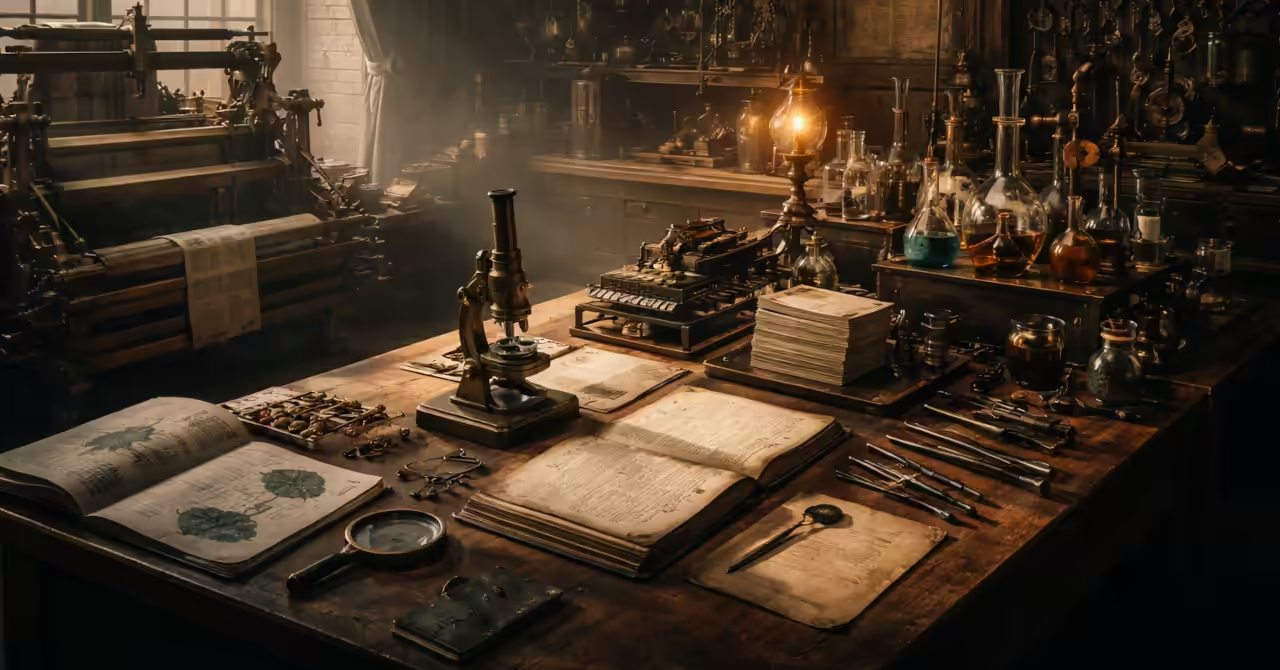
This is the curious proposition of the 1895 GRIN machine. It is not a single patent or miraculous apparatus. It is a way of seeing a room full of tools, diagrams, specimens, and mechanisms as parts of one older human project. We have long sought to control life, motion, knowledge, and matter. What has changed is scale, speed, and precision.
The 1895 GRIN Machine
What if a Victorian workshop already contained all four GRIN domains?
- Genetics → selective breeding manuals, early heredity thinking
- Robotics → clockwork automata, mechanical looms
- Information → telegraph networks, punch cards
- Nano → chemistry, dyes, metallurgy (proto-material engineering)
This is not a claim of equivalence. It is a shift in perspective. The tools differ, yet the ambitions align.
[G] The Genetic Corner
Begin with genetics, though a person in 1895 would not yet have used the word in the modern scientific sense. In practice, however, heredity was already being handled as a field of intervention. Farmers selected stock. Gardeners saved seed. Pigeon fanciers, orchid enthusiasts, and agricultural improvers all worked with inherited traits, even where the underlying mechanism remained obscure. A breed book, a seed catalogue, and a notebook full of observed outcomes formed a modest technology stack of their own.
There is something recognisably modern in this habit of guided selection. Desired features are identified. Unwanted variation is reduced. Repetition becomes method. The language is humbler than contemporary biotechnology, yet the underlying instinct is similar. Life is not merely admired. It is adjusted.
[R] The Robotic Bench
Move now to the mechanical bench. Here the workshop becomes lively with cams, springs, gears, escapements, belts, and linkages. Robotics in 1895 did not look like a walking machine with polished sensors. It looked like a loom, an automatic feeder, a regulator, a clockwork figure, or a production machine that repeated the same motion faithfully over and over. Much of early automation was not theatrical. It was industrial.
The important point is not whether these mechanisms resembled a modern robot in outward appearance. It is that they transferred intention into repeatable action. A human being designed a sequence, set tolerances, and arranged control through material means. Once started, the device behaved. It performed a task with limited need for fresh judgement. That is a family resemblance worth noticing.
[I] The Information Drawer
Then comes information, which in an 1895 setting is often hiding in plain sight. Consider the telegraph code book, the punched card, the stencil, the engraved scale, the filing cabinet, the tabulated ledger, or the factory pattern sheet pinned to a wall. A surprising amount of nineteenth-century industry relied on converting knowledge into transferable form. Symbols stood in for actions. Instructions could be detached from the instructor, a process reflected in the structured methods found in Victorian trade journals, where technique itself was recorded, standardised, and shared.
This is where the workshop begins to feel oddly current. Information systems do not require silicon before they become information systems. They require rules, encoding, retrieval, and reliable transmission. A punched card directing a loom is not software in the modern sense, but it belongs to the same long effort to store decision-making outside the human body. It is an artefact of memory made portable.
[N] The Nanotechnological Impulse
The last element is the trickiest, because nanotechnology invites the most obvious objection. No Victorian machinist was arranging atoms with modern laboratory instruments. Yet the desire for finer and finer control over matter was already present in chemistry, metallurgy, coatings, dyes, microscopy, and precision manufacture. The scale was larger, but the trajectory was set. Surfaces mattered. Grain structures mattered. Purity mattered. The hidden behaviour of materials mattered, as seen in the careful practices of Victorian metalcraft, where material performance depended on control beyond what could be easily observed.
A microscope slide, a specialist polish, a photographic emulsion, or a carefully prepared alloy may not satisfy the strict definition of nanotechnology. Even so, they show the same directional urge. Human beings were learning that material performance could be transformed by interventions too small for unaided sight. The invisible world was becoming practical.
If the Workshop Had Continued
It is worth pausing to consider an alternative path. Not a fantasy of impossible machines, but a simple shift in emphasis. What if the Victorian workshop had pursued these four ambitions with sustained coordination rather than in parallel? What if heredity, automation, information, and material science had been treated as one system, rather than adjacent curiosities?
The first difference would likely have been one of integration. A loom does not merely repeat motion. It encodes instruction. A breeding programme does not merely select traits. It accumulates data. A chemical process does not merely produce colour. It reveals structure. If these observations had been deliberately connected, the workshop might have evolved into something closer to a systems laboratory, where feedback between domains became the primary method.
The workshop did not lack invention. It lacked integration. The moment these domains begin to speak to each other, the system itself becomes the machine.
Such a world would not necessarily arrive at microelectronics any sooner. The limiting factors of materials and energy would remain. Instead, progress may have taken a different shape. Mechanical computation could have grown more elaborate, not as a curiosity but as infrastructure. Encoded instruction might have spread deeper into industry, with standardised patterns, interchangeable logic components, and portable decision systems becoming commonplace.
In this setting, information would take on a more formal role. Pattern libraries, breeding records, and machine instructions could begin to resemble an early form of shared knowledge system. The telegraph network, already a carrier of signals, might also become a carrier of methods. Techniques, not just messages, could move between workshops.
Material science, pursued with the same intensity, may have driven a quiet revolution. Finer tolerances, controlled surfaces, and repeatable chemical processes would allow machines to behave more predictably. The boundary between mechanism and material would narrow. Performance would increasingly depend on what cannot be seen.
The result is not a world of instant transformation, but one of deeper continuity. Instead of a sharp break between mechanical and digital eras, there might be a long plateau of increasingly sophisticated analogue systems. Machines would still turn, click, and regulate, but they would do so with a level of coordination that begins to resemble organised intelligence.
In such a world, the language of GRIN would not be necessary. The convergence would be implicit in practice. The workshop would simply have become more complete, extending its reach into life, motion, knowledge, and matter without ever naming the pattern it followed.
Had these four ambitions been pursued as a unified system, the results would not necessarily resemble modern digital life. Instead, we might recognise a parallel world built on mechanical coordination, encoded knowledge, and material precision. A few possibilities suggest themselves:
- Standardised mechanical logic modules, interchangeable components that perform repeatable decision functions within machines
- Telegraph-based knowledge exchange networks, transmitting not just messages but machine instructions and process methods between workshops
- Advanced analogue computing devices embedded into factories, regulating processes through continuous feedback rather than discrete calculation
- Self-regulating industrial systems, where mechanical feedback loops adjust performance without direct human intervention
One Workshop, Four Ambitions
Seen this way, the 1895 GRIN machine is best imagined not as one contrivance but as a cabinet of cooperating ambitions. On one shelf sits controlled heredity. On another stands automated motion. A drawer holds encoded instruction. A bench carries experiments in material fineness. None of these domains was complete. None had reached its later power. Yet all were recognisably underway.
This older view also makes modernity feel less sudden. The present has not produced entirely new appetites. It has given old appetites sharper teeth. We still want to shape organisms, delegate labour, externalise knowledge, and command matter at ever smaller scales. The difference is that our workshop now stretches across laboratories, data centres, factories, and networks of extraordinary reach.
Perhaps that is why the notion of GRIN feels both futuristic and familiar. It names a convergence, but the converging roads are old ones. In 1895 they ran through the workshop, the foundry, the telegraph office, the glasshouse, and the laboratory. Today they run through code repositories and clean rooms. The pattern remains.
The quirky comfort of the 1895 GRIN machine is that it restores some continuity to the story of progress. Our age may be stranger in degree, but it is not wholly strange in kind. The Victorian artisan, breeder, engineer, and chemist would not have recognised the acronym. They might, however, have understood the ambition at once. The value of the 1895 GRIN machine is not that it anticipates modern technology directly, but that it reveals the continuity of human ambition. The pattern becomes visible once named. What appears new is often a refinement of something much older.
Author's Notes
I have always been drawn to the idea that modern systems are less invented than revealed. The more I read through Victorian material, the more I find familiar patterns hiding in plain sight. This article came from that feeling. The sense that we are not the first to organise the world in this way.
The GRIN framework gave me a useful lens, but the real interest was seeing how far back that lens could be applied without forcing the argument. I was careful to avoid claiming equivalence. A loom is not a robot in the modern sense. Yet it performs a similar role within a system. That distinction matters.
What stays with me is the continuity. The workshop, the lab, and the network are all part of the same long effort to externalise thought and control. If anything, this piece is less about prediction and more about recognition. The pattern was already there. We are simply moving faster through it.
Notes & Memoranda
Glossary
- GRIN technologies
- A conceptual grouping of Genetics, Robotics, Information systems, and Nanotechnology, used to describe converging technological domains that shape modern and future systems.
- Analogue systems
- Systems that operate through continuous physical processes such as motion, pressure, or voltage, rather than discrete digital states.
- Automation
- The use of machines or mechanisms to perform tasks with minimal human intervention, often through repeatable and controlled processes.
- Information encoding
- The process of representing instructions or knowledge in a transferable form, such as symbols, punched cards, or written systems.
- Material precision
- The control of material properties and tolerances to achieve consistent and predictable performance in tools and systems.
Frequently asked questions
What are GRIN technologies and where does the term come from?
GRIN technologies is a conceptual grouping of Genetics, Robotics, Information systems, and Nanotechnology. The term is used to describe converging technological domains that can reshape how humans work with life, machines, knowledge, and matter.
Did Victorian workshops really use early forms of GRIN technologies?
Victorian workshops did not use GRIN technologies in the modern scientific sense, but they often worked with early forms of the same ambitions. Selective breeding, mechanical automation, encoded instructions, and precision material practices all suggest older roots for the pattern described by GRIN.
How did mechanical systems encode information before computers?
Before digital computers, mechanical systems encoded information through physical forms such as punched cards, engraved scales, templates, pattern sheets, and regulated machine parts. These methods allowed instructions and decisions to be stored outside the human mind and repeated with consistency.
Could industrial-era technologies have evolved into modern systems differently?
Yes. If industrial-era work in heredity, automation, information handling, and material science had developed as a more unified system, the modern world might have seen a longer and more sophisticated analogue pathway before the rise of digital technologies.
Further Reading…



References
- Radical Evolution: The Promise and Peril of Enhancing Our Minds, Our Bodies—and What It Means to Be Human, Joel Garreau [retrieved 2026-04-06]
- Deep Space, Ian Douglas (view availability) [retrieved 2026-04-06]
Disclosure
This article presents an interpretive exploration of GRIN technologies through a Victorian lens, combining historical observation with speculative editorial analysis. It reflects a conceptual reading of technological convergence rather than a definitive account of nineteenth century science or engineering. Readers seeking primary understanding should consult original sources and technical histories.