Selling the Machine Age: 1893 Industrial Advertisements
·Revised

Introduction
Advertisements in the April 1893 issue of Engineer and Inventor can be read as evidence of a broader industrial system. Each notice appears modest in isolation. Taken together, they describe a coordinated world of manufacture, supply, legal protection, and practical use. These are not speculative notices. They are working signals within an already functioning economy.
In the 1890s, industrial practice was shaped by constraint as much as by innovation. High transport costs limited the efficient movement of heavy machinery, while protective tariffs encouraged domestic production over imported goods. As a result, manufacture, repair, and adaptation were often carried out close to where machines were used. This gave rise to tightly coupled local systems in which workshops, suppliers, and specialist trades operated within the same economic sphere. The advertisements reflect this condition. They do not describe isolated products moving freely across borders. They describe capabilities embedded within place.
The Advertisement as Industrial Evidence
These advertisements assume a reader who is already engaged with machinery and trade. The language is direct and functional. There is little effort to persuade through imagery or narrative. Instead, the notices communicate capability, location, and scope of service. This suggests that advertising in this context operates as infrastructure rather than spectacle.
The density of information reflects a culture of utility. Readers are expected to interpret technical claims without simplification. The advertisement becomes a compact contract between supplier and practitioner. It signals availability within a shared industrial language.
The Hidden Pattern: An Industrial Stack in Plain Sight
When these advertisements are read together, a consistent structure begins to emerge. Each notice occupies a different position within a broader industrial arrangement. The magazine does not present a random assortment of products. It presents a layered system in operation.
This structure can be understood as a sequence of interdependent functions:
- Machine: Finished products such as Wanderer Cycles translate industrial capability into practical use.
- Component: Elements such as Dodge pulleys enable motion and continuity within production environments.
- Supply: Firms such as the Machinery and Supply Company organise access to equipment across new and secondary markets.
- Legal: Patent specialists such as Charles H. Riches define ownership, protection, and commercial value.
- Adoption: Systems such as T.W. Ness telephones extend these capabilities into shared social and operational networks.
Each layer depends on the others. A machine requires components. Components require distribution. Innovation requires legal definition. Systems require adoption. The advertisements therefore function as markers within a coordinated industrial whole.
The pattern is not declared within the magazine. It is revealed through arrangement. What appears as separate notices becomes, on inspection, a complete description of industrial life.
Layers of the Industrial System
The Finished Machine: Wanderer Cycles

The Wanderer Cycles advertisement presents a completed product ready for use. It does not dwell on invention. It emphasises reliability and suitability for Canadian roads. This framing places the bicycle within an environment rather than as an isolated novelty.
The machine is positioned as part of daily movement. Its value is measured through performance in real conditions. This indicates that the cycle industry had moved beyond experimentation. It had entered a phase of refinement and expectation.
The advertisement therefore represents the outer layer of the system. It connects industrial production to the individual user. It translates mechanical capability into lived experience.
The Emerging System: T.W. Ness Telephones

The T.W. Ness telephones advertisement reflects a different stage of development. The technology is established, yet its social integration remains incomplete. The notice describes the service without relying on familiar conventions such as standardised contact methods.
This absence is instructive. It shows a system in transition. The infrastructure exists, but habits are still forming around it. The advertisement must therefore introduce both the device and its context of use.
Here the industrial layer is not a finished object but a network. The telephone depends on connections, exchanges, and shared participation. The advertisement reveals a system that requires collective adoption to function fully.
The Invisible Backbone: Dodge Wood Split Pulleys
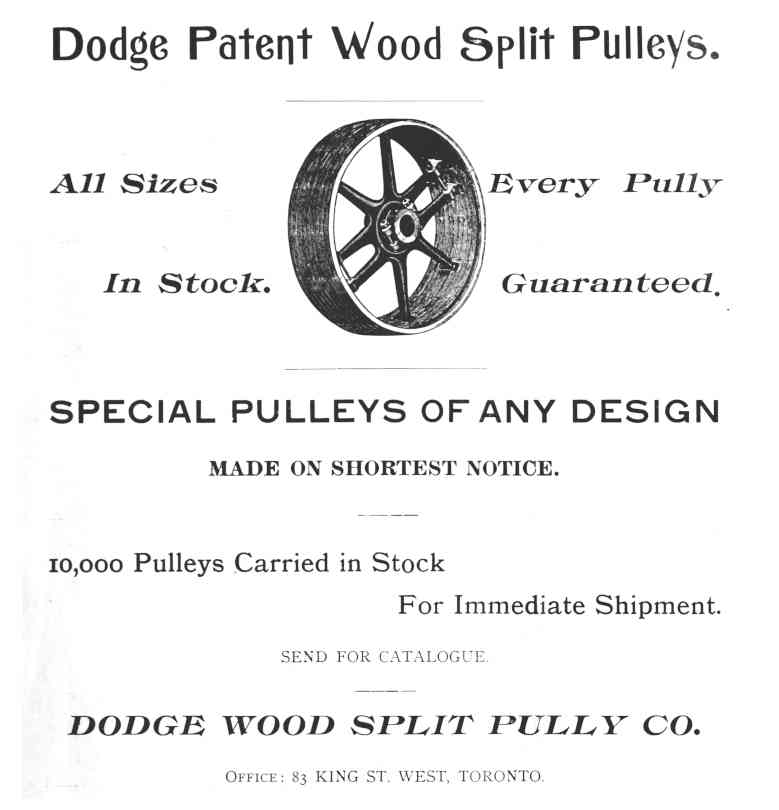
The Dodge Wood Split Pulley advertisement represents the internal mechanics of industry. These components are not visible to the end user. They operate within workshops and factories as part of larger power systems.
The emphasis is on reliability and continuity. A pulley must perform without failure. Its success is measured through absence of interruption. This differs from the presentation of finished machines, which are evaluated through visible performance.
The pulley exists within line shaft systems that distribute mechanical energy across a workspace. It is a connector between power and motion. The advertisement therefore represents the structural layer of industry. It supports production without drawing attention to itself.
The Supply Layer: Machinery and Supply Company

The Machinery and Supply Company advertisement introduces distribution as a distinct function. It offers both new and second-hand equipment. This dual offering suggests an established market with varying levels of entry.
The company operates as a broker between manufacturers and users. It provides access rather than invention. Its role is to organise availability across a wide range of machinery and parts.
This layer stabilises the system. It ensures that equipment can be sourced, replaced, or upgraded. It also indicates the presence of a secondary market, where machinery continues to circulate after initial use. The advertisement reflects an economy that values continuity as much as innovation.
The Legal Layer: Charles H. Riches Patent Attorney

The advertisement for Charles H. Riches introduces the legal dimension of industry. It addresses the protection and management of ideas. Patent work is presented as a specialised service requiring expertise and interpretation.
The offer of free preliminary advice functions as an entry point. It invites inventors to engage with the system before committing to formal processes. This gesture establishes trust while guiding potential clients toward professional services.
The presence of such an advertisement indicates that intellectual property is already embedded within industrial practice. Innovation is not only technical. It is also legal and commercial. The patent attorney operates alongside engineers and suppliers as part of the same ecosystem.
The System Behind the Advertisements
Read together, these advertisements reveal more than a list of products and services. They describe an industrial culture shaped by distance, cost, and practical necessity. In the 1890s, high transport costs and protective tariffs made local manufacture, local repair, and regional supply more important than they would later become in a fully globalised market. What appears in these notices is therefore not just commerce, but a working map of how industry was organised on the ground.
Each advertisement points beyond itself. A bicycle implies metalworking, fitting, and skilled assembly. A pulley points to workshops, power transmission, maintenance, and the wider machinery of production. A telephone system suggests installation, electrical knowledge, and the gradual formation of shared technical habits. Even the patent attorney belongs to this same world, translating invention into something that could be protected, traded, and brought into use. Taken together, the notices show an interdependent ecosystem rather than a random assortment of offerings.
Labour sits quietly at the centre of this system. The advertisements do not dwell on the workers behind the machines, yet skilled hands are assumed everywhere within them. Mechanics, fitters, foundry workers, installers, clerks, and repair trades made these services real. Their presence can be felt in the confidence of the notices. What is being advertised is not only an object for sale, but the local capability to produce, maintain, adapt, and support it.
This is what makes the page culturally significant. These advertisements are not attempts to persuade in isolation. They are signals of capability within a local industrial system shaped by constraint and skill. They show how machinery, knowledge, and labour were organised within place. Read in this way, the notices stop being advertisements in the modern sense. They become evidence. They show how the machine age was built, maintained, and made practical in 1893.
Reading the Periodical as a System
For a broader method on interpreting trade journals as structured artefacts, see Technical Periodicals of the Airship Era.
Conclusion
Viewed together, these advertisements describe a complete industrial structure. The finished machine connects to the user. The emerging system extends capability through networks. Components sustain production behind the scenes. Supply organisations distribute and maintain access. Legal services define ownership and value.
Read in isolation, each notice offers a product or service. Read together, they offer something more useful. They show how to interpret industrial artefacts as evidence of a working system. The advertisements reveal a locally grounded economy shaped by cost, distance, and skill, where production, repair, and knowledge were closely linked. This is the real significance of the page. It does not simply document the machine age. It teaches how to read it.
Author's Notes
I approached these advertisements as individual artefacts at first. Each one seemed complete in its own right. It was only when I placed them side by side that a larger structure became visible. The pattern was not stated. It emerged through comparison.
What interested me was the level of coordination already present. The machine, the component, the supplier, and the legal framework all appear as established parts of a working system. There is little sense of uncertainty. The industrial world presented here is already organised and understood by its readers.
I was careful not to impose a modern framework too strongly. These advertisements belong to their own time and conditions. Yet the relationships between them feel familiar. The continuity lies in how systems are assembled and maintained rather than in the technologies themselves.
What remains with me is the quiet confidence of these notices. They do not argue for the future. They assume it is already in motion. This article is an attempt to recognise that moment, where invention gives way to operation and the machine age becomes an everyday reality.
Notes & Memoranda
Glossary
- Industrial stack
- A layered model of industrial activity including machines, components, supply networks, legal frameworks, and adoption systems, interpreted as an interdependent structure rather than isolated functions.
- Industrial system
- A coordinated structure of production, supply, distribution, and legal frameworks that enables industry to function as a connected whole rather than as isolated activities.
- Line shaft system
- A method of distributing mechanical power in workshops using rotating shafts, belts, and pulleys to drive multiple machines from a single power source.
- Split pulley
- A pulley designed in two halves that can be installed without dismantling the shaft, commonly used in industrial power transmission systems.
- Second-hand machinery
- Previously used industrial equipment resold into the market, reflecting a mature system where machinery is circulated and reused rather than discarded.
- Patent system
- A legal framework that grants inventors exclusive rights to their inventions, enabling protection, licensing, and commercialisation within an industrial economy.
- Industrial advertisement
- A functional notice aimed at engineers, tradespeople, or businesses, focusing on specifications, availability, and service rather than emotional persuasion.
- Infrastructure
- The underlying systems and networks, such as communication or power distribution, that support and enable industrial and economic activity.
- Adoption
- The process by which a technology becomes integrated into regular use within society, moving from novelty to accepted and expected practice.
Frequently asked questions
Why do these 1893 advertisements appear so technical and direct?
The advertisements were written for readers already engaged in engineering and trade. They prioritise function, specification, and availability over persuasion, reflecting a shared industrial language rather than mass consumer marketing.
How do these advertisements reveal a complete industrial system?
Each advertisement represents a different layer of industry, including finished machines, mechanical components, supply networks, and legal services. Together, they form a coordinated system where production, distribution, and ownership operate in alignment.
What does the presence of second-hand machinery tell us about the period?
The availability of second-hand machinery indicates a mature industrial economy. Equipment was not only produced but also circulated, reused, and resold, showing that continuity and access were as important as innovation.
Why is the patent attorney advertisement significant in this context?
The inclusion of patent services shows that intellectual property was already embedded within industrial practice. Innovation required legal definition and protection, making the patent system a core part of the industrial ecosystem.
Mentions & Echoes
The following articles extend or reflect the ideas explored here, returning to similar questions through different materials, contexts, and lines of inquiry.
- The Phillaneum Gazette 004 – The Vintage Advertisement Edition – Featured as a new article in this issue, where it forms a central study in reading advertisements collectively, revealing the machine age as a coordinated system of manufacture, supply, and persuasion.
Further Reading…




Disclosure
This article presents an interpretive reading of 1893 advertisements from Engineer and Inventor, examining them as evidence of an underlying industrial system. It reflects editorial analysis rather than a definitive account of nineteenth century industry. Readers seeking primary context should consult original publications and historical sources.