Only Historians Care About Vintage Ads
·Revised
Relevance Begins Once the Page Is Read Properly
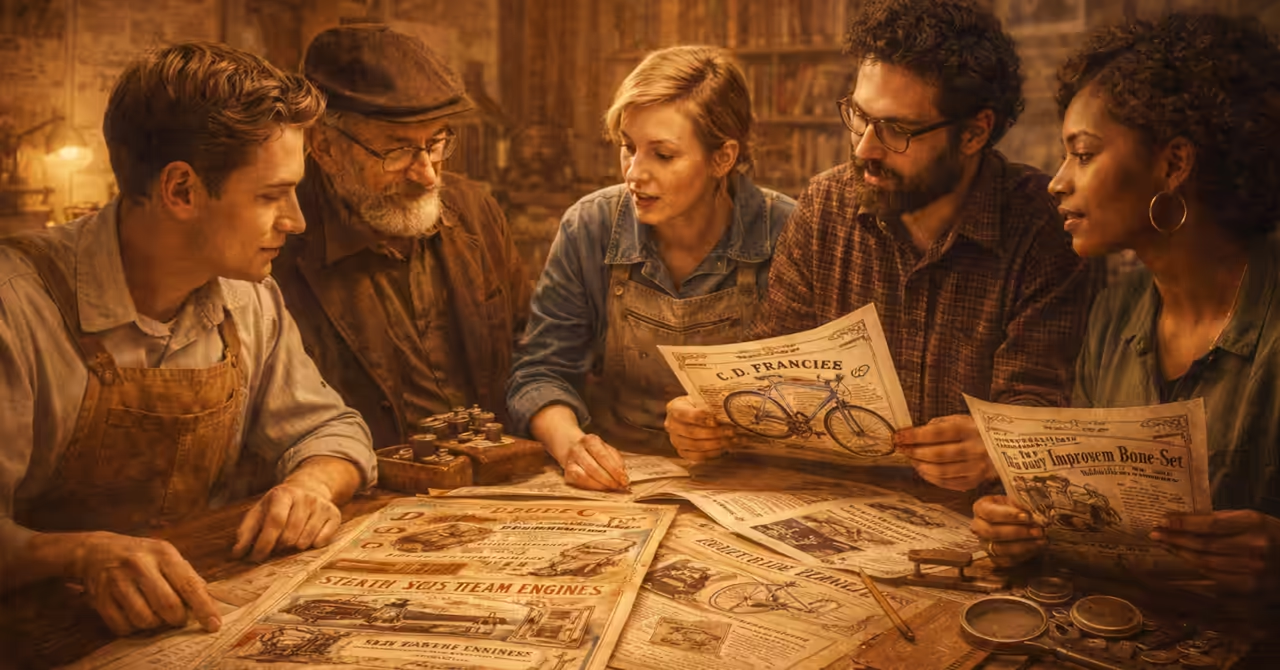
The idea that only historians care about vintage advertisements sounds plausible until one asks what such pages actually contain. That is the relationship worth establishing at the outset. A vintage advertisement is not merely an old piece of paper for specialists in dates, styles, and archives. It is also a compact statement about products, values, materials, habits, persuasion, and everyday problem-solving. Once read in that broader way, the audience immediately expands. Historians certainly have reason to care, but they are far from the only readers who can make use of these pages.
This matters because the old advertisement sits at an unusual crossroads. It speaks in the language of commerce, yet it also preserves traces of design, technical explanation, consumer expectation, and social aspiration. It can show how a product was introduced, how a firm wanted to be seen, and what sort of knowledge a reader was expected to possess. That makes it useful not only for formal history, but for collectors, designers, makers, writers, curators, readers of material culture, and anyone interested in how objects enter ordinary life.
The false narrowing of audience comes from treating the page as if age were its only feature. Once the page is old enough, some people assume it belongs to the historian by default. Yet age alone does not explain the appeal of a trade card, a machinery notice, a textile advertisement, or a household circular. These survive because they continue to reveal something that still feels active. They preserve how one world explained itself to another. That remains interesting well beyond the historian’s desk.
Old Advertisements Still Speak to Living Interests
Part of the misunderstanding comes from the word vintage itself. It can suggest distance, specialism, and polite admiration from behind glass. But many vintage advertisements are surprisingly direct when read without that filter. They explain use, compare qualities, identify materials, show methods, and name problems. A page advertising a stove, a watch, a saddle soap, a sewing machine attachment, or a set of architectural fittings is not only preserving a dead commercial moment. It is showing how a product was made intelligible to people who might adopt it.
That directness gives the page a wider modern usefulness. A designer may study the typography and layout. A maker may study the object and its implied use. A curator may study the assumptions of the intended audience. A writer may study tone and persuasion. A reader with no professional stake at all may simply find pleasure in the way the advertisement lets a practical world come back into view. The page supports all of these readings because it joins visual appeal to applied explanation.
There is also a cultural pleasure here that should not be underestimated. Vintage advertisements often reveal a world in which products had to be described more fully, and sometimes more patiently, than they are now. That makes them readable in a satisfying way. They ask not only for attention, but for judgement. They assume that explanation can support desire. For many modern readers, that older relation between seller and audience is itself part of the interest.
Collectors, makers, and readers all find different value
One reason the claim fails is that vintage advertisements serve many kinds of curiosity at once. The collector may value rarity, condition, or named firms. The maker may notice construction details, tool forms, fittings, finishes, or workshop logic. The designer may read the page for composition, lettering, spacing, and image hierarchy. The cultural reader may look at class assumptions, gendered appeals, domestic ideals, or changing standards of taste. None of these readers needs to be a professional historian in order to care seriously.
This variety is not accidental. Advertisements were made to connect objects to people. Because of that, they preserve several layers of meaning in a compact space. A single page may hold decorative appeal, product description, trade language, and social positioning all at once. It is therefore perfectly natural that different readers approach it from different directions. The historian is one reader among many, not the sole legitimate custodian of interest.
In fact, some of the strongest modern engagement with vintage advertising comes from outside academic history. Collectors preserve material that institutions missed. Craftspeople recognise forgotten methods. Independent publishers and curators place such pages into new interpretive contexts. Readers encounter them not as duty, but as discovery. The field remains alive precisely because it is porous.
Practical interest survives even when the market is gone
Another reason people continue to care is that old advertisements often retain practical meaning after their original market has disappeared. A page for a machine part may still show how a class of device worked. A notice for furnishing materials may reveal preferences in finish, colour, and durability. An advertisement for a patent domestic improvement may show what households found troublesome enough to solve. Even when no one intends to purchase the exact goods, the page still carries usable knowledge.
This is especially true when advertisements are read collectively rather than singly. One page might seem quaint. Ten pages establish patterns. Repeated claims about cleanliness, efficiency, portability, or strength begin to outline the pressures of the period. Shared terminology clarifies itself. Supporting goods and adjacent industries come into view. A modern reader begins not simply to admire the page, but to understand the environment that produced it.
That kind of practical reading has obvious relevance for many audiences. It can support curation, reconstruction, collecting, design research, writing, and broader cultural interpretation. The page remains useful because it was never only an image. It was a working argument addressed to a real set of needs.
These pages widen curiosity rather than narrowing it
The best vintage advertisements do something generous. They invite the reader into a world of relationships. A product points to a material. The material points to a process. The process points to a trade. The trade points to a neighbourhood, a household, a workshop, or a network of supply. What begins as a small commercial notice opens into a wider field of curiosity. That is why these pages travel so well into the present.
To say that only historians care about vintage ads is therefore to underestimate both the pages and the readers. It mistakes age for irrelevance and specialism for ownership. In reality, vintage advertisements remain compelling because they are still legible as acts of explanation, persuasion, and design. They let us see how goods were made visible, how preferences were formed, and how ordinary life was furnished with language and objects.
The next useful step is simple. Instead of asking whether a vintage advertisement belongs to history alone, ask what sort of reader it can still serve now. That question usually produces more than one answer. It also returns the page to a wider public, which is where much advertising wanted to be in the first place.
Author's Notes
Notes & Memoranda
Further Reading…



Disclosure
This article presents an interpretive reading of historical advertisements and related material, with attention to their technical, cultural, and practical context. It reflects editorial analysis rather than a definitive account of historical practice. Readers seeking primary context should consult period sources and surviving examples.