The Problem of Isolated Artefact Pages
·Revised
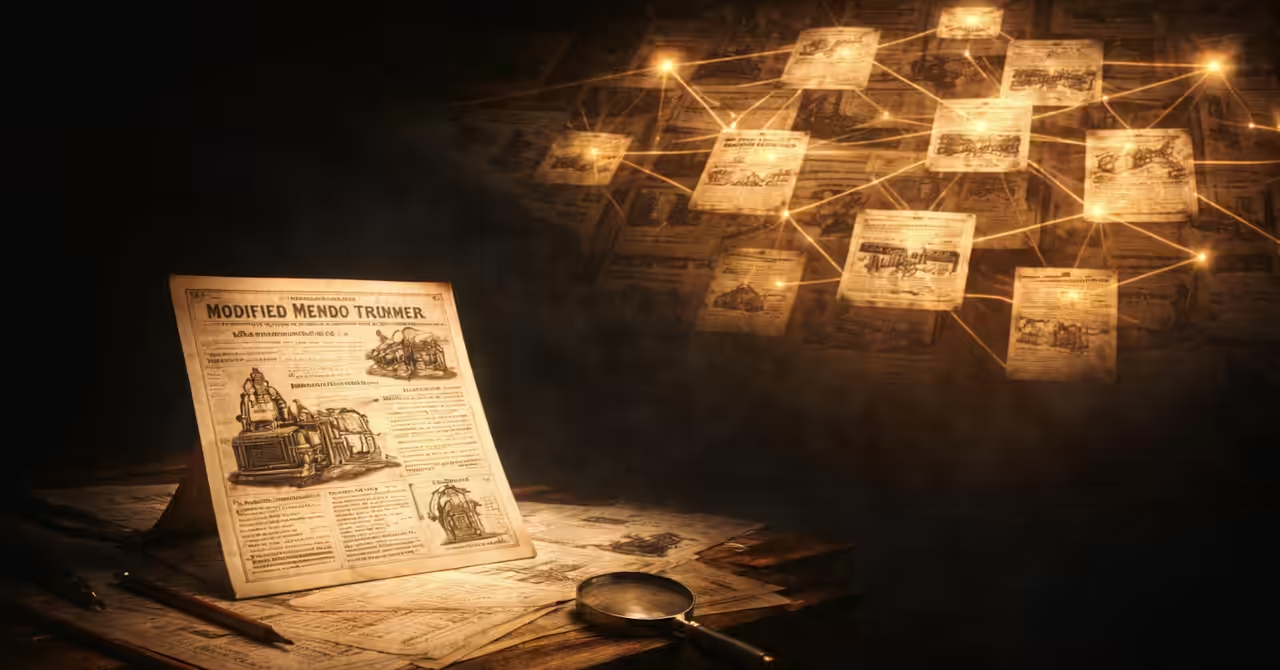
Single Artefacts Rarely Explain Their Own World
The problem of isolated artefact pages begins with a relationship that is easy to miss. An artefact page may preserve one object well, yet still fail to preserve the system that made the object meaningful. A single advertisement, tool, label, trade card, or catalogue leaf can be described accurately in isolation and still leave the reader with only a partial understanding. The object remains visible, but its surrounding world becomes faint. That gap matters because many historical things were never designed to stand alone. They were made to exist within networks of use, trade, manufacture, and interpretation.
This is especially noticeable in digital curation. A page may do everything properly at the object level. It may present a clean scan, a date, a short description, and perhaps a few notes on visual features or provenance. Such work is valuable. It preserves the item and gives it a readable presence. Yet if the page stops there, the artefact risks becoming detached from the very conditions that once gave it force. The reader sees the piece, but not the field it belonged to.
That is why isolated artefact pages can feel strangely thin even when they are carefully made. The object is present, but the reader cannot easily tell what it connected to, what problem it answered, what neighbouring objects mattered, or why this fragment deserves more than momentary interest. In effect, the page performs preservation without full orientation. It secures the artefact, but it does not yet restore the world around it.
Context Loss Happens Even on Well-Made Pages
The weakness here is not usually poor intention. It is structural. Many artefact pages inherit the logic of cataloguing rather than the logic of interpretation. They are built to identify, store, and display. Those are necessary functions, but they do not automatically generate meaning beyond the item itself. An isolated page therefore tends to answer the simplest questions first. What is it. When was it made. Who produced it. Where did it come from. These are sound foundations, yet they are only the beginning of historical usefulness.
The real trouble appears when the page leaves the reader without routes outward. A trade advertisement may never be connected to the journal it appeared in, the product class it belonged to, the technical terms it used, or the broader market it addressed. A household artefact may never be linked to the domestic routine it assumed. A printed notice may not point toward related firms, materials, or contemporary debates. The result is subtle but important. The object survives as a picture and a record, while its interpretive value remains underdeveloped.
This weakens curation in two ways. First, it narrows the reader’s experience. Second, it limits the object’s ability to support further discovery. A well-curated artefact should not only be visible. It should also help the reader move toward wider understanding. If that movement is absent, the page preserves a fragment without fully activating it.
Detached pages hide the dependencies around an object
Most artefacts imply other things. A machinery advertisement implies materials, fittings, power sources, maintenance routines, and fields of use. A clothing page implies fibres, tailoring practices, ideals of respectability, and systems of retail display. A household object implies room arrangement, labour habits, cleaning methods, and nearby goods that made it workable. When an artefact page is isolated, these dependencies often disappear from view.
This matters because historical understanding is rarely built from single objects alone. It grows from relationships. One thing points to another. A product leads to its supporting tools. A printed claim leads to a technical problem. A brand name leads to a district, a trade, or a catalogue. Once that chain begins, the artefact becomes far more than an object of curiosity. It becomes an entry point into a system. An isolated page can interrupt that process by presenting the object as if its border were also the boundary of its meaning.
The effect is especially limiting for readers who arrive without specialist knowledge. They may admire the page but remain unsure why it matters. Without guidance toward related objects or concepts, the artefact can appear interesting but inert. Its capacity to teach is weakened not by the object itself, but by the lack of visible connection.
Interpretation requires more than preservation
Preservation is the first duty of an artefact page, but it cannot be the last. Interpretation requires a second layer of work. The curator must help the reader understand what kind of question this object can answer. Is it evidence of design change, technical standardisation, social aspiration, commercial language, domestic routine, or workshop practice. A single sentence or a carefully framed contextual note can begin that work, but the strongest effect comes when the page points beyond itself.
This does not require heavy academic apparatus. In many cases, a few deliberate links are enough. A reader may need a route to a related article, a topic page, a glossary note, a cluster of similar artefacts, or an interpretive essay that situates the object within a broader pattern. These supporting structures do not distract from the artefact. They return depth to it. They help the reader recognise that this page is one station within a larger historical landscape.
Once that structure exists, the isolated artefact page changes character. It stops being a terminal point and becomes a junction. The object remains central, but its interpretive potential is no longer trapped inside a single frame.
Good curation turns single pages into connected propositions
The most effective response to isolation is not to abandon artefact pages, but to design them as connected propositions. Each page should preserve the item and also suggest what larger field the item belongs to. A vintage advertisement might lead toward trade journals, patents, or related product classes. A decorative printed piece might lead toward material culture, household use, or period taste. A technical artefact might lead toward supporting tools, manufacturing practice, or changing standards. The goal is not to overload the reader. It is to restore relation.
This is where curatorial pattern recognition becomes especially useful. One begins to see that artefacts rarely ask to be interpreted alone. They ask to be grouped, compared, and situated. The page then becomes more generous. It gives the reader the object, but also an onward path. That path is what transforms preservation into living curation.
The problem of isolated artefact pages is therefore not that they exist, but that they can stop short of their own potential. They save the fragment while leaving the system underdrawn. The next useful step is to make each artefact page point outward through related pages, interpretive notes, and thematic clusters. Once that is done, the reader gains more than access to a single object. The reader begins to recover the world around it.
Author's Notes
Notes & Memoranda
Mentions & Echoes
The following articles extend or reflect the ideas explored here, returning to similar questions through different materials, contexts, and lines of inquiry.
- How to Read a Victorian Era Patent – References this article when discussing the importance of contextualising historical artefacts. Using a nineteenth-century brewing patent as a working example, it demonstrates how patents become more meaningful when connected to the wider networks of trade, industry, technology, and evidence that surround them, reinforcing the argument against treating artefacts as isolated curiosities.
Further Reading…

Disclosure
This article presents an interpretive reading of historical advertisements and related material, with attention to their technical, cultural, and practical context. It reflects editorial analysis rather than a definitive account of historical practice. Readers seeking primary context should consult period sources and surviving examples.