What Victorians Did With Their Evenings Before Radio?
The Parlour Hour
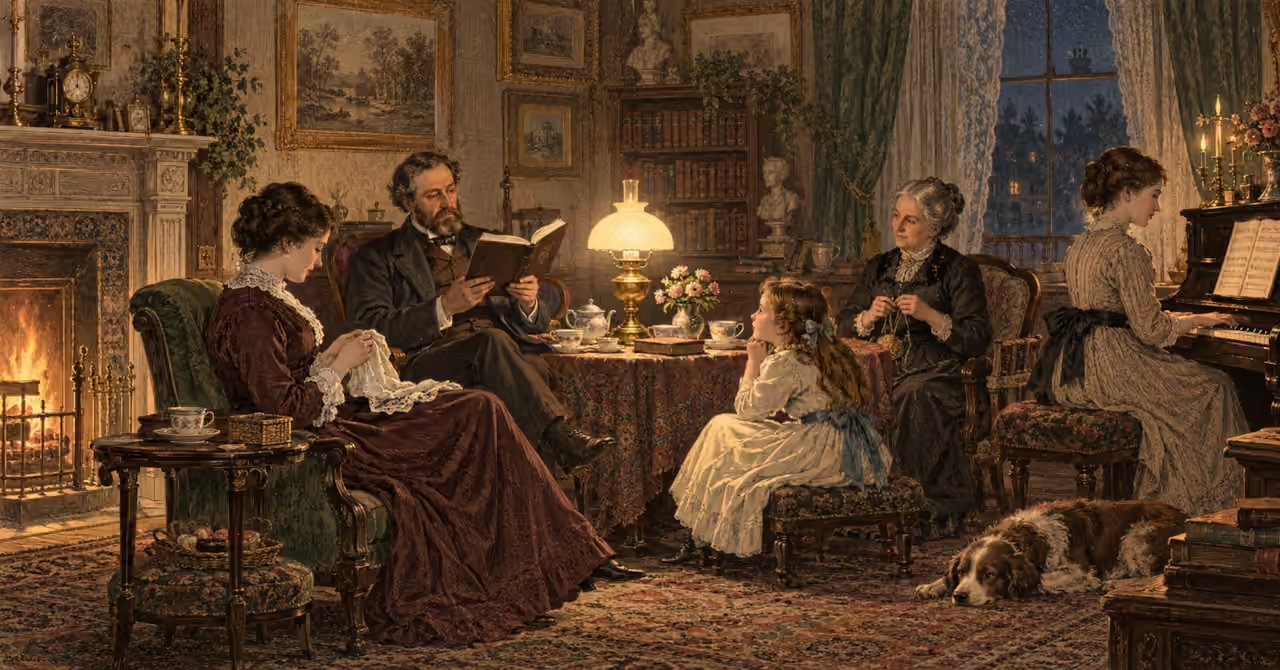
Our recent Gazette article, Reading as a Learned Art, got us wondering: what did Victorians actually do with their evenings before radio? Without a wireless to entertain them, families made their own fun. A book read aloud, a song at the pianoforte, a lively game of charades, a little sewing, a newspaper or a cup of tea with a visitor who came “just for an hour” and somehow stayed all evening. There was no shortage of ways to pass the time, even if not everyone agreed on what counted as entertainment.
In comfortable Victorian homes, much of this activity took place in the parlour or drawing room, where families entertained guests and displayed their best manners. Reading, music and needlework were popular pursuits, encouraged by household guides such as Mrs Beeton's. The parlour was a place for pleasure, certainly, but also for showing that the family was respectable, educated and pleasantly accomplished. A wrong note at the piano or a disastrous attempt at charades probably made the evening more memorable.
Of course, not everyone had a parlour, let alone a piano. Working families might eat, mend clothes and relax in the same small room, while domestic servants were often still busy long after their employers had settled down. Time, money and even the cost of lighting shaped what people could enjoy. Yet whether gathered around a polished drawing-room table or a modest kitchen fire, Victorians found plenty of ways to fill the hours between work and bedtime.
Reading Together
One of the simplest Victorian evening pleasures was reading aloud. Instead of everyone disappearing into their own book, one person became the storyteller while the others listened, sewed or rested. A good novel might bring laughter, suspense or a lively argument about what would happen next. Reading together was entertaining, educational and wonderfully economical. After all, one book could keep an entire family amused.
And there was plenty to read beyond novels. Magazines and journals offered everything from household advice and fashionable furnishings to curious inventions and practical lessons. Publications such as Engineer and Inventor introduced readers to new machines and scientific discoveries, while guides to personal accomplishments promised to improve their speaking, writing and other useful skills. Domestic journals such as The House, published in the early Edwardian years, continued this enthusiasm for crafts, decoration and practical knowledge. Reading was a way to enjoy an evening while learning something new.
Reading aloud was not confined to comfortable parlours. During the Chartist movement of the 1830s and 1840s, working people gathered to hear newspapers such as the Northern Star. The latest news could spark lively arguments about politics and everyday life. Sharing a newspaper also meant that people who could not afford their own copy, or struggled to read, could still join the conversation. A public reading might become quite a spirited debate!
Of course, reading after dark presented its own difficulties. Before electric lighting became widespread, families relied on candles, oil lamps or gas where it was available. All cost money, and household guides encouraged people to use them carefully. Cassell's household advice noted that bright gas lighting came at a price. Gathering around one well-lit table was sensible, especially when a single book or newspaper could entertain several people. It also made it easier to share a laugh, discuss a surprising passage or argue over what the author meant.
Music at Home
If reading gave the Victorian evening a voice, music gave it a melody. Families gathered around the piano to sing favourite songs, try new sheet music or enjoy a performance by a visiting friend. Household guides such as Mrs Beeton's offered advice on organising musical evenings, while Cassell's recommended telling guests beforehand if they were attending a musical party. Presumably, nobody wanted to arrive for a quiet cup of tea only to discover they were expected to perform!
By the late nineteenth century, the piano had become a prized possession in many middle-class homes. Playing well was considered a sign of education and good manners, particularly for young women. But musical accomplishment could be a duty as much as a pleasure. The writer Eliza Cook questioned why every girl should be expected to excel at music, regardless of her talents or interests. A daughter invited to play for visitors might enjoy the attention, dread every note or produce a performance that everyone politely applauded anyway.
Fortunately, Victorian music was not all formal performances and piano lessons. Families sang familiar songs, guests joined in favourite choruses, and a wrong note could bring as much laughter as embarrassment. Nor did music require an expensive instrument. Singing together after supper was a pleasure available to many households, even those without a drawing room or piano. The important thing was often the company rather than the quality of the performance.
Of course, professional singers offered something quite different from the family singalong. Victorian audiences celebrated performers whose voices filled theatres and concert halls, although most lived before sound recording could preserve their performances. Our article 10 Famous Victorian Singers We Will Never Hear introduces some of these remarkable entertainers and the musical world they inhabited.
And if all this has put you in the mood for a little nineteenth-century music, visit Kurtz Vintage Vibes, where beautiful melodies from the past are being rediscovered and brought back to life. You might even find a forgotten favourite worthy of your own parlour concert. Piano optional!
Games and Talking
When the book was closed and the piano fell silent, Victorian evenings could become surprisingly lively. Cards, charades, guessing games and friendly competitions gave everyone a chance to join in. Etiquette books encouraged such amusements, provided nobody became too rowdy or competitive. Even fun had manners, although we suspect a particularly dreadful attempt at charades could test everyone's good behaviour!
Parlour games were popular because they needed little equipment and could entertain adults and children alike. Word games, drawing challenges and amateur acting could turn an ordinary evening into something memorable. A wrong guess might produce more laughter than a correct answer, while a shy visitor could suddenly become the star of the room. Curious about the games themselves? Our article 6 Common Victorian Children's Games explores some of the amusements that kept younger Victorians busy, many of which can still be enjoyed today.
Of course, conversation was entertainment in its own right. Visitors brought news, neighbours supplied gossip, and families exchanged stories about their day. A good storyteller could hold a room's attention without needing a single prop. Household guides placed great importance on keeping guests comfortable and conversation flowing, though not every discussion went quite as smoothly as the advice suggested.
And sometimes, nothing much happened at all. Someone tended the fire, another returned to their sewing, and a book lay open on the table. Conversation faded for a while before someone thought of something else to say. Victorian evenings were not endless rounds of organised entertainment. There was room for comfortable silence, too.
These quieter moments rarely made it into diaries or etiquette books. After all, who would record an evening in which everyone simply sat together and enjoyed themselves? Yet those ordinary hours were as much a part of Victorian family life as the liveliest parlour party.
Work in Disguise
Not every Victorian evening was spent relaxing. While someone read aloud or played the piano, others might be sewing, mending clothes, folding laundry or preparing for the next day. Keeping busy was considered a virtue, and household guides encouraged activities that occupied the hands without spoiling a pleasant conversation. A little needlework beside the fire could be both useful and enjoyable.
Of course, there was a difference between embroidering a pretty cushion for pleasure and mending a pile of worn socks because the family couldn't afford new ones. Both might look peaceful by lamplight, but one was a hobby and the other was work that simply had to be done. The arrival of the sewing machine promised to make some of that work faster, although it also changed expectations about how much sewing could be accomplished. Discover more in our article Why the Sewing Machine Became an Icon of the Victorian Era.
In wealthier homes, the family might enjoy music and visitors while servants continued working behind the scenes. Someone had to prepare supper, tend the fire, wash the dishes and get everything ready for tomorrow. Mrs Beeton's household advice even described evening duties for the housekeeper, including checking accounts and organising supplies. The drawing room might be full of laughter, but the kitchen was not necessarily quiet!
Even the mistress of the house had responsibilities. Welcoming visitors, arranging refreshments and making sure everyone enjoyed themselves required effort. A musical evening might be delightful for the guests, but someone still had to organise it. Being a good hostess could feel rather like having a job while everyone else was enjoying a holiday.
Yet work and pleasure often went together. A familiar task could seem lighter when accompanied by conversation, laughter or a good story. Sewing beside a friend might be more enjoyable than sewing alone, even when the work itself was necessary. Victorian families did not always draw a clear line between being useful and having fun.
Perhaps that is what makes these evenings so recognisable today. Some people relaxed, others kept busy, and everyone was expected to contribute something to family life. The Victorian ideal was a home filled with good company, useful occupations and pleasant conversation. Whether everyone found it quite so pleasant probably depended on who still had the washing-up to do.
What the Evening Reveals
What did Victorians do with their evenings before radio? They did what homes have always tried to do when they are left to their own devices: they turned time into company. Sometimes that company was a book read aloud, sometimes a song, sometimes a round of charades, sometimes talk, sometimes quiet stitching while someone else read.
The details varied enormously. A household with servants, a piano and room for visitors had opportunities that a working family in crowded accommodation might not enjoy. The price of lighting, the length of the working day and the demands of domestic labour all influenced how much evening leisure was possible. Even within one home, different members of the family might experience those hours quite differently.
Yet there was something recognisably human in the way people made use of whatever time they had. A familiar tune, an interesting newspaper, a visitor with a good story or a game that made everyone laugh could turn an ordinary evening into a memorable one. Other nights passed quietly, with little to distinguish them beyond the pleasure of putting down the day's work.
The Victorian evening was not always elegant, entertaining or even especially restful. But it offered countless small occasions for people to share their interests, fulfil their obligations and enjoy one another's company. Long before radio brought distant voices and music into the home, those voices and that music were already there, supplied by the people who lived within it.
From the Curator's Workshop
A good book, a comfortable evening and a little Victorian charm make excellent companions. Why not bring some of that nineteenth-century elegance into your own daily life? Our William Morris tote bag celebrates one of the great figures of the Arts and Crafts movement, combining beautiful Victorian-inspired design with everyday practicality. Ideal for carrying your favourite books, visiting markets or discovering your next little treasure, it also makes a thoughtful gift for anyone who loves art, history and vintage style.

Author's Notes
Notes & Memoranda
As is often the case, the subject extends beyond the bounds of a single article. The notes and memoranda below gather together useful definitions, related observations, references, and occasional curiosities discovered along the way.
Glossary
Some of the terms used in this article have specialised, historical or technical meanings. This glossary provides additional context for selected terms and ideas.
- parlour (drawing room)
- The formal reception room in many Victorian houses used to receive visitors and display the family's respectability; its tidy furnishings and restricted use made it the public face of domestic life, the place where reading, music and needlework were staged as signs of moral cultivation—even though many poorer households had no separate parlour, making the idea as much an aspiration as an everyday reality.
- Beeton's Book of Household Management
- A widely read mid‑Victorian household manual by Isabella Beeton that combined recipes, budgets, domestic routines and etiquette; it codified middle‑class ideals about thrift, hospitality, servants and evening entertainments, and therefore helped shape how households organised work, leisure and displays of respectability.
- Chartist movement
- A working‑class political movement in Britain in the 1830s–1840s that campaigned for electoral reform (including universal male suffrage) and improved social conditions; Chartist meetings and networks used printed newspapers read aloud to inform, mobilise and provoke discussion among people who might not own or be able to read a paper themselves.
- serialized novels
- Novels published in instalments in newspapers or periodicals over weeks or months rather than as a single book; instalment publication made fiction more affordable, produced cliff‑hanger suspense and encouraged communal reading aloud at home, so families could enjoy and discuss the same story together.
- pianoforte
- An early name for the piano (emphasising its dynamic range from soft to loud) that by the later nineteenth century had become more widely manufactured and sold; owning and playing a pianoforte in the drawing room was a common mark of middle‑class cultural aspiration and a focal point for domestic music‑making and female ‘accomplishment.’
Frequently asked questions
Curious about something you’ve just read? These frequently asked questions explore some of the key ideas, details and questions surrounding the topic.
What did Victorians do for entertainment in the evenings before radio?
Victorian families enjoyed reading aloud, singing, playing music, parlour games, storytelling, conversation and visits from friends. Some gathered around a piano, while others shared books or newspapers by lamplight. Activities varied according to income, available space and household responsibilities, and quieter evenings were common too.
Why did Victorian families read aloud together?
Reading aloud allowed several people to enjoy the same book or newspaper while others listened, sewed or rested. It was an affordable way to share stories, learn new things and discuss the news. Reading was not limited to wealthy households; working people also gathered to hear newspapers such as the Northern Star during the Chartist movement.
What kind of music did Victorians enjoy at home?
Victorian households enjoyed popular songs, piano music, family singalongs and informal performances by friends and relatives. The piano was a valued possession in many middle-class homes, and young women were often encouraged to learn it. However, families without a piano could still enjoy singing together, making music an accessible form of evening entertainment.
What parlour games did Victorian families play?
Popular Victorian evening amusements included charades, guessing games, word games, drawing games, cards and amateur acting. Many required little equipment and could involve adults and children together. Conversation, storytelling and sharing news were also important forms of entertainment.
Did everyone in a Victorian household have time to relax in the evening?
No. Evening leisure depended on social class, income and household duties. While some family members enjoyed reading, music or games, others continued sewing, mending, preparing meals or cleaning. Domestic servants often worked while their employers entertained guests, and even the mistress of the house might have responsibilities for organising the evening.
Further Reading…
References and Further Reading
- Isabella Beeton, The Book of Household Management (Project Gutenberg edition): https://www.gutenberg.org/cache/epub/10136/pg10136.html
- Cassell’s Household Guide, “Evening Entertainments: Private Concerts, Music Parties, etc.” (Victorian London): https://www.victorianlondon.org/cassells/cassells-37.htm
- Oxford University Podcasts, “The Social Life of Books: A History of Reading Together at Home”: https://podcasts.ox.ac.uk/live-event-social-life-books-history-reading-together-home
- Charlotte Barrett, “Victorian Publishing History” (Oxford Great Writers Inspire): https://writersinspire.podcasts.ox.ac.uk/content/victorian-publishing-history
- Canadian Museum of History, “Victorian Parlour”: https://epe.lac-bac.gc.ca/100/200/301/ic/can_digital_collections/bytown/exhibits/victorian-parlour-exhibit.htm?nodisclaimer=1
Disclosure
This article explores everyday evening activities during the Victorian era, drawing upon historical household guides, contemporary accounts and cultural research. Experiences varied considerably according to social class, income, location and household responsibilities. The domestic scenes described are illustrative of common practices and contemporary ideals rather than representative of every Victorian household.