The Phillaneum Gazette 002 – Reading as a Learned Art

The Editor's Quill
There was a time when reading was understood as an art learned slowly, in company, and with care. Not a race to the end, not a verdict to be delivered, but an experience to be shared. This issue of The Phillaneum Gazette returns to that intentional understanding of reading.
To read appreciatively is to accept that meaning is layered. There is what is said, and there is what is meant, but also why these words were chosen, how they were arranged, and what they echo. A trade journal, an etiquette guide, an advertisement, a poem: each speaks not only for itself, but in relation to other texts, other objects, other readers. Reading well means learning to notice those relationships, and allowing them time to reveal themselves.
Appreciative reading does not demand agreement, nor does it rush to judgement. It is an act of attention through which meaning takes shape over time. In returning to a work with care, we do not merely discover value, we participate in its making.
What strikes me most, particularly in the essays and reflections gathered here, is how human this process remains. Writer and reader may never meet, yet they share a moment of recognition. We discover what we enjoy, what troubles us, what lingers. This is not reading as entertainment alone, nor reading as argument, but reading as companionship.
In an age of speed and certainty, these works invite us to slow down and read together, to practise appreciation, and to rediscover the pleasure of understanding as it unfolds.

New Additions to the Collection
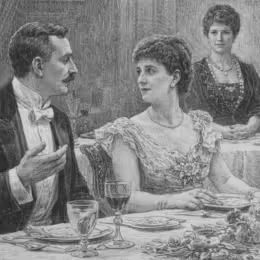

Changes on the Estate
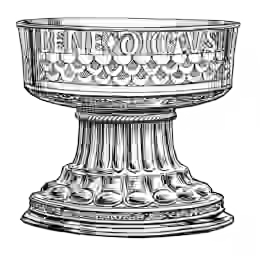

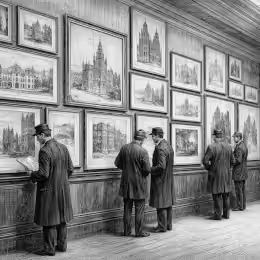

Marginalia
Hermeneut
- Meaning
- One who practises attentive interpretation, drawing meaning from texts or artefacts through context, tradition, and sustained reading rather than surface comprehension.
- When used
- Used when reading demands patience, where meaning is layered, historically situated, and shaped by the presence of earlier readers.
- Pronunciation (Australian English)
- /ˈhɜːmɪnjuːt/ “HER-mi-nyoot”
- In a sentence
- She read the magazine not for conclusions, but as a hermeneut, listening for what the pages assumed, remembered, and quietly passed on.
- Why use it (rather than “interpreter” or “critic”)
-
- Hermeneut names a mode of reading grounded in tradition and return.
- Interpreter suggests translation rather than discovery.
- Critic implies judgement, ranking, and closure.
- Phillaneum note
- At Phillaneum, the hermeneut reads in company, aware that meaning emerges between the artefact, its past readers, and the present moment of attention.
Curiosities from Abroad
- Reading as a Social Practice – A reflective essay examining reading as a shared human activity shaped by habits, discussion, and context, rather than as a purely objective extraction of meaning from texts.
- Letter to a Future Lover – A book written as an address across time, treating reading as an intimate meeting between writer and reader. Available via the Internet Archive and requires a free account to borrow.
- Blue Stockings Society – An eighteenth-century English social and intellectual circle that foregrounded conversation, reading, and shared learning, illustrating how reading functioned as a communal and social practice.
Numerical Curiosities
78 ◆ 85 ◆ 92 ◆ 43 ◆ 86
Selected from the seed of this issue. Determined by rule, not by omen.
Recreations

(no registration required)
The Maker's Ledger
A few notes from the workshop: what's been fixed, improved, or learned on the road to keeping this site fast, useful, and brimming with curiosities.
- Discovering the Gazette as an Artefact
- During the assembly of this issue, it became clear that the Gazette itself was no longer merely a summary or index of recent work. The act of gathering essays, marginalia, recreations, and notes into a single issue revealed the Gazette as a primary artefact in its own right—a place where meaning emerges through adjacency, sequence, and return. The articles remain essential, but they now live in conversation with one another, shaped by the frame that brings them together.
- Digital Housekeeping and the Cost of Change
- Ongoing work to refresh and stabilise the site has involved a great deal of digital housekeeping: retiring old structures, clarifying paths, and improving internal consistency. One unexpected consequence has been a noticeable drop in Google search traffic. My working assumption is that search systems are cautious by design and tend to treat structural change as a temporary risk. As the site settles and patterns stabilise, I expect that visibility will recover in time. For now, this feels like the necessary cost of putting things in better order.
At the Next Gathering
At our next gathering, the Cabinet turns its drawers toward the sky, where the old dream of the airship rises again with fresh purpose. The Phillaneum Gazette 003 – Sustainable Airships will consider lighter-than-air flight as history, engineering, speculation, and possible answer to a more careful age of transport.