The Phillaneum Gazette 003 – Sustainable Airships
The Editor's Quill
This month, the Cabinet turns its drawers toward the sky.
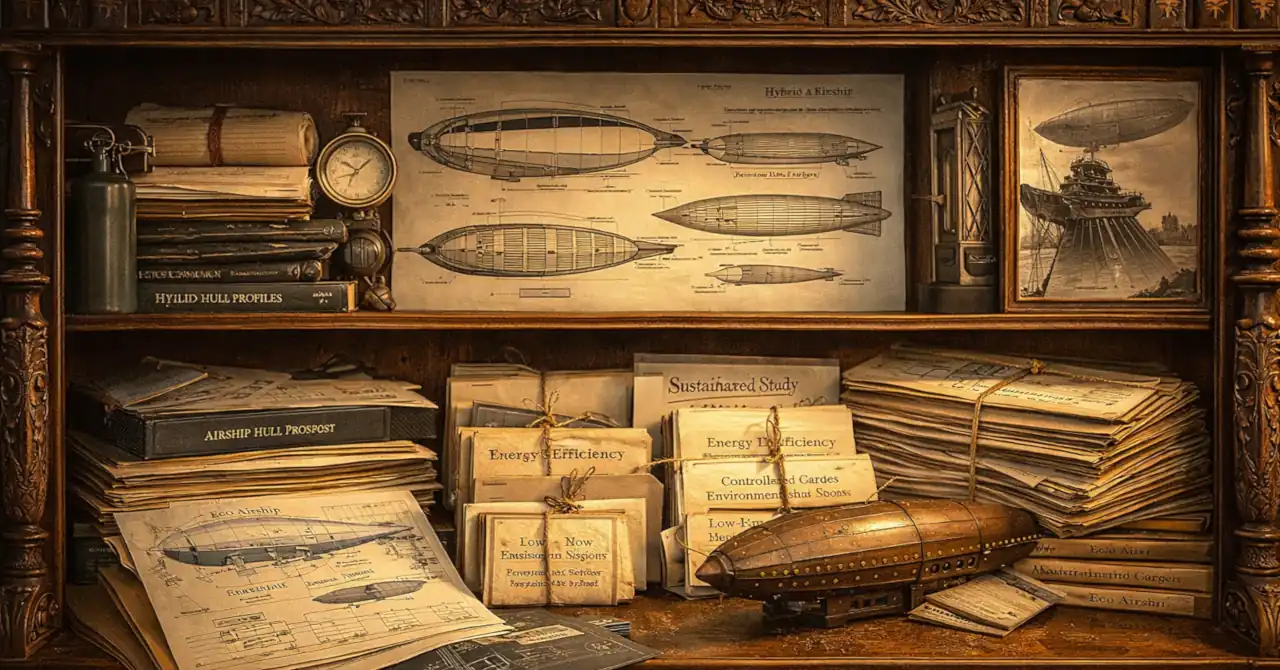
Airships once carried the feeling of a new century. They arrived with the confidence of invention. They promised distance without conquest. They offered a future shaped by design. At the turn of the 1900s, lighter than air flight was not a novelty. It was a serious technology boom. It drew engineers, publishers, and the curious public into a shared experiment.
Phillaneum exists for that kind of moment. We collect the objects, yes. We also collect the habits of mind. We look for work that invites attention. We look for work that can be handled. We look for work that asks the reader to participate.
These new and updated airship articles do exactly that. They form a small cabinet within the larger cabinet. Classification sits beside practical application. Technical periodicals sit beside modern sustainability. Speculation sits beside disciplined engineering. Each piece is an object of thought. Each one rewards careful reading.
We also welcome a special guest writer. Phil Reichert writes as a systems engineer. He treats an idea as something you can test. He asks what must be true. He names constraints. He keeps wonder, but he refuses vagueness. That approach suits Phillaneum. It honours the Arts and Crafts spirit. It values craft over spectacle. It values usefulness alongside beauty.
Airships still belong to our time. The pressures have changed. The questions have sharpened. Energy matters. Infrastructure matters. Remote access matters. Airships offer quiet opportunities. They also offer a lesson from the past. Progress is not only speed. Progress can be care.
Open the drawer. Linger. Let the cabinet do its work.

New Additions to the Collection

Changes on the Estate




Marginalia
Lenticular
- Meaning
- Shaped like a lens, convex on both sides, often used to describe streamlined forms designed to reduce drag and move efficiently through air or water.
- When used
- Used when describing aerodynamic hulls, cloud formations, or engineered structures whose curved symmetry serves both beauty and performance.
- Pronunciation (Australian English)
- /lɛnˈtɪkjʊlə/ “len-TIK-yuh-luh”
- In a sentence
- The designer chose a lenticular hull profile to give the airship both visual grace and measurable aerodynamic efficiency.
- Why use it (rather than “oval” or “streamlined”)
-
- Lenticular conveys precise geometric intent rooted in optics and physics.
- Oval suggests a simple outline without functional implication.
- Streamlined implies reduced resistance but lacks descriptive specificity.
- Phillaneum note
- The lenticular form reminds us that engineering elegance often arises from necessity, where efficiency and beauty converge in a single disciplined curve.
Curiosities from Abroad
- Hybrid Air Vehicles – News & Overview – A contemporary British initiative developing hybrid airships for low-emission cargo and passenger transport, offering a thoughtful laboratory of ideas where buoyancy, efficiency, and modern materials converge.
- U.S. Navy Airships & Dirigibles – An institutional archive detailing the United States Navy’s long and often overlooked experience with lighter-than-air craft, including patrol, endurance missions, and experimental development.
- Airships.net – A richly illustrated independent archive of photographs, narratives, and technical histories spanning rigid and non-rigid airships worldwide, ideal for unhurried exploration.
Numerical Curiosities
3 ◆ 94 ◆ 89 ◆ 20 ◆ 42
Selected from the seed of this issue. Determined by rule, not by omen.
Recreations
(no registration required)
The Maker's Ledger
A few notes from the workshop: what's been fixed, improved, or learned on the road to keeping this site fast, useful, and brimming with curiosities.
- The Managing Editor and the Discipline of Choosing
- This month I found myself thinking more like a Managing Editor than a collector. The role is not simply to approve what arrives. It is to decide what matters next. It is to set a pace that can be sustained. It is to protect the workshop from overreach. Capacity is a real material. Attention is a finite supply. A good edition is not built by doing everything. It is built by choosing what not to do.
- Restoring Lift to a Neglected Theme
- In reviewing the estate, one imbalance became clear. Airships had slipped into the background. This was surprising. They were once among our hottest topics. The neglect was not philosophical. It was practical. Other projects simply crowded the bench. The Managing Editor’s response was to intervene with intent. We paused. We scanned the shelves. We asked what was missing. Then we chose a single focus and gave it proper attention.
- Topic Clustering as Workshop Method
- The result was a deliberate burst of airship work. We brainstormed updates. We commissioned fresh writing. We strengthened reference material. We improved how the pieces connect. Instead of scattering small additions across the site, we built a concentrated cluster. It reads as a cabinet within the cabinet. Each article gains weight through its neighbours. The hope is simple. That this special edition feels coherent. That it feels generous. That it reminds readers why lighter than air craft still deserve serious curiosity.
At the Next Gathering
At our next gathering, the Cabinet descends from the sky to the printed page, where the vintage advertisement waits to be read not merely as ornament, but as evidence of systems at work. The Phillaneum Gazette 004 – The Vintage Advertisement Edition will examine industrial-era persuasion, trade networks, patent services, machinery notices, telephones, bicycles, and the quiet machinery by which trust was once set into type.