Why the Sewing Machine Became an Icon of the Victorian Era
A machine that belonged indoors
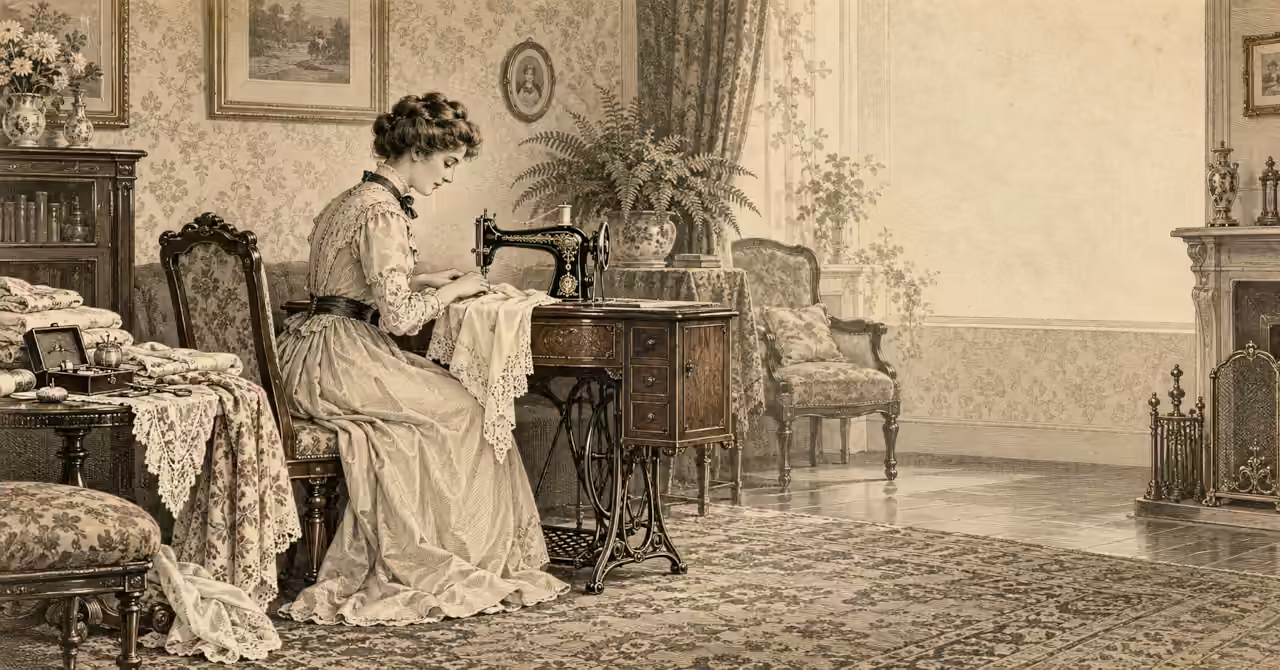
If you had to choose a single object to represent the Victorian age, the sewing machine makes a surprisingly strong claim. It lacks the grandeur of a railway station, the drama of a steam engine, or the authority of a palace. Instead, it does something more intimate and revealing: it carries industrial power across the threshold of the home, places it among the furniture, and asks that machinery to behave itself.
That is why the sewing machine feels so distinctly Victorian. It sits exactly where the period liked to imagine a boundary: between manufacture and home, labour and respectability, usefulness and ornament. As we explored in Why Needlework and Decorative Panels Once Belonged Together, needlework already formed part of a wider domestic language in which craft, decoration and respectable surroundings belonged together. The sewing machine entered that world as something new and mechanical, but it was quickly taught to look as though it had always belonged there.
Unlike the better-known emblems of industrial progress, the sewing machine also became part of daily life. It appeared in homes and workrooms, used by dressmakers, servants and householders for clothing, alteration, mending and furnishings. Its significance lies in more than speed. The Victorians did not merely admire machinery in factories; they found ways to make machinery acceptable inside respectable domestic life. The sewing machine became modernity in miniature, invited into the parlour without overturning the furniture.
Respectable power
The early domestic sewing machine was often presented less as a bare tool than as a piece of furniture. Singer’s 1850s marketing described a smaller, lighter machine intended to be “a beautiful ornament in the parlor or boudoir,” and surviving examples were frequently lacquered, decorated, and mounted in handsome cabinets. That is a typically Victorian compromise: the device must work, but it must also look as though it belongs among the furnishings of a respectable house.
This was not trivial packaging. It reveals the domestic ideal behind the object. The Victorian home was expected to be orderly, tasteful, and morally improving; practical things were expected to share those qualities. A sewing machine in that environment was not merely a means of joining cloth. It was a sign that modern mechanical force could be disciplined into propriety. It joined the same household culture that valued polished wood, patterned wallpaper, framed prints, and carefully arranged ornaments: usefulness was acceptable, but usefulness refined by taste was better.
That aesthetic also made the machine politically useful to its owners and sellers. If industrial power could be turned into a parlour object, then modernity itself could be made to look harmless—even civilized. The sewing machine did not just serve a function; it helped translate the industrial age into a language the middle-class home could accept.
Women’s work, made faster
The sewing machine also exposes a central Victorian contradiction; The culture depended on women’s labour while pretending that domestic femininity was primarily a matter of virtue, not work. Needlework was widely treated as an essential part of female accomplishment and moral duty. The machine changed the conditions of that work without removing its burden.
It was sold as a labour-saving invention, and in the most literal sense it certainly was. But whose labour did it save, and what happened to the time it released? In many households, the machine simply accelerated work that still had to be done: making children’s clothes, altering garments, repairing linen, producing furnishings and keeping a family presentable on a limited budget. The sewing machine did not abolish domestic obligation so much as rearrange its tempo. Victorian efficiency often meant doing more with less, rather than finally doing less.
There is a quieter irony here. Victorian society admired women who were hardworking, but it also expected respectable women not to look as though they were doing hard labour. The sewing machine fitted neatly into that idea. It helped women sew faster and with less effort, while the work could still be seen as skillful and proper. The jobs did not disappear, but some of the strain became easier to hide. In that sense, the machine changed not only how women worked, but also how that work was seen.
Sold as thrift, bought as status
The sewing machine also belongs to the Victorian consumer world, which was not nearly as stable or democratic as its self-image suggested. The V&A notes that in the 1860s a machine could represent a significant portion of an average family’s annual income, which helps explain why manufacturers developed hire-purchase arrangements to make ownership possible.
That matters because it shows the machine was never only a private convenience. It was a commodity sold into aspiration. Manufacturers marketed it as a way to save time, save money, and manage the household better, but it was also a prestige object. To own one was to signal that the household was modern, competent, and forward-looking—a machine for prudence and a badge of aspiration at once.
The domestic sewing machine therefore sat inside a wider Victorian economy of improvement. It promised that families could participate in modern life without surrendering thrift. It also made consumer respectability look efficient, which is one reason it fitted the era so neatly. Victorian culture loved objects that could justify themselves morally as well as practically.
At the same time, the sewing machine was part of a much bigger change. More clothing was being made in workshops and factories, so commercially made garments became easier for many families to buy. This meant the home no longer had to make every piece of clothing from scratch. Domestic sewing did not disappear, but its role began to change. The sewing machine in the parlour was therefore both a household tool and a sign that industry was slowly changing what families needed to do for themselves.
The invention behind the intimacy
Part of the sewing machine’s Victorian character lies in the gap between its domestic surface and its unruly technical past. The British Library traces a longer pre-history that includes Thomas Saint’s 1790 patent and Elias Howe’s 1846 lockstitch machine, before Isaac Singer’s practical commercial machine helped turn the device into a mass-market success. The Victorians inherited not a neat invention story, but a technology shaped by patents, lawsuits, refinement, branding, and competition.
That commercial aggressiveness belongs in the picture. The age admired invention, but it admired invention that could scale. Singer’s success was not only technical; it was organisational. The machine entered the market alongside modern systems of distribution, salesmanship, and branding. The object in the parlour was also an object of enterprise—circulating through an increasingly connected market and carrying ideas of efficiency and improvement with it.
Yet the machine never lost its intimacy. Unlike the railway, it did not require crowds. Unlike the telegraph, it did not require abstraction. It was touched by fingers and driven by the foot. It turned thread into seam at the rhythm of a household. That physical closeness is part of why it feels so Victorian: it makes modern power seem obedient to domestic life. The machine works hard, but it works quietly, where family order is supposed to be made and maintained.
Why it looks like the century
If the sewing machine feels more Victorian than bustles, fog or iron bridges, it is because it captures a deeper habit of mind. It suggests that speed can be civilised, commerce can be tasteful and machinery can leave the factory without losing respectability. It also reveals how readily supposedly separate spheres could overlap in practice. Industry entered the home, domestic labour became mechanised, and technological progress was judged not only by what it could do, but by whether it could be made socially acceptable.
That is where the sewing machine becomes especially revealing. It promised relief from toil, yet often reorganised toil rather than removing it. It was sold as convenience, yet ownership could carry status. It belonged to domestic life, yet depended on patents, manufacturing, branding and commercial networks. Its real significance lies in that tension. Victorian modernity did not simply replace old habits with new machines. It repeatedly absorbed machines into existing ideas about class, gender, taste and proper behaviour.
The machine in the parlour is therefore more than a useful invention. It is a miniature argument about what the Victorians wanted progress to look like: efficient but decorous, mechanical but domestic, industrious but respectable. And the sewing machine was not alone. Other household technologies had to undergo the same cultural negotiation before they could become ordinary. In How Vacuum Brooms Changed the Way Victorians Cleaned Their Homes, the same story continues in another room of the house, where even cleaning became a proving ground for new machinery.
For the Collectors
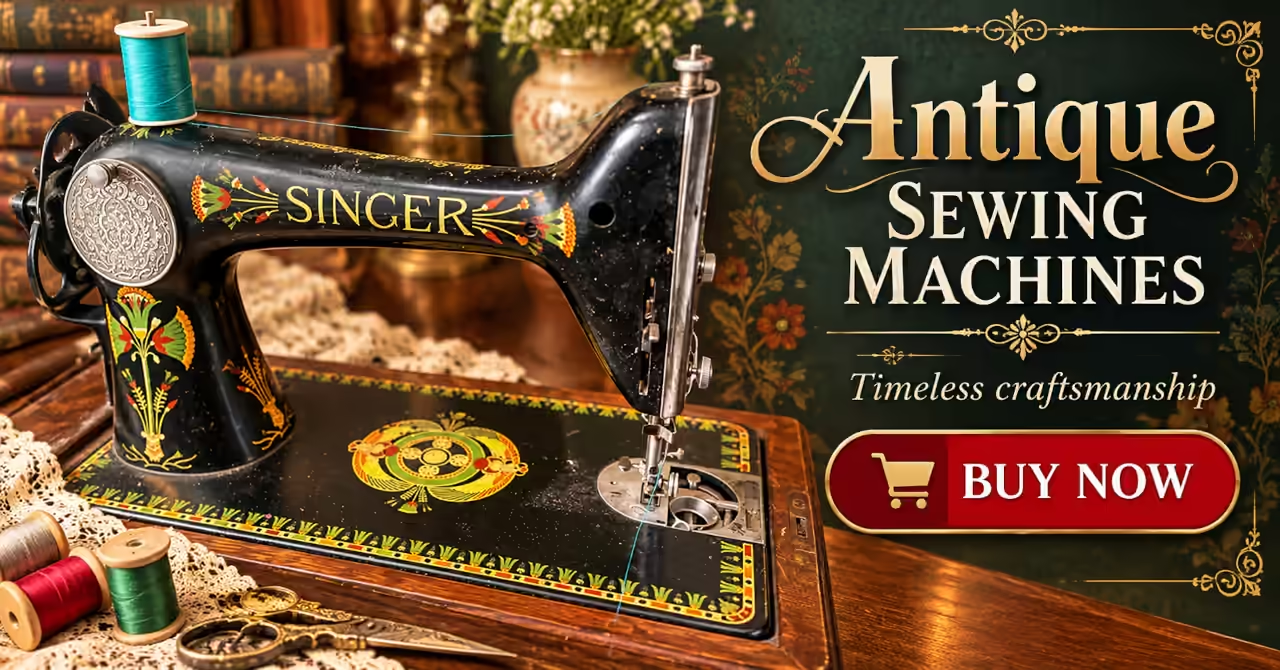
A collector is likely to find a remarkably broad marketplace rather than a neat catalogue of pristine antiques. Complete black-enamel machines with elaborate decals sit alongside cabinet and treadle models, later electric machines, incomplete examples, spare parts and accessories, with condition ranging from display-worthy survivors to obvious restoration projects. Singer appears strongly represented, but the variety is wide enough that buyers can shop either for a recognisable decorative piece or something more unusual. The main challenge is therefore not availability, but discrimination: originality, completeness, decal condition, mechanical wear, cabinet condition and whether a machine has been sympathetically preserved or heavily altered will matter far more than age alone.
Author's Notes
Notes & Memoranda
As is often the case, the subject extends beyond the bounds of a single article. The notes and memoranda below gather together useful definitions, related observations, references, and occasional curiosities discovered along the way.
Glossary
Some of the terms used in this article have specialised, historical or technical meanings. This glossary provides additional context for selected terms and ideas.
- parlour
- A formal reception room in a Victorian house used for entertaining visitors and displaying the family's taste and respectability; because it was a space for presentation rather than everyday work, placing a sewing machine there signalled that an industrial device had been domesticated and made to conform to middle‑class standards of decorum and display.
- lockstitch
- A sewing stitch produced when a top needle thread and a lower bobbin thread interlock between fabric layers, creating a flat, durable seam; the lockstitch (made commercially practicable in the 1840s) transformed garment manufacture by producing stronger, more reliable seams and underpins most modern sewing machines.
- hire‑purchase arrangements
- A mid‑19th‑century sales method that let buyers take an expensive item into use while paying in instalments, with legal ownership typically transferring only after the final payment; this form of consumer credit made costly household goods such as sewing machines affordable to middle‑class families and helped expand mass markets.
- V&A
- Short for the Victoria and Albert Museum in London, the national museum for decorative arts and design whose collections and scholarship are a principal source for understanding Victorian objects, domestic interiors and consumer culture.
- Isaac Singer
- Inventor and entrepreneur whose practical improvements to earlier sewing‑machine designs, together with aggressive production, marketing and sales tactics, turned the device into a mass‑market household appliance; Singer’s success illustrates how technical invention coupled with organisation and branding scaled domestic technologies.
Frequently asked questions
Curious about something you’ve just read? These frequently asked questions explore some of the key ideas, details and questions surrounding the topic.
Why is the sewing machine considered a quintessential Victorian object?
It put industrial power into ordinary domestic life, sitting at the boundary between manufacture and home and embodying Victorian tastes for modernity that was disciplined, tidy, and decorous.
In what way did sewing machines change women’s domestic work?
They sped up tasks like making, altering, and repairing clothes but did not eliminate domestic obligations; instead they reorganised labour so households could do more with less while preserving the appearance of feminine competence.
How were sewing machines marketed and displayed in Victorian homes?
Manufacturers presented them as pieces of furniture and ornaments—often lacquered, decorated, and mounted in cabinets—and promoted ownership as both a way to save time and money and a mark of modern, respectable status, with hire-purchase plans used to make them affordable.
What technological and commercial developments made domestic sewing machines successful?
The machine evolved from earlier patents and inventions (such as Thomas Saint’s 1790 patent and Elias Howe’s 1846 lockstitch) and succeeded through refinement, branding, competition, legal battles over patents, and organisational innovations exemplified by Singer’s mass-market approach.
Further Reading…

References and Further Reading
- Victoria and Albert Museum, “A Stitch in Time: Home Sewing Before 1900” https://www.vam.ac.uk/blog/news/a-stitch-in-time-home-sewing-before-1900
- Victoria and Albert Museum, “Pandemic Objects: Sewing Machine” https://www.vam.ac.uk/blog/design-and-society/pandemic-objects-sewing-machine
- Smithsonian National Museum of American History, “1873 - Singer New Family Sewing Machine” https://americanhistory.si.edu/collections/object/nmah_645504
- British Library, “Sewing machines – who really invented them?” https://www.bl.uk/stories/blogs/posts/sewing-machines-who-really-invented-them
- Smithsonian Institution, “Sewing machine” brochure illustration and discussion in historical technology collection https://www.sil.si.edu/DigitalCollections/hst/cooper/pdf/Cooper1976sewing.pdf
Disclosure
This article interprets the sewing machine as a cultural object within Victorian domestic life. Experiences varied widely by class, occupation, household and location, and the social meanings discussed here should be read as broad historical patterns rather than universal conditions. This article contains an affiliate link to eBay. Phillaneum may earn a commission from qualifying purchases made through this link, at no additional cost to the buyer.