Silver Dust Flour: A Victorian Gulgong Advertisement (1900)
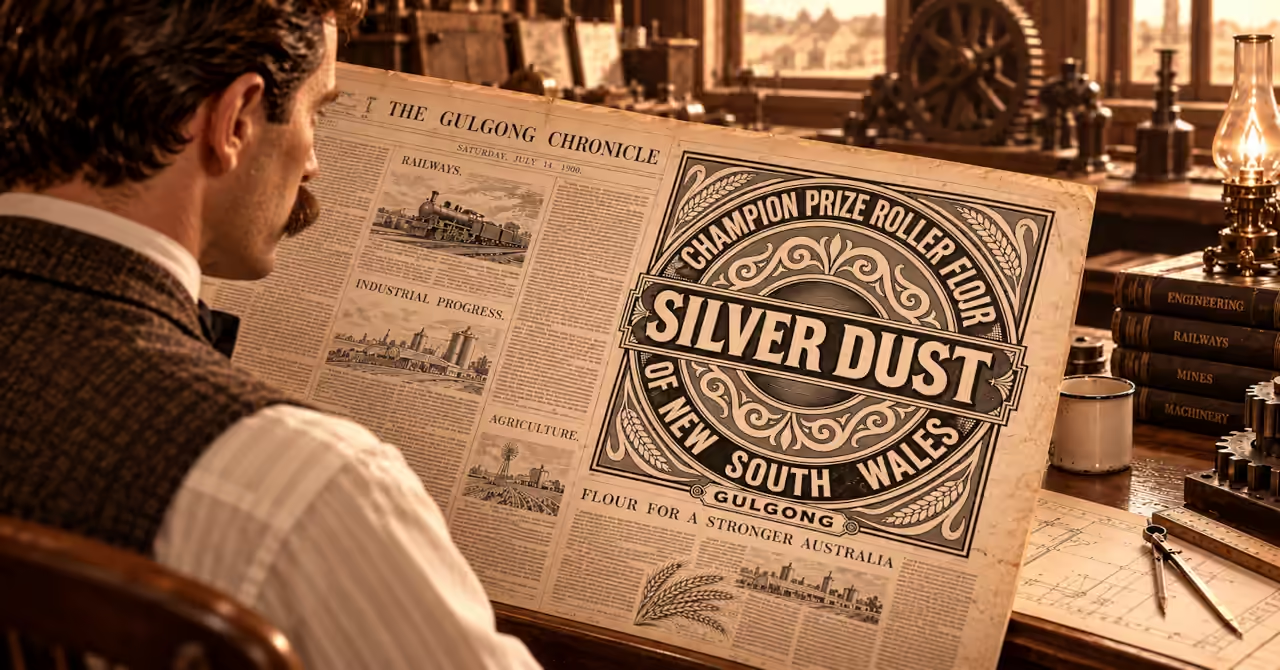
Silver Dust: A Flour Advertisement from Gulgong in 1900
At the turn of the twentieth century, even an ordinary bag of flour could be promoted with the grandeur of a prize-winning exhibition. On 5 January 1900, readers of The Gulgong Advertiser encountered an elaborate advertisement for Silver Dust, a brand of roller-milled flour from regional New South Wales. More than a century later, this surviving illustration offers a fascinating glimpse into the commercial ambitions and visual culture of Victorian Australia.
As explored in our earlier exhibit, Blackburn & Sons: A Vintage Advertisement from 1927 , historical advertisements reveal much about the businesses, fashions and consumer expectations of their time. Silver Dust takes us nearly three decades further into the past, when elaborate commercial artwork could transform a humble agricultural product into a symbol of quality, prestige and regional pride.
Digitally remastered from the original newspaper illustration, this Phillaneum exhibit examines the advertisement's distinctive design, its connection to Gulgong's milling industry and the cultural value of preserving vintage advertising. It also raises an important question about digital heritage: when damaged historical artwork is reconstructed, where does restoration end and modern interpretation begin?
Reading the Silver Dust Advertisement
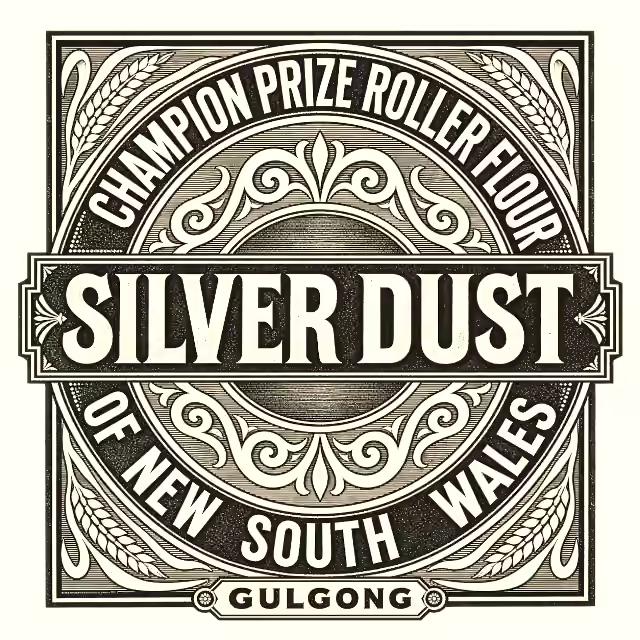
The advertisement is a striking example of late-Victorian commercial graphic design. The words Silver Dust dominate a broad horizontal banner, framed by elaborate curved lettering, symmetrical scrollwork and decorative flourishes. Above the central name, the inscription "Champion Prize Roller Flour" follows a sweeping arch, while "Of New South Wales" curves around the lower portion.
The composition deliberately resembles a commemorative medal or exhibition award. Its concentric borders, ornamental detailing and imposing typography create an impression of distinction rather than merely identifying the product. This was advertising designed to be noticed, remembered and associated with quality, even when reproduced in the relatively coarse printing of a regional newspaper.
Particularly intriguing is the prominent claim of "Champion Prize Roller Flour". Such language suggests competitive achievement and manufacturing excellence, although the surviving advertisement does not identify the competition or award behind the claim. Whatever its precise origin, the wording demonstrates how manufacturers used the language of prizes and recognition to establish credibility in an increasingly competitive marketplace.
Silver Dust and the Gulgong Flour Industry
The advertisement belonged to an established local milling enterprise. Historical accounts identify Silver Dust as a flour brand associated with C. R. Young, a Gulgong merchant who established a modern steam-powered roller flour mill beside his commercial premises in the early 1890s.
Roller milling represented an important development in flour production. Compared with traditional millstones, systems using metal rollers offered greater control over the milling and separation of grain. For a regional agricultural community, local milling facilities also reduced dependence on transporting wheat and flour between distant towns.
Silver Dust was not merely a local curiosity. A report in the Mudgee Guardian and North-Western Representative dated 11 July 1899 described C. R. Young shipping a twenty-ton consignment of Silver Dust flour to London. This provides an intriguing commercial context for the advertisement published six months later: a regional Australian product was being promoted at home while reaching markets overseas.
From Newspaper Print to Digital Remaster
The original illustration survives through the digitised collection of the National Library of Australia's Trove service. Its appearance reflects the limitations of newspaper printing, historical wear and the subsequent digitisation process. Fine lines have deteriorated, some decorative details merge into the surrounding print, and portions of the lettering are difficult to distinguish.
Phillaneum has produced a digitally remastered interpretation to make the advertisement more accessible to contemporary readers. The reconstruction restores contrast, clarifies ornamental elements and presents the design in a square format with a transparent background.
Editorial restoration disclosure: The remastered illustration is not a photographic reproduction of the original newspaper image. Some decorative details have been reconstructed, and the faint lettering at the bottom has been replaced with the word "GULGONG". Although the advertisement's association with Gulgong is historically supported, this particular lettering cannot be confidently established from the surviving image. The remaster must therefore be understood as an interpretative reconstruction, rather than an exact restoration of the original artwork.
Readers interested in the historical evidence should consult the original newspaper page on Trove. Preserving access to the source is particularly important when modern restoration techniques introduce details that may differ from the original printing.
Why Vintage Advertisements Matter
Historical advertisements are often overlooked because their original purpose was so ordinary. They were designed to sell flour, soap, furniture, machinery or other everyday products, and were rarely intended to survive beyond the newspaper in which they appeared.
Yet these advertisements are valuable records of commercial culture. Their typography, imagery, slogans and claims reveal what businesses believed would attract customers and inspire confidence. The language of prizes, quality and regional identity provides evidence of the aspirations that shaped nineteenth-century marketing.
Silver Dust demonstrates how advertising borrowed visual conventions from medals, certificates and prestigious awards. Its ornamental lettering and symmetrical composition make the product name appear almost ceremonial. The intention was to distinguish one brand of flour from its competitors and encourage customers to associate that name with quality.
Such designs also remind us that graphic design was a significant part of everyday Victorian commercial life. Lettering, decorative borders and illustration had to communicate effectively in black ink, often on inexpensive paper and alongside densely printed news and notices. The resulting artwork could be remarkably elaborate.
Preserving the Ordinary Past
The cultural importance of an advertisement like Silver Dust extends beyond its appearance. It connects graphic design with agriculture, industrial technology, regional enterprise and the economic ambitions of a country town.
Its survival also reveals something about historical preservation. Museums readily collect significant paintings, machinery and ceremonial objects, but newspaper advertisements preserve the quieter evidence of everyday commerce. They capture brands, businesses and visual fashions that might otherwise disappear from the historical record.
By presenting the original source alongside an openly identified reconstruction, Phillaneum seeks to make this fragment of Australian commercial history accessible without obscuring the distinction between surviving evidence and modern interpretation.
Silver Dust may have begun as a simple advertisement for flour, but today it is also a small surviving expression of Victorian craftsmanship, regional ambition and the enduring appeal of historical graphic design.
Conclusion
The Silver Dust advertisement began as a simple attempt to sell flour in regional New South Wales. More than 125 years later, it tells a much richer story about Victorian enterprise, industrial progress and the visual language of commerce. Its elaborate lettering, ornamental design and confident claims of quality remind us that even everyday products were presented with considerable imagination and artistic ambition.
Preserving such advertisements allows us to recover fragments of commercial history that might otherwise disappear. Digital remastering can make their artistry accessible again, provided we remain transparent about the distinction between historical evidence and modern reconstruction.
Silver Dust is just one example of the remarkable advertising heritage hidden within old newspapers and magazines. To discover how businesses once competed for attention through illustration, typography and persuasive storytelling, continue exploring our Vintage Advertising Journal , where the forgotten advertisements of yesterday reveal the ingenuity, ambitions and changing tastes of their time.
From the Curator's Workshop
Our Dodge Patent Wood Split Pulley T-shirt remasters the wonderful 1893 advertisement that inspired this article, preserving its period typography and distinctive pulley engraving. It is wearable industrial history for engineers, machinists and vintage machinery enthusiasts — and purchasing one helps support Phillaneum.
Author's Notes
Notes & Memoranda
As is often the case, the subject extends beyond the bounds of a single article. The notes and memoranda below gather together useful definitions, related observations, references, and occasional curiosities discovered along the way.
Glossary
Some of the terms used in this article have specialised, historical or technical meanings. This glossary provides additional context for selected terms and ideas.
- Roller milling
- A late‑nineteenth‑century method of grinding grain using a series of metal rollers rather than a single pair of stone wheels; the rollers crush and progressively separate endosperm from bran so millers can extract a finer, whiter flour with greater speed and consistency. Its adoption enabled larger, more standardised output and underpinned the industrialisation of flour production in towns and cities.
- Steam‑powered mill
- A milling works whose machinery is driven by a steam engine instead of water, wind or animal power; steam power freed mills from riverside locations, boosted capacity and reliability, and required significant capital investment—marking a transition from cottage or village industry to mechanised, export‑capable production.
- Champion Prize
- A promotional claim indicating that a product was judged superior in a competition or exhibition; in the nineteenth century such phrases referenced agricultural shows, industrial exhibitions or prize medals and were used to signal quality and trustworthiness to customers, though the precise origin of a claim is not always documented.
- Trove
- The National Library of Australia’s free online service that aggregates digitised historical newspapers, magazines, government documents and other sources, offering searchable page images and OCR text; Trove is a key public tool for locating original print evidence, though digitisation and OCR can introduce legibility errors that researchers must check against scanned pages.
- Editorial restoration disclosure
- A statement acknowledging that a digitally remastered image includes interpretative reconstruction rather than being an exact photographic facsimile; such disclosures explain what was altered (for example, contrast enhancement, reconstructed lettering or removed noise) so viewers can distinguish surviving historical evidence from modern additions and assess the image’s evidential limits.
Frequently asked questions
Curious about something you’ve just read? These frequently asked questions explore some of the key ideas, details and questions surrounding the topic.
What was Silver Dust and who produced it?
Silver Dust was a brand of roller-milled flour from New South Wales associated with Gulgong merchant C. R. Young, who established a steam-powered roller flour mill beside his premises in the early 1890s and even shipped consignments overseas.
Why does the advertisement look like a medal or award?
The design uses elaborate curved lettering, ornamental scrollwork and a symmetrical composition with the prominent phrase "Champion Prize" to convey quality, distinction and regional pride, although the advertisement does not establish which competition or award inspired that description.
How has the original advertisement been preserved and altered for modern viewing?
The illustration survives in the National Library of Australia's Trove digitised newspapers, and Phillaneum produced a digital remaster that restores contrast, clarifies ornamentation, presents a square image with a transparent background, and reconstructs some details—including replacing faint bottom lettering with the word "GULGONG"—so the remaster should be seen as an interpretative reconstruction rather than an exact photographic reproduction.
What historical insights do vintage advertisements like Silver Dust provide?
They reveal commercial culture through typography, imagery, slogans and claims—showing how businesses signalled quality, regional identity and industrial capability—and preserve everyday evidence of brands, businesses and visual fashions that might otherwise disappear from the historical record.
Further Reading…


References and Further Reading
- The Gulgong Advertiser (1900), 5 January, p. 1. Silver Dust roller flour advertisement. National Library of Australia, Trove. View digitised newspaper page . Primary source for the original advertisement.
- Mudgee Guardian and North-Western Representative (1899), 11 July. Contemporary report concerning C. R. Young's export of Silver Dust flour to London. Reproduced in The Online History of Gulgong, C. R. Young . Historical context for the business and its commercial activities.
- The Online History of Gulgong (2023), Flour . A historical compilation documenting Gulgong's flour milling industry, drawing upon regional newspapers, local historical records and museum material. Useful for further research into the development of milling in the district.
Disclosure
This article is based on a historical newspaper advertisement published in The Gulgong Advertiser on 5 January 1900 and includes editorial interpretation. The remastered image is not a perfect restoration of the original print. Some ornamental details and faint lettering, particularly at the bottom of the advertisement, have been clarified or reconstructed for presentation. Readers should consult the original Trove newspaper page for the surviving primary-source evidence.