Blackburn & Sons: A Glimpse into 1927 Australian Advertising
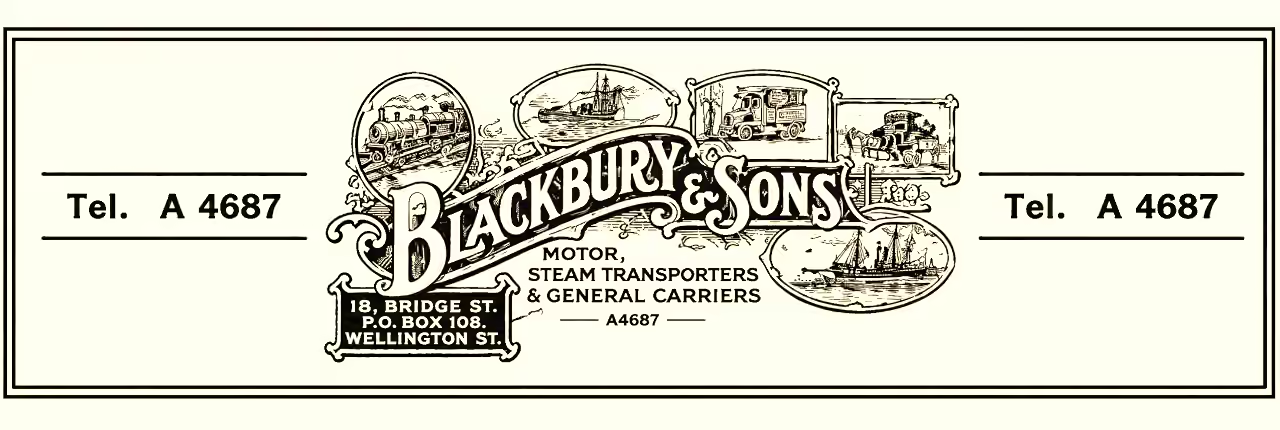
What can an old advertisement tell us about life nearly a century ago? Quite a lot, as it turns out. In 1927, Blackburn & Sons placed an illustrated advertisement in a Perth shipping and trade newspaper, promoting its freight and transport services. Steamships, locomotives and motor vehicles all appear beneath the company's bold lettering. At first, it looks like a simple attempt to attract customers. Look closer, however, and it reveals a business world where older and newer technologies worked side by side.
As we explored in Why Old Ads Make More Sense Than New Ones, vintage advertisements often had a remarkable ability to explain what a business offered at a glance. This example, preserved through the National Library of Australia's Trove collection, gives us a colourful glimpse of Australian commercial life in the late 1920s, despite being printed entirely in black and white.
The Advertisement: Blackburn & Sons
The first thing that catches the eye is the company's name. Large, sweeping letters give Blackburn & Sons a grand appearance, while smaller illustrations fill the advertisement with signs of movement and industry. Steamships, railway engines and motor vehicles share the space, each representing a different way of moving goods. The company describes itself as offering motor and steam transport services and general carrying. Together, the words and pictures present a business that wants customers to see it as capable, established and ready for work.
There is plenty to discover in the smaller details. The telephone number, A4687, appears prominently, making it easy for a potential customer to get in touch. An address panel provides another practical point of contact. These details remind us that advertisements were once an important way to find local services, long before websites and online business directories. Yet Blackburn & Sons was doing more than providing contact information. Its decorative lettering and transport illustrations turned an everyday freight service into something memorable. The pictures also suggest a wider range of transport, although they do not tell us exactly which vehicles the company owned or operated.
The image displayed in this exhibit has been digitally remastered from the surviving newspaper scan. Contrast and definition have been improved to make the design easier to appreciate, while some faded lettering and illustration details have been reconstructed. The result brings the advertisement's visual character back into focus. Because parts have been recreated, this version is a modern restoration rather than an exact copy of the original printing. Readers can compare it with the surviving newspaper page through the archival link below.
Discovery and Historical Context
This advertisement was discovered in Trove, the National Library of Australia's digital newspaper collection. It appeared on page 8 of the Daily Commercial News and Shipping List on 24 October 1927 (Volume 1, Number 142). A newspaper devoted to trade and shipping was an ideal place for a transport business to find customers. You can still explore the original newspaper page and see the advertisement as readers did nearly a century ago.
Australia in 1927 was experiencing a transport revolution. Ships and railways still carried enormous quantities of freight, but motor trucks were opening new routes between ports, railway stations and customers. Old and new technologies worked together, sometimes carrying the same shipment on different stages of its journey. Blackburn & Sons advertised during this changing era, presenting a business ready to serve a world increasingly on the move.
Look closely at the illustrations. Steam-powered transport suggests established industrial strength, while motor vehicles point towards a changing future. Whether the company operated every vehicle pictured remains unknown, but its message is clear: Blackburn & Sons wanted to appear capable, dependable and ready for modern business. Almost a century later, that confident sales pitch has become a revealing piece of Australian commercial history.
Vintage Advertising: Commerce, Illustration and Persuasion
Old advertisements reveal more than what businesses sold. They show what customers were expected to value. Blackburn & Sons advertised freight transport, yet its elaborate lettering and impressive machinery suggest something larger: strength, reliability and progress. In 1927, a steamship or locomotive was more than a means of transport. It was a powerful symbol of industry, and the company used that imagery to build confidence in its services.
The advertisement also shows a clever understanding of how people read. The bold company name grabs attention, the illustrations explain its capabilities, and the telephone number offers an immediate next step. It is a complete sales message, delivered largely through pictures. Nearly a century before digital marketing, businesses were already guiding customers from curiosity towards action.
Perhaps the greatest insight is that advertisements record what a society admires. Today's advertising often celebrates convenience, lifestyle and personal identity. Blackburn & Sons celebrated industrial capability. The tools of persuasion have changed, but the underlying question remains: what does a business need to show us before we trust it?
Conclusion
The Blackburn & Sons advertisement has outlived the purpose for which it was printed. What once helped customers find a transport business now helps us understand the people, expectations and commercial relationships of 1927. It reminds us that history is not only found in major events and famous inventions, but also in the everyday exchanges that kept communities working. Perhaps that is the real value of vintage advertising: it preserves the things people once considered important enough to announce to the world. To discover more about the messages, ambitions and changing values hidden in historical advertisements, explore our Vintage Advertising Journal, where the sales pitches of yesterday become stories about the people who made and read them.
From the Curator's Workshop
Phillaneum's Cabinet of Curious Vintage Mechanisms design gathers the visual language of old machines, patents and illustrated technical catalogues into a monochrome vintage-style graphic. It is a T-shirt rather than a historical artefact, but it is intended as a wearable extension of the same curiosity: the pleasure of seeing how ingenious, awkward and consequential mechanisms can be.

Author's Notes
When I look at this advertisement, I wonder about the people behind the freight. The drivers starting before dawn, the railway workers loading goods, and the shopkeepers waiting for deliveries. None appear in the illustrations, yet their livelihoods depended on the transport networks being advertised. It reminds me how easily ordinary working lives disappear from history.
What interests me most is the trust involved. A customer was not simply hiring a vehicle but placing valuable goods in someone else's hands. Behind this confident advertisement were countless human relationships, expectations and promises. For me, that unseen social world is what makes this small piece of advertising worth preserving.
Notes & Memoranda
As is often the case, the subject extends beyond the bounds of a single article. The notes and memoranda below gather together useful definitions, related observations, references, and occasional curiosities discovered along the way.
Glossary
Some of the terms used in this article have specialised, historical or technical meanings. This glossary provides additional context for selected terms and ideas.
- Trove
- An online repository run by the National Library of Australia that digitises and makes searchable large quantities of historical material—especially newspapers—using scanned pages and optical character recognition (OCR); researchers use it to locate original printed items, but must allow for OCR errors and the editorial work sometimes needed to interpret damaged or faded pages.
- Steamships
- Seagoing vessels powered by steam engines rather than sail; in the 1920s they were the principal means of long-distance freight and coastal trade, so depicting steamships in an advertisement signalled a company's ability to handle overseas or port-to-port shipments and conveyed industrial reliability and scale.
- General carrying
- A business phrase historically used by haulage and forwarding firms to mean the transport and handling of varied goods rather than a specialised service; it implied flexibility—moving cargo by road, rail or ship—and often encompassed packing, short-term storage and door-to-door delivery in a single offering.
- Telephone number A4687
- An example of an early alphanumeric telephone exchange code where a leading letter identified a local exchange and the following digits routed the call within that exchange; advertising such a number emphasised immediate, local contactability at a time when telephone networks were still organised around named exchanges rather than the all-digit national systems used later.
- Digitally remastered
- A process applied to a scanned historical image that improves legibility and visual contrast—often by cleaning blemishes, boosting definition and reconstructing badly faded or missing elements—resulting in a clearer representation useful for display or study but not an exact facsimile of the original printed page.
Frequently asked questions
Curious about something you’ve just read? These frequently asked questions explore some of the key ideas, details and questions surrounding the topic.
Who were Blackburn & Sons?
Blackburn & Sons was a transport business advertising motor and steam transport services and general carrying in Western Australia in 1927. Its illustrated newspaper advertisement featured steamships, railway locomotives and motor vehicles to promote its transport capabilities.
Where was the 1927 Blackburn & Sons advertisement discovered?
The advertisement was discovered in the National Library of Australia's Trove digital newspaper collection. It appeared on page 8 of the Daily Commercial News and Shipping List, published on 24 October 1927, Volume 1, Number 142. The original newspaper page is available at https://nla.gov.au/nla.news-page30432166.
What does the advertisement reveal about Australian transport in 1927?
The advertisement reflects a period when steam-powered transport, railways, shipping and motor vehicles operated alongside one another. During the late 1920s, road transport was becoming increasingly important for moving goods between railway stations, ports, businesses and customers.
Why are vintage newspaper advertisements valuable historical artefacts?
Vintage advertisements reveal how businesses presented their products and services, which technologies people used and what customers were expected to value. Their illustrations, lettering and promotional messages offer insights into everyday life, commercial culture and changing social attitudes. They preserve historical details that might otherwise be overlooked.
Further Reading…


References and Further Reading
- Daily Commercial News and Shipping List (Perth, WA), 24 October 1927, Vol. 1, No. 142, p. 8. Blackburn & Sons transport advertisement. National Library of Australia, Trove. View original newspaper page . Accessed 29 October 2026.
Disclosure
This article presents a historical interpretation of a Blackburn & Sons advertisement published in the Daily Commercial News and Shipping List on 24 October 1927, preserved in the National Library of Australia's Trove collection. The discussion of transport technology, commercial culture and advertising practices draws upon the advertisement and its historical context. Interpretations of the company's intentions, capabilities and promotional messages should not be regarded as independently verified facts about its operations. The featured image has been digitally remastered, with some indistinct lettering and illustration details reconstructed to improve clarity and presentation. It is therefore a modern restoration rather than an exact facsimile of the original newspaper advertisement. Readers are encouraged to consult the original Trove record for historical reference.