Should We Continue to Ignore Decorative Panels When Furnishing?
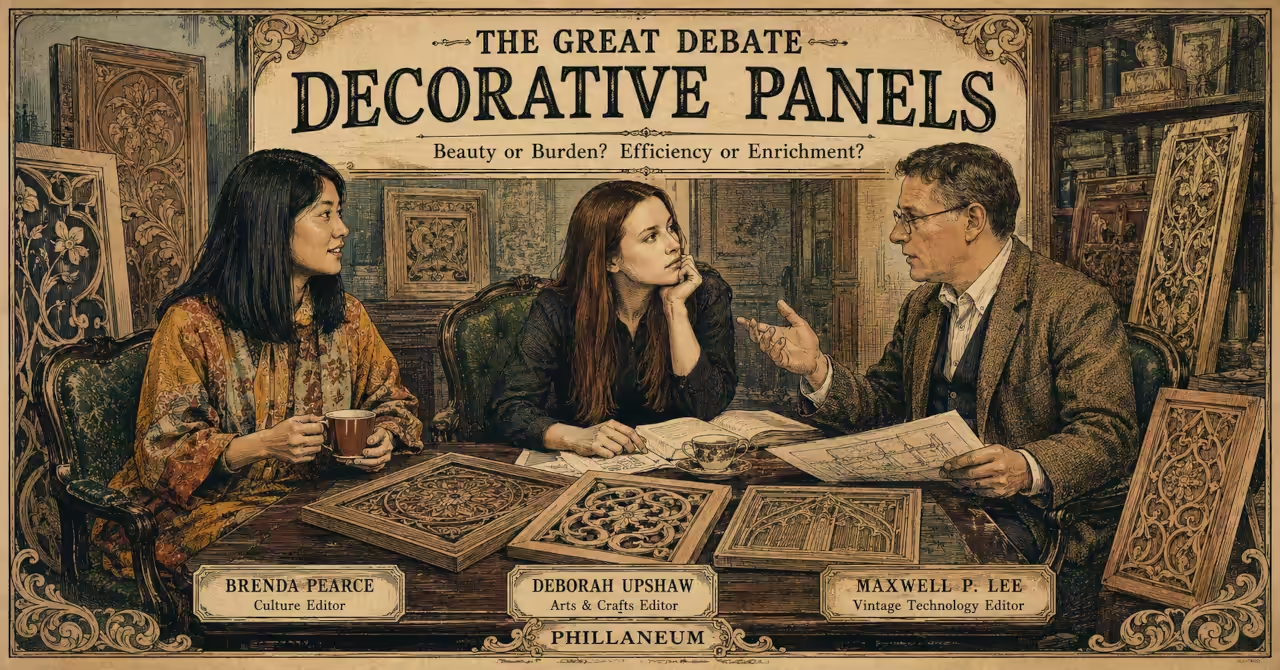
The Participants
For this Great Debate, Phillaneum assembled three of its regular contributors to discuss an apparently simple question that quickly became something much larger.

Culture Editor. Brenda explores the relationship between objects, memory, atmosphere, and the emotional lives of interiors.

Arts & Crafts Editor. Deborah studies traditional craftsmanship, decorative furniture, and the visual language of historic interiors.

Vintage Technology Editor. Maxwell examines how technology, manufacturing, and industrial systems influence culture.
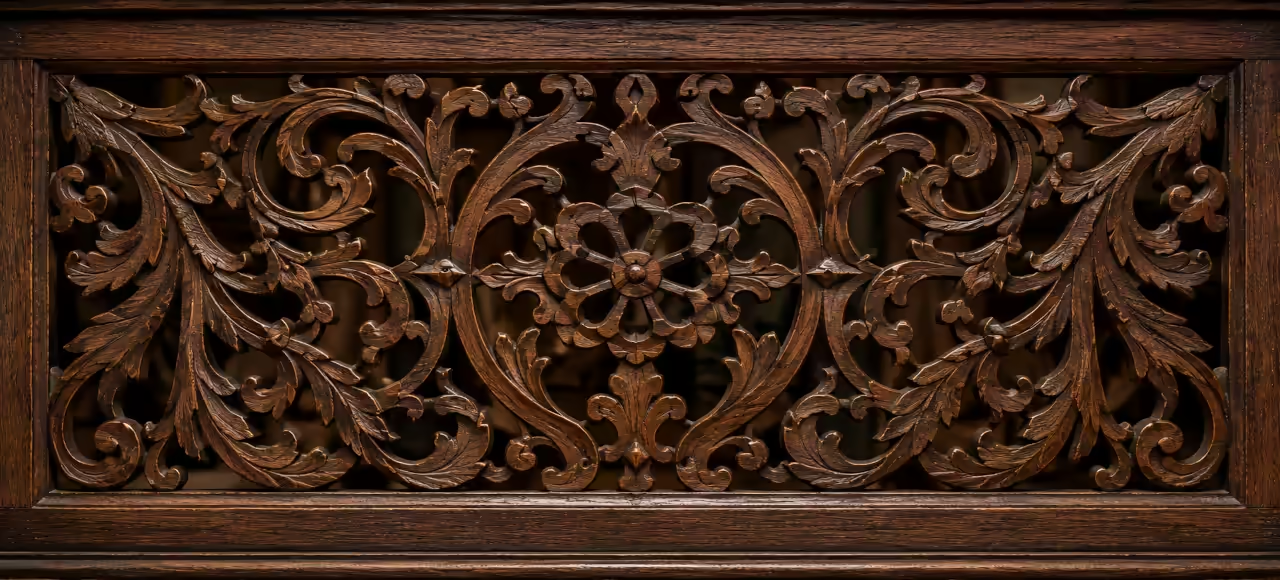
There are few objects more quietly revealing than the front of a piece of furniture. A wardrobe door, a cabinet face, a sideboard panel: these are not glamorous machines. They do not whistle, calculate, illuminate, rotate, amplify, or make toast. Their great technical achievement is usually that they open, close, and remain where the maker put them. Yet for several centuries, people still looked at these plain mechanical surfaces and decided they should carry carving, pattern, shadow, moulding, veneer, brasswork, fretwork, or some other visible sign that the object had not entirely surrendered to usefulness.
That is the oddity before us. Decorative panels are easy to dismiss precisely because they perform no obvious modern function. They do not increase storage capacity. They do not improve broadband reception. They do not make a drawer run smoother, a room larger, or a mortgage kinder. From the perspective of clean industrial logic, they are excess material, excess labour, excess visual information. A flat panel is cheaper, simpler, faster, and easier to manufacture. The spreadsheet has every reason to vote against ornament.
And yet the human eye keeps defecting.
We pause over carved oak. We photograph fretwork. We rescue fragments from salvage yards. We call old furniture atmospheric when what we often mean is that its surfaces have not gone silent. So the question is not simply whether decorative panels still deserve attention when furnishing a room. The better question is why we trained ourselves to ignore them in the first place.
When we discuss decorative furniture panels, I suspect many readers imagine we are debating a minor decorative preference. It can sound like a conversation about carved timber, antique wardrobes, old-fashioned sideboards, and whether a piece of furniture ought to have a little more visual flourish than it strictly requires.
I do not believe that is what we are debating at all.
The real question is whether a home should merely contain our lives, or whether it should actively participate in them.
For most of human history, domestic interiors were not designed to disappear into the background. Rooms were expected to possess character. Surfaces were expected to contribute atmosphere. Furniture was expected to do more than store objects. The wardrobe, the cabinet, the dresser, and the sideboard all played small but meaningful roles within a larger visual conversation occurring throughout the home.
A decorative panel was never simply a decorative panel. It was part of a broader language of domestic expression. It belonged alongside framed photographs, embroidered textiles, wallpaper borders, patterned carpets, lampshades, bookshelves, and collections of cherished objects. Together these elements created environments that reflected memory, personality, aspiration, and affection.
Modern interiors often pursue a very different goal. Increasingly, the highest compliment that can be paid to an object is that it disappears. Furniture becomes quieter. Surfaces become flatter. Ornament is reduced. Visual complexity is removed. Rooms are simplified until they feel efficient, flexible, and uncluttered.
There is much to admire in clarity and restraint. I am not arguing that every home should resemble a Victorian parlour or an Edwardian hotel lobby. Yet I sometimes wonder whether, in our pursuit of visual simplicity, we have unintentionally discarded forms of emotional richness that once came naturally to domestic life.
As explored in Why Decorative Ornament Became Unfashionable, many forms of decoration did not disappear because they ceased to be loved, but because cultural fashions increasingly associated visible ornament with the past.
Consider how often people are drawn to images of old libraries, historic hotels, period dramas, or forgotten manor houses. We describe these places as atmospheric. We describe them as warm, inviting, comforting, mysterious, or romantic. Rarely do we stop to examine why.
Part of the answer lies in ornament.
Decorative panels create shadow. They create texture. They create visual rhythm. They give the eye places to pause and explore. They transform otherwise anonymous surfaces into surfaces that appear touched by human intention. Even when we do not consciously notice them, they influence how a room feels.
What fascinates me most is that people continue seeking these qualities despite decades of predictions that ornament would simply fade away. We rescue decorative fragments from demolition yards. We collect antique furniture. We recreate Victorian colour palettes. We romanticise old reading rooms and historic interiors. We fill social media feeds with images of spaces rich in texture and atmosphere.
The appetite clearly remains.
The disappearance of ornament did not eliminate the human desire for atmosphere.
That is why I cannot view decorative panels as an isolated furniture detail. They are symptoms of a larger philosophy. They belong to a tradition that understood homes as emotional habitats rather than efficient containers. Their purpose was not merely to impress visitors. Their purpose was to enrich everyday experience.
Perhaps decorative panels survive because they continue to perform a task that modern design sometimes overlooks. They remind us that a home is not simply a machine for living in. It is a place where memory settles, where identity accumulates, and where ordinary life acquires meaning through atmosphere.
The debate before us, then, is not really about decorative panels at all. It is about whether we still believe our surroundings should nourish the imagination as well as serve a practical function.
I agree with Brenda on one important point: this debate is not really about decorative panels.
However, I arrive there by a different route.
Brenda approaches the subject through atmosphere and culture. I approach it through furniture itself. Through timber. Through surfaces. Through craftsmanship. Through the quiet decisions made by people who build things.
Whenever I visit an antique shop, a restoration workshop, or even an ordinary second-hand furniture warehouse, I find myself looking at the fronts of things. Not because I am searching for perfection, but because the front of a piece of furniture often reveals what its maker believed was worth caring about.
Look closely at a Victorian sideboard. Examine an Edwardian cabinet. Open the doors of an old wardrobe. Again and again you encounter small decisions that required extra effort but served no strict practical purpose. A carved border. A raised panel. A shaped moulding. A section of fretwork. A decorative veneer arranged to catch the light differently as you walk past.
None of these details increase storage capacity. None make the furniture stronger. Most were invisible from a purely functional point of view.
And yet somebody included them.
Decorative furniture asks a simple question: what if usefulness alone is not enough?
That matters.
Modern manufacturing often teaches us to think differently. We are encouraged to view furniture as equipment. A cabinet stores objects. A dresser stores clothes. A bookcase stores books. Once the function has been satisfied, everything else is frequently treated as unnecessary cost.
The result is that many contemporary furniture pieces appear designed to avoid attracting attention altogether. They are efficient. They are tidy. They are often perfectly serviceable. Yet they rarely invite closer inspection.
By contrast, decorative furniture asks to be looked at.
Not admired from a distance in some grand artistic sense. Simply noticed.
A carved panel catches a shadow during the afternoon. A fretwork detail reveals itself when sunlight falls through a nearby window. An unusual grain pattern becomes visible while dusting a shelf. Decorative furniture rewards repeated encounters because it contains visual information beyond its immediate function.
This is why I become slightly uneasy when ornament is dismissed as unnecessary. The word itself suggests that decorative work contributes nothing of value. Yet when people discover antique furniture they love, the reasons are often deeply connected to these supposedly unnecessary details.
Collectors become fascinated by irregular carving. Restorers spend hundreds of hours preserving decorative surfaces. Salvage hunters rescue damaged fragments of panels that no longer perform any practical role whatsoever. Entire online communities exchange photographs of mouldings, veneers, brasswork, and carved details.
Human beings clearly care about such things.
What interests me most is that decorative furniture often reveals evidence of the maker's presence. Perfectly flat surfaces tell us very little. Decorative surfaces tell stories. They reveal judgement, taste, labour, experimentation, and occasionally even small mistakes. A hand-carved detail may be slightly asymmetrical. A decorative motif may differ subtly from its counterpart. The furniture feels human because traces of the human remain visible.
I sometimes think of decorative panels as the furniture equivalent of handwriting.
A typed document may communicate information more efficiently, but handwriting reminds us that a person was involved. Decorative furniture performs a similar function. It reminds us that somebody once cared enough about an object to make it more interesting than it strictly needed to be.
That is why I believe decorative panels deserve our attention. Not because every home requires elaborate ornament. Not because Victorian interiors should become universal again. But because decorative surfaces reveal a philosophy of making that valued beauty alongside usefulness.
To me, the disappearance of decorative panels represents something larger than a change in style. It reflects a gradual loss of confidence in the idea that ordinary objects can enrich everyday life.
A wardrobe is still a wardrobe. A cabinet is still a cabinet. Yet somewhere along the way we stopped expecting them to contribute anything beyond storage.
That seems a remarkably low ambition for the objects we choose to live among every day.
Listening to Brenda and Deborah, one could easily conclude that decorative panels represent a tragic cultural loss. Atmosphere has been diminished. Craftsmanship has been neglected. Furniture has become anonymous. Homes have become quieter, flatter, and perhaps less emotionally expressive.
There is considerable truth in those observations.
The difficulty is that history rarely changes direction without a reason.
If decorative panels have largely disappeared from everyday furnishing, we should be cautious before assuming society simply made a mistake. Entire industries, design movements, manufacturing systems, and consumer markets spent more than a century moving away from ornament. Such transitions do not occur accidentally.
The uncomfortable possibility is that decorative panels were not abandoned despite their disadvantages.
They were abandoned because of them.
Consider the problem from the perspective of a furniture manufacturer rather than a collector. A flat panel can be designed quickly. It can be manufactured efficiently. It requires fewer specialised skills. It reduces labour costs. It simplifies repairs. It allows products to be produced at larger scales and sold at lower prices.
Now imagine furnishing not a Victorian townhouse for a prosperous family, but an entire twentieth-century society. Millions of homes. Expanding cities. Growing populations. Rising expectations of comfort and affordability.
Under such conditions, decorative carving begins to look less like cultural enrichment and more like a production bottleneck.
Modernism did not emerge solely because designers disliked ornament. It emerged because industrial society increasingly valued standardisation, efficiency, accessibility, and functional clarity. Decorative panels represented time, labour, cost, and manufacturing complexity. Flat surfaces represented speed.
And speed won.
The same pattern appears throughout technological history.
Early machinery often displayed decorative castings. Railway stations incorporated elaborate ornament. Typewriters featured decorative flourishes. Radios were housed in furniture-like cabinets. Even electrical appliances once carried traces of decorative ambition.
Over time these elements were stripped away. Not because engineers suddenly became hostile to beauty, but because industrial systems relentlessly reward simplification. Every additional operation consumes resources. Every decorative feature introduces another decision, another process, another opportunity for variation.
From a systems perspective, ornament is expensive information.
There is another factor that deserves consideration. Decorative styles age. A heavily ornamented object often carries strong historical associations. What appears sophisticated to one generation may appear unfashionable to the next. Simpler forms possess a certain adaptability. They can move between changing tastes more easily than objects deeply committed to a particular decorative language.
This adaptability became increasingly valuable as twentieth-century culture accelerated. Fashion cycles shortened. Homes changed more frequently. Consumers became more mobile. Furniture was expected to survive not only physical use but changing aesthetic preferences.
Under those conditions, neutrality became a feature rather than a compromise.
Viewed this way, the modern flat panel begins to look remarkably successful. It is inexpensive, flexible, widely available, easy to manufacture, and difficult to date. By almost every measurable industrial metric, it outperformed its decorative predecessor.
Which leaves us facing a rather awkward conclusion.
If decorative panels disappeared because industrial society solved for efficiency, affordability, flexibility, and scale, then perhaps their decline was not evidence of failure at all.
Perhaps it was evidence of success.
The question we must now consider is whether those were the only objectives worth optimising.
I find very little to disagree with in Maxwell's description of how decorative panels disappeared.
Indeed, one of the most persuasive aspects of his argument is that it explains the transition so clearly. Industrial society rewarded efficiency. Manufacturing rewarded simplification. Consumers benefited from lower costs and greater accessibility. Decorative surfaces required labour, skill, time, and expense. Flat surfaces required less of all four.
History often moves in precisely this manner.
What interests me, however, is not why decorative panels became less common. The historical explanation is relatively straightforward. What interests me is why, despite all those rational forces, so many people continue to be drawn toward ornamented environments.
Human beings are not solely practical creatures.
We know this because we routinely surround ourselves with things that serve purposes beyond utility. We display photographs. We collect books we may never read again. We preserve family heirlooms. We travel to historic cities. We visit museums. We hang artwork on walls that would function perfectly well without it.
None of these activities represent efficient optimisation.
They represent meaning.
The same applies to our homes. A room can certainly succeed as a container. It can provide shelter, storage, lighting, heating, and comfort. Yet most people instinctively ask more of their surroundings than simple functionality. We want places that feel welcoming. We want rooms that reflect our personalities. We want environments that possess character and emotional texture.
This is where I believe decorative panels become significant.
Not because they are essential, but because they remind us that previous generations often expected domestic environments to communicate something beyond practical competence. A carved surface, a patterned border, or an ornamented cabinet front quietly announces that beauty and usefulness are not opposing forces. They are allowed to coexist.
Maxwell is correct that industrial society became extraordinarily successful at producing affordable furniture. Yet I wonder whether we sometimes confuse what is easiest to manufacture with what is most satisfying to inhabit.
The two are not necessarily the same.
After all, if efficiency alone determined human preference, we would not continue to romanticise historic libraries, old hotels, Victorian interiors, or atmospheric reading rooms. We would admire them intellectually and move on. Instead, people repeatedly return to such spaces because they offer experiences that feel emotionally distinctive.
That recurring attraction suggests something important. Beneath changing fashions and manufacturing systems, many people still desire environments that feel expressive, memorable, and alive.
Perhaps decorative panels survive in our imagination for the same reason stories survive, and rituals survive, and beautiful objects survive. They satisfy needs that spreadsheets cannot easily measure.
Efficiency tells us how well something works.
Atmosphere tells us how it feels to live with.
The challenge for modern furnishing is not choosing one or the other. It is remembering that both matter.
I think Maxwell is absolutely correct when he says that decorative panels lost the battle for efficiency.
The evidence is difficult to argue with. Flat surfaces are cheaper to manufacture. They require fewer specialised skills. They are easier to reproduce consistently and easier to sell across changing fashions. If the objective is to furnish millions of homes quickly and affordably, decorative carving appears to be a remarkably inefficient use of resources.
In The Lost Psychology of Panelled Furniture, we examined how raised surfaces, shadow lines, and visual depth influence our perception of quality and permanence.
What I question is the assumption that efficiency alone tells us whether something was worth preserving.
After all, efficiency is very good at removing things.
It removes steps. It removes costs. It removes complications. Sometimes it removes frustrations. But occasionally it also removes qualities that people quietly valued without ever measuring.
Furniture provides an interesting example. If we compare many contemporary pieces with their Victorian or Edwardian predecessors, we can clearly see the gains. Modern furniture is often lighter, more affordable, easier to transport, easier to manufacture, and available to vastly more people than ever before.
Those are genuine achievements.
Yet when I visit antique fairs, restoration workshops, architectural salvage yards, and collectors' homes, I encounter another pattern. People repeatedly gravitate toward furniture that displays evidence of care.
Not perfection.
The details people remember are rarely the most efficient ones.
Care.
A carved edge. A shaped panel. A decorative moulding. A section of fretwork that serves no practical purpose beyond making the object more visually engaging. These details often become the very features that owners discuss most enthusiastically.
Nobody stands beside an antique sideboard and says, "What I truly admire is the optimisation of the manufacturing process."
They run their hand across the timber.
They point to a carved detail.
They notice how the light catches the surface.
They respond to the object as a human creation rather than a storage solution.
This is why I am not entirely convinced by the argument that decorative panels became victims of progress. They became victims of a particular definition of progress.
Industrial systems became increasingly skilled at asking how cheaply, how quickly, and how consistently something could be produced. Those are important questions. The difficulty is that they are not the only questions worth asking.
There is also the question of delight.
There is the question of visual interest.
There is the question of whether an object rewards attention after ten years rather than ten minutes.
Most decorative furniture was never intended to astonish people. It was intended to make everyday life slightly richer. A panel on a wardrobe. A carved detail on a cabinet. A decorative front on a sideboard. Small gestures repeated throughout a home until beauty became part of the ordinary environment.
What concerns me is that once those details disappear, people gradually stop expecting them. We adapt to simpler surroundings and eventually forget that alternatives ever existed.
Perhaps the most significant loss is not the decorative panel itself.
Perhaps the loss is the habit of noticing.
Decorative furniture encourages observation. It rewards curiosity. It invites people to look more closely. In a world increasingly optimised for speed and convenience, those qualities strike me as more valuable than ever.
So while Maxwell is right that efficiency won the argument inside the factory, I am less certain it won the argument inside the home.
At this stage of the discussion, I find myself in an unusual position.
I largely agree with everybody.
Brenda is correct that people continue seeking atmosphere, meaning, and emotional richness within their surroundings. Deborah is correct that decorative objects often preserve forms of craftsmanship and human attention that are difficult to quantify but immediately recognisable when encountered.
At the same time, the historical forces that diminished decorative panels were neither irrational nor malicious. Industrial society solved genuine problems. It provided affordable furniture to millions of households. It simplified manufacturing. It reduced costs. It increased accessibility.
Perhaps ornament is not a design feature at all. Perhaps it is a human behaviour.
Viewed from almost any practical perspective, the modern flat panel was a triumph.
Which raises a fascinating question.
If ornament lost, why does it keep returning?
This is the point where I begin to suspect we have been discussing the wrong subject.
Throughout modern history, decorative traditions have been declared obsolete with remarkable confidence. Yet they never seem willing to remain dead. Arts and Crafts emerged as a reaction against industrial uniformity. Art Nouveau returned organic ornament to modern life. Historic preservation movements rescued decorative architecture. Collectors filled museums with objects that supposedly belonged to the past. More recently we have witnessed renewed enthusiasm for traditional craftsmanship, vintage interiors, dark academia, cottagecore, restoration culture, and countless other movements centred upon atmosphere and visual character.
The names change.
The impulse does not.
The historical role of decorative surfaces as social signals was discussed previously in Why Decorative Panels Once Signalled Good Taste.
Each generation appears to rediscover some version of the same idea: that human beings desire more from their surroundings than pure functionality.
As a student of technological history, I find this pattern difficult to ignore. Engineers, manufacturers, and designers repeatedly optimise systems for efficiency. Then people reintroduce personality. Manufacturers simplify products. People customise them. Buildings become standardised. Occupants fill them with objects, colours, collections, memories, and decorative traces.
It happens so consistently that one begins to wonder whether ornament is not a design feature at all.
Perhaps it is a human behaviour.
The decorative panel suddenly appears rather different when viewed through this lens. It is no longer merely a carved surface on a cabinet door. It becomes evidence of a recurring tension that extends far beyond furniture.
On one side stands the desire for efficiency, simplicity, standardisation, and functional clarity. These forces have delivered extraordinary improvements to modern life.
On the other stands the equally persistent desire for identity, atmosphere, beauty, memory, and self-expression. These forces are less easily measured, yet they repeatedly reappear whenever people begin shaping spaces of their own.
Seen in this way, decorative panels are not the issue under debate.
They are merely where the debate becomes visible.
A carved wardrobe door. A panelled cabinet. A section of fretwork. These objects are simply artefacts left behind by a larger philosophical disagreement about what homes are for.
Are they efficient containers for modern life?
Or are they cultural environments that shape how modern life feels?
The closer I examine the history of decorative panels, the less convinced I become that we are witnessing a dispute between old-fashioned design and modern design.
Instead, I believe we are observing two enduring visions of human flourishing. One asks how effectively a home can serve its occupants. The other asks how deeply a home can enrich them.
And unlike decorative fashion, that argument shows no sign of disappearing.
Final Statements
Throughout this discussion, decorative panels have served as our example. Yet my concern has never been the survival of any particular decorative feature.
What concerns me is whether our homes continue to provide emotional nourishment.
Human beings remember rooms long after they forget floorplans. We remember the atmosphere of a library, the warmth of a sitting room, the character of a grand hotel, or the quiet comfort of a familiar study. The details themselves matter less than the feeling they create.
Decorative panels are simply one of many ways previous generations expressed the belief that homes should possess personality, memory, and emotional depth.
For me, the question is not whether we should preserve ornament exactly as it once existed. The question is whether we still believe beauty deserves a place within everyday life.
I have spent many years looking closely at old furniture, and one observation returns again and again.
The objects people treasure most are rarely the most efficient.
They are the objects that reveal care.
A carved panel, a decorative moulding, a section of fretwork, an unusual grain pattern—these details remind us that somebody once invested attention in creating something more than a functional object.
I do not believe every cabinet requires ornament. I do believe we should be cautious whenever efficiency becomes the only measure of value.
Furniture occupies our homes for decades. That seems reason enough to ask it for a little beauty as well as utility.
Decorative panels have endured a curious fate.
They lost the industrial argument, yet somehow survived the cultural one.
Manufacturing systems found countless reasons to eliminate them. Consumers continue finding reasons to rediscover them.
That contradiction is what fascinates me.
The history of technology repeatedly demonstrates that people optimise systems for efficiency and then spend the next generation reintroducing individuality, meaning, and character.
Perhaps that is because human beings do not merely inhabit environments. We personalise them.
Decorative panels may seem like a small subject, but they reveal a remarkably large truth: whenever we create a place to live, we eventually begin asking it to express something about who we are.
From the Curator's Workshop
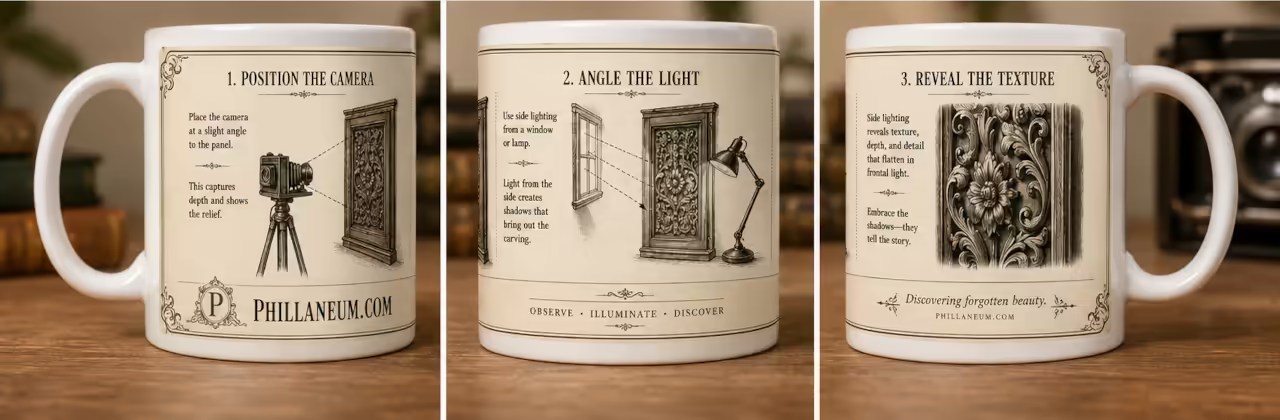
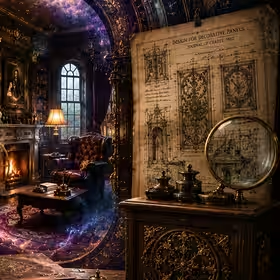
The illustrated camera and lighting guide featured in this article is also available as a decorative coffee mug inspired by historic instructional plates and workshop reference diagrams.
When this debate began, the question appeared straightforward.
Should we continue to ignore decorative panels when furnishing?
After listening to both arguments, I am no longer convinced that decorative panels are the true subject under discussion.
They are evidence. They are artefacts. They are clues left behind by a much larger conversation.
What Brenda and Deborah have really described are two competing philosophies of modern living.
The first philosophy views the home primarily as a system.
Its purpose is to provide shelter, comfort, efficiency, flexibility, storage, and convenience. Within this framework, furniture succeeds when it performs its function reliably and economically. Decorative panels are optional because decoration itself is optional. Beauty may be welcome, but it remains secondary to performance.
This philosophy has achieved extraordinary things.
It helped furnish growing populations. It reduced costs. It increased accessibility. It allowed well-designed objects to reach people who would previously have been excluded from such comforts. Much of the material prosperity of modern life rests upon this way of thinking.
The second philosophy views the home differently.
It treats domestic space not merely as a system but as a cultural environment. A home is not simply somewhere life happens. A home actively shapes how life feels.
Within this framework, furniture performs two functions simultaneously. It serves practical needs while also contributing atmosphere, identity, memory, beauty, and emotional texture. Decorative panels matter not because they improve storage, but because they participate in the experience of inhabiting a place.
Neither philosophy is entirely right.
Neither philosophy is entirely wrong.
The difficulty arises when either attempts to govern alone.
A world designed exclusively around efficiency eventually begins to feel strangely anonymous. Every problem appears solvable through optimisation. Every surface becomes simpler. Every object becomes quieter. Gradually, distinction gives way to standardisation.
Yet a world designed exclusively around ornament produces its own difficulties. Cost increases. Complexity accumulates. Maintenance expands. Objects become less adaptable and often less accessible.
Human beings have spent centuries moving between these two poles.
We simplify.
Then we personalise.
We standardise.
Then we decorate.
We optimise.
Then we search for meaning.
The pattern repeats so consistently throughout history that it begins to resemble a law of cultural behaviour.
This is why I find decorative panels fascinating.
Not because they are especially important in themselves, but because they make this larger tension visible. A carved cabinet door becomes a record of somebody deciding that usefulness alone was insufficient. A decorative sideboard becomes evidence that practicality and beauty were once expected to coexist. A panelled wardrobe becomes a reminder that previous generations often viewed ordinary objects as opportunities for expression rather than merely solutions to problems.
Perhaps that explains why decorative panels continue attracting attention long after their industrial relevance declined.
Collectors search for them.
Restorers preserve them.
Photographers frame them.
Homeowners rediscover them.
Even people who would never describe themselves as enthusiasts often respond positively to the atmosphere they create.
The market may have moved on.
The human impulse did not.
And here we arrive at the most surprising conclusion of all.
The disappearance of decorative panels was never proof that people stopped appreciating ornament.
It was merely proof that industrial systems stopped prioritising it.
The two are not the same thing.
In fact, the continued popularity of historic interiors, restoration culture, decorative salvage, traditional craftsmanship, and atmosphere-driven design suggests the opposite. Again and again, people demonstrate a desire for environments that feel distinctive, expressive, and emotionally resonant.
They may not always choose Victorian carving.
They may not always choose decorative panels.
But they repeatedly choose character.
Which brings us back to our original question.
Should we continue to ignore decorative panels when furnishing?
My answer is no.
Not because every home requires ornament.
Not because every cabinet deserves carving.
And certainly not because we should attempt to recreate the nineteenth century.
Rather, we should stop ignoring decorative panels because they remind us to ask a more important question.
When we furnish a home, are we merely solving practical problems?
Or are we creating a place that reflects what it means to be human?
Decorative panels do not answer that question.
They simply reveal that it exists.
And that, I suspect, is why they continue to matter.
Notes & Memoranda
As is often the case, the subject extends beyond the bounds of a single article. The notes and memoranda below gather together useful definitions, related observations, references, and occasional curiosities discovered along the way.
Further Reading…
Disclosure
This Great Debate is an editorial discussion exploring decorative furniture panels as a lens through which to examine broader ideas about design, ornament, craftsmanship, and modern living. The views presented by the contributors are thematic interpretations intended to encourage reflection and discussion rather than provide formal design, restoration, or historical advice.