The Decorative Panel Styles eBay Buyers Always Notice
The Allure of Decorative Panels in Vintage Furniture
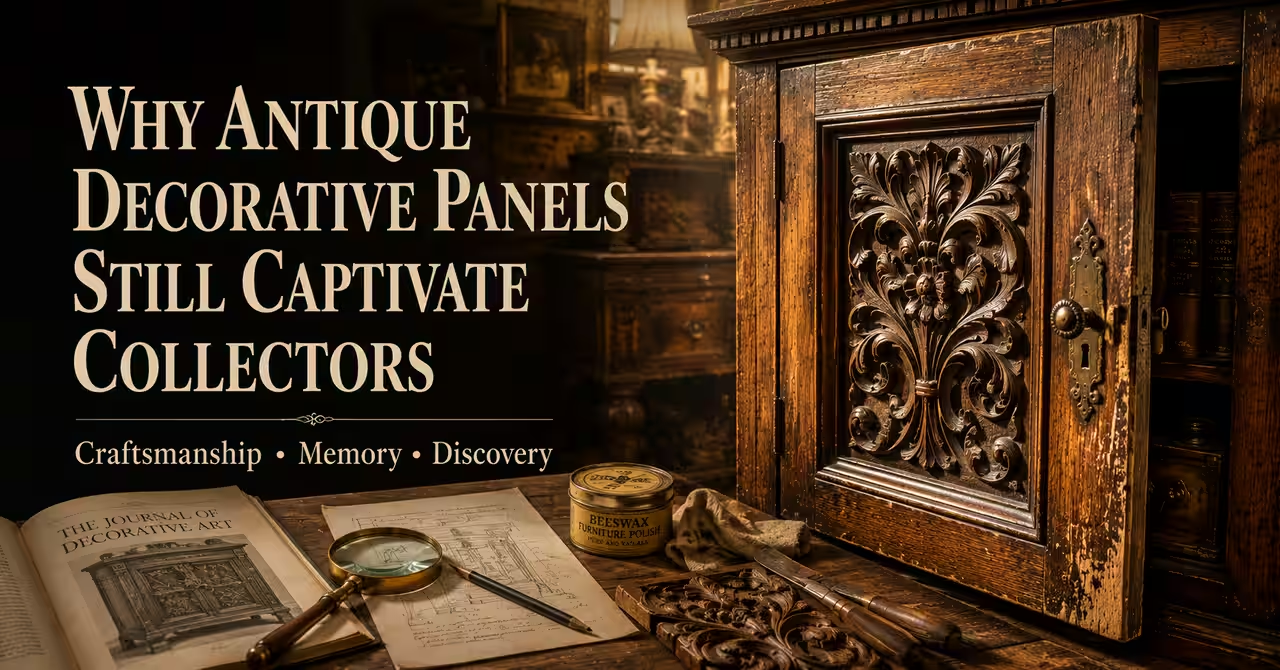
In the world of collectible furniture, decorative panels possess an undeniable charm, breathing life into pieces that might otherwise blend into the background of our homes. Their craftsmanship offers a glimpse into a realm where wood, metal, shadow, and hand-worked surface all contribute to the first impression of a piece. On eBay, where furniture is often judged first through a small photograph and a few words of listing text, those details matter more than they may initially appear.
A plain cabinet can be overlooked. A cabinet with a carved door, pierced fretwork, embossed insert, or richly figured panel has a different chance of stopping the eye. From the evocative carvings of the Arts and Crafts movement to the delicate embellishments of Victorian and Edwardian furniture, decorative panels help a listing communicate age, craft, atmosphere, and value before the buyer has read very far at all.
Exploring the Textures of Time
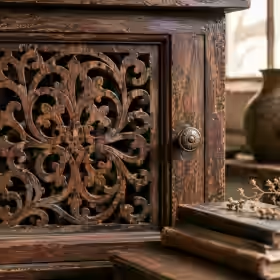
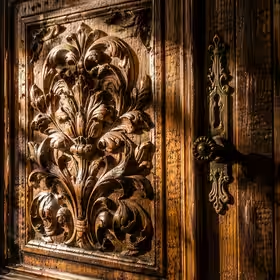
Consider, for a moment, the tactile pleasures of decorative wood panels. Running your fingers along the shadowed recesses of a finely carved design allows you to feel the weight of history embedded within the grain. Each texture unfolds a story, whether through the rugged embrace of reclaimed oak or the sleek finish of a polished mahogany. Often lovingly maintained with natural oils and beeswax, such surfaces carry the palpable essence of their past lives, a blend of warmth and authenticity that beckons collectors.
The wear of polish, a sheen softened over decades, divulges the tales of every hand that has touched it. From the dust settling gently in corners to the shifting shadows cast by ambient light, these elements create an atmosphere rarely replicated by modern pieces. In this context, each flaw and mark becomes a badge of honour, chronicling not just craftsmanship but the passage of ownership, love, and care.
What Buyers Actually Notice in Online Listings
After reviewing active and recently completed eBay listings for carved oak sideboards, pierced fretwork cabinets, and Art Nouveau cabinet panels, an interesting pattern emerges. Buyers rarely appear to be searching for decorative panels in isolation. Instead, they encounter them while browsing sideboards, cabinets, pedestals, mirrors, and other pieces of period furniture. Yet certain decorative treatments repeatedly stand out, regardless of the object being offered.
Deeply carved oak panels are among the easiest decorative features to recognise. Strong relief carving creates shadows that remain visible even in small listing photographs, allowing detail to survive image compression and thumbnail viewing. Many of the strongest Victorian furniture listings use these carved panels as their primary visual feature, often positioning them prominently in the lead image.
Pierced fretwork appears to attract attention for a different reason. The openwork construction creates negative space and shadow patterns that immediately distinguish a piece from surrounding listings. Even when buyers are scrolling rapidly through search results, fretwork often remains recognisable because the eye is naturally drawn to contrast and depth.
Embossed and highly textured decorative surfaces show a similar advantage. Raised ornament catches light differently from flat timber panels, creating visual variation that photographs well and communicates craftsmanship at a glance. Decorative features that remain visible from a distance tend to be easier for buyers to evaluate than subtler details that require close inspection.
Perhaps most revealing is that recently sold listings often share one characteristic: their decorative elements remain identifiable even when viewed as small images within a crowded search page. Buyers may not consciously search for “deep relief carving” or “negative-space fretwork”, but the market repeatedly demonstrates that visible craftsmanship continues to attract attention. In an environment where hundreds of objects compete for a moment of consideration, decorative panels that communicate texture, depth, and ornament quickly often become the panels buyers notice first.
Ornament as Emotional Landscape
The intricate motifs found in decorative panels do more than beautify; they transform spaces and evoke feelings that statistics cannot capture. Picture a mid-century sideboard with floral carving lining its doors, becoming a focal point in a reading room, inviting conversations over decades. This emotional depth allows a simple piece of furniture to evolve into a source of memory, enhancing the atmosphere surrounding it.
Envision the softly lit parlour where a restored cabinet inspires whispers, its decorative panels radiating warmth. In such settings, the environment itself deepens our connection to both the furniture and its history. Here, collectors engage not merely with objects but in a dialogue with past lives, a communion echoed in every ornamental detail.
Recognising the Uncommon in the Ordinary
When browsing eBay for these exceptional panels, understanding the vocabulary of collectors elevates the experience. Terms like “barley twist”, “fretwork”, “carved oak”, “Art Nouveau”, “embossed”, “French polish”, and “sideboard” can shift the search from vague browsing into more purposeful discovery. The wording matters because sellers often describe the whole object rather than the decorative panel itself.
This is one reason decorative panels can be easy to miss. A buyer may find a valuable carved door panel inside a listing titled as a cabinet, dresser, hallstand, sideboard, mirror, or wardrobe. For those pursuing authenticity, learning the language of furniture forms, surface finishes, and ornamental styles not only improves search results but also fosters deeper respect for the craftsmanship that brings these pieces to life. For further insights, refer to The Vintage Decorative Panel Searches Experts Actually Use.
The Quiet Journey of Restoration
As we navigate the world of decorative panels, it is vital to acknowledge the gentle journey of restoration, where careful, skilled hands breathe new life into tired wood or dulled metal. Each restored piece carries a duality of history and renewal. Imagine a cabinet, once overshadowed by age, now illuminated by a fresh polish that reveals its grain in vibrant detail. Restoration transcends mere repair; it is a meditative process that enriches the life of the object, allowing it to once again share its narrative with future owners.
In this transformative journey, a sense of melancholy intertwines with renewal. A panel shaped by years of memories awaits new stewards who may find inspiration in its imperfections and historical nuances. This sentiment underscores how the past continues to shape our present, creating a communal bond that whispers through each detail of craftsmanship.
Curating Collections with Emotional Depth
As collectors, the styles that resonate often reside within pieces bearing the soft scars of time, where beauty is found not in perfection, but in history. A Victorian carved panel, still showcasing traces of age and memory, can evoke visceral responses precisely because of its contrasts. In this visual resonance, each collector finds the pulse of their own story, where personal journeys intertwine with the forces of time.
As you explore decorative panels and their rich textures and histories, let curiosity guide your choices. Each click on an eBay listing opens a doorway to potential stories, promising new experiences waiting to be discovered. Remember, every panel has endured the tides of time; like our collective memories, they embody an ongoing journey, patiently awaiting new meanings to be attached by discerning collectors.
Explore More About Decorative Panels
If you find yourself captivated by these decorative panels, consider broadening your exploration of their multifaceted charm. For insights on the specific terminology that collectors treasure, take a look at Strange Decorative Furniture Details Buyers Now Obsess Over. If you are interested in authenticity in salvage pieces, the article Why Decorative Salvage Feels More Authentic Than Modern Decor offers a deeper look at the allure of the past in contemporary design. Together, these threads weave a richer narrative that speaks to the craftsmanship and emotional legacy held within each decorative panel, guiding you further along in the art of collecting.
Market Snapshot
Recent eBay research revealed a surprisingly active market for Victorian carved oak furniture. While many buyers associate decorative panels with architectural salvage or small collectible fragments, some of the strongest completed sales were attached to substantial pieces such as carved oak sideboards, cabinets, and hall furniture.
The listings that stood out most often featured deep relief carving, highly visible panel work, and strong photographic presentation. Interestingly, the decorative panel itself frequently became the focal point of the listing photographs, suggesting that craftsmanship remains a major driver of buyer attention even when the furniture is being sold as a complete piece. This snapshot reflects editorial observation of active and completed eBay listings reviewed during article preparation, rather than a formal market valuation survey.
Collectors researching decorative furniture panels may therefore find it worthwhile to broaden searches beyond panels alone. Terms such as Victorian carved oak sideboard, carved oak cabinet, and ornate Victorian furniture often reveal examples where decorative panel work forms the visual centrepiece of the object.
Author's Notes
While researching this article, I spent more time browsing completed eBay listings than I had originally intended. What surprised me was not simply the variety of decorative furniture still changing hands, but the prices being achieved by pieces featuring strong carving, fretwork, and ornamental detail.
There is a tendency to assume that decorative furniture belongs to a forgotten era, admired occasionally but largely ignored by modern buyers. Yet many completed sales suggested otherwise. Pieces with visible craftsmanship, distinctive panels, and decorative character were still attracting serious interest.
What I found most interesting was that the decorative panel itself often seemed to become the focal point of a listing. The carving, shadow, texture, or fretwork was frequently the first thing visible in the seller's photographs and often the detail that distinguished one piece from dozens of similar alternatives.
For me, this reinforced a simple idea. Decorative panels are not merely historical curiosities. They remain active participants in how people discover, evaluate, and ultimately choose furniture today. The market may have changed, but the ability of ornament to attract attention appears remarkably resilient.
Notes & Memoranda
Glossary
- Art Nouveau
- Art Nouveau was a decorative design movement popular from the late nineteenth century into the early twentieth century. In this article, the term refers to furniture featuring flowing organic forms, curved ornament, and nature-inspired motifs that continue to attract collectors seeking distinctive decorative character.
- Carved Oak Panel
- A carved oak panel is a decorative timber surface featuring ornament cut directly into solid oak. Throughout this article, carved oak panels are discussed as one of the most visually recognisable forms of furniture decoration, particularly because their shadows and relief remain visible in online listing photographs.
- Embossed Surface
- An embossed surface contains raised decorative patterns formed through pressing, stamping, casting, or applied ornament. In the context of this article, embossed details are highlighted for their ability to catch light and create visual texture that attracts attention in both furniture displays and online marketplaces.
- French Polish
- French polish is a traditional finishing technique using multiple thin layers of shellac to create a rich reflective surface. The article references the term as part of the collector vocabulary often encountered when researching decorative furniture and evaluating condition.
- Fretwork
- Fretwork describes decorative openwork created by cutting patterns through timber or other materials. In this article, pierced fretwork is presented as one of the easiest decorative styles to recognise online because its shadows, cut-outs, and negative space remain visible even in small photographs.
- Negative Space
- Negative space refers to the empty areas surrounding or passing through a decorative design. Within this article, negative space is used to explain why pierced fretwork often stands out visually, allowing light and shadow to become part of the ornament itself.
- Ornament
- Ornament refers to decorative features added to enrich the appearance of an object beyond its basic functional purpose. The article explores ornament as both a visual attraction and a signal of craftsmanship that continues to influence collector interest today.
- Patina
- Patina describes the softened appearance that develops through age, handling, polishing, oxidation, and long-term use. In this article, patina is treated as evidence of authenticity and material history, contributing to the character that many collectors value in older furniture.
- Relief Carving
- Relief carving is a technique where decorative designs project from a flat background surface. The article discusses deep relief carving as particularly effective in online listings because it creates strong shadow and visual depth that remain visible at thumbnail size.
- Thumbnail Photograph
- A thumbnail photograph is the small preview image shown within online search results. Throughout this article, thumbnail photographs are important because they often determine whether decorative details are noticed by potential buyers while browsing marketplaces such as eBay.
Frequently asked questions
Which decorative panel styles do eBay buyers notice most?
Buyers often notice decorative panels with strong visible character, especially deeply carved oak panels, pierced fretwork, embossed surfaces, and highly textured ornamental details. These features stand out because they remain recognisable in small listing photographs.
Why do carved oak panels stand out in eBay listings?
Carved oak panels stand out because deep relief carving creates shadow, contrast, and visible surface depth. These qualities often survive thumbnail viewing, helping buyers recognise craftsmanship quickly while browsing.
Why is pierced fretwork attractive to collectors?
Pierced fretwork attracts attention because its open construction creates negative space, shadow patterns, and visual contrast. This makes it easy to recognise in photographs and gives furniture a strong decorative presence.
Do buyers search for decorative panels directly?
Buyers do not always search for decorative panels directly. They often find them while searching for sideboards, cabinets, dressers, mirrors, hallstands, and other period furniture where decorative panels form part of the larger object.
What makes a decorative furniture panel valuable online?
A decorative furniture panel is more likely to attract attention online when its carving, fretwork, texture, or ornament remains clear in photographs. Visible craftsmanship, age, condition, rarity, and the quality of the whole furniture piece also influence buyer interest.
Further Reading…
Disclosure
This article explores decorative furniture panel styles commonly associated with Victorian and Edwardian interiors, including carved oak, fretwork, embossed ornament, inlaid surfaces, and decorative veneers. The feature is presented in the curatorial style of Phillaneum.com and combines decorative commentary, historical interpretation, and atmosphere-focused interior observations. It is intended as an introductory editorial guide rather than a formal restoration manual, valuation guide, or conservation reference.