How the Vintage Elite Defined Luxury and Taste
·Revised
Luxury Before the Age of Product Culture
Modern luxury media often links wealth with acquisition. It presents a world of watches, cars, hotels, jewellery, and private access, then invites the reader to see these things as proof of arrival. The luxury itself seems to sit inside the object. Yet the period from the 1890s to the 1920s suggests a different relationship. Wealth and luxury were still visible, often extravagantly so, but they were discussed through social position, cultivated taste, architectural setting, artistic judgment, and command of new industry. In other words, material display existed, but it was carried by a wider culture of reading and recognition.
This difference matters because it changes what luxury meant. In the modern mode, luxury is often framed as premium consumption. In the earlier mode, luxury was more often framed as a way of life that had to be recognised, learned, and performed. The wealthy elite did not rely on a single magazine that listed desirable purchases in a neat sequence. They encountered luxury through a distributed set of journals and illustrated papers that taught them what counted as refinement, who embodied it, and where authority in taste resided.
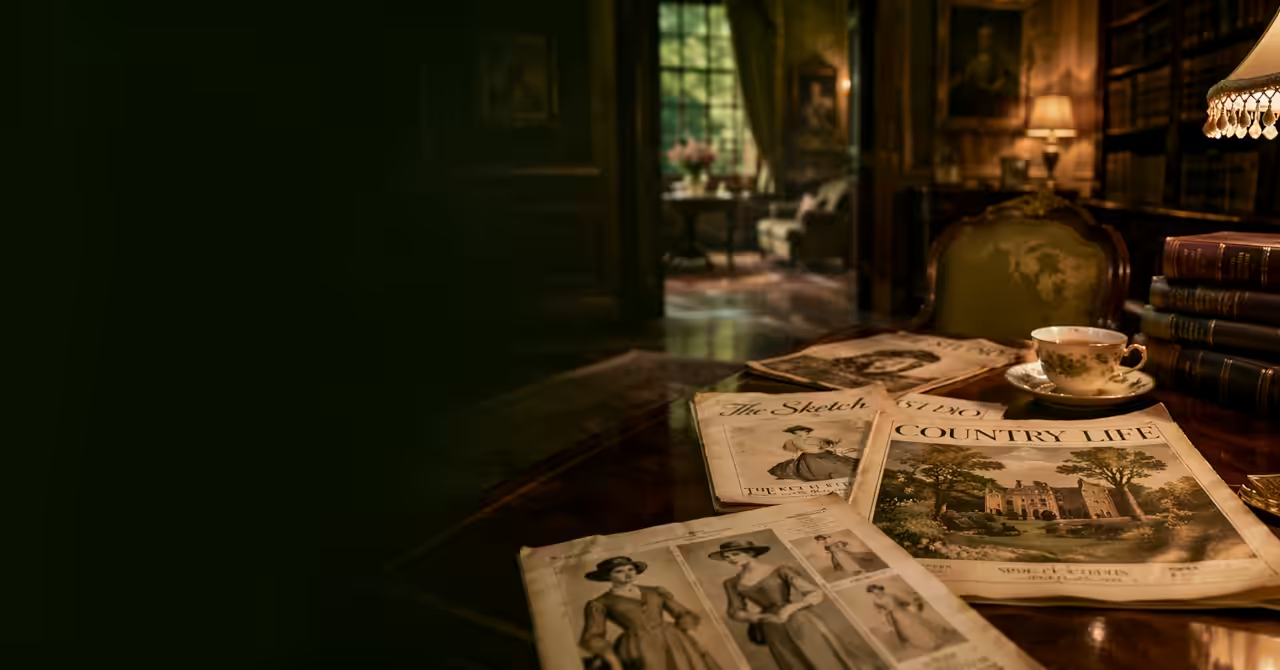
This is not simply a historical abstraction. A working example can be found in the Phillaneum magazine library, where domestic, artistic, and technical journals sit side by side, showing how taste was formed across multiple forms of reading rather than a single category.
Elite Taste Was Learned Across Many Pages
The key relationship is simple. Early elite culture did not separate luxury from society, art, and cultivated domestic life. Instead, it embedded luxury within them. A country house was not only a possession. It was a setting for proper living. A painting was not only an asset. It was evidence of discernment. A motor car or yacht could signal modernity, but its force came from the reader already knowing how such things fitted within a larger hierarchy of manners, leisure, and status.
That is why journals aimed at the upper classes or aspirational professional elites often worked indirectly. They described houses, gardens, interiors, exhibitions, salons, races, country pursuits, and social calendars. They showed portraits, furnishings, textiles, table settings, and architectural detail. They reported on people as much as things. Luxury appeared through context. The reader was not merely told what to desire. The reader was trained to see why certain settings, materials, and habits carried prestige.
This gave luxury a more social and interpretive quality than the modern catalogue approach. It was less about isolated products and more about belonging to a world where objects, surroundings, and behaviour formed a coherent picture. To read such material was to absorb a code. One learned that quality had a tone, that distinction had a setting, and that wealth without taste could still appear crude.
Society Pages Turned Visibility into Prestige
The first mechanism was social visibility. Publications such as society papers and illustrated weeklies did not need to announce themselves as luxury journals in order to perform luxury work. They covered country weekends, drawing rooms, debutante circles, titled families, notable hostesses, and fashionable gatherings. Through repetition, these pages established a public image of the desirable life. Prestige was attached to persons, houses, and occasions before it was attached to brands.
This mattered because status in that period still relied heavily on recognition by others. One could be wealthy without being fully accepted. The pages of society journalism helped stabilise who counted, who was rising, and what settings signalled legitimacy. Even architecture and decoration appeared as extensions of social authority. A house was reported almost as a character reference. Its taste reflected on its owner. Its furnishings suggested education, inheritance, or intelligent patronage.
Here luxury functioned less as a shopping list and more as a language of presence. To be seen in the right environment, surrounded by the right forms of culture, carried its own force. The mechanism was not simply ownership. It was visibility joined to approval.
Refinement Carried More Weight Than Display
The contrast with modern luxury culture becomes clearest when one looks at arts, design, and domestic journals. These publications often treated beauty, proportion, craftsmanship, and historical awareness as serious matters. They assumed that a cultivated home should express judgment rather than mere expense. A well-made chair, a textile pattern, a restrained mantel, or a thoughtfully arranged room could signal a higher form of wealth than overt excess.
A clear example can be seen in The House, a journal devoted to home arts and crafts, where furnishing, decoration, and everyday life are presented as matters of considered taste rather than display. You can explore a surviving issue in the September 1902 edition.
This has an important implication. The elite reader was not only being sold aspiration. The reader was being educated into preference. Such journals rewarded attentiveness. They asked their audience to notice line, material, harmony, setting, and relation. They often criticised vulgarity, novelty for its own sake, and decorative overload. In doing so, they created a more demanding standard. Luxury was not simply what cost the most. Luxury was what could withstand scrutiny.
That older model now feels surprisingly modern in one respect. It suggests that prestige weakens when it becomes too easy to copy. The wealthy classes of the period were therefore drawn to forms of distinction that depended on knowledge. Taste had to be exercised. One needed to know what one was looking at, and why it mattered. This made luxury less immediate, but also more durable.
From Lost Reading Habits to a Modern Lesson
The broader extension is that early luxury culture was sustained by an information environment rather than a single category of media. Society pages affirmed rank. Design journals shaped domestic judgment. Architectural and country house publications connected land, leisure, and lineage. Even technical and motoring journals could contribute, especially when industrial progress became part of elite identity. Together, these forms of reading produced a world in which luxury emerged from context, competence, and recognition.
That offers a useful lesson for modern readers. It suggests that luxury becomes thin when it is detached from the culture that once supported it. If every premium object is presented as self-evidently desirable, then taste no longer needs to be formed. The older journals assumed the opposite. They assumed that a reader might need to be guided into better perception. Their work was not only promotional. It was interpretive.
For a publication such as Phillaneum, this opens an interesting path. The real subject is not simply old wealth, nor merely old magazines. It is the way period reading taught people how to value houses, furnishings, art, leisure, and innovation as parts of a single civilised life. To study those journals now is to recover a richer model of cultural authority than product culture usually allows.
Reading Luxury as a Cultural Education
The early wealthy elite did discuss luxury, but often without naming it in the modern manner. They discussed it through society, taste, setting, and cultivated attention. Luxury was present, though dispersed. It lived in houses, journals, exhibitions, textiles, portraits, country pursuits, and forms of social acknowledgement. That made it broader than commerce and more demanding than display.
The next step is to examine the period’s advertising within this wider world. Once luxury is understood as a learned culture, advertisements can be read differently. They stop looking like simple sales tools and begin to appear as attempts to enter an already established hierarchy of value. That is where the deeper story begins.
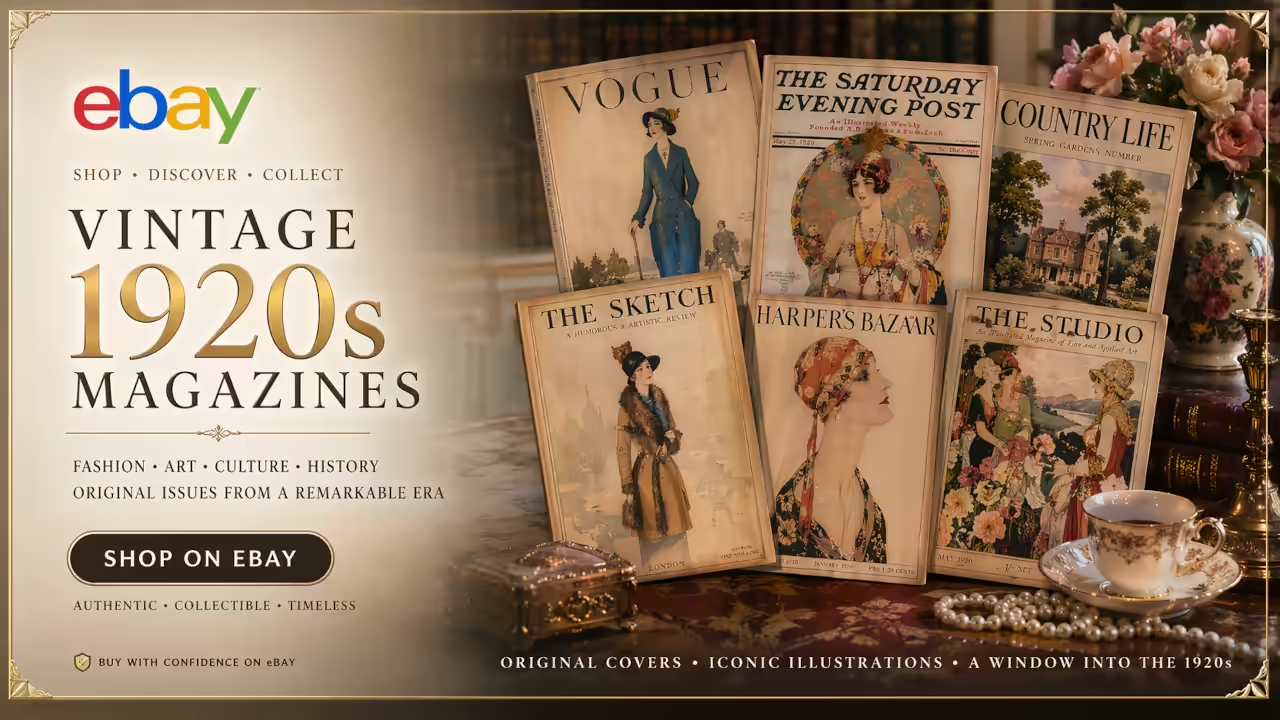
Collector market snapshot: The linked eBay catalogue shows a lively collector market for original 1920s magazines, with fashion titles, illustrated society weeklies, art periodicals, and general interest issues appearing side by side. Buyers can expect a mix of single issues, bound volumes, and occasional grouped lots, with condition ranging from fragile reading copies to bright display-worthy covers. Typical pricing appears to run from modest entry-level purchases for worn or common issues through to higher collector prices for visually striking covers, scarce titles, or cleaner examples. For most readers, the appeal lies in the cover art, period advertising, and direct tactile link to the printed culture of the decade.
Author's Notes
Notes & Memoranda
Glossary
- Luxury
- In this article, luxury refers not simply to expensive goods, but to a cultivated way of living expressed through taste, social setting, and informed judgment rather than isolated purchases.
- Society pages
- Society pages were sections of period magazines that reported on elite individuals, gatherings, and domestic settings, used here to show how visibility and recognition shaped status.
- Taste
- Taste is used in this article as a learned ability to judge quality, proportion, and refinement in objects and environments, rather than a matter of personal preference.
- Refinement
- Refinement refers to the disciplined expression of good taste, where restraint, proportion, and appropriateness signal a higher level of cultural understanding.
- Design journals
- Design journals are period publications focused on interiors, craftsmanship, and decorative arts, used here as tools that educated readers in how to recognise quality and beauty.
- Elite culture
- Elite culture describes the shared practices, values, and environments of the wealthy classes, presented in this article as something reinforced through reading and social visibility.
- Print culture
- Print culture refers to the network of magazines, journals, and illustrated papers that shaped how ideas, taste, and status were communicated and understood.
- Cultural authority
- Cultural authority is used to describe the power to define what is considered refined or valuable, often held by editors, publications, and recognised social circles.
- Domestic interiors
- Domestic interiors refers to the design and arrangement of the home, used here as a key site where wealth and taste were expressed and evaluated.
- Illustrated papers
- Illustrated papers were widely read publications featuring images alongside text, helping readers visualise elite life and absorb standards of appearance and conduct.
Frequently asked questions
What did luxury mean to the wealthy before modern consumer culture?
Luxury was understood less as a product category and more as a cultivated way of life. It appeared through social standing, domestic refinement, artistic judgment, and participation in recognised forms of elite culture.
Why were there no dedicated luxury magazines in the early 1900s?
Luxury was not usually separated into its own media category because it was embedded across society journalism, design periodicals, architectural publications, and illustrated cultural magazines. Readers encountered it through a wider world of taste and status.
How did society pages influence perceptions of status?
Society pages made prestige visible by showing the people, houses, gatherings, and settings that defined elite life. They helped readers recognise who mattered and what forms of display and environment carried social authority.
Why was taste considered something that needed to be learned?
Taste was treated as a form of judgment rather than simple preference. Design and arts journals taught readers how to recognise quality, proportion, craftsmanship, and restraint, helping distinguish refinement from mere expense.
Mentions & Echoes
The following articles extend or reflect the ideas explored here, returning to similar questions through different materials, contexts, and lines of inquiry.
- Strange Decorative Furniture Details Buyers Now Obsess Over - Discusses how luxury was often found in the details on high quality furniture.
Further Reading…


References
- Vintage magazines covering home, crafts, engineering, art, and industry, Phillaneum.com (retrieved 2026-04-18)
- The House: Journal of Home Arts and Crafts, September 1902, Phillaneum.com (retrieved 2026-04-18)
Disclosure
This article offers an interpretive reading of how luxury, taste, and social value were discussed across elite print culture between the late nineteenth and early twentieth centuries. It is intended as an editorial synthesis rather than a complete survey of period magazines, class structures, or consumer history. Readers seeking fuller historical grounding should consult primary sources and specialist studies of society journalism, design culture, and print history.