William Morris Wasn’t the Whole Arts and Crafts Movement
Morris Became the Label
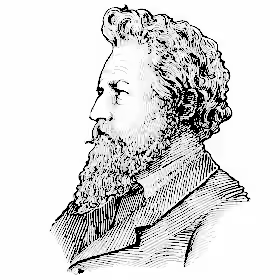
William Morris is so closely associated with Arts and Crafts that it is easy to mistake him for the movement itself. He was certainly its most visible English advocate: a designer of force, a serious polemicist, a writer with a public audience, and a man whose work gave handcraft a moral and aesthetic vocabulary that later generations could quote back at him. But that visibility has a cost. Once Morris becomes the whole story, Arts and Crafts starts to look like the invention of a single brilliant man rather than the result of a wider culture of making.
The Victoria and Albert Museum is careful on this point. Arts and Crafts was not a single style imposed from above. It was a movement held together by shared ideas, overlapping institutions, and practical alliances: the Arts and Crafts Exhibition Society, the Art Workers’ Guild, schools, workshops, firms, makers, and buyers. Morris mattered enormously, but he was one figure inside an ecology, not the map itself. That distinction changes the history. It shifts the emphasis from authorship to infrastructure.
In that sense, Morris can be misleading precisely because he is so useful. He gives the movement a face, a biography, a firm, a philosophy, and a set of recognizable patterns. He makes the whole thing teachable. But the clarity he provides is also a simplification. Arts and Crafts survived because it spread through many hands and many institutions, and because later makers could adapt its ideas without waiting for Morris to bless them.
The Movement Ran on Networks
If you look past the famous name, the movement appears less like a manifesto and more like a production system. It depended on schools that trained hands, workshops that turned designs into objects, societies that staged public discussion, shops that connected makers to clients, and magazines and lectures that kept the language of reform in circulation. That is not glamorous, but it is the machinery that made the ideal workable.
This is why the movement’s history cannot be told only as a sequence of masterworks. Morris’s influence was real, but so were the quieter forms of labour that sustained the movement day after day: teaching, editing, organizing, pattern drafting, embroidery instruction, metalworking, cabinetmaking, glazing, marketing, and the awkward business of persuading buyers that handmade things were worth the trouble. Arts and Crafts spread because many people did the unromantic work of making it usable.
Seen this way, the movement’s persistence is less mysterious. It did not need a single centre. It needed a network capable of reproducing its habits. Some of those habits were visual, like stylised natural forms and disciplined repetition. Others were organisational: apprenticeships, exhibitions, schools, and firms that could translate ideals into objects. Morris was central to the movement’s public image, but the movement itself ran on many more connections than his name can contain.
Women Were Not Additions
A Morris-centred history also distorts who was doing the work. Women were not latecomers to an otherwise male story; they were active makers, teachers, business owners, and advocates in the movement’s development. The V&A notes that Arts and Crafts created an environment in which women could participate both as makers and as consumers, and modern scholarship has made clear that women were central to its practical life, especially in domestic and commercial design.
May Morris is the obvious case, and she should not be treated as a subsidiary figure to her father. She took responsibility for embroidery in Morris & Co. in 1885, helped carry Arts and Crafts ideas forward after his death, taught at the Central School of Arts and Crafts, and co-founded the Women’s Guild of Arts. She was an editor, lecturer, and advocate as well as a maker. If William Morris gave the movement one kind of authority, May Morris helped sustain its working discipline.
She was not alone. Jessie Newbery in Glasgow established an embroidery department that taught the technique for modern garments, helping turn needlework into a live professional practice rather than a decorative afterthought. Jewellers such as Georgie Gaskin, Charlotte Newman, and May Hart Partridge also gained public recognition in a field where women’s skill could be acknowledged more openly than in some other decorative trades. These are not peripheral names. They show that the movement’s reach depended in part on women’s teaching, professionalisation, and commercial visibility.
This matters because women’s work often appears in histories only when it has a signature attached to it. Arts and Crafts is a reminder that the absence of a famous name does not mean the absence of influence. In a movement built on making, some of the most important contributions were embedded in practice rather than in authorship.
Places Changed the Meaning
Another reason Morris should not stand in for the whole movement is geographical. A London-centred story makes Arts and Crafts look as though it radiated outward from a single source. In reality, it was reworked in regional centres that gave the movement different accents. Birmingham, Edinburgh, Glasgow, Manchester, and other places developed their own combinations of art education, industry, and local taste.
Birmingham is a strong example. Already a major jewellery centre, it developed progressive teaching in silversmithing and enamelling. The Gaskins worked there, and their practice shows how Arts and Crafts could grow out of existing local trades rather than being imported as pure doctrine from London. Glasgow offers another version: embroidery teaching and design education helped produce a modern decorative language with a distinct character.
Scotland complicates the Morris story even further. Charles Rennie Mackintosh and Margaret Macdonald Mackintosh fused Arts and Crafts values with a more abstract, inventive language associated with Art Nouveau, while still respecting natural materials and traditional techniques. That is not a minor deviation from Morris. It is proof that the movement was adaptable enough to generate regional forms that went beyond his own habits and preferences.
The point is not simply that different cities produced different styles. It is that Arts and Crafts depended on institutions that could support local variation. Schools, technical colleges, and workshops gave the movement a regional life. Once those are taken seriously, Morris stops looking like the source of everything and starts looking like one node in a much larger system.
Industry Was Part of the Story
It is also too simple to imagine Arts and Crafts as a clean opposition between small hand workshops and the factory floor. Morris certainly valued craftsmanship and disliked the cheapening of labour under industrial capitalism. But later practitioners often worked in more ambiguous conditions, using large firms, machine production, and commercial distribution without abandoning the movement’s ideals.
The Powells at Wedgwood make this especially clear. Alfred and Louise Powell were committed to Arts and Crafts principles, but they also took seriously the advantages of large-scale machine production. They wanted workers to participate in design and making, yet they did not assume that beauty had to be cut off from industry in order to be genuine. Their ceramics show a practical compromise: not a surrender of principle, but an attempt to make principle survive in the world as it was.
That compromise helps explain why so many Arts and Crafts objects are deceptively simple. Visible joints, exposed pins, dovetailing, rivets, and hand-painted surfaces were not just stylistic preferences. They often signalled a different way of organising labour and value. The object was meant to show how it had been made. But that ethic could be realised through workshops, schools, and, at times, industrial support. Morris’s ideal mattered; so did the people who translated it into production systems that could actually endure.
This is where the movement’s historical meaning becomes clearer. Arts and Crafts was not an anti-modern retreat from manufacturing. It was a negotiation over how making should be organised, who should control it, and what kind of dignity labour could still claim inside modern systems. Morris helped define the terms of that argument. He did not monopolize its outcome.
What the Single Name Hides
Morris is the easiest entry point into Arts and Crafts because he makes the movement coherent. He offers a philosophy, a style, a firm, a body of writing, and a charismatic biography. But coherence can be deceptive. It can hide the actual labour of the movement: embroiderers, teachers, metalworkers, jewellers, stained-glass makers, pattern designers, shop organisers, factory collaborators, and regional institutions that kept the whole thing moving.
It can also hide a more important fact: Arts and Crafts was never one thing in one place. In London it might look like a guild or a workshop. In Birmingham, a jeweller’s trade. In Glasgow, a school-based rethinking of embroidery and domestic design. In the Cotswolds, a rural centre of craftsmanship and production. Elsewhere, a set of ideas adapted to local conditions. The movement survived by being legible enough to share and flexible enough to change.
That is why Morris should be understood less as the whole movement than as the name that made the movement easier to remember. He helped create its language and its public authority. But the movement’s real life was distributed across a network of makers, teachers, schools, workshops, and firms that could not be reduced to one famous figure without losing what made Arts and Crafts work in the first place.
So the better conclusion is not that Morris was overpraised, though sometimes he plainly was. It is that he became the shorthand for a much larger culture of making. Once you stop treating him as the whole frame, Arts and Crafts looks less like a heroic biography and more like a working system: collaborative, regional, gendered, commercial, and stubbornly practical. That is a messier history. It is also the truer one.
From the Curator's Workshop
William Morris remains the movement’s most recognisable figure, even when the wider story leads us well beyond him. The Phillaneum William Morris Portrait Library Tote Bag turns that familiar face into a useful everyday object while helping support the continuing work of the collection.

Author's Notes
Notes & Memoranda
As is often the case, the subject extends beyond the bounds of a single article. The notes and memoranda below gather together useful definitions, related observations, references, and occasional curiosities discovered along the way.
Glossary
Some historical and specialist terms used in this article.
- Arts and Crafts Movement
- A broad design and social-reform movement, prominent from the late nineteenth century, that valued skilled work, thoughtful design and the relationship between makers, materials and everyday life.
- Art Workers’ Guild
- A British professional association founded in 1884 that brought together designers, architects and craftspeople to discuss the relationships between art and practical making.
- Enamelling
- The decoration of metal with glassy material fused to its surface by heat; one of several skilled techniques used by Arts and Crafts jewellers and metalworkers.
- Dovetail joint
- A woodworking joint made with interlocking wedge-shaped sections, particularly useful in drawers and cases and often valued for its visible expression of construction.
Frequently asked questions
Was William Morris the founder of the entire Arts and Crafts Movement?
He was a highly influential advocate and designer, but the movement developed through many workshops, schools, professional societies and regional makers. Its history cannot be reduced to Morris alone.
What role did women play in Arts and Crafts?
Women worked as designers, embroiderers, jewellers, teachers, business owners and organisers. May Morris, Jessie Newbery and Georgie Gaskin are among the individuals discussed in this article.
Was the Arts and Crafts Movement opposed to all machine production?
No. Its participants differed in how they approached machinery and commerce. Some emphasised small workshops, while others explored ways to retain skilled design and meaningful labour within larger manufacturing systems.
Further Reading…
References and Further Reading
- Victoria and Albert Museum, “Arts and Crafts: an introduction” https://www.vam.ac.uk/articles/arts-and-crafts-an-introduction
- Victoria and Albert Museum, “Pattern design after William Morris” https://www.vam.ac.uk/articles/pattern-design-after-william-morris
- Victoria and Albert Museum, “How the Arts and Crafts movement influenced fashion” https://www.vam.ac.uk/articles/how-arts-and-crafts-influenced-fashion
- Victoria and Albert Museum, “Arts and Crafts enamels” https://www.vam.ac.uk/articles/arts-and-crafts-enamels
- Mary Greensted, “Morris and the Arts and Crafts Movement” in The Cambridge Companion to William Morris (Cambridge University Press, 2024) https://www.cambridge.org/core/books/cambridge-companion-to-william-morris/morris-and-the-arts-and-crafts-movement/8713B264E2246E8BFD94C1C019A18C51
- Zoë Thomas, “Introduction” in Women Art Workers and the Arts and Crafts Movement (Cambridge University Press, 2026) https://www.cambridge.org/core/books/women-art-workers-and-the-arts-and-crafts-movement/introduction/4CC574B9DF92176335ACD9A9688972E6
Disclosure
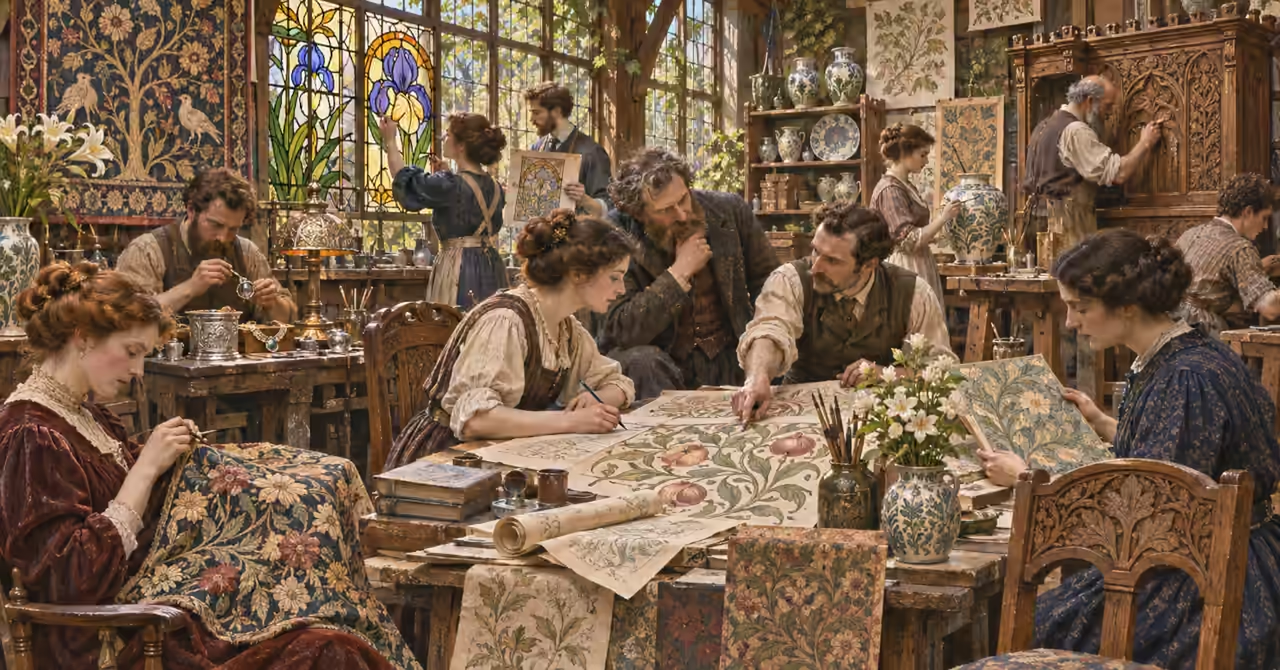
This article draws upon published historical research and museum materials listed in the references. It offers an interpretive account of the Arts and Crafts movement rather than an exhaustive survey of its contributors. The accompanying banner, if supplied as an illustrative reconstruction, should not be mistaken for a documentary photograph of identifiable historical individuals.