The Arts & Crafts Network - William Morris Was Never a Solo Act
Fame hides the system
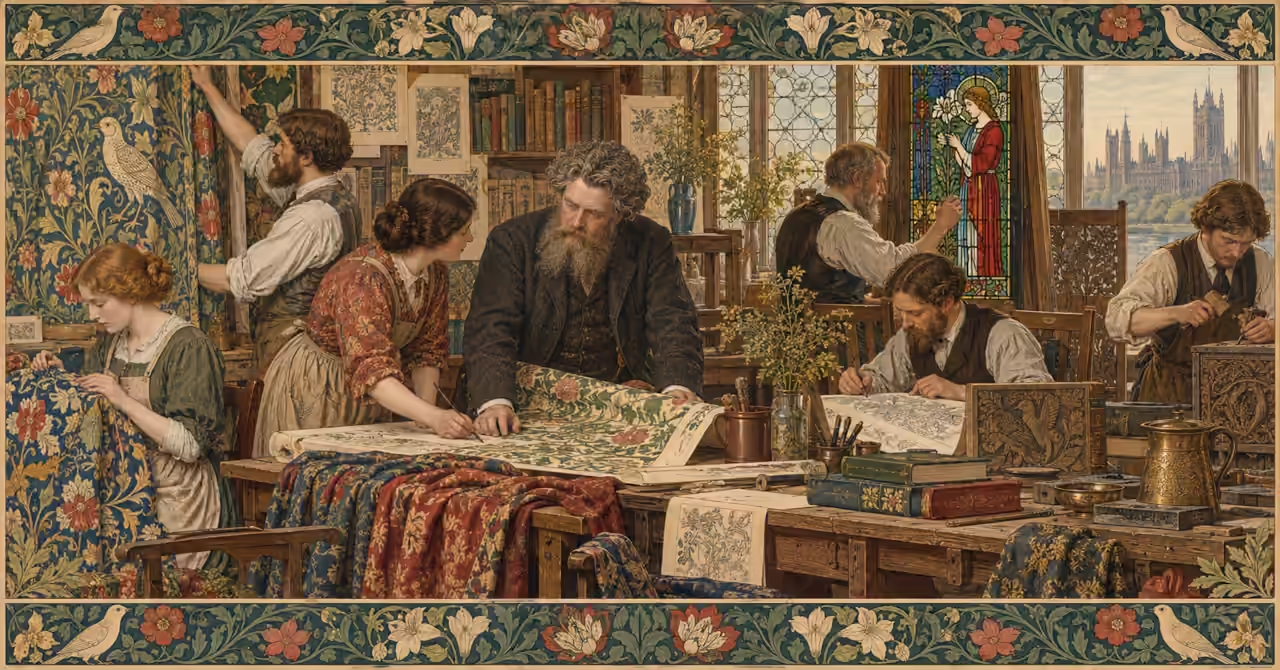
William Morris is usually treated as though he generated the Arts and Crafts movement by sheer force of personality. That is a convenient story, but it badly compresses the evidence. The movement was not a one-man workshop with a reputation larger than its output. It was a working network: architects, designers, embroiderers, printers, metalworkers, teachers, patrons, writers, and organisers whose labour overlapped, argued, borrowed, and sometimes kept the whole enterprise moving after Morris himself had stepped back from day-to-day design. The familiar name is real enough. What it often conceals is the infrastructure that made the name matter.
That is more than a corrective to hero worship. It changes how the objects should be read. An Arts and Crafts textile, stained-glass window, cabinet, or wall hanging is rarely the pure expression of one mind. It may be a sequence of decisions: an idea shaped by a designer, translated by workshop hands, adjusted to material constraints, then made legible to the public through publication, exhibition, teaching, or collecting. The movement’s strength lay partly in that division of labour. It did not abolish collaboration; it tried to make collaboration morally and aesthetically meaningful.
Friendships became the workshop
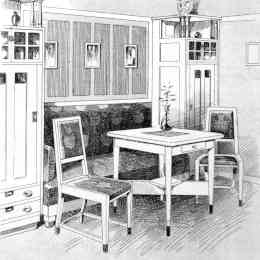
The Arts and Crafts movement began not with a grand manifesto, but with friendships and a shared desire to make beautiful, useful things. William Morris and architect Philip Webb brought those ideas to life at Red House, Morris's home in Kent. Built in 1859–60, it became a creative experiment. Furniture, wallpaper, embroidery and interior decoration were designed to work together, rather than simply fill empty rooms. It was a house where the makers could test their ideas, live with the results and discover what worked.
That experiment helped inspire the founding of Morris, Marshall, Faulkner & Co. in 1861. Morris was its driving force, but he was certainly not working alone. Edward Burne-Jones contributed stained-glass designs, Dante Gabriel Rossetti brought his distinctive artistic imagination, and Webb applied his architectural and design skills. Each brought something different to the workshop. Their ambitions soon reached beyond private houses. At the South Kensington Museum, now the Victoria and Albert Museum, Morris and his colleagues helped create the celebrated Green Dining Room, a richly decorated interior combining painted panels, stained glass, decorative surfaces and architectural design. It was a striking demonstration of what several creative minds could achieve together.
Of course, friendship did not mean everyone agreed. Designs had to be discussed, materials tested and practical problems solved. A beautiful drawing was only the beginning: someone still had to turn it into glass, fabric, furniture or decoration that could actually be used. The workshop succeeded because different people contributed different skills, sometimes challenging one another along the way. Morris gave the enterprise a powerful direction, but it was the combined talent of the workshop that turned ambitious ideas into lasting works of art.
Many hands, not one hand
Once you look closely, Morris’s output is full of other people’s labour, judgement, and dexterity. The V&A records that Morris’s first embroidered wall hangings were made with Jane Morris and their friends for Red House, and that in 1885 he stepped away from direct involvement in embroidery, placing May Morris in charge of production at just 23. That is not a footnote. It is the point where family, workshop, and movement blur into one another. The embroidery that survives under the Morris name is often a record of several minds and hands, not one.
May Morris deserves particular attention because she exposes how easily movement history gets flattened when only the father is remembered. She was not merely assisting a famous parent; she was shaping the visibility of embroidery as an art form, lecturing, writing, and preserving working drawings. The V&A’s holdings of her father’s work are significantly shaped by her bequest, which included designs that help us understand not just what Morris liked, but how his designs were developed and handled in practice. In her own work, authorship could also be distributed across the finished piece: a hanging might be designed by May and embroidered by Theodosia Middlemore, with the final object carrying the labour of several hands and several decisions.
That arrangement is central to the Arts and Crafts ideal. The movement did not always insist that one person do everything. It insisted, instead, that the maker remain close to the work, that design respect process, and that skill should be visible rather than hidden. Assisted labour was not a contradiction if the chain of work remained intelligible. What the movement distrusted was not collaboration but the erasure of making.
Standards travel through people
The workshop was also a place of translation. Morris may be the name most people recognize, but the later development of Morris & Co. depended on assistants and senior staff, including Henry Dearle and May Morris. As Morris increasingly focused on writing, activism, and refining production, a new generation of designers consolidated the Arts and Crafts pattern language. The V&A notes that Dearle’s mature work moved beyond simple imitation into more original use of Persian and Turkish sources. The firm’s style was not frozen in one founder’s hand. It evolved because others were permitted to extend it.
The same point appears in the textiles themselves. Morris’s later involvement with weaving was not merely aesthetic; it was technical. He taught himself weaving, established a tapestry loom, and became deeply interested in how materials and methods affected the final result. Yet the work now associated with “Morris” also reflects the contributions of those who managed production and colour, interpreted drawings into repeatable surfaces, and kept the workshop running. The design survived because the network was competent enough to sustain it.
Thomas Wardle is one of the figures who makes that fact plain. Morris and Wardle began collaborating around 1875, and Wardle’s dye-house knowledge helped Morris adapt historical and non-European dyestuff knowledge into practical textile production. The important point is not that Wardle is an overlooked genius waiting to be reassigned the centre of the story. It is that Arts and Crafts was always entangled with industrial knowledge, skilled foremen, and technical expertise. Morris’s politics did not abolish process; they depended on it.
Read that way, the movement starts to look less like an aesthetic manifesto and more like a system of standards. Shared principles mattered, but those principles travelled through workshops, apprenticeships, commissions, and publication. The network was not just a set of friendships. It was a way of keeping methods coherent while allowing different people to contribute differently.
The movement became public
The Arts and Crafts movement grew beyond Morris and his friends as artists and makers formed societies to share ideas, exhibit their work and develop their skills. The Art Workers’ Guild, founded in 1884, brought architects, designers and craftspeople together. The Arts and Crafts Exhibition Society followed in 1887, holding its first exhibition in 1888. These organisations helped turn a circle of creative friends into a movement that could reach people far beyond their workshops.
The Art Workers’ Guild was not simply a club of Morris admirers. Its members had different tastes, and not everyone shared his love of medieval design. What united them was a belief that skilled craftsmanship deserved the same respect as fine art and architecture. They could disagree about style while learning from one another. This exchange of ideas helped the movement grow without everyone having to follow a single artistic vision.
By the 1890s, exhibitions, magazines and teaching were spreading Arts and Crafts ideas across Britain. Designers such as Philip Webb, C.F.A. Voysey and C.R. Ashbee helped shape new approaches to furniture, buildings and everyday objects. Ashbee founded the Guild of Handicraft in London's East End in 1888, promoting handmade metalwork instead of relying on factory production. Its craftsmen often left visible hammer marks on their work, proudly showing the skill involved. The maker's hand was something to celebrate, not hide.
How Everyone Shaped the Movement
Seen this way, the Arts and Crafts movement is less a heroic manifesto than a practical ecology. Morris supplied energy, ideals, and a formidable range of designs. Webb helped shape domestic space. Burne-Jones and Rossetti carried visual ideas into the early firm. May Morris stabilised and extended embroidery practice. Dearle refined pattern at Merton Abbey. Wardle and other technical collaborators made the colour and cloth possible. Ashbee and the Guild movement turned craft into an organised professional culture. Each person altered the possibilities of the others.
That does not dilute Morris’s importance. It gives it a truer shape. He was central because he could connect people, practices, and institutions; because he understood that a movement needs more than a signature; because he worked in a world where design had to be translated into cloth, glass, print, plaster, metal, and timber by other skilled hands. The objects associated with his name are evidence of a community of judgement. They show where one maker’s vision ended and another maker’s decision began—and how often that boundary was productive rather than exclusive.
The broader implication is still useful now. Arts and Crafts was not simply a rejection of industry in favour of purity. It was an effort to recover dignity in making without pretending that design could happen without organization, training, adaptation, or commerce. The movement’s finest work is full of those tensions. You can see them in the repeated tendrils of a wallpaper, the hammered edge of a silver bowl, the careful irregularity of a stitched panel. Those are not just style markers. They are the visible record of a network at work.
From the Curator's Workshop
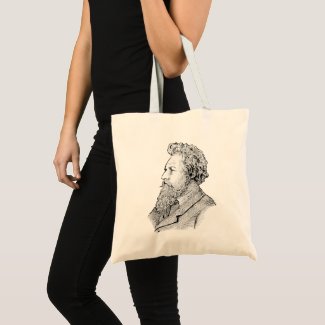
If William Morris had been offered a tote bag, we suspect he would at least have appreciated the idea of a useful object made beautiful. Our William Morris tote bag brings one of the great names of the Arts and Crafts movement into that most practical of modern objects: something made to be used, carried and seen. If this article has left you wondering what Victorian makers might recognise in our own age, take a little of their design philosophy with you, and support Phillaneum while you're at it.
Author's Notes
Notes & Memoranda
As is often the case, the subject extends beyond the bounds of a single article. The notes and memoranda below gather together useful definitions, related observations, references, and occasional curiosities discovered along the way.
Glossary
Some of the terms used in this article have specialised, historical or technical meanings. This glossary provides additional context for selected terms and ideas.
- Red House
- A domestic project built for William Morris and family by Philip Webb that functioned as an experimental studio for the emerging Arts and Crafts ideals; its rooms and furnishings were treated as a testing-ground where patterns, furniture and surface decoration were designed, tried in use and adjusted, showing how domestic space could be integral to design thinking rather than merely a setting for decoration.
- Morris, Marshall, Faulkner & Co.
- The collaborative firm founded in 1861 by Morris and several artist-designers that pooled artistic, decorative and manufacturing skills rather than privileging a single signature name; its workshop model—combining painters, metalworkers, embroiderers and other specialists—made repeatable, institutionally commissioned decorative work possible and helped define the practical organisation of the Arts and Crafts movement.
- V&A
- Short for the Victoria and Albert Museum in London, the national museum of decorative arts and design whose collections, exhibitions and archival holdings helped conserve, legitimise and circulate Arts and Crafts objects and working drawings; its stewardship (including bequests such as May Morris’s) shaped how designers’ processes and collaborative practices are historically understood.
- Art Workers’ Guild
- A professional society founded in 1884 by architects and designers to create a forum where architectural, craft and intellectual work could be discussed and exhibited on equal terms; rather than enforcing a single aesthetic, the Guild institutionalised professional exchange, teaching and exhibition opportunities that spread Arts and Crafts techniques and standards across workshops and commissions.
- Dye-house knowledge (Thomas Wardle)
- The technical expertise in dyeing and colour processes exemplified by Thomas Wardle, whose practical know-how about historical and non‑European dyestuffs allowed artists to translate aesthetic designs into reliably coloured textiles; such dye-house skills were essential to turning design drawings into repeatable, saleable cloth and show how industrial and artisan knowledge were entangled in the movement.
Further Reading…

References and Further Reading
- Victoria and Albert Museum, “Arts and Crafts: an introduction” — V&A article
- Victoria and Albert Museum, “Introducing William Morris” — V&A article
- Victoria and Albert Museum, “William Morris textiles” — V&A article
- Victoria and Albert Museum, “Philip Webb: a new vision for domestic space” — V&A article
- Victoria and Albert Museum, “Arts and Crafts: design for the home” — V&A article
- The Art Workers’ Guild, “About us” and Guild history materials — Art Workers’ Guild
Disclosure
This article presents an interpretive examination of the collaborative networks behind William Morris and the Arts and Crafts movement. It draws upon historical research to explore the contributions of designers, craftspeople, workshops and institutions. While individual contributions and relationships are documented, broader conclusions about collaboration, influence and the movement's legacy represent editorial interpretation. The accompanying workshop illustration is an imaginative historical reconstruction, not a depiction of a documented event.