How the Arts and Crafts Movement Lost Its Women
Misfiled, not absent
Ask someone to name a famous figure from the Arts and Crafts Movement, and William Morris will probably come to mind. But who designed the jewellery, stitched the embroidery, made the stained-glass windows and taught the next generation of artists? Many were women, working in busy workshops, schools and studios. They were skilled designers, makers and leaders whose work helped shape the movement.
As we explored in our earlier article about influential women in Arts and Crafts, their achievements deserve far more attention. Yet an interesting mystery remains: if these women were so important, why do we remember so few of their names today?
The problem is not that these women vanished. Many were visible to contemporaries, at least in certain circles. What changed was later history’s filing. Women’s contributions were sorted into smaller, less searchable categories: embroidery rather than design, assistants rather than authors, local figures rather than movement-makers, women’s work rather than art. In that sense, “forgotten” is often the wrong word. Misfiled is closer to the truth. Their names survive unevenly in drawing albums, catalogue entries, school records, church windows, and the occasional exhibition notice—exactly what one would expect from a movement whose labour was both collaborative and material. The work stayed; the filing system failed.
Education opened, but unevenly
The Arts and Crafts Movement did widen the path into professional design for women, but not on equal terms. The Victoria and Albert Museum notes that the movement created an environment in which women could begin to take a more active role in developing new forms of design, both as makers and consumers. That opening mattered because it connected art education to paid work, and paid work to specific skills. Birmingham was especially important. Its Municipal School of Art offered local entry scholarships and art education for women, helping produce decorative artists, stained-glass makers, and metalworkers who worked across media rather than being confined to polite drawing-room accomplishments.
Even so, the route had boundaries. Women were often encouraged toward fields that seemed compatible with respectability or domestic use: embroidery, textile design, illustration, bookbinding, jewellery. Those areas could be commercially serious and technically demanding, but they aligned with the kinds of labour society was willing to imagine women doing. Moving from pattern drawing into metalwork, or from illustration into stained glass, meant crossing both a technical threshold and a social one. The movement’s schools made those crossings possible; they did not make them simple.
May Morris and the workshop
May Morris grew up surrounded by some of the finest designers and craftspeople of the Victorian age. Her father was the famous William Morris, but May was far more than the daughter of a celebrated artist. She became an important designer in her own right and helped transform embroidery into a respected professional craft. By 1885, when she was just 23, she was running the embroidery department at Morris & Co. The Victoria and Albert Museum recognises her as a pioneer of art embroidery, yet her achievements have often been overshadowed by her father's enormous reputation.
Running an embroidery workshop involved much more than choosing attractive patterns. May had to design the artwork, select suitable materials, guide skilled embroiderers and make sure the finished pieces matched her vision. A single design might pass through several pairs of hands before it was completed. This was one of the interesting contradictions of the Arts and Crafts Movement: it celebrated the beauty of handmade objects, yet producing them often required careful planning and teamwork. The finished embroidery might carry one designer's name, even though several talented women had helped create it.
One beautiful example is The Orchard, an embroidered wall hanging completed in 1894. May Morris designed the artwork, while Theodosia Middlemore carried out the embroidery. The Victoria and Albert Museum preserves the work and identifies both women, giving credit to the designer and the skilled embroiderer. Their collaboration shows how two different talents could come together to create something remarkable. Fortunately, both names survived alongside the finished work.
But imagine finding a similar piece of embroidery in a museum today, labelled only "Morris & Co." Who drew the original design? Who spent hours carefully stitching the fabric? Who chose the colours and solved the problems along the way? Without surviving records, those questions can be difficult to answer. May Morris and Theodosia Middlemore offer a valuable reminder that the history of Arts and Crafts is not simply the story of famous designers. It is also the story of the skilled hands behind their creations, and how easily those contributions can disappear from view.
Jewellery made women visible
Jewellery was the first Arts and Crafts field in which women received real public acknowledgement. The V&A names Georgie Gaskin, Carrie Copson, May Hart Partridge, Charlotte Newman, and May Morris among the women who won recognition there. That makes sense. Jewellery was small enough to be produced in a studio rather than a heavy industrial plant, but exacting enough that a maker’s judgement remained legible in the finished object. It offered visibility without demanding the large-scale architectural authority that was still more likely to be reserved for men.
A beautiful example survives in the Powerhouse Museum collection in Australia. Made between 1900 and 1920, a matching set of jewellery attributed to Georgie Cave Gaskin and her husband Arthur includes a pendant, brooch and earrings. The pendant features delicate silver wirework, curling leaves, touches of gold, pearls and coloured stones arranged into flower-like patterns. Look closely and the skill becomes apparent: each stone needs a secure setting, while the metalwork must remain strong enough to wear without losing its delicate appearance. The result is more than a pretty ornament. It shows how artistic imagination and technical knowledge came together in the Gaskins' workshop. Importantly, the museum credits both Georgie and Arthur, preserving their shared contribution rather than placing the work under her husband's name alone.
Georgie Cave Gaskin, working with her husband Arthur in Birmingham, shows how the field developed. Their early jewellery was relatively simple, often based on wirework, but by the early 1900s it had become more technically ambitious, with enamel and gemstones. The shift is not just ornamental. It marks an expansion of the workshop’s technical vocabulary. Wirework, enamelling, stone setting, and surface finish each demand different decisions about heat, thickness, balance, and proportion. A piece can look delicate while being structurally demanding; it can look modest while requiring considerable control. The recognition Gaskin received suggests that Arts and Crafts jewellery was not a genteel sideline, but a serious field in which women could be valued for judgement as much as taste.
The market remained conflicted. Arts and Crafts designers often wanted to make beautiful things for ordinary life, yet many pieces were affordable mainly to the well-to-do. That tension helps explain why women designers could be visible and still not broadly remembered. Their work circulated through exhibitions, shops, and elite buyers rather than mass ownership. Visibility did not automatically create durable public memory.
Windows, schools, and attribution
Birmingham’s women artists show how education, exhibition, and workshop practice reinforced one another. Birmingham Museums’ account of Victorian Radicals names Kate Bunce and her metalworking sister Myra, stained-glass designer Florence Camm, enameller Fanny Bunn, and embroiderer, painter, and designer Mary Newill as important figures in the School. The range of media matters. These were not isolated “lady artists” working in private rooms; they were part of an ecosystem in which design moved across materials, with one discipline feeding another.
Mary J. Newill is especially revealing because she moved easily between embroidery, painting, illustration, and stained glass. Birmingham Museums notes her among the women who raised the city’s profile, and a University of Birmingham thesis records that her stained-glass panel cartoon was shown at the Arts and Crafts Exhibition Society in 1893—only the second stained-glass design by a female artist to be exhibited there. This is not a footnote to be admired and forgotten; it is evidence of how narrow public recognition still could be, even for women already working professionally. The exhibition room was not just a showcase. It was a gatekeeper.
Stained glass itself makes the point sharper. The process sits at the intersection of drawing, cutting, painting, leading, and architectural fit. The V&A notes that the technique was relearned and championed by Gothic Revivalists and Arts and Crafts designers, and that women such as Mabel Esplin and Mary Lowndes made substantial contributions. A designer had to think in full size, then in pieces; had to understand how lead lines would alter an image; had to account for light, scale, and the window’s physical setting. Women who worked in stained glass were not adding decoration after the fact. They were composing for a medium that only exists when joined, suspended, and lit.
Why the record thins out
So why did so many talented women fade from the story of the Arts and Crafts Movement? There was no single reason. History books often focused on famous men such as William Morris, while the achievements of women were placed into smaller categories such as embroidery, jewellery, teaching and decorative design. These were skilled and important professions, but they were not always given the same attention as architecture or painting. As a result, a woman might be well known within her own craft, yet barely mentioned in a broader history of the movement.
There was another problem, and it began in the workshops themselves. Arts and Crafts objects were rarely the work of just one person. A designer might draw a pattern, another craftsperson might prepare the materials, and several others might help produce the finished piece. Yet a shop, exhibition or catalogue could identify the work under the name of a business rather than everyone who contributed. This did not always mean someone was deliberately hiding women's achievements. Sometimes it was simply how workshops operated and how their records were kept. But when later historians used those records, they could inherit the same gaps. Over time, the name of a workshop might become famous while the people who worked inside it became harder to identify.
This reveals something important about how history is written. We tend to remember the people whose names were recorded, rather than everyone whose work made an achievement possible. A stained-glass window might survive for more than a century, while the names of those who designed, painted and assembled it disappear from public memory. The same could happen to an embroidered wall hanging or a piece of handmade jewellery. The object remains, but part of its story is lost. Fortunately, museum collections, old exhibition catalogues and workshop records can sometimes help us put those names back where they belong.
Looking again at these women changes how we understand the Arts and Crafts Movement. It was not simply a collection of famous artists creating beautiful objects. It was a network of schools, workshops, designers and skilled makers who shared ideas and learned from one another. Women were an important part of that network, helping to develop techniques, teach new craftspeople and turn designs into objects that people could use and enjoy. Their contributions remind us that great craftsmanship is often a team effort, even when history remembers only one name. The work was never hidden. The record simply learned to look past it.
And perhaps that is the most interesting lesson to take into the present. Today, people are once again gathering in workshops, sharing designs, learning traditional skills and making things by hand. We call it the modern maker movement, but would the Victorian craftspeople have recognised it? And have we become any better at giving credit to everyone involved? Explore these questions in our next article, Would Victorian Makers Recognise Today's Maker Movement?, where the workshops of the past meet the makers of today.
Author's Notes
Notes & Memoranda
As is often the case, the subject extends beyond the bounds of a single article. The notes and memoranda below gather together useful definitions, related observations, references, and occasional curiosities discovered along the way.
Glossary
Some of the terms used in this article have specialised, historical or technical meanings. This glossary provides additional context for selected terms and ideas.
- Arts and Crafts Movement
- A late‑19th to early‑20th‑century design and social movement that rejected industrial mass‑production in favour of handcraft, material truth and integrated design; it combined aesthetic ideals with practical workshops, schools and small firms so that decoration, utility and social reform were presented as a single programme for everyday objects and buildings.
- Morris & Co.
- The design and production firm associated with William Morris that organised designers and craftworkers to make textiles, embroideries, furniture and decorative objects; its workshop system and pattern books turned artistic ideas into repeatable, saleable products and so blurred simple notions of individual authorship and collective manufacture.
- panel cartoon (stained glass)
- A full‑size preparatory drawing or painted design used as the exact template for cutting and assembling a stained‑glass window; cartoons guided colour, scale and the placement of lead cames and were often exhibited or kept as documentary proof of a designer’s hand.
- enamelling
- A decorative technique in which finely ground glass powder is fused to a metal surface by firing, producing durable, coloured surfaces and delicate pictorial effects; it demands precise control of temperature, compatibility between metal and glass, and compositional planning, which made it a technically respected skill in Arts and Crafts jewellery.
- lead lines / leading
- The strips of lead (cames) used to join individual pieces of coloured glass in a window; beyond their structural role, lead lines define composition and rhythm—breaking or emphasising contours and altering how an image reads when lit—so designers had to plan imagery around them as an intrinsic part of the medium.
Frequently asked questions
Curious about something you’ve just read? These frequently asked questions explore some of the key ideas, details and questions surrounding the topic.
Why were women overlooked in the history of the Arts and Crafts Movement?
Many women were recognised as designers, makers and teachers during their lifetimes, but later historical accounts often emphasised prominent male figures. Women's contributions were frequently categorised under embroidery, jewellery, decorative arts or collective workshop production, making individual achievements less visible.
Who were some influential women in the Arts and Crafts Movement?
Important contributors included May Morris, Georgie Cave Gaskin, Mary J. Newill, Florence Camm, Mary Lowndes and Mabel Esplin. Their work encompassed embroidery, jewellery, illustration, stained glass and decorative design, demonstrating the breadth of women's involvement in the movement.
How did art schools help women participate in the Arts and Crafts Movement?
Institutions such as the Birmingham Municipal School of Art provided women with opportunities to develop professional design and craft skills. These schools supported participation in fields including metalwork, embroidery, enamelling and stained glass, although social expectations continued to restrict professional opportunities.
What role did May Morris play in the Arts and Crafts Movement?
May Morris was an influential embroidery designer and workshop leader who took responsibility for the embroidery department at Morris & Co. in 1885. She helped establish embroidery as a disciplined professional design practice, combining artistic judgement with the organisation and execution of skilled workshop production.
Further Reading…

References and Further Reading
- Victoria and Albert Museum, “Arts and Crafts: an introduction” — https://www.vam.ac.uk/articles/arts-and-crafts-an-introduction
- Victoria and Albert Museum, “How the Arts and Crafts movement influenced fashion” — https://www.vam.ac.uk/articles/how-arts-and-crafts-influenced-fashion
- Victoria and Albert Museum, “Unsung Artists: May Morris (1862–1938)” — https://www.vam.ac.uk/blog/caring-for-our-collections/unsung-artists-may-morris-1862-1938
- Birmingham Museums, “Victorian Radicals” — https://www.birminghammuseums.org.uk/stories/victorian-radicals
- University of Birmingham / WRAP, Laura Hoban, “The Birmingham Municipal School of Art and opportunities for women’s paid work in the arts and crafts movement 1885–1914” — https://etheses.bham.ac.uk/id/eprint/5124/1/Hoban14PhD.pdf
- Victoria and Albert Museum, “Arts and Crafts enamels” — https://www.vam.ac.uk/articles/arts-and-crafts-enamels
- Powerhouse Museum, “Suite of jewellery by Arthur and Georgie Gaskin” — https://collection.powerhouse.com.au/object/36988
Disclosure
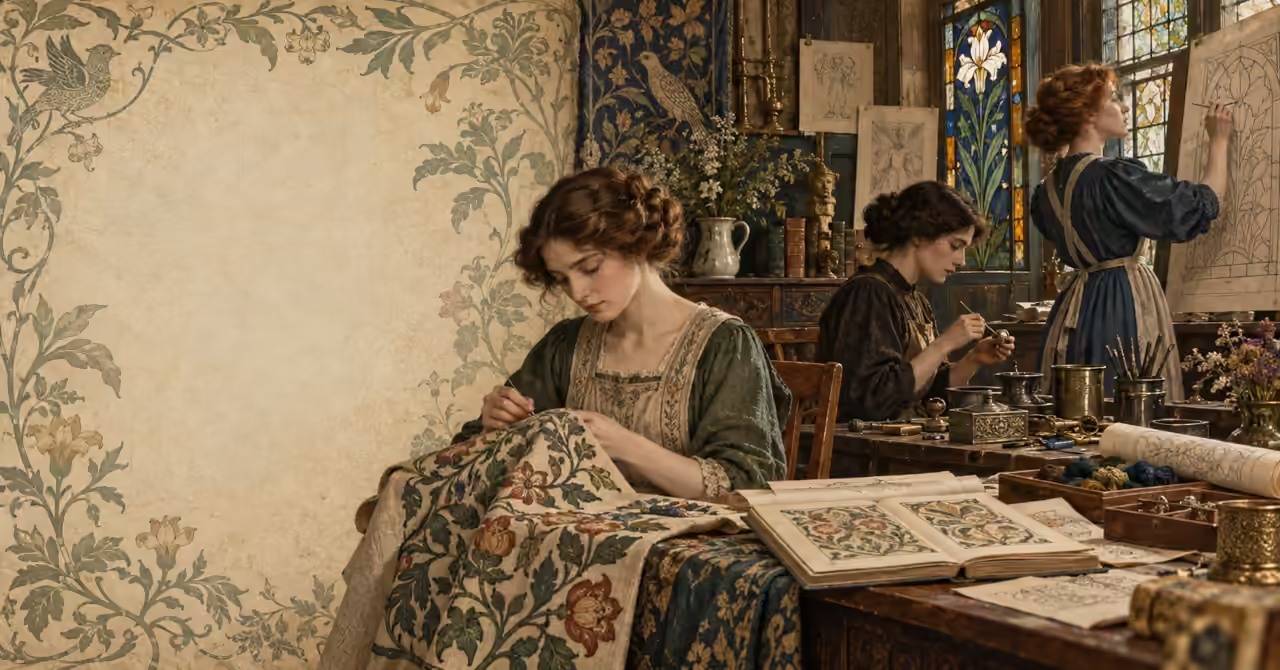
Historical information has been drawn from published research, museum collections and institutional archives, with sources acknowledged in the references. The accompanying hero illustration is AI-generated and represents a fictional Victorian Arts and Crafts workshop rather than identifiable historical individuals or events. The article offers an interpretive examination of women's contributions to the movement and the circumstances that influenced their recognition in subsequent historical accounts.