Victorian Engineering and the Art of Moving a Problem
Solutions with a new address
Victorian engineers are often remembered as if they simply solved problems: filthy rivers, dark streets, slow transport, overcrowded cities. But a more revealing pattern is less heroic and more practical. They usually solved one problem by changing its location, its timing, or its form. Sewage could be pushed downstream. Smoke and chemical residue could be concentrated at the edge of town. A railway could clear a traffic bottleneck while cutting a new scar through the urban fabric. That isn’t an insult to Victorian engineering. It describes how infrastructure works when it has to be built with steam power, wrought and cast iron, brick, horse labour, and city governments that can tolerate only so much disruption at once.
The real Victorian achievement wasn’t the elimination of inconvenience. It was the relocation of inconvenience to a place where it was politically and socially easier to bear. Seen that way, Victorian engineering looks less like a gallery of final answers and more like a sophisticated system of trade-offs.
London pushed the river east
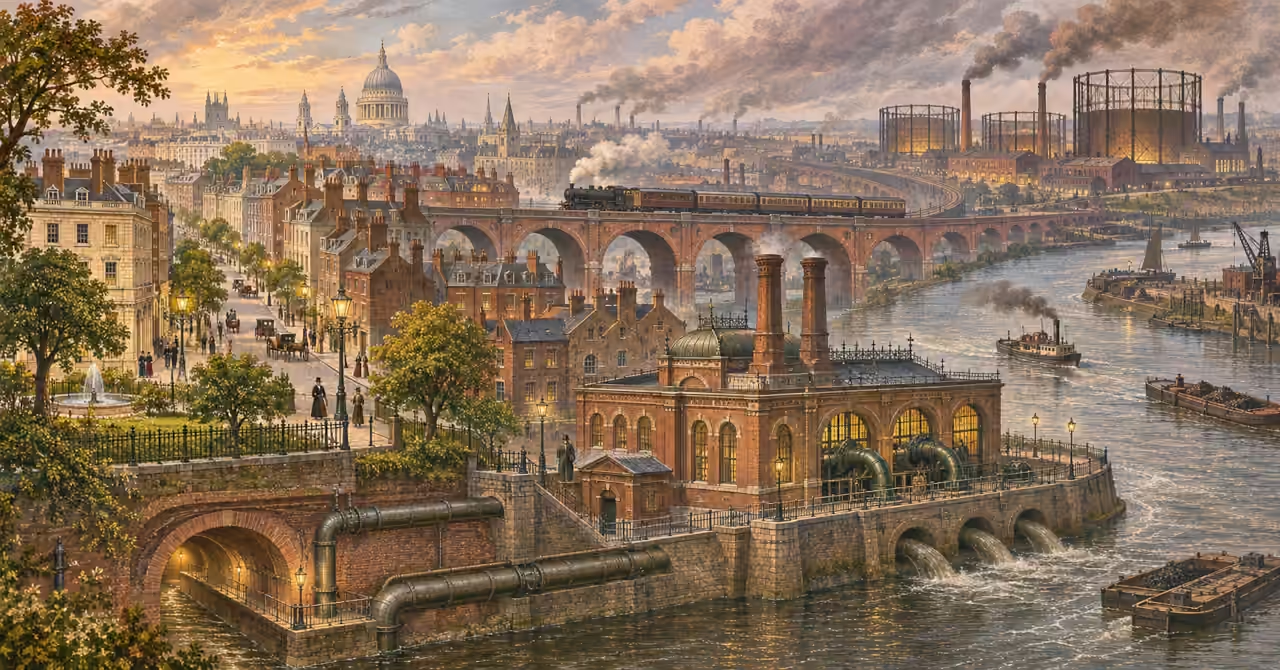
The clearest example is London’s sewerage. Before Joseph Bazalgette’s intercepting system, the Thames served as drain, dump, and water source all at once. The 1858 Great Stink didn’t create the problem; it made the contradiction impossible to ignore. What followed was an engineering response, as well as a geographic one. Sewage from central and north London was intercepted and carried eastward, with pumping stations where gravity alone wasn’t enough, toward treatment works downstream. The centre of the city became more bearable because the nuisance was moved out of immediate sight and smell.
That was a genuine public-health transformation. It helped end the most visible phase of the sewage crisis and turned a river that had functioned as an open sewer into something more like a managed channel. Yet it was never a pure cure. The system depended on gradients, pumping, and discharge points. It was built for the London of its day, not for the later city with more people, more hard surfaces, and heavier rainfall. Thames Water’s own material notes that modern growth and weather can overwhelm combined sewers, producing storm discharges into the Thames. In the nineteenth century, London solved its sanitary emergency by exporting part of it into the future.
That isn’t failure in the simple sense. It is the basic condition of urban infrastructure. A sewer isn’t a moral victory; it is an arrangement of levels, flows, and tolerated overflow. Bazalgette’s network was brilliant because it bought the city time. It also shows how Victorian engineering worked at its best: not by abolishing contradiction, but by reorganising it into a form people could live with.
Gaslight and its residue
The same logic shaped gas lighting. Coal gas gave nineteenth-century towns a new kind of night life. Streets became brighter, commercial hours lengthened, and urban interiors could be lit more cheaply and consistently than before. But that convenience depended on a hidden industrial geography. Historic England notes that gasworks were commonly sited on the fringes of towns, near rivers, canals, and railways. They needed space for retorts and gasholders, access to coal deliveries, and enough distance that their mess was less politically visible.
The by-products weren’t incidental. Coal tar was a major residue of gas manufacture, and Historic England’s research notes that disposal was a persistent problem in the early years. Dumping into rivers was common enough to attract fines and complaints. So the city obtained light by turning coal smoke into an invisible network. But the chemical remainder still had to go somewhere. Gas lighting didn’t remove pollution; it redistributed it into retort houses, purifier houses, sidings, contaminated soils, and eventually expensive remediation.
Even the landmarks of the system tell the story. Gasholders were monumental because they had to contain large volumes of low-pressure gas, not because engineers were indulging in civic ornament. They became visible symbols of a hidden utility. Victorian urban life was increasingly powered by systems that were physically present but socially pushed aside. The city enjoyed the service; the edge of the city carried the residue.
Railways cut through cities
Railways are often celebrated as if they merely shrank distance. They did that, but they also re-cut the city. Historic England describes the railway viaduct as one of the most visible and characteristic Victorian engineering forms, built at unprecedented scale across Britain. These structures weren’t just bridges for trains. They were arguments in brick and iron about how to force a level route through a built and uneven world. Where the railway couldn’t conform to the city, the city had to conform to the railway.
That conformity came at a local cost. Railway approaches, stations, embankments, and yards meant demolition, severance, and the reordering of neighbourhoods. Historic England’s archive material on the Albert Embankment notes that streets in Lambeth were demolished to make room for the work. Other transport works altered areas around stations such as Bishopsgate in response to congestion and the need for larger, better-sited facilities. Victorian transport improvement wasn’t just a matter of drawing lines on a map. It was urban surgery.
And like surgery, it left new edges behind. A viaduct might carry movement over a district, but underneath it there could be shadowed land, awkward access, noise, and a different kind of urban boundary. The railway solved the problem of mobility by creating new frontiers within the city itself. Some later became places of commerce or redevelopment. Others remained awkward strips of land that inherited the railway’s geometry for generations.
The hidden ledger of progress
The deeper Victorian pattern is that infrastructure tends to externalise its costs. It can do so in space, by pushing burden downstream, outboard, below street level, or to the city’s edge. It can also do so in time, by handing maintenance, pollution, or obsolescence to a later generation. That is why Victorian engineering still echoes in contemporary arguments about storm overflows, tunnel projects, rail upgrades, and utility works. The old systems were often overbuilt in one respect and underbuilt in another. Bazalgette’s sewers were large enough to serve a growing city, but not large enough to absorb later combination of denser development and heavier runoff. Gas networks lit the city while leaving contaminated ground behind. Railways accelerated movement while consuming land and forcing costly rearrangements of streets and stations.
It would be too easy to say that Victorian engineers simply passed the buck. They didn’t. They built durable public works under cramped political and technical conditions, and they often got closer to the right answer than their critics appreciated. But they worked in a world where the best available answer was frequently a redistribution of burden, rather than a true elimination of it. Their embankments, tunnels, sewers, and viaducts are impressive not because they achieved purity, but because they managed trade-offs at the scale city life demanded.
That is the useful way to read the era: not as a parade of clean solutions, but as a record of what a society was willing, able, or forced to see. Infrastructure is a kind of civic mirror. It reflects not only technical ingenuity, but also the limits of what officials could measure, what residents would tolerate, and what could be made to disappear from the centre without vanishing altogether. Victorian engineering was often brilliant because it understood—instinctively or deliberately—that problems don’t always go away. Sometimes they just change address.
What the Victorians understood
Seen in that light, the Victorians weren’t naive optimists about progress. They understood that a city can be made more liveable only by deciding who pays, where, and when. London’s sewers improved health by moving filth away from the affluent centre. Gasworks improved light by concentrating smoke and residue in specialised industrial districts. Railways improved transport by cutting through streets, fields, and finances alike. Each achievement was real. So was the displaced cost.
The most modern thing about Victorian engineering may be this blunt recognition: no infrastructure is free of consequences, and no consequence stays invisible forever. The work of engineering isn’t to conjure a perfect solution from nowhere. It is to choose which problem will be seen, by whom, and on what timetable. The Victorians were very good at that. That is why their systems lasted—and why they still matter now.
From the Curator's Workshop
Victorian infrastructure was built from practical components that each solved one small part of a much larger system. Our Dodge Patent Wood Split Pulley T-shirt celebrates that same mechanical world: visible power transmission, industrial supply networks and engineering designed to be maintained rather than hidden. Purchasing one helps support Phillaneum.

Author's Notes
Notes & Memoranda
As is often the case, the subject extends beyond the bounds of a single article. The notes and memoranda below gather together useful definitions, related observations, references, and occasional curiosities discovered along the way.
Glossary
Selected infrastructure terms used in this article.
- Intercepting sewer
- A large sewer designed to collect flows from smaller local sewers and carry them onward to a different discharge or treatment point.
- Combined sewer
- A sewer that carries both wastewater and stormwater, so heavy rain can increase flows sharply and exceed system capacity.
- Gasholder
- A large storage structure used to contain manufactured gas at relatively low pressure while balancing supply and demand across a gas network.
- Viaduct
- A long bridge-like structure, usually made from a series of spans or arches, that carries a route across streets, valleys or uneven ground.
- Externalise
- In the infrastructure sense used here, to shift a cost or consequence away from the immediate user or location so that it is borne somewhere else or at another time.
Frequently Asked Questions
What does “moving a problem” mean in Victorian engineering?
It means changing the location, timing or form of a burden rather than eliminating it completely. The article uses sewage, gasworks and railways to show how infrastructure could make one place more liveable while transferring costs elsewhere or into the future.
How did Bazalgette’s sewer system move London’s sanitation problem?
The intercepting system collected sewage from central and north London and carried it eastward and downstream, using pumping stations where gravity was insufficient. This greatly improved conditions in the centre while relocating part of the sanitary burden.
Why were Victorian gasworks often built on the edges of towns?
Gasworks needed substantial space and good access to coal deliveries by river, canal or railway. Their smoke, tar and chemical residues also made fringe locations politically and socially easier for growing towns to tolerate.
What trade-off did Victorian railways create inside cities?
Railways improved mobility and reduced travel time, but approaches, viaducts, yards and stations could require demolition, divide neighbourhoods and create new zones of noise, shadow and awkward access.
Further Reading…


References and Further Reading
- Thames Water, “>History of London’s sewer system”
- Thames Water PDF, “Creating London’s sewerage system” — https://www.thameswater.co.uk/media-library/home/about-us/responsibility/thames-days-out/sites/heritage/abbey-mills-information.pdf
- Historic England, “The Great Stink - A Victorian Solution to the Problem of London’s Waste” — https://historicengland.org.uk/images-books/archive/collections/photographs/the-great-stink/
- Historic England, “Gasworks and Gasholders” — https://historicengland.org.uk/images-books/publications/iha-gasworks-gasholders/
- Historic England, “Steam-Powered Pumping Stations and the Sanitary Crisis of Victorian Cities” — https://historicengland.org.uk/whats-new/research/back-issues/steam-powered-pumping-stations-and-the-sanitary-crisis-of-victorian-cities/
- Historic England, “Historic Railway Buildings and Structures” overview
Disclosure
This article is an interpretive historical essay based on the Thames Water and Historic England sources listed above. “Moving a problem” is used as an analytical framework for infrastructure trade-offs, not as a claim that Victorian engineers merely displaced harm or failed to improve public life. The banner is a reused Phillaneum illustration representing interconnected Victorian infrastructure rather than a depiction of one specific historical site. This page may include advertising and affiliate links; those commercial relationships do not determine the editorial interpretation.