How Victorian Speaking Tubes Made Houses Talk
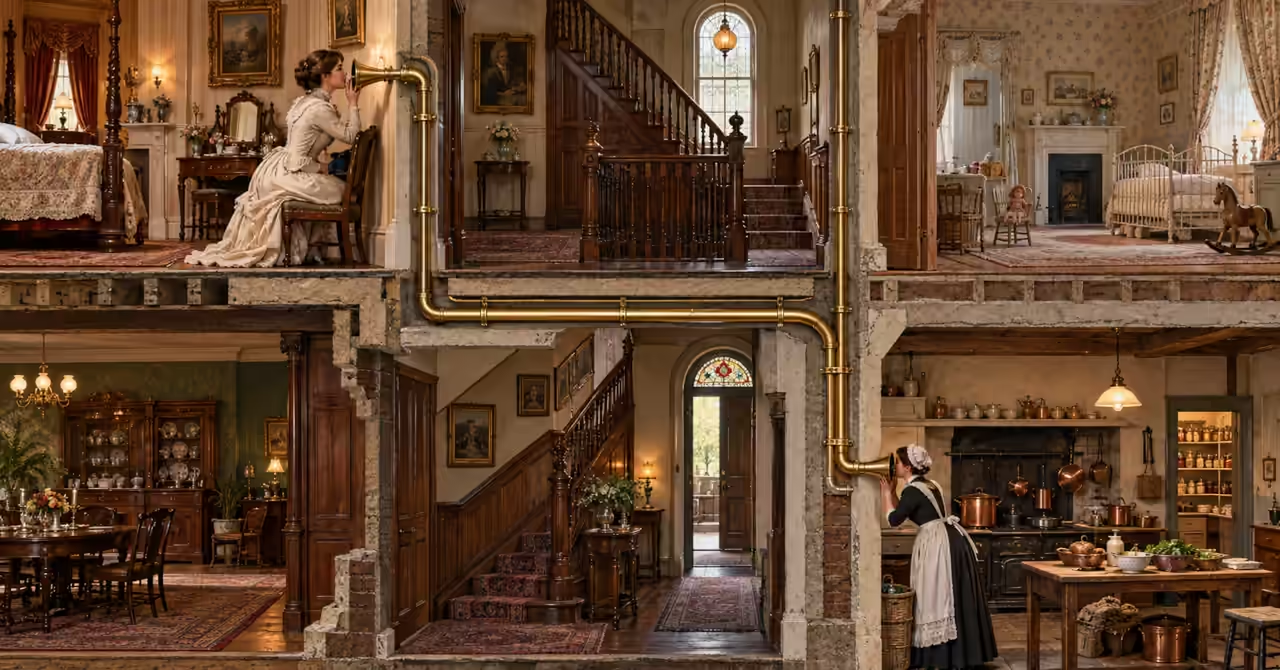
A building that muffled voices
A Victorian house could be a surprisingly deep place. Not deep in the modern sense of square footage, but socially deep: drawing room above dining room, nursery above servants’ rooms, pantry below kitchen, master bedchamber at the end of a corridor, and somewhere in between the endless business of getting one person’s needs to another person’s ears. In a building like that, ordinary speech was a poor technology. Thick walls, long passages, multiple floors, and the etiquette of service all worked against easy conversation.
The speaking tube answered that problem with almost comic simplicity. It was a narrow air passage, usually smooth, with a mouthpiece at one end and a receiver at the other. A voice entered one end and emerged at the other as sound pressure moving through a confined path. No batteries, no switch, no current—just a tuned route for air and speech. In a large house, or on a ship, or in an institution, that made it useful for the same reason a corridor is useful: it gives a direct line between places that should not have to shout at each other.
That is the real historical oddity here. The speaking tube looks like a gadget, but it’s better understood as architecture taking responsibility for communication. It exists because the building itself has made normal human hearing inconvenient.
How the tube carried speech
The mechanics were straightforward. The speaker talked into one end of the tube; the listener put an ear to the other. The flared or bell-shaped ends often seen on surviving examples weren’t decorative indulgences. They helped couple the voice to the air column more efficiently, making it easier to get speech into and out of the tube. Contemporary technical discussion treated voice pipes as practical acoustic devices, not curiosities. A 1909 U.S. Naval Institute article noted that an ordinary open-ended tube could often do the job nearly as well as a more elaborate mouthpiece, provided the speaker did not crowd the opening and muffle the sound.
That detail matters because it reveals what the tube was—and what it wasn’t. It didn’t transmit speech in the electrical sense. It didn’t convert voice into a signal and then reconstruct it elsewhere. It simply guided sound through a confined column of air, preserving enough of the voice to remain intelligible over a useful distance. Contemporary naval tests found that ordinary open-ended tubes could perform surprisingly well and that even standard right-angle bends did not necessarily impair transmission as much as might be expected. Length, leaks, poor joints and obstructions were more significant limitations. The whole device depended on ordinary physics behaving politely inside a building.
That is why the speaking tube feels both primitive and sophisticated. Primitive, because it uses nothing but air and brass. Sophisticated, because it exploits the geometry of a building and the acoustics of speech with remarkable efficiency. It’s a reminder that some problems yield to engineering long before they yield to electricity.
What it solved in practice
Speaking tubes existed because large households had communication problems that were mundane but constant. Bells could summon servants, but a bell could only say, “Come here.” It couldn’t explain why, answer a question, or send a quick instruction back down the line. A speaking tube filled the gap between a bell-pull and a personal visit. It let a mistress ask for coal, a servant check on a message, a nursery summon attention, or a kitchen confirm a request—without making every exchange a matter of footwork.
In the Victorian household, that wasn’t a small convenience. Domestic labor was spatially distributed and socially stratified. People were expected to be available, but not necessarily visible. The speaking tube let the house behave as though its separated rooms were closer together than they really were. It reduced delay without eliminating hierarchy. The master’s room could speak to the pantry; the nursery could call below; the servants’ domain could answer without anyone crossing the whole building.
There is also a quieter operational truth here: the tube was useful because movement inside these buildings was expensive in time and attention. A message delivered by walking could mean several flights of stairs and several interruptions. A message delivered through a tube moved at the speed of speech. That made it attractive wherever a building had been designed to separate functions but still required coordination. The National Trust’s discussion of country-house communication notes that speaking tubes flourished in the second half of the nineteenth century, alongside bells, as part of a larger domestic communication system. They were never magical. They were a practical compromise between distance and urgency.
And they weren’t limited to houses. Ships used voice pipes to connect stations where wind and machinery would have drowned ordinary speech, and institutional buildings used them where staff needed quick contact without sending a runner. The principle stayed the same: when people are separated by architecture, a voice needs a channel.
The household as network
Once you start looking for them, speaking tubes reveal something larger about Victorian buildings. They weren’t static shells around domestic life. They were serviced machines. Hidden behind plaster and woodwork were bell wires, gas pipes, hot-water circuits, dumbwaiters, and later electric cabling. The speaking tube belonged to that hidden infrastructure. It was part of the machinery that made a grand interior function without exposing the labor required to keep it running.
That is why these tubes are so revealing to historians of the house. They show that architecture wasn’t only about display, proportion, and taste. It was also about routing labor. A fine room wasn’t self-sufficient; it depended on a chain of invisible systems and people. The speaking tube helped keep that chain moving while preserving the social order that made the house intelligible to itself.
The tube also gives a useful picture of Victorian communication more generally. The era is often remembered for telegraph wires and telephones, but before those systems were common inside homes, there was already an appetite for internal networks: ways to send requests, commands, and confirmations without physically moving the whole household around. A speaking tube was, in effect, a private voice network built from brass, carpentry, and air. It made the house smaller where it needed to be smaller, without making it less hierarchical.
There’s a practical elegance in that. The device didn’t try to flatten the building. It worked with the building’s existing plan. Hallways, service routes, and stair voids became communication paths. The architecture itself became part of the delivery system. In modern terms, the house had routing.
Why it disappeared
Speaking tubes declined not because they stopped working, but because better communication systems gradually overtook them. Electric bells had already helped households summon servants, but they could not explain what was wanted; speaking tubes extended that signalling system by allowing an actual message to pass between rooms. The telephone eventually offered the more decisive alternative, carrying conversation over greater distances with far more flexibility and privacy. A hollow pipe, after all, will carry whatever voice is put into it. It is difficult to have a discreet conversation when the channel is, quite literally, open.
The tube also had structural limitations. Its useful range depended on the quality and condition of the installation, and leaks, poor joints or obstructions could reduce intelligibility. More importantly, it was a fixed route between predetermined locations. If a building changed, the tube did not adapt gracefully. Telephone and later intercom systems were easier to extend, reroute and connect in more flexible arrangements. Once those systems became practical inside houses and institutions, the voice pipe increasingly became a vestige: useful in some places, obsolete in many others.
Still, the speaking tube did not vanish entirely. Ships retained voice pipes because they required no electrical power and could provide a mechanically simple means of communication when electrical systems were damaged or unavailable. Naval discussions of voice pipes continued to value them as emergency or supplementary communication, particularly where redundancy mattered more than convenience. If the air column remained intact and the crew knew the drill, the pipe could still speak.
That resilience explains their long afterlife. In the places that kept them, speaking tubes were not merely quaint relics. They remained practical infrastructure, valued because their simplicity gave them a role alongside newer systems. Their weakness and their strength were much the same thing: they depended on little more than an intact passage through which a voice could travel.
The network before the network
The most revealing thing about Victorian speaking tubes is not that they were clever. It’s that they changed the shape of domestic life without changing its basic logic. They let rooms talk across distance, but only within a carefully managed order. They compressed time. They reduced friction. They made a house feel more compact than it was. Yet they never stopped being part of a hierarchy of command, service, and separation.
If that sounds familiar, it should. The speaking tube is an ancestor of modern internal communication systems, but also a reminder that every network begins as a response to inconvenience. People didn’t invent voice pipes because they wanted novelty. They invented them because shouting across a large building was inefficient, and because sending a person to fetch an answer was slower still. The tube was the answer that fit the architecture already in place.
So the house that could speak was never enchanted. It was wired by air, tuned by geometry, and made useful by the old Victorian habit of solving social problems with hidden machinery. That is what makes the speaking tube more interesting than a charming relic. It was a small but precise piece of domestic engineering for an age that knew how much work it took to move a voice from one room to another.
From the Curator's Workshop
Phillaneum's Cabinet of Curious Vintage Mechanisms design gathers the visual language of old machines, patents and illustrated technical catalogues into a monochrome vintage-style graphic. It is a T-shirt rather than a historical artefact, but it is intended as a wearable extension of the same curiosity: the pleasure of seeing how ingenious, awkward and consequential mechanisms can be.

Author's Notes
Notes & Memoranda
As is often the case, the subject extends beyond the bounds of a single article. The notes and memoranda below gather together useful definitions, related observations, references, and occasional curiosities discovered along the way.
Glossary
Some of the terms used in this article have specialised, historical or technical meanings. This glossary provides additional context for selected terms and ideas.
- Speaking tube
- A narrow enclosed tube designed to carry speech between two locations by guiding sound through a confined column of air. Speaking tubes required no electricity and were commonly fitted with mouthpieces or flared openings at each end.
- Voice pipe
- Another term for a speaking tube, particularly in maritime and institutional settings. Voice pipes provided direct communication between separated locations and remained useful where electrical communication was unavailable or unreliable.
- Mouthpiece
- The widened or shaped opening at the end of a speaking tube into which a person spoke. Its form helped couple the speaker's voice to the air inside the tube so that speech could travel along the enclosed passage.
- Air column
- The enclosed body of air inside a speaking tube through which sound waves travelled. The intelligibility of speech depended partly on the length, condition, bends, joints and sealing of the tube containing this air column.
- Bell-pull
- A mechanical household signalling system used to summon servants, usually by pulling a cord or handle connected to a bell elsewhere in the building. Unlike a speaking tube, it could signal attention but could not convey a spoken message.
- Intercom
- An internal electrical communication system that allows speech between different rooms or locations. Intercoms and telephones eventually displaced many speaking tubes because they offered greater range, flexibility and privacy.
Frequently asked questions
Curious about something you’ve just read? These frequently asked questions explore some of the key ideas, details and questions surrounding the topic.
What is a speaking tube and how did it carry speech?
A speaking tube is a narrow air passage with a mouthpiece at one end and a receiver at the other that guides sound pressure through a confined path; flared or bell-shaped ends helped couple voice into the air column and smooth, sealed runs preserved intelligibility. It transmitted sound mechanically through air, not electrically or electronically.
What practical problems did speaking tubes solve in Victorian households?
They let occupants send instructions, ask questions, or summon servants without a personal visit, filling the gap between a bell and walking across a large, socially stratified house and thus reducing delay while preserving household hierarchy. Examples include a mistress requesting coal, a nursery summoning attention, or the kitchen confirming requests.
Why did speaking tubes decline in popularity?
They were supplanted by electric bells, telephones, and intercoms that offered two-way flexibility, easier expansion, and greater privacy, while tubes had limited range and performance that degraded with bends, leaks, or long runs. Tubes were also inflexible when buildings were altered, making electrical systems preferable as they became practical.
Where did speaking tubes continue to be used and why?
Ships and some institutions kept voice pipes because they required no electricity and could function when circuits failed or when noise or machinery made electrical signals unreliable, so they remained dependable backups valued for their reliability.
Further Reading…


References and Further Reading
- National Trust, “Country house communication through the ages” — https://www.nationaltrust.org.uk/discover/history/art-collections/country-house-communication-through-the-ages
- U.S. Naval Institute Proceedings, “Voice Pipes” (1909) — https://www.usni.org/magazines/proceedings/1909/september/voice-pipes
- U.S. Naval Institute Proceedings, “The Value of Voice Pipes for Fire Control Communication” (1917) — https://www.usni.org/magazines/proceedings/1917/july/value-voice-pipes-fire-control-communication
- U.S. Patent 133,610, “Improvement in Speaking-Tubes” (1872) — https://patents.google.com/patent/US133610A/en
- U.S. Patent 326,568, “Speaking-Tube” (1885) — https://patents.google.com/patent/US326568A/en
- Library of Congress, “House History: A Guide to Uncovering the Stories of Local Buildings and Properties” — https://guides.loc.gov/house-history/surveys
Disclosure
This article describes Victorian speaking tubes in general historical and technical terms. Their design, materials, range and use varied between buildings, ships and institutions, and surviving examples do not represent a single universal standard. Illustrations and reconstructed scenes are interpretive, while later technical and maritime sources are used to explain operating principles rather than to imply that every domestic installation worked in precisely the same way.