Measuring magnetic fields by electromagnetic induction
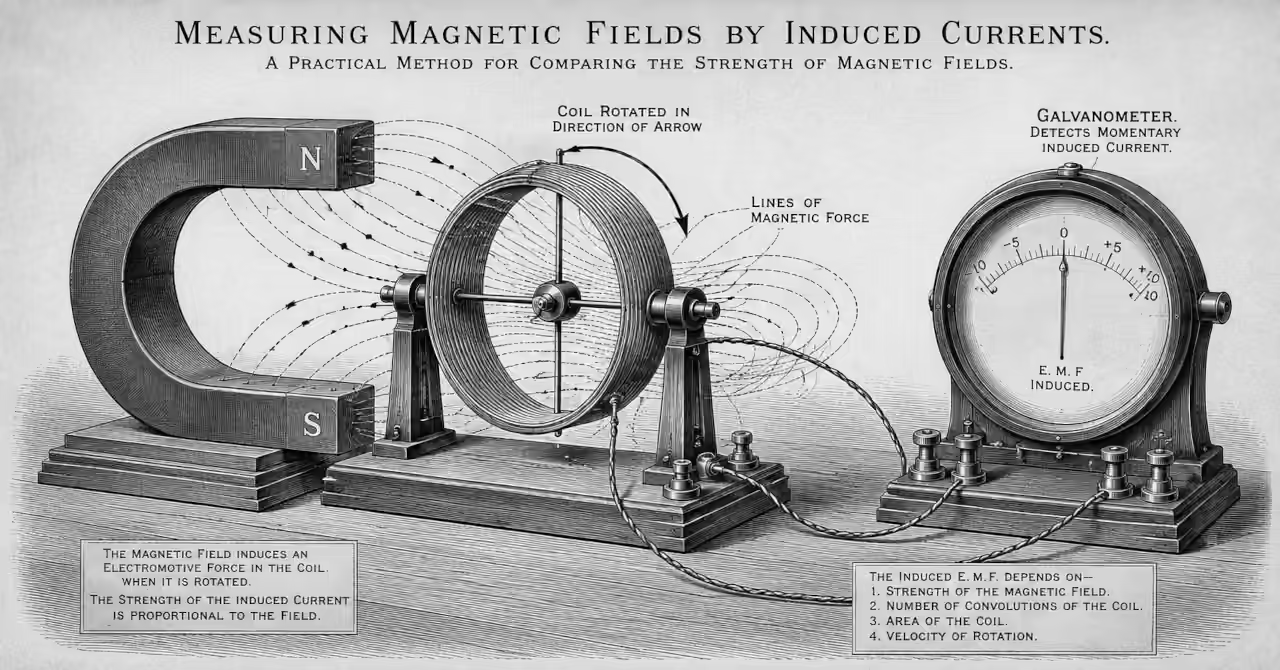
Measuring the strength of an electromagnetic field is a difficult practical problem. One method relies on electromagnetic induction: moving a wire through a magnetic field generates an electric current. Because the induced current depends on both the strength of the magnetic field and the rate at which the wire cuts through the magnetic lines of force, different magnetic fields can be compared by moving the wire at the same speed.
Greater accuracy is obtained by winding the wire into a small coil. The coil is first placed so that its surface is perpendicular to the magnetic field, allowing the magnetic lines of force to pass through it. It is then quickly rotated through ninety degrees so that the plane of the coil becomes parallel to the field, causing the magnetic flux through the coil to fall to zero.
The resulting electromotive force (E.M.F.) is proportional to the number of turns in the coil, the strength of the magnetic field, the area enclosed by the coil, and the speed at which the magnetic flux changes. Sensitive galvanometers can measure these brief induced currents, enabling the relative strengths of different magnetic fields to be determined.
—Electrical Age.
From the Curator's Workshop
If Victorian patents, workshop diagrams, and ingenious mechanical arrangements capture your imagination, our Cabinet of Curious Vintage Mechanisms design celebrates the same spirit of technical curiosity. Inspired by the machines, inventions, and industrial artefacts explored throughout the Phillaneum, it is a wearable tribute to the engineers, inventors, tinkerers, and collectors who see beauty in the workings beneath the surface.
Electromagnetism was one of the defining scientific and engineering frontiers of the Victorian era.
While the relationship between electricity and magnetism had been revealed through the pioneering work of Hans Christian Ørsted, André-Marie Ampère, Michael Faraday and James Clerk Maxwell during the nineteenth century, the 1880s and 1890s saw these discoveries transformed into practical technologies. Electric lighting, dynamos, motors, telegraphy and the first large-scale power distribution systems created an urgent need for engineers to accurately measure and compare magnetic fields. Articles such as this reflect the transition from scientific discovery to practical engineering, where reliable measurement techniques became essential tools for designing, testing and improving the electrical technologies that were rapidly reshaping Victorian society.
This article offers a glimpse into the practical work of Victorian electrical engineers, who increasingly relied on measurement rather than observation alone. As electrical technology advanced, engineers needed reliable methods to compare the strength of magnetic fields when developing generators, motors and scientific instruments. The technique described—rotating a wire coil within a magnetic field and measuring the resulting current with a galvanometer—illustrates how nineteenth-century engineers transformed the emerging science of electromagnetism into repeatable engineering practice, laying the foundations for the rapid expansion of electrical technology in the decades that followed.
As you continue exploring Victorian engineering, consider how many technological breakthroughs depended not on spectacular inventions, but on the steady refinement of measurement and testing. Behind every successful generator, electric motor or lighting system were engineers who developed reliable methods for comparing results, validating designs and improving performance. Articles such as this remind us that engineering progress is built as much upon accurate measurement and disciplined experimentation as upon moments of inspiration, encouraging us to look beyond famous inventors and appreciate the practical knowledge that enabled the electrical age.
Curator's Notes
On first reading, this appears to be a brief technical note of little consequence. However, it captures an important moment in the development of electrical engineering, illustrating how Victorian engineers transformed Faraday's discoveries into practical methods for measuring and comparing magnetic fields. Such articles reveal the everyday engineering knowledge that underpinned the rapid expansion of electrical technology during the late nineteenth century.
If this exhibit has sparked your curiosity, the natural next step is A New Claimant for the Invention of the Electric Glow Lamp. While this article explains how Victorian engineers measured and compared magnetic fields, the glow lamp article explores one of the technologies that transformed those scientific principles into everyday life. Together, the two exhibits illustrate the progression from understanding electricity in the laboratory to harnessing it for practical illumination, helping to explain why the late nineteenth century became the age of electrical innovation.
Notes & Memoranda
Glossary
Electro-Magnetism
Electromagnetism is the branch of physics that studies the relationship between electricity and magnetism. In Victorian engineering, it explained how electric currents could create magnetic fields and how changing magnetic fields could generate electricity.
Lines of Force
Lines of force were the nineteenth-century way of visualising a magnetic field. Engineers imagined invisible lines extending through space, with a stronger magnetic field represented by a greater concentration of lines.
Electromotive Force (E.M.F.)
Electromotive force, usually abbreviated to E.M.F., is the electrical pressure that causes an electric current to flow. Today it is commonly measured in volts.
Galvanometer
A galvanometer is a sensitive scientific instrument used to detect and measure small electric currents. Victorian engineers relied upon galvanometers for laboratory experiments and electrical measurements.
Convolutions
In nineteenth-century electrical engineering, the term convolutions referred to the number of turns of wire wound into a coil. Increasing the number of turns increased the electrical effect produced by the coil.
Frequently asked questions
How did Victorian engineers compare the strength of magnetic fields?
They moved or rotated a wire coil through a magnetic field and compared the brief electric currents produced. When the movement was performed at equal speeds, the induced current provided a practical way to compare different field strengths.
Why was a coil used instead of a single wire?
Winding the wire into a coil increased the measurable electrical effect because each turn contributed to the induced electromotive force. The result also depended on the area of the coil and the speed at which it was rotated.
What role did the galvanometer play in the experiment?
A specially constructed galvanometer detected the sudden momentary current generated when the coil was turned. By comparing these readings, engineers could estimate the relative strength of different magnetic fields.
This article presents a curated extract and editorial interpretation of material originally published in Engineer and Inventor, April 1893. The content reflects the language, assumptions, and technical understanding of its time. While care has been taken to preserve the original context, minor formatting and presentation changes have been made. Readers seeking deeper technical accuracy or historical verification should consult primary sources and period engineering references.