Did Victorian Battery Trams Pioneer Electric Transport?
Introduction
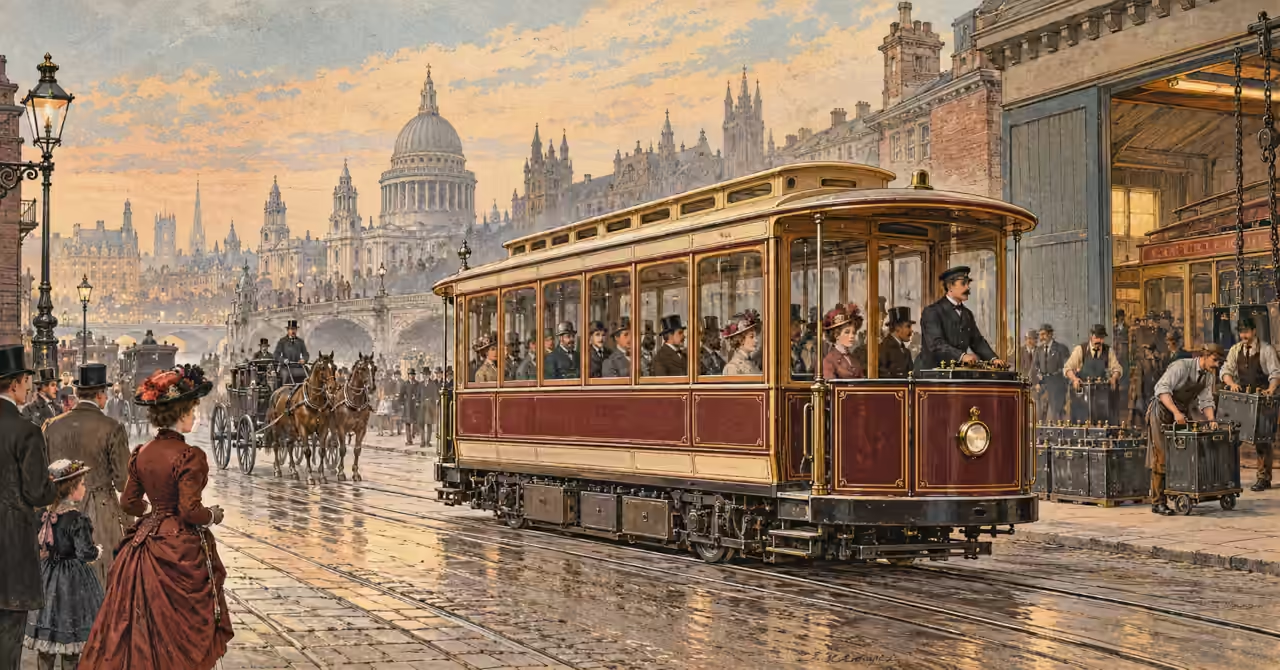
Imagine stepping aboard a Victorian tram in the 1880s. The streets are busy with horses and carriages, yet your tram glides away without a horse, a steam engine, or even an overhead electric wire. What is powering this remarkable machine? Hidden beneath the floor are heavy rechargeable batteries, carrying enough electricity to move passengers through the city. It sounds surprisingly like the electric vehicles we drive today, but Victorian engineers were already experimenting with the idea more than 140 years ago.
As we explored in Dawn of Electric Trams: A Victorian Revolution in Urban Transport, electricity promised to transform crowded city streets. Battery-powered trams took that ambition one step further by carrying their own energy instead of drawing it from wires above the road. But this freedom came with challenges. How far could they travel before recharging? How much weight could they carry? And could they compete with trams connected to an electrical network? The answers reveal a fascinating early chapter in the history of electric transport.
The wire problem
By the 1880s, electric tramways had exposed a central urban tension. The motor was no longer the mystery. The harder question was how to deliver power in a way cities would accept. Overhead wires were mechanically straightforward but visually unpopular. Conduit systems kept the street cleaner to the eye, but demanded expensive and fussy infrastructure. Battery traction offered a third route: if the tram could carry its own electricity, it would not need a wire above the road or a slot below it.
That promise was real, and it was compelling. A self-contained tram could, in principle, use ordinary street track while avoiding the fiercest arguments about poles, wires, and street disfigurement. But the bargain was severe. A battery has to travel with the car—meaning its weight, size, charging regime, and limitations travel with it, too. Electric traction didn’t disappear; it simply moved into the vehicle.
Antwerp’s working proof
One of the clearest early demonstrations came at Antwerp in 1885. Contemporary observers described a tramcar powered by accumulators and fitted with two battery sets, so that one could be charged while the other was in service. The exchange took about ten minutes, including moving the car off the tramway and back again, and it was done after every seven journeys. The same account gives the vehicle a total battery mass of roughly 2,460 pounds, with the complete car weighing 5,654 pounds. Those numbers make the point plainly: a substantial share of the vehicle’s own weight was stored energy, not passengers, structure, or equipment.
The Antwerp car was also technically serious. Its batteries were divided into series and rearranged by commutators so the motor could be run in different electrical combinations. It was reversible from either end, and speed was controlled by cutting batteries out of circuit rather than wasting energy through resistance. This was not a toy or a publicity stunt. It was a careful attempt to make battery traction behave like real tramway service, with frequent stops, reversals, and ordinary street duty.
Still, the same report is unforgiving about endurance. The two battery sets were said to suffice for about forty-two miles over sixteen hours, with charging taking seven to nine hours per set. That arrangement could work only with modest service and a tightly managed routine. The supposed freedom from wires had not removed infrastructure. It had shifted it into the depot, where spare battery sets, trained staff, and a charging schedule became part of the operating system.
The civic bargain
Battery trams were often attractive for reasons that had as much to do with politics as engineering. They promised electrification without visible overhead lines, without the excavation required for a conduit system, and without asking every council member to accept a streetscape threaded with poles and wires. In Birmingham, for example, the Bristol Road extension had originally been proposed for overhead electrification, but opposition from the council and a neighbouring landowning family pushed the company toward accumulator cars in 1890.
That made the battery tram a compromise vehicle. It was not usually the first engineering choice; it was the one reached when the preferred option could not pass the civic test. A tramway is never just an electrical circuit. It is also a negotiation with the street, the view from adjacent windows, the habits of municipal government, and the people who object to industrial hardware placed in front of them. Battery traction appealed because it made electric transport look less like fixed plant and more like a conventional tram.
But the hidden machinery did not go away. It simply moved beneath the seats, into the depot, and into the timetable.
Why it broke down
Birmingham’s accumulator trams show the practical penalty with unusual clarity. The batteries were housed beneath the passenger seats, a layout the National Tramway Museum describes as hazardous, with passengers complaining of acid fumes and occasional damage to clothing. The practical range was only about thirty miles when fully charged. By 1894, all but two of the fourteen accumulator cars had already been withdrawn. The Bristol Road service finally adopted overhead wires in 1901, once opposition had softened enough to permit the more obvious solution after all.
These failures were not just managerial mishaps. They exposed the physical limits of nineteenth-century batteries. Lead-acid accumulators were a major advance over earlier portable electrical systems, but they were still heavy, maintenance-sensitive, and tied to charging cycles that fit poorly with a vehicle expected to work all day in traffic. A tram does not move gently. It starts hard, stops often, carries changing loads, climbs grades, waits, reverses, and does it again in bad weather. Each of those demands punishes a battery that is already burdened by its own weight.
That is why the battery tram’s apparent simplicity was deceptive. To keep it running, operators needed charging sheds, spare cells, transfer routines, and disciplined scheduling. Contemporary patent literature shows how seriously engineers took the problem: some proposals described apparatus for transferring exhausted batteries quickly for charged ones, while another imagined a vehicle carrying its own secondary batteries on a second wheeled vehicle. These were not odd side notes. They were attempts to make the battery behave less like a burden and more like a replaceable fuel package.
But the more support infrastructure the battery required, the less convincing the claim of wire-free simplicity became. At a certain point, the operator had traded one visible network for another—and one with poorer energy density besides. The overhead trolley wire, however unpopular, delivered power continuously and cheaply by the standards of the time. Once public opposition eased, the engineering path of least resistance was usually to put the wire where the current belonged: above the street.
What the idea left behind
Did Victorian battery-powered trams pioneer electric transport? In an important way, yes. More than 140 years ago, engineers proved that a vehicle could carry rechargeable batteries and use their stored electricity to move passengers through busy city streets. The same basic idea powers millions of electric cars today. These early trams were not simply curiosities. They were working examples of a future that had yet to arrive.
The Victorian engineers faced problems that would sound familiar to modern electric vehicle designers: how far could a vehicle travel on one charge, how much should its batteries weigh, and how quickly could they be recharged or replaced? Their lead-acid batteries were heavy, slow to charge and difficult to maintain. Modern battery technology has overcome many of these limitations, but the questions remain surprisingly similar. The engineers of the 1880s were already exploring solutions to challenges that would occupy inventors for generations.
Yet the battery tram also taught another important lesson. Electricity could be stored aboard a vehicle, or supplied continuously from a network. Both approaches had advantages, and Victorian engineers experimented with each. While battery trams demonstrated the freedom of carrying their own power, overhead wires offered a practical way to keep public transport running throughout the day.
That choice leads to another remarkable Victorian innovation. Engineers were not only inventing electric vehicles; they were also discovering better ways to distribute electricity. One particularly ingenious development was the three-wire system of electric distribution, which helped make electrical networks more economical and practical. Together, these inventions reveal how Victorian engineers were laying the foundations of our modern electric world.
Author's Notes
Notes & Memoranda
As is often the case, the subject extends beyond the bounds of a single article. The notes and memoranda below gather together useful definitions, related observations, references, and occasional curiosities discovered along the way.
Glossary
Some of the terms used in this article have specialised, historical or technical meanings. This glossary provides additional context for selected terms and ideas.
- Accumulator
- A nineteenth‑century name for a rechargeable electrochemical cell, most commonly a lead‑acid battery; called an accumulator because it 'accumulates' and releases electrical charge. In tramway use the term emphasises practical features — heavy lead plates and acid electrolyte, slow charging, maintenance needs, and fumes — that made such cells bulky, hazardous and operationally demanding compared with a continuous supply from a conductor in the street.
- Conduit system
- A method of supplying tram power without overhead wires by running live conductors in a channel beneath the road surface, accessed through a narrow slot beside the rails; contact shoes or mechanical arms reached down to pick up current as the vehicle passed. It kept the streets free of poles and wires but required expensive excavation, insulation, pits, drainage and frequent maintenance, making it politically and economically costly despite its visual advantage.
- Commutator
- An electrical switching device used to change how electricity flows through a circuit. In Victorian battery-powered trams, the term described a switching arrangement that allowed engineers to connect groups of batteries in different combinations, helping control the tram's speed and direction without wasting electricity through resistors. This differs from the commutator inside a traditional DC electric motor, which reverses current through the motor's rotating windings. Both devices control electrical connections, but they perform different jobs.
- Overhead trolley wire
- A continuous conductor strung above the street that supplies electricity to a tram via a pole or pantograph mounted on the vehicle; it delivers power on demand so the tram need not carry heavy fuel or batteries. Although visually intrusive and politically contested in the nineteenth century, the overhead system proved operationally superior because it provided steady, high‑availability power with far greater effective energy density than on‑board accumulators.
- Depot discipline
- The set of logistical routines, staffing practices and scheduled operations needed to keep battery‑powered trams running — for example charging timetables, spare battery inventories, rapid battery exchanges and trained attendants. It describes the hidden infrastructure and managerial burden that replaced visible street plant when power was carried on the vehicle, explaining why 'wire‑free' often meant a more complex, depot‑centred system.
Frequently asked questions
Curious about something you’ve just read? These frequently asked questions explore some of the key ideas, details and questions surrounding the topic.
Why were battery (accumulator) trams adopted in some cities?
They promised electric tramways without visually unpopular overhead wires or the excavation required for conduit systems, making electrification politically acceptable in places where councils or neighbours opposed poles and wires.
What were the main technical and operational problems with accumulator trams?
Lead-acid batteries were heavy, maintenance-sensitive, produced fumes, had limited range and long charging times, and required charging sheds, spare cells and disciplined depot routines that offset the apparent simplicity of being wire-free.
How did the Antwerp accumulator tram work in practice?
An 1885 Antwerp tram carried two battery sets so one could be charged while the other ran, a swap took about ten minutes after every seven journeys, the batteries weighed roughly 2,460 pounds with the complete car at 5,654 pounds, and the sets sufficed for about forty-two miles over sixteen hours with seven to nine hours charging per set.
Why did cities eventually revert to overhead wires despite early opposition?
Once public opposition eased, overhead trolley wires supplied continuous power more cheaply and avoided the mass, upkeep and scheduling burdens of on-board batteries, making the overhead system the engineering path of least resistance.
Further Reading…



References and Further Reading
- Scientific American Supplement, No. 530, 27 February 1886, contemporary account of the Antwerp accumulator tram experiment: Project Gutenberg – Scientific American Supplement No. 530
- National Tramway Museum, “Birmingham Central Tramways 75 Class Cable Tram,” including the Birmingham accumulator-car episode: https://tramway.co.uk/collections/trams/birmingham-75/
- Encyclopædia Britannica (1911), “Tramway,” for the contemporary comparison of tramway systems and Birmingham operating costs: https://en.wikisource.org/wiki/1911_Encyclop%C3%A6dia_Britannica/Tramway
- Library of Congress, “A.I.E.E. pamphlets: Bentley-Knight Electric Railway Co., 1884-1889,” for nineteenth-century tramway electrification practice and infrastructure: https://www.loc.gov/pictures/item/2012646897/
- U.S. Patent US434863, “Apparatus for transferring electric car batteries,” 1890: https://patents.google.com/patent/US434863A/en
- U.S. Patent US408231, “Means for propelling vehicles by secondary batteries,” 1889: https://patents.google.com/patent/US408231A/en
Disclosure
This article examines nineteenth-century experiments with battery-powered tramways using historical publications, engineering records and contemporary accounts. Technical specifications, operating performance and reported experiences reflect the sources and conditions of their time and may contain historical inaccuracies or inconsistencies. Comparisons with modern electric vehicles are intended to illustrate technological development rather than establish a direct lineage between Victorian tramways and contemporary battery-electric transport.