Five Victorian Technologies That Still Make Mechanical Sense
Introduction
It is easy to picture Victorian technology as a museum of ingenious machines: brass fittings, polished timber and inventions long since overtaken. Look beyond the individual objects, though, and another picture appears. Beneath streets and between buildings, engineers created networks that moved power, messages, heat and waste. Even the humble speaking tube turned a length of pipe into a way for people in different rooms to communicate.
Some of these systems disappeared, while others adapted or remain useful in particular settings. Each has its own history, but five reveal a shared ambition: organise the difficult work centrally, connect the places that need it, and keep the service running. From hydraulic power beneath London to wastewater drawn through pipes, they show why Victorian engineering was about more than clever inventions. It was also about infrastructure, maintenance and the practical business of making a network work.
Hydraulic power as utility
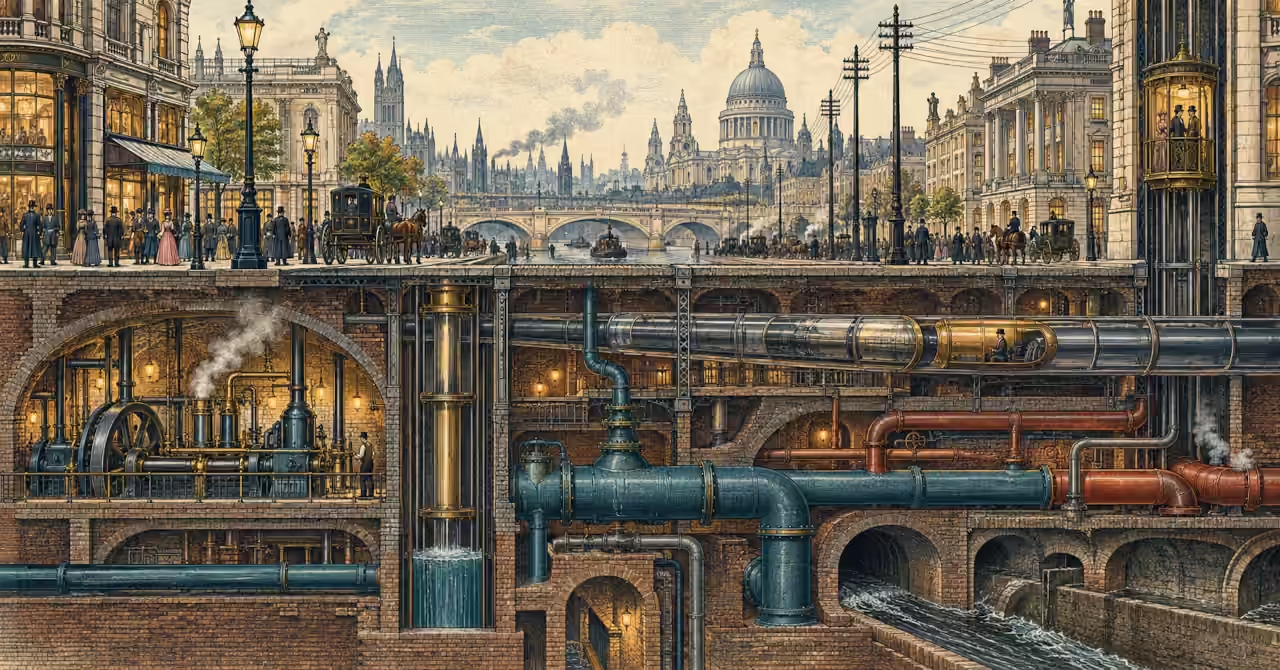
London’s hydraulic power networks are one of the clearest examples. The London Hydraulic Power Company was established by Act of Parliament to lay high-pressure cast-iron mains under the city and supply pressurised water to customers who needed compact, controllable force: lifts, cranes, stage machinery, dock equipment, and the like. The elegant part was not the pressure itself, but the decision to distribute pressure instead of engines. A few pumping stations could serve many loads, while accumulators—heavy weights storing pressure mechanically—smoothed demand.
That arrangement reads as old-fashioned only until you compare it with the alternatives. If every building has to generate its own force, every building needs its own engine room, fuel supply, operator, and maintenance schedule. A hydraulic network turns force into a public utility service. It separates energy generation from energy delivery, and that separation is still the backbone of modern utilities. The Victorian version is particularly interesting because it solved a problem that never stopped being a problem: how to deliver dependable mechanical power into dense urban spaces without filling each block with boilers.
Pneumatic tubes and small distances
Pneumatic tube systems are a reminder that not every network has to span a continent to be useful. Victorian and Edwardian cities experimented with tubes that moved letters, forms, and small parcels by air pressure or vacuum. The principle is simple enough to fit on a postcard: create a pressure difference, and a carrier can be pushed along a pipe with surprising speed. The difficulty is in the details. The capsule must fit closely enough to move efficiently, but not so tightly that it jams or turns the pipe into a maintenance problem.
That balance between speed and fragility is why the technology never became universal, even where it was obviously clever. Routing tubes through crowded underground services was difficult. Pipe size limited what could be sent, and some city conditions made installation impractical. Yet the idea never really disappeared. Hospitals, offices, banks, and secure facilities still use pneumatic tubes where a capsule can beat a human runner over a short, fixed distance. The Victorian insight was not that every message should be automated, but that some messages are governed by friction—and friction has a price. If the route is fixed and the volume is high enough, air pressure can be an efficient substitute for shoes.
Steam beyond the boiler room
Imagine a winter morning in a Victorian town. Instead of each building tending its own boiler, a central plant raises steam and sends it beneath the streets to a network of customers. In 1877, inventor Birdsill Holly put this idea to work in Lockport, New York, establishing an early district steam-heating system. His pipes carried heat from a central source into surrounding buildings, turning the boiler room into a shared service.
The attraction was practical. A central plant could concentrate fuel delivery, operation and maintenance in one place, while customers gained heat without each having to tend a separate boiler. Whether the arrangement was more efficient depended on the plant, the condition of the pipes and how much heat customers needed. Heat lost along the way was part of the price of the service.
This is one Victorian-era technology for which “abandoned” is the wrong word. District steam networks still serve some cities, leaving their successors an inheritance of buried pipes, connected buildings and maintenance obligations. Those networks can be difficult to alter, but they also offer a foundation for change. The question for engineers today is whether an existing system can be improved, converted or supplied with lower-carbon heat more effectively than it can be replaced. Holly’s central insight remains recognisable: produce heat in one place, distribute it where it is needed, and make the network do the travelling.
Vacuum sewers for awkward ground
Getting waste away from a city is easy enough when gravity cooperates. But what happens when the ground is flat, groundwater is high, or deep trenches are difficult to dig? In the nineteenth century, engineer Charles Liernur explored another way: use air pressure to help move the waste. His vacuum system was introduced in Dutch cities, including Leiden and Amsterdam, during the 1870s. It collected human waste separately through a network of pipes, with the material gathered for possible use as fertiliser.
Modern vacuum sewer systems follow the same broad principle, although their equipment and operation differ from Liernur’s arrangements. Pumps at a central station create lower pressure in the collection pipes. When a valve opens, the difference between atmospheric pressure and the pressure inside the pipe helps propel wastewater towards the collection station. Gravity still has a role in bringing wastewater from individual buildings to the vacuum system.
Vacuum sewerage is not a universal replacement for conventional sewers. It can be particularly useful where flat terrain makes gravity flow difficult, where groundwater is high, or where deep excavation would be costly. In return, the network needs reliable pumps, valves and maintenance. The enduring lesson is a practical one: sometimes the ground refuses to cooperate, and the engineer must find another force to do the work.
The telegraph’s lasting architecture
Tap a key in one city, and a message begins a journey along a wire. By the Victorian era, the electric telegraph had made that journey possible over extraordinary distances, connecting offices, railways and markets through networks of lines and skilled operators. The familiar sound of Morse code was only one part of the achievement. Behind it stood an infrastructure built to move information quickly and reliably.
Distance, however, posed an electrical problem: signals weakened as they travelled. A telegraph relay could respond to a weak incoming signal and use a local battery to operate another circuit. A repeater could then send a renewed signal onwards. Routing a message towards its destination was a separate task, managed through the connections and operating practices of the network. Both were necessary parts of making long-distance communication work.
The comparison with today’s digital networks is tempting, and useful if treated with care. Telegraphy did not work like the internet, but both rely on agreed ways of representing information and on systems that carry it between distant points. The Victorian equipment has largely disappeared from everyday use, yet the question its engineers faced remains familiar: how do you move a message across a network and make sure it arrives?
Conclusion
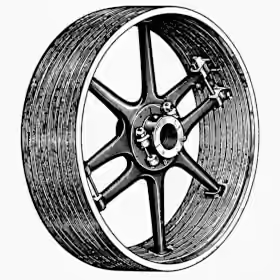
Look again at these five technologies and a pattern emerges. Each depends on more than a clever device. Pipes, wires, pumping stations and people must work together to move power, heat, messages or waste from one place to another. The same principle can be found inside a Victorian workshop, where a wood split pulley helped transmit power from a rotating shaft to the machinery that needed it. Whether the network crossed a factory floor or ran beneath a city, somebody had to design it, operate it and keep it working.
These systems followed different paths. Some were replaced, some adapted, and others remain useful in particular settings. Their histories remind us that a sound idea must also contend with cost, materials, competing technologies and the demands of maintenance. That makes Victorian engineering rewarding to revisit. Behind the unfamiliar machinery are questions we still ask: how do we deliver a useful service, make it reliable and keep it affordable? The equipment may change, but the challenge endures.
From the Curator's Workshop
Victorian engineers found ingenious ways to distribute power, whether through hydraulic mains beneath city streets or belts and pulleys inside workshops. Our Dodge Patent Wood Split Pulley T-shirt celebrates the latter with a remastered 1893 advertisement, preserving its period typography and distinctive pulley engraving. It is wearable industrial history for engineers, machinists and vintage machinery enthusiasts, and purchasing one helps support Phillaneum.

Author's Notes
Notes & Memoranda
As is often the case, the subject extends beyond the bounds of a single article. The notes and memoranda below gather together useful definitions, related observations, references, and occasional curiosities discovered along the way.
Glossary
Some of the terms used in this article have specialised, historical or technical meanings. This glossary provides additional context for selected terms and ideas.
- Accumulator (hydraulic)
- A device that stores energy and helps maintain pressure in a hydraulic system. In a Victorian weighted accumulator, pumps forced water into a cylinder beneath a heavily loaded piston. As demand increased, the descending weight helped push water back into the network. It was one way to make a shared power supply respond to changing demand. Victorian workshops used a different method to distribute mechanical power, including shafts, belts and devices such as the wood split pulley.
- Pneumatic tube
- A system that uses a difference in air pressure to propel fitted carriers through pipes. Pneumatic tubes have transported letters, documents and other small items along fixed routes, and remain useful in some hospitals and other facilities. A related use of pipework, the Victorian speaking tube, carried voices rather than physical messages.
- District steam
- Steam produced at a central plant and distributed through pipes to heat or otherwise serve multiple buildings. By sharing a source of heat, customers may avoid operating separate boilers, although the efficiency of the system depends on the plant, the network and demand. Buried pipes also require maintenance and can make conversion or decarbonisation a substantial undertaking.
- Vacuum sewerage (vacuum sewers)
- A wastewater collection system that uses a difference in air pressure to help move sewage through pipes towards a collection station. Wastewater may first flow by gravity from a building to a collection chamber, before entering the vacuum network through a valve. Vacuum sewers can be useful on flat ground, where groundwater is high or where deep excavation is difficult, but they depend on pumps, valves and regular maintenance.
- Telegraph relay system
- An arrangement used in telegraphy to help signals operate over long distances. A relay responds to a weak incoming electrical signal and uses a local power source to operate another circuit. A repeater can renew and transmit the signal onwards. Routing a message towards its destination is a separate task, managed through the connections and operating practices of the network.
Frequently asked questions
Curious about something you’ve just read? These frequently asked questions explore some of the key ideas, details and questions surrounding the topic.
How did Victorian hydraulic power networks work?
Hydraulic power networks used pumping stations to send pressurised water through underground mains. Customers could use that pressure to operate equipment such as lifts, cranes and theatre machinery. Weighted accumulators helped maintain pressure as demand changed.
How did pneumatic tube systems move messages?
Pneumatic tube systems used a difference in air pressure to propel carriers through pipes. Letters, documents and other small items travelled inside the carriers along fixed routes. Similar systems remain useful in places such as hospitals.
Why would a city use a vacuum sewer instead of a gravity sewer?
A vacuum sewer uses a pressure difference to move wastewater towards a central collection station. It can be useful in flat areas, where groundwater is high or where deep excavation for gravity sewers would be difficult or expensive.
What do Victorian infrastructure networks have in common?
Victorian infrastructure networks connected equipment, routes and users to deliver services such as mechanical power, heat and communication. Their effectiveness depended on the whole system, including the people and maintenance needed to keep it operating.
Further Reading…


References and Further Reading
- Science Museum Group Collection, London Hydraulic Power Company.
- Science Museum Group Collection, Hydraulic accumulator.
- U.S. Postal Service, Pneumatic Tube Service.
- Smithsonian National Postal Museum, Pneumatic Tube Canister.
- American Society of Mechanical Engineers, Holly District Heating System.
- U.S. Department of Energy, Better Buildings, Carleton College: Steam to Hot Water District Energy Transition.
- Stichting Historie der Techniek, Openbare hygiëne: Geschiedenis van de techniek in Nederland, 1800–1890.
- Christchurch City Council, Types of wastewater systems.
- Smithsonian National Museum of American History, Brownson telegraph repeater patent model.
- Science Museum, Sending messages across the Atlantic.
- Smithsonian Magazine, Review of The Victorian Internet.
Disclosure
This article offers an interpretive overview of Victorian technologies and the engineering principles that connect them with later systems. The examples described differ in their historical development, operation and practical applications. Their continued usefulness in some settings should not be taken to mean that they are suitable for every situation or that modern systems operate in exactly the same way.