Soap, Scrubbing, and How Hygiene Rebuilt Medicine
Cleanliness as a medical shift
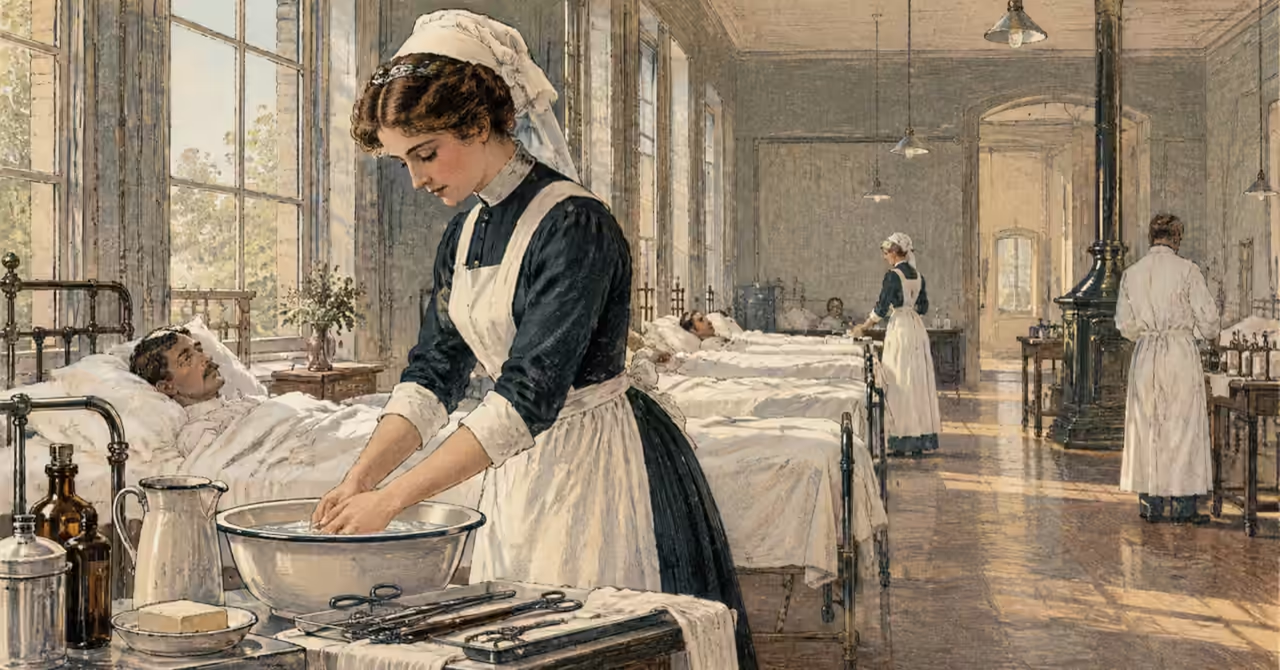
If you want the nineteenth century's great medical breakthroughs, it is easy to look first at the spectacular things: anaesthesia, bacteriology, new instruments and new drugs. Yet one of the most consequential changes was humbler and less theatrical. Medicine increasingly began to treat cleanliness as part of treatment rather than merely as a sign of respectability. Washing hands, airing wards, cleaning instruments, separating the sick and scrubbing floors did not simply accompany medical progress. Together, they helped change how medicine understood the conditions in which treatment succeeded or failed.
This was not a single discovery, nor did nineteenth-century doctors and reformers suddenly arrive at a common theory of infection. Practices that we now associate with hygiene emerged from different observations and competing explanations of disease. Miasma, putrefaction, contagion and, eventually, germ theory could all lead people towards practices intended to produce cleaner surroundings. Sometimes the practice worked before its practitioners fully understood why.
What gradually emerged was something more important than cleanliness alone. Medicine began paying closer attention to the environment surrounding the patient. The hand, the instrument, the ward, the water supply, the air and the routine of care could all affect an outcome. Treatment was no longer only something done directly to the body.
The industrialising nineteenth century made that lesson difficult to ignore. Growing cities and dense institutions such as factories, barracks, workhouses and hospitals concentrated people and disease. Sanitation therefore became more than a matter of private fastidiousness. A contaminated hand, an inadequately cleaned instrument or a badly managed ward could have consequences far beyond untidiness.
The hand becomes suspect
One of the clearest demonstrations came from obstetrics. In Vienna in the 1840s, Ignác Semmelweis observed striking differences in mortality between maternity wards. He concluded that doctors and medical students moving between autopsies and labouring women were carrying something dangerous with them. He did not possess the later explanatory framework of germ theory, but he had a practical response: handwashing using a chlorinated lime solution. Mortality fell sharply.
The significance of Semmelweis's observation extended beyond the particular washing solution he prescribed. It suggested an uncomfortable possibility: the practitioner himself could become part of the mechanism by which disease travelled.
That challenged the traditional moral geography of medicine. The doctor's hand was supposed to represent examination, assistance and healing. Now it also had to be regarded as a possible means of transmission. Clean hands could therefore become something more than evidence of personal respectability. They could represent professional discipline.
Semmelweis also illustrates an important feature of nineteenth-century hygiene: useful practice did not always wait for complete theory. Observation could reveal that an intervention worked before medicine could satisfactorily explain the mechanism. The hand became an object of medical suspicion before microorganisms provided the eventual explanation for why that suspicion mattered.
The procedure becomes controllable
If Semmelweis drew attention to the practitioner's hands, Joseph Lister extended the problem into the surgical procedure itself. Influenced by Louis Pasteur's work, Lister reasoned that wound infection could be reduced by preventing contamination of exposed tissue. His antiseptic methods employed carbolic acid in dressings and around surgical practice, forming part of a developing attempt to control what entered the wound.
The importance of antisepsis was not simply that surgeons acquired another substance to apply. It encouraged surgery to be understood as an environment that could be deliberately controlled. Instruments, hands, dressings, clothing and the operating field increasingly became objects of attention.
This was a significant change in medical thinking. The surgeon's skill still mattered enormously, but skill alone could not determine the outcome. What happened before, during and after an operation also mattered. The procedure acquired a surrounding system.
Antiseptic practice was neither instantaneous nor universally accepted, and later aseptic techniques would differ from Lister's early methods. Nevertheless, the underlying direction was profound. Surgery was moving towards the idea that contamination could be anticipated, managed and prevented rather than merely endured as one of the hazards of operating.
The hospital becomes an instrument
The same enlargement of attention can be seen in hospital reform. Florence Nightingale is too often reduced to a lamp and a legend. She was also a formidable sanitary reformer who treated ventilation, light, spacing, cleanliness, statistical monitoring and ward organisation as questions with consequences for health.
Nightingale's explanations of disease were not identical to later germ theory. Like many of her contemporaries, she placed considerable emphasis on bad air and sanitary conditions. Yet this makes her contribution to the history of hygiene more revealing rather than less. Effective sanitary reform did not have to wait until every mechanism of infection had been settled.
The hospital itself could be treated as part of the patient's treatment. Ventilation, bed spacing, laundry, drainage, water, cleanliness and ward routines were not merely matters of housekeeping. They affected the conditions under which patients recovered.
Architecture consequently entered the medical problem. A hospital was no longer simply a building in which sick people happened to be gathered. Its layout, services and operation could contribute to good or poor outcomes. Once those outcomes were recorded and compared, institutional arrangements themselves could be questioned.
Nightingale's influence also extended through nursing, training and administration. Cleanliness, observation and orderly routines became increasingly associated with skilled nursing practice. The development of professional nursing had many causes, but sanitary reform helped establish the idea that disciplined everyday care was medically consequential rather than merely domestic labour.
From the patient to the system
Put these developments together and a larger progression becomes visible. Semmelweis made the hand suspect. Antiseptic surgery made the procedure controllable. Sanitary reform made the hospital itself part of the treatment environment.
The circle then widened again.
Disease could be considered not only inside the patient's body but in the conditions surrounding it: air, water, bedding, laundry, surfaces, drains, overcrowding and waste. Public sanitation, sewerage, water supply, housing and workplace conditions increasingly became matters with medical consequences.
This did not happen because nineteenth-century medicine suddenly acquired a single coherent theory. Quite the opposite. Sanitary reform, antisepsis and emerging bacteriology sometimes proceeded from different assumptions. What increasingly united them in practice was the recognition that changing the patient's surroundings could change the patient's chances.
That was an important conceptual enlargement of medicine. The patient could not always be understood independently of the environment in which the patient lived, worked and received treatment.
Hygiene becomes a workflow
There is a practical side to this history that is easily obscured by famous names and discoveries. Cleanliness requires resources. Hands cannot be washed without suitable water and facilities. Bedding cannot remain clean without laundry. Instruments cannot be prepared without equipment, labour and time. Wards cannot remain orderly without somebody deciding who cleans what, when and how.
Hygiene therefore became a workflow, not a sermon.
Once an institution expected cleanliness to occur consistently, it had to organise people and materials around that expectation. Who washes? Who supplies the water? Who changes the linen? Who cleans the instrument? Who removes waste? Who checks that these things have happened? Who has enough time to do them properly?
The mundane character of these questions is precisely what makes them important. A brilliant physician could wash his own hands, but reliable hygiene across an entire hospital required more than individual virtue. It required repeatable practices, assigned responsibilities, suitable infrastructure and institutional discipline.
In that sense, the nineteenth-century hygiene revolution was partly organisational. Medicine was learning that a desirable outcome could depend upon a chain of ordinary actions performed reliably by many different people.
Cleanliness and authority
None of this should be mistaken for a simple victory of cleanliness over dirt. As sanitary reform gathered authority during the nineteenth century, cleanliness increasingly became something that could be prescribed, inspected and expected. That brought enormous benefits, but it also raised a more difficult question: who decided what counted as clean?
Public-health reformers confronted genuine dangers in overcrowded housing, inadequate drainage, contaminated water and poorly ventilated workplaces. Yet sanitary arguments could also blur the distinction between unhealthy conditions and supposedly unhealthy people. Poverty, domestic disorder and personal habits could become part of the same conversation, making cleanliness not only a medical concern but also a measure of respectability.
This created a revealing paradox. Once cleanliness was accepted as having consequences for health, institutions gained stronger reasons to regulate environments and behaviour. Washing hands before touching a patient could protect life. Improving drainage could protect a neighbourhood. But the wider principle also meant that hospitals, employers and public authorities increasingly had grounds to prescribe how spaces should be maintained and how people should behave within them.
Nor did acceptance automatically follow evidence. Semmelweis's handwashing requirements met resistance, while Lister's antiseptic methods spread unevenly before becoming widely influential. Sanitary ideals could be enthusiastically promoted in manuals and regulations yet applied inconsistently in everyday life. Habit, professional scepticism, cost, inconvenience and existing beliefs all stood between a good idea and routine practice.
That gap between prescription and behaviour is one of the most interesting parts of the history. A rule can tell us what people were expected to do; resistance tells us what had to change before they would actually do it. The hygiene revolution therefore changed more than soap, water and hospital routines. It gradually changed expectations about responsibility, acceptable risk and who had the authority to insist that cleanliness mattered.
What hygiene taught medicine
By the end of the nineteenth century, medicine had not solved infection, nor had every hospital adopted what we would recognise as modern infection control. But the intellectual landscape had changed substantially. Cleanliness, antisepsis, sanitation and increasingly bacteriology had made the conditions surrounding treatment impossible to dismiss.
The deeper inheritance was a way of thinking.
The hand mattered. The instrument mattered. The procedure mattered. The ward mattered. The water, air and drains mattered. The behaviour of the people working within the system mattered.
Modern infection control would develop considerably beyond these nineteenth-century practices, but its underlying logic is recognisable: good outcomes cannot depend solely upon the brilliance or good intentions of an individual practitioner. The surrounding system must make harmful transmission less likely.
That may be the most enduring achievement of the nineteenth-century hygiene revolution. It enlarged medicine's field of attention from the patient to the system surrounding the patient.
The final irony is worth keeping. The industrial age is remembered for smoke, soot and speed; its medicine learned patience from soap and water. The great advance was not a single cure but a rearrangement of attention: towards the hand, the instrument, the ward, the drain, the air and the routine.
Hygiene did not make medicine pure. It made medicine more conscious of the possibility that saving a life could begin long before treatment itself—with the ordinary work of making infection harder to travel.
From the Curator's Workshop
If the Victorians taught us anything, it is that useful things need not be dreary. Our William Morris tote bag carries that idea into everyday life: a practical modern object enlivened by the decorative spirit of one of the nineteenth century's most influential designers. Take a little Victorian colour on the train, to the library or through the Saturday markets, and support Phillaneum while helping us keep curious histories like this one alive.

Author's Notes
Notes & Memoranda
As is often the case, the subject extends beyond the bounds of a single article. The notes and memoranda below gather together useful definitions, related observations, references, and occasional curiosities discovered along the way.
Glossary
Some of the terms used in this article have specialised, historical or technical meanings. This glossary provides additional context for selected terms and ideas.
- miasma
- A nineteenth‑century theory that disease sprang from 'bad air' arising from putrefaction and filth; it led reformers to emphasise ventilation, drainage and cleanliness because removing foul smells and stagnant air seemed to reduce illness, even though the true agents of many infections are microorganisms discovered later.
- Ignác Semmelweis
- A Hungarian obstetrician in the 1840s who linked high maternal mortality in one maternity ward to doctors moving from autopsies to deliveries and instituted handwashing with a chlorinated lime solution; his work was important because it showed practitioners could carry disease and that simple procedural changes could sharply cut infections before germ theory supplied the mechanism.
- chlorinated lime solution
- A chlorine‑releasing disinfectant (historically called chlorinated lime or bleaching powder) used to scrub hands and surfaces; valued in the nineteenth century for its strong deodorising and germ‑killing properties, it removed organic contamination and offensive odours that were thought to spread disease and thus produced immediate reductions in infection even before microbes were fully understood.
- antisepsis
- A set of practices that use chemical agents applied to wounds, instruments and surgical fields to kill or neutralise microbes and reduce infections; associated with Joseph Lister’s carbolic‑acid dressings, antisepsis treats the operating environment by disinfection, distinct from asepsis, which seeks to prevent contamination in the first place.
- sanitary reform
- A broad public‑health and institutional movement that reorganised buildings and services—ventilation, spacing, water supply, sewage, laundry and waste removal—to reduce disease, combining engineering, administration and nursing practice; it required new infrastructure and labour routines and had powerful social consequences because standards of cleanliness could be enforced or used to judge class and moral behaviour.
Further Reading…


References and Further Reading
- WHO/NCBI Bookshelf, Historical perspective on hand hygiene in health care.
- Wellcome Collection, Florence Nightingale, Notes on matters affecting the health, efficiency, and hospital administration of the British Army (1858).
- Wellcome Collection, Florence Nightingale, Suggestions on a system of nursing for hospitals in India (1865).
- PubMed Central, Innovations in health care: antisepsis as a case study.
- PubMed Central, The little-known history of cleanliness and the forgotten pioneers of handwashing.
- NCBI Bookshelf, A History of the Public Health System.
Disclosure
This article is presented for historical and educational purposes and describes medical beliefs, hygiene practices and public-health developments of the nineteenth century. Historical practices discussed here should not be interpreted as contemporary medical advice or guidance. Medical knowledge and infection-control standards have developed substantially since this period; for current health advice, consult appropriate contemporary medical and public-health sources.