Babbage’s Difference Engine: The Beauty of Calculation
Introduction
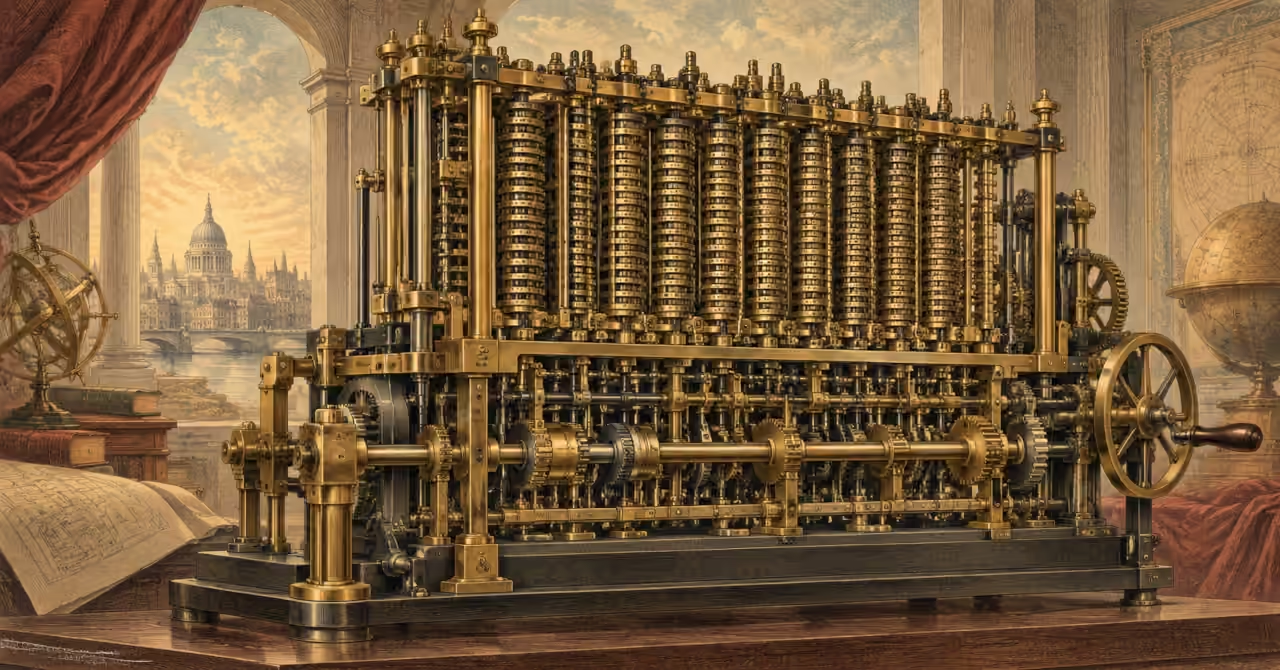
What was the most beautiful machine of the nineteenth century? Was it a magnificent steam engine, its great iron limbs moving with almost theatrical precision? A delicate scientific instrument, fashioned with the care of a master jeweller? Or something altogether less obvious: a calculating machine whose extraordinary beauty emerged not from ornament, but from the elegance of its reasoning? Among the century's remarkable inventions, Charles Babbage's Difference Engine No. 2 makes a compelling claim. Conceived in the 1840s, designed around nineteenth-century engineering capabilities, and finally completed by the Science Museum in 1991, with its printing mechanism added in 2002, it represents something exceptional: a machine in which mathematical intelligence becomes visible, intricate and unexpectedly beautiful.
As explored in our examination of Victorian analogue computers that worked without electricity, nineteenth-century inventors discovered ingenious ways to translate mathematical principles into physical mechanisms. Yet Babbage's Difference Engine transcends the fascination of mechanical calculation alone. Consider the traditional beam engine, with its rhythmic rise and fall, rotating governor and powerful connecting rods. Its appeal is immediate, a magnificent spectacle of controlled force. Babbage himself admired the steam-engine governor as a "beautiful contrivance", recognising the extraordinary economy of its design. But his Difference Engine offers another kind of mechanical splendour. It does not simply demonstrate what machinery can accomplish. It invites us to witness thought itself, transformed into brass, steel and purposeful motion.
Beauty as Legibility
The nineteenth century did not treat machinery and beauty as opposites. It inherited a strong division between the fine arts and the “useful arts,” but that divide was never very clean in practice. Industrial societies needed machines that were efficient, durable, and reliable; they also learned to admire mechanisms whose arrangement seemed inevitable. A machine looked beautiful when its parts were not merely fitted together, but fitted together with intellectual restraint. Strength, motion, and control had to be distributed with economy.
That is why exposed mechanisms mattered. A hidden mechanism can be efficient, but an exposed one can be understood. The eye follows the chain of cause and effect: a handwheel turns, a shaft moves, a linkage converts motion, an outcome appears. The pleasure is not decorative. It is the satisfaction of seeing a difficult problem solved without unnecessary fuss. In that sense, beauty in machinery was often a form of legibility—the machine looked good because it could be read.
Babbage understood this deeply. In On the Economy of Machinery and Manufactures, published in 1832, he treated mechanical contrivance as a field of intellectual economy. He praised devices that embodied compact answers to stubborn problems. In his terms, a good machine was one in which each component earned its place. That is as close as the nineteenth century often came to a working definition of mechanical beauty: not ornament applied to utility, but utility made intelligible in form.
Why Calculation Looked Noble
Why should a calculating machine count as beautiful at all Its work was among the most exacting kinds of labor the century knew? Mathematical tables drove navigation, astronomy, surveying, engineering, and finance. Any systematic error could propagate through other works and other machines. A machine that could tabulate without fatigue or distraction promised not only speed, but certainty.
Babbage proposed the first Difference Engine in 1820 and built a small section of it; the Science Museum collection records a portion of Difference Engine No. 1 built by Joseph Clement in 1832. The underlying method was mechanical repetition: repeated addition arranged so that differences could generate tables automatically. That sounds dry until you remember what it was replacing. Hand computation was slow, tiring, and vulnerable to human error. The machine was an answer to the cost of repetition.
What gives that answer a strange beauty is that the machine’s visual order mirrors its function. Difference engines store and update values in columns, with the carry mechanism moving through the digits in a way that is mechanically intricate but conceptually clean. In reconstructed form, the columns and racks resemble a piece of precision architecture. The Science Museum’s technical description of Difference Engine No. 2 makes plain how much of the design was devoted to making the arithmetic both reliable and buildable in nineteenth-century terms. Its elegance is not smoothness. It is coherence under constraint.
There is also a quiet irony here. The steam engine is often treated as the emblem of the Industrial Revolution because it makes power visible. The difference engine is its quieter cousin, making correctness visible. One turns heat into motion. The other turns logic into motion. In both cases, the machine does not merely perform a task; it embodies a principle. The difference is that the principle in Babbage’s machine is procedure, not force.
Engineering as a Moral Discipline
The late nineteenth century certainly developed a harsher reaction against mechanisation, especially in circles that feared what industrial production might do to labour and design. But even critics who distrusted the machine often reserved admiration for works in which mechanism was honest and intelligible. The complaint was rarely against machinery as such. It was against bad machinery: designs whose power was separated from any sense of integrity, or whose operation could not be understood by the people who depended on it.
That helps explain why calculating machines can feel more than merely clever. They present a compact moral logic. A proper machine is not supposed to bluff. It should do what it says, repeat what it can repeat, and avoid the seduction of unnecessary complication. In Babbage’s case, that ethic becomes visible in metal. The engine is a serious proposal, not a fantasy. He worked through design revisions, workshop realities, and the unforgiving limits of nineteenth-century precision. The machine had to work in theory and in the workshop.
The later history of Difference Engine No. 2 sharpens the point. The Science Museum completed it in 1991, and its printing mechanism was added in 2002. That afterlife matters because it shows the design was not simply visionary in the vague sense. It was realizable, if patience and engineering discipline were available. The machine’s beauty is therefore not retrospective decoration. It is proof of concept made visible.
The Machine That Explains Itself
A beautiful object invites the eye to return to it. The Difference Engine does that not through surface ornament, but through the legibility of its logic. Its parts are not arranged merely to move; they are arranged to calculate without confusion. The machine is beautiful because it cannot do its work without being exactly itself.
That is why Babbage remains such a compelling figure. He belongs to a generation that still believed mechanical invention could be a form of exact thinking. His engines were not decorative fantasies. They were attempts to build reasoning into matter. If the beam engine is a sculpted gesture, the difference engine is a sentence written in brass and steel, each clause dependent on the one before it. The eye does not just admire the machine. It reads it.
Conclusion
The nineteenth century never produced a single most beautiful machine, because its greatest inventions expressed beauty in remarkably different ways. Some commanded immense forces with effortless grace. Others measured the world with exquisite precision, while still others revealed the hidden workings of nature through ingenious mechanical arrangements. Yet Charles Babbage's Difference Engine stands apart. Here, mathematics becomes a mesmerising choreography of gears, columns and calculated movements, transforming abstract reasoning into something the human eye can admire. Its beauty is not an embellishment of its purpose, but the very expression of it.
And perhaps that is the most fascinating legacy of Victorian mechanical ingenuity. These inventors were not simply building machines; they were exploring how far human thought could be translated into physical form. From Babbage's extraordinary calculating apparatus to the curious ambitions explored in the 1895 GRIN Machine and its vision of the future, the nineteenth century repeatedly challenged the boundary between mechanism and intelligence. The Difference Engine leaves us with an intriguing question: when a machine makes thought visible, are we admiring the elegance of its machinery, or the extraordinary ingenuity of the human mind that conceived it?
From the Curator's Workshop
Our Dodge Patent Wood Split Pulley T-shirt celebrates the same marriage of mechanical ingenuity and visual elegance explored in Charles Babbage's Difference Engine. Featuring a beautifully remastered 1893 industrial advertisement, with its authentic period typography and intricate pulley engraving, this design captures an age when engineering was both practical achievement and mechanical artistry. It is wearable industrial history for engineers, inventors and admirers of Victorian craftsmanship — and purchasing one helps support Phillaneum.

Author's Notes
Notes & Memoranda
As is often the case, the subject extends beyond the bounds of a single article. The notes and memoranda below gather together useful definitions, related observations, references, and occasional curiosities discovered along the way.
Frequently asked questions
Curious about something you’ve just read? These frequently asked questions explore some of the key ideas, details and questions surrounding the topic.
Why is Babbage’s Difference Engine No. 2 often described as beautiful?
Its beauty comes from making purpose visible in structure: the machine’s parts fit together with intellectual restraint so that its function is legible, turning abstract procedure into an elegant physical choreography.
How does legibility make a machine beautiful?
Exposed mechanisms let the eye follow chains of cause and effect, so beauty arises from seeing a difficult problem solved without unnecessary fuss—utility made intelligible in form.
Why was a calculating machine considered important or noble in the nineteenth century?
Mathematical tables underpinned navigation, astronomy, surveying, engineering, and finance, so a machine that automated repetition reduced fatigue and human error and promised greater speed and certainty; Babbage’s design used mechanical repetition, columnar storage, and carry mechanisms to achieve that reliability.
What does the later history of Difference Engine No. 2 show about the design?
The Science Museum completed the engine in 1991 and added its printing mechanism in 2002, demonstrating the design was realizable in nineteenth-century terms and serving as a visible proof of concept requiring patience and engineering discipline.
Further Reading…


References and Further Reading
- Charles Babbage, On the Economy of Machinery and Manufactures (1832), digitized at Project Gutenberg: https://www.gutenberg.org/cache/epub/4238/pg4238.html
- Science Museum Group, “Difference Engine No. 1” collection record: https://collection.sciencemuseumgroup.org.uk/objects/co62243/difference-engine-no-1-difference-engine
- Science Museum Group, “Babbage’s Difference Engine No. 2” collection record: https://collection.sciencemuseumgroup.org.uk/objects/co62748/babbages-difference-engine-no-2-2000-difference-engines
- Computer History Museum, “A Brief History” and “Overview” of the Babbage Engine project: https://www.computerhistory.org/babbage/history/ and https://www.computerhistory.org/babbage/overview/
- Smithsonian Institution, National Museum of American History, “Difference Engines”: https://www.si.edu/spotlight/calculating-machines/difference-engines
- Science Museum Group, Charles Babbage biographical record: https://collection.sciencemuseumgroup.org.uk/people/cp36993
Disclosure
This article explores the aesthetic and engineering significance of Charles Babbage's Difference Engine No. 2. Judgements of mechanical beauty are subjective and informed by historical writings, technical designs and museum records. Conceived in the 1840s, the engine was completed in 1991, with its printing mechanism added in 2002. Illustrations may be artistic interpretations rather than exact historical representations. This article also features a Phillaneum Zazzle product; purchases may generate revenue that supports our independent publishing.