Why the Safety Bicycle Felt Lovely, and Inevitable
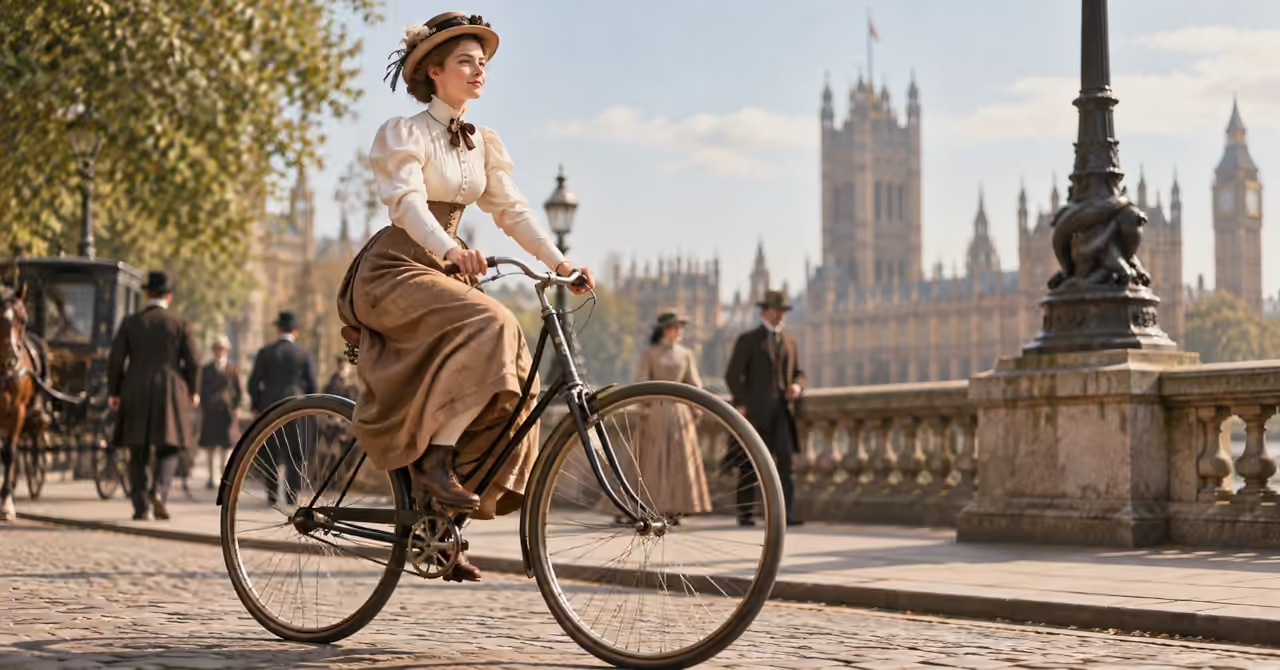
Victorian inventors produced plenty of machines that dazzled from a distance. The safety bicycle is more interesting because it does the opposite: it looks inevitable once you understand it. That is a rarer kind of beauty. The best inventions are not always the most theatrical; sometimes they are the ones that make a hard problem feel modest after the fact, as if the answer had been waiting in plain sight all along.
The safety bicycle earned that status by solving several problems at once. It was faster, steadier, easier to mount, and less punishing to stop than the high-wheel ordinary, or penny-farthing, it displaced. More than that, it turned cycling from a specialist’s stunt into an ordinary form of motion. That is why it won. It is also why it remains lovely: its form is the visible trace of a design that finally got the human scale right.
The wrong kind of elegance
The penny-farthing had a striking silhouette, but its elegance was unstable. Its large front wheel was not a whim of style; it was a mechanical solution to the limits of direct drive. If the pedals are attached to the driving wheel, then wheel size helps determine speed. The larger the wheel, the farther one pedal stroke carries you. The machine’s dramatic proportions were therefore the consequence of a serious engineering constraint, not a taste for eccentricity.
But the cost of that solution was obvious to anyone who had to ride one. The rider sat high above the road, making mounting awkward and falls dangerous. Balance was more precarious. Stopping required more nerve than comfort would normally recommend. The older machine was not foolish; it was provisional. It was what happened when designers had not yet found a way to separate gearing from wheel size.
That separation proved to be the crucial breakthrough. The safety bicycle did not merely refine the ordinary; it changed the arrangement that had forced the ordinary into its awkward shape.
The chain changes everything
John Kemp Starley’s 1885 Rover safety bicycle is the key object here. The Science Museum Group identifies it as using rear-wheel chain drive, and treats it as a decisive step toward the modern bicycle. That detail is easy to admire now and harder to underestimate. A chain seems almost too small a thing to alter the history of transport, but in practice it was the liberating mechanism.
By driving the rear wheel with a chain, the pedals no longer had to sit on the wheel that determined speed. That freed the frame to use two similar-sized wheels and let the rider sit much lower. The result was a machine that was easier to control, easier to mount, and less dangerous to stop. The bicycle’s familiar outline is not just a matter of appearance; it is the physical record of a design that removed a bad compromise.
The rest of the form follows from that decision. The front wheel steers. The rear wheel drives. The frame carries the load between them. The rider sits in the middle rather than perched on top of one wheel, as though waiting for a gust of bad luck. As the safety bicycle evolved, the diamond frame became a particularly neat structural answer to the problem of making a light frame stiff enough for repeated human effort.
This is where the bicycle becomes especially beautiful. Not because it is ornate, but because nothing in it feels wasted. It has the economy of a solution tested against reality and found not merely adequate but right.
Beauty that can be used
A useful invention can be admired in the abstract. A beloved one has to survive contact with the body. The safety bicycle did that in a way the penny-farthing could not. It was more stable, and that made it easier to ride for people who had no interest in turning every trip into a minor dare. It brought the machine down to a level where ordinary road use could be imagined without theatrics.
The social consequences followed from that lower stance. The Science Museum notes that the lower frame and chain drive made riding easier, including for women in skirts, and that the bicycle became tied to the idea of the “New Woman.” The Smithsonian likewise describes the bicycle as a declaration of independence for many women riders. In other words, the machine did not just improve locomotion; it widened the field of who could plausibly use it.
That is one reason the safety bicycle feels so complete. It does not merely carry a rider. It collaborates with a rider’s balance, judgment, and strength instead of insisting on a performance of courage. The bicycle succeeds because it asks the body for ordinary competence, not heroics. There is a quiet dignity in that: a machine that gives mobility back to the scale of everyday life.
The period’s accounts of the bicycle craze make the same point from another angle. The bicycle was not just a vehicle but a symbol of personal mobility: a way of moving through space under one’s own power, without dependence on horse, tram, or timetable. That is a technical achievement, but it is also a change in feeling. A machine that makes movement feel self-directed will always seem larger than its parts.
Why the form endured
The safety bicycle survived because it solved more than one problem at once. Mechanically, it redistributed gearing and weight more rationally. Commercially, it could be sold as practical transport rather than only as a sporting novelty. Culturally, it was legible at a glance: ordinary wheels, ordinary posture, ordinary roads. Anyone could see that it was meant to be lived with.
There is a subtler reason it endured as well. The safety bicycle does not show off its cleverness. It looks calm. That matters because calm design is often what happens when engineering stops trying to impress and starts trying to cooperate. Once cycling ceased to be a high-wire act, the machine acquired the dignity of obviousness. Its shape feels inevitable now because the separate requirements finally agreed with one another.
That is also why the bicycle is easier to love than many Victorian inventions. Steam engines, telegraphs, locomotives, dynamos—these are all more dramatic, and many are more historically consequential in the abstract. But they are not as intimate. The bicycle meets the user at the scale of balance, road texture, and weather. It is a machine you live with in the body rather than just in the imagination.
The loveliest machine
The safety bicycle won because it made the right compromise disappear. It kept the useful parts of speed, but removed the danger and ungainliness that had come attached to the earlier form. It translated a difficult engineering problem into a machine that looked natural, behaved naturally, and could be used naturally. That is a very Victorian triumph: not simply invention, but refinement until the object itself seems to have discovered its own purpose.
If the penny-farthing resembles a dare, the safety bicycle resembles a sentence that has finally found the correct punctuation. That is the sort of beauty that lasts. It does not depend on spectacle. It depends on fit. And the safety bicycle—its chain drive, equal wheels, low posture, and unobtrusive intelligence—fitted the human body and the ordinary road so well that the modern bicycle was essentially already there.
So yes, it is a lovely Victorian invention. Not because it is decorative, but because it is exact. It took a tangle of compromises and turned them into an enduring form. That is why it won—and why, more than a century later, it still looks less like a relic than like the moment someone finally got cycling right.
From the Curator's Workshop
Phillaneum's Cabinet of Curious Vintage Mechanisms design gathers the visual language of old machines, patents and illustrated technical catalogues into a monochrome vintage-style graphic. It is a T-shirt rather than a historical artefact, but it is intended as a wearable extension of the same curiosity: the pleasure of seeing how ingenious, awkward and consequential mechanisms can be.

Author's Notes
Notes & Memoranda
As is often the case, the subject extends beyond the bounds of a single article. The notes and memoranda below gather together useful definitions, related observations, references, and occasional curiosities discovered along the way.
Frequently asked questions
Curious about something you’ve just read? These frequently asked questions explore some of the key ideas, details and questions surrounding the topic.
What engineering breakthrough allowed the safety bicycle to replace the penny-farthing?
The adoption of rear-wheel chain drive separated gearing from wheel size, so pedals no longer had to sit on the driving wheel; that permitted two similar-sized wheels and a much lower, safer seating position.
How did the safety bicycle make cycling more accessible to ordinary people?
It was steadier, easier to mount and stop, and its lower stance improved stability and reduced the danger of falls, making routine use possible for a much wider range of riders, including women in skirts.
What role does the diamond frame play in the safety bicycle's design?
The diamond frame is a structural solution that keeps the bicycle light while making the frame stiff enough for repeated human effort, efficiently carrying the load between the steering front wheel and driven rear wheel.
Why is the safety bicycle often described as beautiful or 'lovely'?
Its beauty comes from exactness and economy: an unshowy, calm design in which nothing feels wasted and the machine fits the human body and ordinary roads so well that its form seems inevitable.
Further Reading…




References and Further Reading
- Science Museum Group Collection, “Rover ‘Safety’ Bicycle, 1885” — https://collection.sciencemuseumgroup.org.uk/objects/co25833/rover-safety-bicycle-1885
- Science Museum Group Blog, “Ordinary, radical and sustainable: bicycles in the Science Museum Group collection” — https://blog.sciencemuseumgroup.org.uk/ordinary-radical-and-sustainable-bicycles-in-the-science-museum-group-collection/
- Smithsonian Institution, “The 19th-Century Bicycle Craze” — https://www.si.edu/stories/19th-century-bicycle-craze
- Science Museum Group Blog, “Perilous Penny-farthings” — https://blog.sciencemuseum.org.uk/perilous-penny-farthings/
- Wikisource, “1911 Encyclopædia Britannica/Cycling” — https://en.wikisource.org/wiki/1911_Encyclop%C3%A6dia_Britannica/Cycling
Disclosure
This article interprets the Victorian safety bicycle using museum collections and historical sources. Some conclusions about design intent, social impact and cultural significance reflect editorial analysis rather than claims established uniformly across all sources.